
Karteikarten
BSL3
Karten in diesem Stapel (26)
- 1SOP SA3001 Exposure to infectious materials Define exposureAn exposure incident is defined as parenteral, mucous membrane, or inhalational exposure to a
research agent.
1. Any spill of infectious agents outside of the BSC.
2. Any breach in PPE while working with or handling infectious agents.
3. Any loss of containment outside of the BSC.
4. Any bite or scratch from an animal within the ABSL-3 facility. - 2SOP SA3001 Exposure to infectious materials Procedure1. Refer to UW EHS exposure response poster for any bite or scratch from ABSL3 animal
2. See SOP SA4000 Response to Non-Life Threatening Medical Event for minor injuries.
3. Employee must contact EHC for all potential exposure. 1) Seek evaluation from a medical provider (yellow proxy card) 2) Notify an EH&S Alternate Responsible Official (ARO) or Responsible Official (RO): - 3EHS Response Poster Procedure1. Perform first aid. Needlestick, cut, bite, scratch: wash with soap and water for 15min. Inhalation: get help immediately
2. Get medical help. For chemical or radiological exposure, call 911. For biological and all other exposures: call EHS.If after hours, call 911.
3. Report the incident. If serious exposure, call EHS main phone line/UWPD after hours. If near miss, submit OARS. - 4SOP SA4000 Response to non-life threatening medical event Procedure: Non-life threatening medical event with intact PPE1. Cease work and secure agents and/or animals if possible.
2. Remove blue gown and change outer gloves.
3. Exit to the inner locker room (E713 or E721) following normal facility exit procedures.
4. Perform basic first aid if you feel comfortable doing so utilizing the first aid kits as necessary. If treating an abrasion or laceration, wash affected area for 15 minutes with soap and water.
5. Contact the Employee Health Center or Campus Health Physician.
6. Notify PI, facility management and EH&S within 24 hours.
7. File a Program Report Form (Form SA5001) with the EHS RO/ARO within 24 hours.
8. File a UW online accident and injury report (OARS) within 24 hours. - 5SOP SA4000 Response to non-life threatening medical event Procedure: Non-life threatening medical event with compromised or non-intact PPE1. If breached PPE could be contaminated: a) Follow SOP SA4017 Section C. b) Perform basic first aid if you feel comfortable doing so.
2. If PPE is not contaminated (e.g., freshly donned): a. Cease work and secure agents and/or animals if possible. b. Remove gloves. c. Immediately wash broken skin thoroughly for 15 minutes with soap and water. d. Don a fresh pair of gloves. e. Exit to the inner locker room following normal facility procedures. f. Perform basic first aid if you feel comfortable doing so.
3. Contact Employee Health Center or Campus Health Physician.
4. Notify PI, facility management, and EH&S within 24 hours.
5. File a Program Report Form (Form SA5001) with the EHS RO/ARO within 24 hours.
6. File a UW online accident and injury report (OARS) within 24 hours. - 6SOP SA3010 Disinfectants: Preparation and Use Safety precaution1. Wear appropriate PPE when handling disinfectants and making solutions
2. Review the SDS (available online at MyChem) for chemical disinfectants before use, and follow all safety precautions.
3. Be aware of chemical incompatibilities that may create hazards or reduce efficacy of disinfectant. - 7SOP SA3010 Disinfectants: Preparation and Use Routine use1. For disinfection of floors, walls, and other large surfaces, prepare the disinfectant in a bucket and use immediately
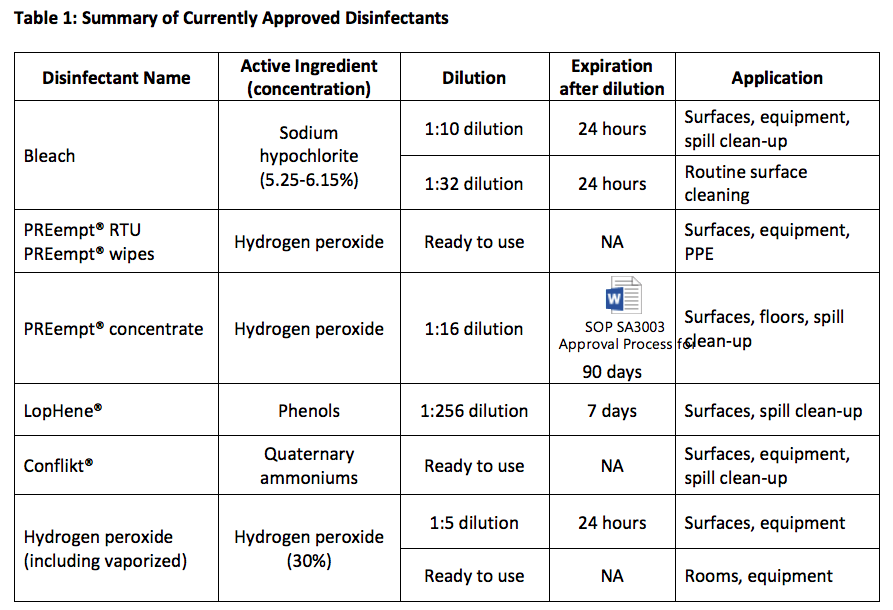
2. For surface disinfection during laboratory activities, prepare the disinfectant in a suitable container. Label container with a) Disinfectant name, b) Preparation date, 3) Expiration date - 8SOP SA3010 Disinfectants: Preparation and Use Approved disinfectants
- 9SOP SA3010 Disinfectants: Preparation and Use PreEmptPreparation
1. PREempt RTU and PREempt wipes are ready to use; no dilution needed.
2. For PREempt concentrate, prepare a 1:16 dilution by mixing 62.5 mL PREempt
concentrate with 937.5 mL water.
3. The diluted concentrate expires in 90 days.
Contact time for Mtb: 5 minutes
Disposal: dump down sink, wipes in biohazard
Hazards: very low hazard with usage
Incompatibilities: mixing PreEmpt with bleach reduces efficacy of both disinfectants due to formation of oxygen and salt water - 10SOP SA3010 Disinfectants: Preparation and use LopHenePreparation
Working dilution is 1:256 or 0.4% LopHene. To prepare a 1:256 (0.4%) dilution, add 4 mL LopHene to 996 mL water.
Contact time for Mtb: 10min
Disposal: Collect all liquid waste containing LopHene as hazardous chemical waste for pick-up by EH&S. LopHene solutions cannot be disposed of via the sanitary sewer due to low pH.
Hazards: acidic, irritant and carcinogen
Incompatibilities: none - 11SOP SA4017 Biological agent spill control Define spillA spill is a loss of containment that can be potentially infectious to other. A spill does not include a droplet that is confined to the work area of the biosafety cabinet and can be easily decontaminated.
- 12SOP SA4017 Biological agent spill control General spill information1. It is important to prevent others from becoming exposed or contaminated.
2. All spills, including SAs and toxins, must be reported to the RO/ARO within 24 hours
by Form SA5001.
3. The following conditions are considered potential exposure. (Follow SOP SA3001)
a. Any spill outside of the BSC
b. Breach of inner PPE while working with or handling select agents or toxins
4. Biological Spill Kits are located in both shared equipment rooms (E714 and E754), the centrifuge room (E762), and all occupied lab and animal rooms. They contain: approved disinfectant, absorbent pads, paper towels, biohazard bags, Tyvek suit, blue gown, nitrile/latex gloves, booties (multiple pairs), warning signs and tape, tongs,. dust pan and hand broom, and a copy of this SOP and SOP SA3001.
5. If PPE is grossly contaminated, do not clean up the spill. Follow the Exit Procedures in Section D. - 13SOP SA4017 Biological agent spill control 3A.1: Spill confined to the BSC metal surface1. Do NOT turn off the BSC
2. Alert others in the room
3. Check yourself for contamination
4. If spill on person, follow SA4017 section C
5. Remove any sharps from the area with tongs and place in sharps container in BSC
6. Cover the spill with paper towels/absorbent materials
7. Change outer gloves
8. Slowly pour disinfectant from outer edge into center. Allow to soak for contact time.
9. Spray everything in BSC with disinfectant. Never place head inside of BSC
10. Place contaminated paper towel and any other cleanup materials inside of biohazard in BSC
11. Change outer gloves
12. Decon spill area again by slowly pouring disinfectant from outside perimeter to inside. Soak for contact time. Place materials in biohazard. Spray biohazard bags with disinfectant before removing from the BSC.
13. Remove contaminated PPE in a manner to avoid cross-contamination
14. Contact facility management or EHS biosafety officer to discuss incident and whether or not to cease work
15. For spills involving select agents, file a SA5001 report within 24hr
13. - 14SOP SA4017 Biological agent spill control 3A.2: Spill overflows under the BSC metal work surface1. Do not turn off BSC
2. Alert others in room
3. Check yourself for contamination. If spill on person, follow section C. If PPE is grossly contaminated, do not stay and clean up spill. Follow section D: Exit Procedures.
4. Change outer gloves
5. Post DO NOT ENTER sign
6. Discontinue work and store all materials in appropriate locations
7. Perform cleanup procedures as outlined in 3A 8-13
8. Contact facility management or EHS biosafety officer to discuss spill. Exit facility as normal but remain available to responding personnel.
9. For spills involving SA, file SA5001 within 24hr - 15SOP SA4017 Biological agent spill control 3B: Spill outside of BSC (1/2)1. Alert others in the room
2. Check yourself for contamination. If on person, follow sect. C, if grossly contaminated, sect. D
3. Change outer gloves
4. If risk of spill flowing under door, obstruct base of door with absorbent material
5. Port DO NOT ENTER sign if spill inside room. If spill in corridor, notify facility management or EHS biosafety officer to post DO NOT ENTER sign on the entire facility.
6. Remove sharps using tongs, discard in biohazard container
7. Cover the spill with paper towels or other absorbent material
8. Change outer gloves
9. For spills in unreachable areas: a) Store items b) Exit facility as normal c) Notify FM or EHS BSO
10. For easily reachable spills: pour decon material from outside in, allow to sit for contact time (LopHene: 5min; PreEmpt: 10min)
11. While waiting for contact time, contact FM or EHS BSO to discuss incident and whether or not your should keep working
12. Wipe up spill by pushing paper towels to center of spill using tongs or dust pan/broom and slowly place in biohazard bag - 16SOP SA4017 Biological agent spill control 3B: Spill outside of BSC (2/2)13. Wipe work surfaces, walls, and equipment in vicinity with paper towels soaked in disinfectant
14. Place contaminated paper towels and other disposable cleanup materials in biohazard bags
15. Decon spill area again by slowly pouring disinfectant and allowing to soak for contact time
16. If not ceasing work: mop floor before continuing
17. If ceasing work and exiting: remove PPE to avoid cross-contamination. Exit as normal
18. Follow SOP SA3001L exposure to infectious material
19. For select agent spills: notify EHS RO/ARO within 24hrs - 17SOP SA4017 Biological agent spill control 3C: Spill on person; Compromised or non-intact PPE (includes contaminated socks)1. Do not remove PAPR
2. Remove any contaminated PPE while minimizing aerosolization and discard in biohazard bag
3. If skin is broken, IMMEDIATELY wash affected skin with antiseptic soap and water for 15min. Put on a new pair of inner gloves
4. Follow section D: Exit procedures - 18SOP SA4017 Biological agent spill control 3C: Spill on person; Coveralls, shoes, or PAPR are contaminated but still intact1. Do not remove PAPR
2. Remove blue gown, change outer gloves
3. Thoroughly wipe down PPE with paper towel soaked in disinfectant, discard in biohazard bag
4. Remove outer gloves
5. Follow Section D - 19SOP SA4017 Biological agent spill control 3C: Spill on person; 1 Outer gloves/sleeves and/or gown contaminated but still intact1. Remove contaminated outer gloves/sleeves/gown and discard in biohazard bag
2. Replace outer gloves and gown. Continue working only if spill was confined to BSC
3. For spill overflow under BSC surface or spill outside of BSC, follow section 3A.2 or section 3B
4. Immediately after leaving facility, notify FM and EHS BSO
5. File SA5001 if SA spill - 20SOP SA4017 Biological agent spill control 3D: Exit procedures (1/2)1. Bring biological spill kit and absorbent pad to room door
2. Post DO NOT ENTER sign
3. Place pad outside room door, soak in disinfectant
4. Step onto pad
5. Remove shoe and sock one foot at a time and put on a bootie from the spill kit while stepping off the pad. Leave contaminated shoes and socks on disinfectant-soaked pad. Leave spill kit behind
6. Walk toward PPE corridor
7. Notify FM or EHS BSO over phone. FM will post DO NOT ENTER sign for entire facility
8. While remaining in front corridor, obtain a fresh pair of booties from the shoe shelf and place on PPE bench
9. Take off PAPR belt and battery, set them on bench while still wearing helmey
10. Sit down on bench as your take off suit, outer gloves, and booties on front corridor side of imaginary line
11. Spin feet into PPE corridor and don fresh booties
12. Leave coveralls, socks, and used booties on corridor floor. Allow space for other users to exit facility. Do not contaminate PPE corridor
13. Remove PAPR. Leave PAPR, belt, and battery on bench
14. Pull disposable gloves from spill kit, use as new outer gloves. - 21SOP SA4017 Biological agent spill control 3D: Exit procedures (2/2)15. Enter locker room and take a full body shower, at least 10min with soap. (Wearing gloves?)
16. Remain available to responding personnel
17. Follow SOP SA3001
18. For spill with SAs, follow SA5001 - 22SOP SA6005 Waste processing Types of wasteBiohazard waste: ALL waste generated within the facility is to be treated as biohazard waste until decon-ed
Solid waste: all considered biohazardous
Liquid waste: treated as contaminated with biohazardous material
Sharps/glass: liquid waste is not allowed in the sharps container for any reason
Chemical waste: considered hazardous. Refer to Chemical Waste Management Guide if uncertain
Radioactive: not approved in facility - 23SOP SA6005 Waste management Autoclave room identificationRoom 719A: Non select agent waste
Room 767A: All waste
Room 763A: All waste - 24SOP SA6005 Waste management Procedure for collecting non-sharp biohazardous waste (Solid)General
1. Minimizing waste is key, difficult to remove waste from BSL3
2. All waste is considered biohazardous. Sharps and solid waste must be autoclaved before removing from the facility. Liquid waste must be decon-ed before user exits the facility.
Collecting solid waste inside of the BSC
1. All solid waste made inside of BSC must be collected in biohazard bag in BSC
2. When bag is full or work completed in BSC, loosely close bag and secure with tie
3. Spray the bag with disinfectant, remove from BSC, and place inside of large foot-operated biohazard bag
Collecting solid waste outside BSC
1. All waste outside of BSC must go in biohazard
2. When large bag is full, loosely close bag by gathering top portion and close with a tie
3. Spray closed biohazard bag with an appropriate disinfectant and place inside of another large biohazard bag (tie?)
4. Insert a chemical steam indicator with extension strip in mouth of double bags, taking care to place strip as far into the bag as practical
5. Spray bag again with disinfectant and place in autoclave bin on the floor in view of the door - 25SOP SA6005 Waste management Procedure for collecting non-sharp biohazardous waste (Liquid)Liquid waste
1. All liquid waste must be collected in an approved container
2. Prior to disposal of liquid waste >10L, call EHS
3. All liquid waste will be autoclaved or treated with a minimum final concentration of disinfectant in the BSC. Solution must sit for appropriate contact time before dumping down drain
4. Autoclave sterilization is an option. Liquid must be placed in an autoclave container and in tray
Liquid waste from mopping
1. Can be discharged down sanitary sewer after treating with appropriate disinfectant - 26SOP SA6005 Waste Management Sharps waste1. Sharps and glass only to be used when there are no alternatives
2. Each sharps container must be labeled with the building (SLU 3.1) and facility room number. User's responsibility
4.Needles/syringes for parenteral administration of agents must be placed in sharps container immediately after use. Plastic serologic pipettes / pipette tips are collected in special puncture-proof containers and treated as solid biohazard waste.
5. When the sharps container is ¾ full, close the container and tape it shut
6. Decon and place in large CLEAR biohazard bag outside of BSC, prevents disposal as regular solid waste
7. Decon clear bag and place in autoclave bin on the floor
Informationen
- Beschreibung
- Karteikarten am BSL3, erstellt von Robyn Emery am 04/09/2019.
- Erstellt von
- Robyn Emery
- Aufrufe
- 3
- Bewertung