
Karteikarten
Learning and Memory
Karten in diesem Stapel (64)
- 1How long is sensory memory retained in the cortex?shorter than 1-2 seconds. often does not reach conscious level
- 2How long is short-term memory retained?on the order of several 10 seconds to minutes
- 3how long is long-term memory retained?days to years
- 4what are the two categories of declarative/explicit memory?episodic memory and semantic memory
- 5what is declarative/explicit memory?can be stated in a few sentences
- 6what is episodic memory?biographical personal memory from particular times and spaces
- 7what is semantic knowledge?world knowledge, object knowledge, language knowledge
- 8where is declarative (episodic and semantic memory) contained?medial temporal lobe, anterior & dorsomedial thalamic nucleus, mammillary body, cerebral cortex, prefrontal cortex
- 9what 4 types of memory are considered non-declarative (implicit) memory?procedural memory, perceptual representation system, classical conditioning, non-associative learning
- 10what is procedural memory?motor, cognitive skills, habit formation. (ex. swimming)
- 11where is procedural memory stored?basal ganglia, cerebellum
- 12what is a perceptual representation system?perceptual timing
- 13where is perceptual priming stored?association cortex
- 14what is classical conditioning?response to conditioned stimulus
- 15where is classical conditioning stored?amygdala (fear), cerebellum (blinking), VTA (reward, dopaminergic cells)
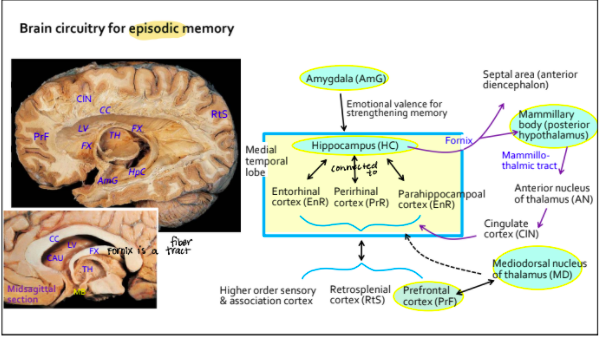
- 16what makes up the medial temporal lobe?hippocampus, EnR (entorhinal cortex), PrR perirhinal cortex, EnR parahippocampal cortex
- 17what connects to the medial temporal lobe giving it emotional valence for strengthening memory?Amygdala
- 18The fornix connects the hippocampus to what?to the septal area/diencephalon and mamillary body (posterior hypothalamus)
- 19The mamillary body (posterior hypothalamus) connects to what?anterior nucleus of thalamus (AN) via the mammilo-thalamic tract
- 20the anterior nucleus of thalamus is connected to what?cingulate cortex
- 21the medial temporal lobe connects to what cortex?prefrontal cortex and mediodorsal nucleus of thalamus
- 22—brain circuitry for episodic memory
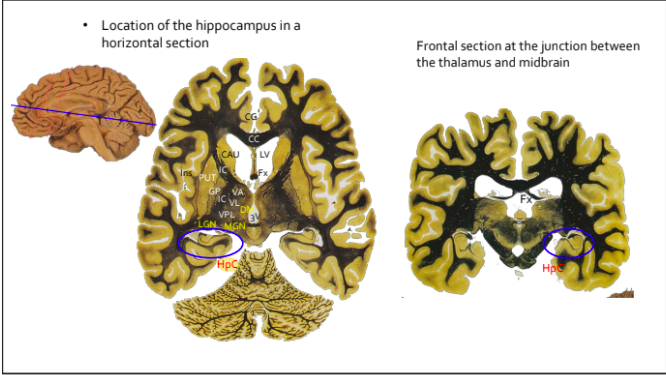
- 23location of hippocampus and medial temporal lobe
- 24What is the MTL essential for?explicit long-term memory formation
- 25what happened when henry molaison had bilateral removal of the MTL?retrograde amnesia - memories from a certain period preceding the trauma are lost. his ability to form new declarative memory was spared
- 26Why can MTL amnesiacs learn motor skills?procedural memory is processed in the basal ganglia, cerebellum, and cerebral and cortical areas
- 27What is anterograde amnesia?memories from the past until the day of trauma remain intact, but no new long term memory formation after trauma
- 28How to treat memory loss/depression with electroconvulsive therapy?two electrodes at the temporal poles, electrical stimulation causes a mild seizure to reset brain activity. causes retrograde amnesia for 6 months and anterograde amnesia for 2 months
- 29a car accident can cause both _____ and _____ amnesiaanterograde and retrograde amnesia
- 30Within the MTL, which part is primarily responsible for new episodeic long-term memory formation?hippocampus
- 31Why is the hippocampus particularly vulnerable to hypoxia?higher metabolic rate
- 32what happened to RB when he had ischemic damage to hippocampus on both sides due to ischemic episode?severe anterograde amnesia - unable to form new memories. when the damage is only in one side it causes on a mild deficit. he also had mild retrograde amnesia
- 33the right-side hippocampus is essential forspatial memory formation and retrieval
- 34long-term memories are stored in the ______ where the information was initially encodedcerebral cortex
- 35what is prosopagnosia? where is the brain affected?unable to recognize the faces of the acquainted. inferior temporal lobe primarily on the right side
- 36what is appraxia of tool use? what part of the brain affected?no concept or vague concept of how to use a particular too. right side parietal cortex and premotor cortex
- 37what is anomia? what part of the brain?word-finding difficulty which can progress to a severe loss of knowledge and language. damage to anterior temporal lobe
- 38what type of dementia starts with word-finding difficulty and and progresses to a severe loss of knowledge and languagefronto-temporal dementia
- 39______ activation is needed for consolidation (short-term memory into the long-term) in the cerebral cortexhippocampal
- 40infromation from the external world is deconstructed into the _____ specific features and is encoded into the relevant cortical areassensory. (face → visual cortex, touch → higher somatic cortex, voice → auditory cortex, smell → olfactory cortex, personality → prefrontal cortex)
- 41where does all the sensory information from the relevant cortices converge to form a coherent memory trace (like an index card) ?hippocampus
- 42What cortex helps us figure out "what is it?" object featureperirhinal cortex
- 43what cortex helps us determine "where is it?" spatial layoutparahippocampal cortex
- 44when the "index is clicked" so to speak, and it activates all the cortical areas that contian information about the memory, describe the pathhippocampus → entorhinal cortex → perirhinal cortex & parahippocampal cortex
- 45the more you think about it ...the conncections among the areas become stronger and can eventually be acticated without lead from the hippocampus. so the long term memory is consolidated and stored
- 46what is the fucntion of the pre-frontal cortex?provides cognitive or strategic control over memory formation and retrieval occuring in other brain areas (particulalry MTL)
- 47Pre-frontal cortex links memory of facts to their ______cortex
- 48______ selects which information is to be rememberedpre-frontal cortex
- 49_____ also supresses interferes, competitive, or irrelevant memeories. some PFC areas are active while trying to forgetpre-frontal cortex
- 50what happens when PFC is damaged?limits learning of new materials building upon the previously learned ones in similar contexts. unable to supress competing memories from interfering with new memory
- 51what else happens when PFC is damaged?source memory deficit. also cant reliably tell the difference between a real-life experience and a fictional story. mix up events/times/places → confabulation
- 52_____ is for "laying down the train tracks" of memory and ______ is for "switching between tracks" in accordance with context and goalhippocampus and prefrontal cortex
- 53_______ thalamic nucleus is connected indirectly to MTLanterior thalamic nucleus
- 54________ thalamic nucleus is heavily connected with pre-frontal cortexmediodorsal thalamic nucleus
- 55when these (mediodorsal and anterior) thalamic nuclei are damaged, there is severe_____ and moderate _____severe anterograde and moderate retrograde amnesia
- 56Papez Circuit for the control of emotion and memory storage
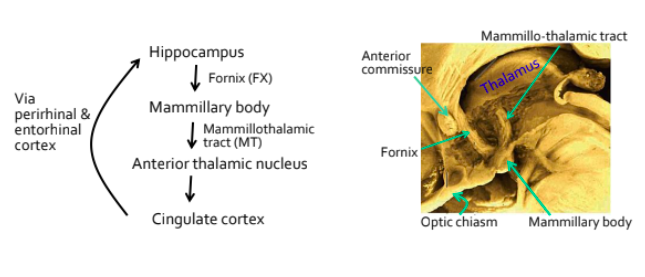
- 57What is Korsakoff syndrome?bilateral damage to mammilary bodies, mammillo-thalamic tract, and dorsomedial thalamic nucleus. caused by Thiamine B1 deficiency and chronic alcoholism. also can be caused by hemorrhage here
- 58When the dorsomedial thalamic nucleus is damaged in korsakoff syndrome, what is seen in patients?confabulation to fill in gaps of memory. lesions often extend into the brainstem oculomotor complexes and (diplopia) and vestibular nucleus (truncal ataxia). hemmorrhages of the mamillary bodies can also cause similar issues
- 59amnesiacs can learn motor skills (procedural learning) whyif basal ganglia and cerebellum are intact
- 60amnesics can learn through perceptual priming. priming depends onassociation cortical regions
- 61amnesics can learn fear through Classical conditioning. what brain part?amygdala
- 62what does the amygdala do?the alarm of the brain. activates in response to scenes or events that are emotionally charged. can evoke fear, panic, anxiety, and PTSD also involved in positive emotions
- 63What is Kluver-Bucy syndrome?bilateral removal of amygdala. no fear learning and blindly trusting
- 64In PTSD, there is a decreased activation of _______ when exposed to traumatic reminders leads to higher activation of the amygdalarostral cingulate cortex
Informationen
- Beschreibung
- Karteikarten am Learning and Memory , erstellt von hanna haile am 19/10/2021.
- Erstellt von
- hanna haile
- Aufrufe
- 0
- Bewertung