
Learning and Memory
140 resources created by 118 users
This Learning and Memory page on GoConqr gathers community-made mind maps, flashcards, quizzes and notes on the Neuroscience strand of Cognitive Neuroscience, from memory types and the case of HM to the hippocampus and synaptic plasticity. It's built for university students revising a topic and teachers after ready-made material. There are over 130 resources here, including more than 70 mind maps, 40 flashcard decks and 10 quizzes, all at university level. Pick a mind map to get your bearings, then test yourself.
Select topic
- Types of Learning8
- Neural Basis of Learning and Memory19
- Synaptic Plasticity and Long-Term Potentiation15
- Brain Regions and Memory8
- Hippocampus and Spatial Memory14
- Memory Systems and Types of Memory10
- Short-Term and Working Memory7
- Long-Term Memory7
- Memory Consolidation and Sleep12
- Amnesia and Memory Disorders14
Top Learning and Memory resources
-
183 cardsNeurobiology 2 What is memory and how is it classified?
-
Mind map Memory
-
47 cardsComputational Neuroscience L2 What is the hippocampus a link between?
-
13 cardsSpatial Cognition What evidence suggests the hippocampus's involvement in spatial memory?
-
64 cardsLearning and Memory How long is sensory memory retained in the cortex?
-
Mind map Hippocampus, Memory and Synaptic Plasticity
-
Mind map Mechanisms of Synaptic Plasticity Role of the hippocampus in spatial memory aquisition. Long term potentiation of hippocampal cells. Presynap...
-
7 cardsBiological Basis of Learning - Short Answer
Quizzes
See all 11 quizzes-
145 questionsNeuroscience and the Mind II A study found that there was a significant impairment in visuospatial working memory when craving
-
54 questions110: ALL Study Problems (FINAL) Someone who has anterograde amnesia would have an inability to remember which of the following?
-
20 questionsBIO 465 - CH 8 Which of the following statements about the plasticity of synapses in the mammalian CNS is false?
-
12 questionsCognitive Neuroscience - Learning and Memory (Part 3 out of 4) 25. Which of the following statements most accurately sums up the current view regarding the distribution/l...
-
13 questionsSelf Assessment 5 2-6: Theories of Working Memory (a) imagination (b) memory field (c) phonological loop (d) short-term memor...
-
15 questionsThe Hippocampus and Cerebellum Role in Memory A thin curved structure which is connected to the frontal lobe, amygdala and thalamus is called the
-
7 questionsCognitive Neuroscience - Learning
-
4 questionsUntitled Anterograde amnesia may be caused by?
Mind maps
See all 75 mind maps-
Memory
-
Hippocampus, Memory and Synaptic Plasticity
-
Mechanisms of Synaptic Plasticity Role of the hippocampus in spatial memory aquisition. Long term potentiation of hippocampal cells. Presynap...
-
Learning and Memory
-
Learning and Memory
-
Stress/Memory
-
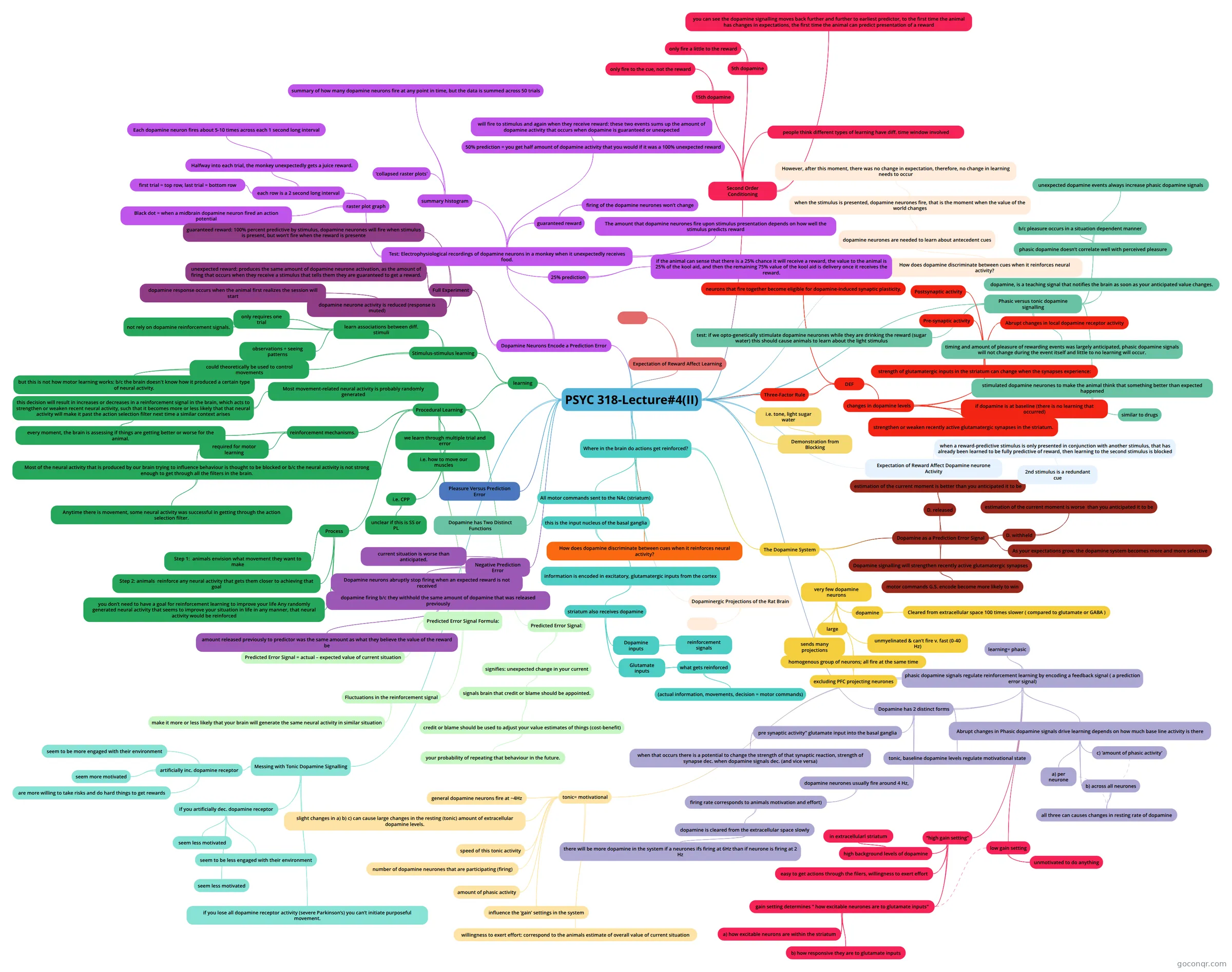 PSYC 318-Lecture#4(II)
-
Week 5: Learning and Memory
Flashcards
See all 47 flashcards-
183 cardsNeurobiology 2 What is memory and how is it classified?
-
47 cardsComputational Neuroscience L2 What is the hippocampus a link between?
-
13 cardsSpatial Cognition What evidence suggests the hippocampus's involvement in spatial memory?
-
64 cardsLearning and Memory How long is sensory memory retained in the cortex?
-
7 cardsBiological Basis of Learning - Short Answer
-
71 cardsCognitive Psychology of Sleep Oudiette et al (2011)
-
47 cardsLecture 9 - The Remembering Brain 2 How is episodic memory defined?
-
29 cardsExam 4 Neuro Review What part of the brain is important for spatial learning?
Flowcharts
Notes
-
Biopsychology Notes - Chapter 12 The Nature of Learning (333-336) THOUGHT QUESTIONS Can you think of specific examples of each of the categories of learning described in this section? Can you think of some examples that include more than one category...
-
Memory, Learning, and Synaptic Plasticity Hypothesis 1: Memory is stored as strengths of synaptic connections in neural circuits synaptic weight matrices can in principle store enormous amounts of information that can be used to transform specific input patte...
-
Learning and Memory - Chapter 13 Module 13.1 Learning, Memory, Amnesia, and Brain Functioning (p374-391) Localized representations of memory (p374-377) Classical Conditioning: Classical conditioning: pairing two stimuli changes the response to one of...
-
Extra notes (learning and memory) Implicit memory is formed by procedures e.g. walking or riding a bikeExplicit memory is memory for facts and events e.g. the capital of FranceWith short-term memory there is no de novo synthesis of macromolecules. In ...
-
Literature summaries Kaplan et al. (2014) Found greater bold activity in the HC for novel relative to familiar environments in the HC and parahippocampal areas. Object novelty was associated with increased activity in posterior hippocampu...
-
Learning and Memory Memory systemsDeclarative memory: Dependent on medial temporal lobe, hippocampus* semantic memory (facts) - everything learned in your lifetime* episodic memory (events) -all different types of memory are dependent on...
Topics in Learning and Memory
More Neuroscience topics
About Learning and Memory
GoConqr OriginalWhat this unit covers
The resources follow learning and memory from behaviour down to cells. Several mind maps set out the big picture: memory as the lifelong adaptation of the brain to its environment, and the split between declarative (explicit) memory for facts and events and implicit (nondeclarative) memory for perceptual and motor skills.
Others go deeper into the hippocampus, spatial and episodic memory, and synaptic plasticity, including long-term potentiation, NMDA receptors and presynaptic mechanisms in the CA1 region.
Where to start
Begin with the mind map called Learning and Memory, which lays out the main terms. Follow it with the Memory mind map, then Mechanisms of Synaptic Plasticity once the vocabulary feels familiar. If you prefer case studies, The Case of HM is a good next stop.
- Read an overview map to see how the memory types fit together.
- Move to the Hippocampus, Memory and Synaptic Plasticity map for spatial and episodic memory.
- Work through a flashcard deck such as Spatial Cognition or Neurobiology 2.
Using maps, flashcards and quizzes together
Maps show how ideas connect, so use them first. Flashcards then drill the details: time courses of working, short-term and long-term memory, what CA stands for, or how classical conditioning is described. The Biological Basis of Learning - Short Answer deck suits this well, with prompts to describe the HM case study and contrast declarative and non-declarative memory.
Finish with a quiz. The Hippocampus and Cerebellum Role in Memory quiz and Cognitive Neuroscience - Learning are useful checks. Wrong answers point you back to the map or deck that covers that gap.
Where it sits
This unit belongs to the Cognitive Neuroscience strand of Neuroscience. Teachers can pull in maps and decks as ready-made material for a lecture or seminar, since everything was made by GoConqr users.
Choose one map today, then try a quiz and see which topics need another look.
Frequently asked questions
Which resource should I open first?
Start with the mind map called Learning and Memory. It outlines the lifelong adaptation of the brain, the main memory types and the split between declarative and implicit memory. After that, the Memory mind map and Mechanisms of Synaptic Plasticity take you further in.
What do the mind maps cover?
They cover memory classification, the hippocampus, spatial and episodic memory, long-term potentiation, NMDA receptors, memory consolidation, reinforcement learning and the case of HM. There are over 70 maps, so you can pick the angle that matches your course.
Are there quizzes for checking my understanding?
Yes, there are over 10 quizzes. Examples include Cognitive Neuroscience - Learning, The Hippocampus and Cerebellum Role in Memory, and Navigational memory hypppocampus. Use them after a map or flashcard deck to see which areas need more work.
Are the resources free, and who made them?
Every resource listed here is free to open, study and take, with no account needed. They were made by GoConqr users, not by GoConqr itself. A free account also saves your quiz scores and lets you make your own quizzes, maps, flashcards and notes.
What level are the resources?
All of them are at university level. They suit university students working through lectures on learning and memory, and teachers who want ready-made maps, decks and quizzes to share or adapt.
What if I can't find the topic I need?
Try the flashcard decks and notes, which often cover lecture-specific topics such as songbird learning, habituation and sensitisation, or the neuropsychology of memory. If a topic is still missing, you can build your own map or deck.