
Karteikarten
LINGUISTICS II

Karten in diesem Stapel (46)
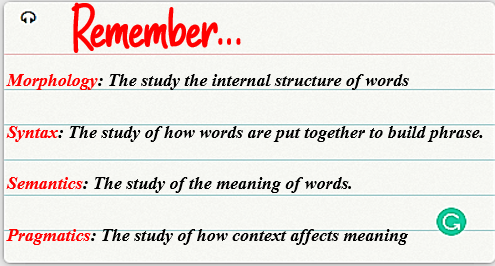
- 1—Area of grammar concerned with the structure of words and with relationships between words that involve the morphemes that compose them.

- 21. Allomorph /ˈalə.mɔːf/Definition
It is one of the variant pronunciations of a morpheme. Morphemes have two or more different pronunciations, called allomorphs, the choice is determined by context (phonological, grammatical, or lexical).
Example
Regular Verb Ending
[t], [d] and [ɪd] or [əd]. - 32. Blend /blend/Definition
A kind of compound in which at least one of the components is reproduced only partially
.
Example
Fantabulous = Fantastic + Fabulous. - 43. Cognate /ˈkɒɡ.neɪt/Definition
In the terminology of historical linguistics, languages that descended from the same ancestral morpheme, are cognate, words derived from the same historical source.
Example
Root: átheos (Greek)
atheist: ateo/a (Spanish), athéiste (French), atheos (Latin). - 54. Exocentric /ˌeksōˈsen.trɪk/Definition
A word class of these headless compounds is not determined by any element inside them (that they have no internal ‘centre’, one might say).
Example
Scarecrow
(scare being a verb and crow a noun). - 65. Grammatical word /ɡrəˈmæt.ɪ.kəl/ /wɜːd/Definition
The term grammatical word is for designations like ‘the plural of the noun’, ‘the third person singular present tense of the verb’, and ‘the past tense of the verb. The lexemic and grammatical content of a word form in a given context.
Example
Morphology studies the internal structures of words. - 76. Lexeme /ˈlek.siːm/Definition
Word seen as an abstract grammatical entity, represented concretely by one or more different inflected word forms according to the grammatical context. Words as lexemes are written in small capitals, while words as inflected forms continue to be represented in italics.
Example
BIND
bind, binds, bound. - 87. Phrasal words /ˈfreɪ.zəl/ /wɜːd/Definition
Phrasal words are the items that have the internal structure of phrases but function syntactically as words.
Example
Jack-in-the-box. - 98. Root /ruːt/Definition
‘Core of a word’. Within a non-compound word, the morpheme that makes the most precise and concrete contribution to the word’s meaning, and is either the sole morpheme or else the only one that is not a prefix or a suffix.
Example
Root: Phobia
Arachnophobia, claustrophobia, hydrophobia. - 109. Syncretism /ˈsɪŋ.krɪ.tɪ.zəm/Definition
When two grammatical words that are distinct for some lexemes are systematically identical for others, as here, these forms are said to be syncretised, or to exhibit syncretism.
Example
-ed suffix
She already collaborated with the quota.
He has not collaborated yet. - 1110. Word form /wɜːd/ /fɔːm/Definition
Word form is so closely to pronunciation that pronunciation is its sole criterion: word forms are the same if and only if they are pronounced the same, or are homophonous. One word form may be shared by more than one lexeme.
Example
Secure (as a verb) security (as a noun) secured (as an adjective) securely (as an adverb). - 12—Syntax has to do with how words are put together to build phrases, with how phrases are put together to build clauses or bigger phrases, and with how clauses are put together to build sentences.
- 131. Active clause /ˈæk.tɪv/ /klɔːz/Definition
Active clauses take as their starting point the participant who carries out an action, who is active in a given situation.
Example
I will make an online dictionary for Linguistics class. - 142. Content words /kənˈtent/ /wɜːd/Definition
Words that have a denotation apply to people, places, things (in the broadest sense), actions, states, and properties. They are known as lexical or content words, and in English include nouns, verbs, adjectives, and adverbs.
Example
English is completely wonderful.
noun verb adverb adjective - 154. Ellipsis /iˈlɪp.sɪs/Definition
The square brackets in the sentence mark the site of the missing words, which are said to have been ellipted. The important point about this type of ellipsis is that it applies only to complete phrases.
Example
c. The snake attacked the snake keeper and [ ] savaged the snake keeper's ankles. - 165. Non-finite clauses /ˌnɒnˈfaɪ.naɪt/ /klɔːz/Definition
Sequences of words which lack a finite verb but nonetheless are treated as subordinate clauses.
Example
You have to write this formulary really carefully in order to see all the detail. - 176. Passive clause /ˈpæs.ɪv/ /klɔːz/Definition
This label was chosen for clauses in English and other languages which take as their starting point the participant on whom an action is carried out, that is, who suffers the action.
Example
An online dictionary for Linguistics class will make by me. - 187. Subcategorisation /sʌbˌkæt.ə.ɡər.aɪˈzeɪ.ʃən/Definition
The constraints that lexical verbs place on number and type of constituents, choice of preposition, and choice of case are known as subcategorisation.
Example
suggest
She suggested some research topics. - 198. Substitution /ˌsʌb.stɪˈtʃuː.ʃən/Definition
A single word can substitute for a number of words hanging together as a phrase.
Example
very
This parcel is astonishingly and frighteningly heavy = This parcel is very heavy. - 209. Transposition /ˌtræn.spəˈzɪʃ.ən/Definition
Many sequences of words can be moved together into different slots in a clause; This transposition indicates separate words combine into a larger block, a phrase. Transposition also applies to phrases without prepositions.
Example
This subject is of interest to all of us. - 2110. Understood subject /ˌʌn.dəˈstud/ /ˈsʌb.dʒekt/Definition
In contemporary terms, the notion of understood subject is translated into that of control.
Example
Charles wanted to marry Victoria.
(Charles is the understood subject of marry). - 22—Knowing a language means knowing how to produce and understand the meaning of infinitely many sentences. The study of linguistic meaning is called semantics

- 231. Argument structure /ˈɑːɡ.jə.mənt/ /ˈstrʌk.tʃər/Definition
The argument structure of a verb is part of its meaning and is included in its lexical entry.
Example
Mary faxed/radioed/e-mailed/phoned Helen the news. - 242. Complementary pairs /ˌkɒm.plɪˈmen.tər.i/ /peər/Definition
A kind of antonyms. They are complementary in that alive = not dead and dead = not alive, and so on.
Example
Legal = not illegal and not illegal = legal. - 253. Heteronyms /ˈhet.ər.əʊ.nɪmz/Definition
When the words are spelled the same, but are pronounced differently, they are called heteronyms rather than homonyms.
Example
Tear /tɪər/ - Tear /teər/
She shed a tear because she had a tear in her new car. - 264. Homonyms /ˈhɒm.ə.nɪm/Definition
Homonyms are words that have different meanings but are pronounced the same, and may or may not be spelled the same. (Also called homophones).
Example
allowed /əˈlaʊd/ - aloud /əˈlaʊd/
Here, we are not allowed to speak aloud. - 275. Idiomatic phrases /ˌɪd.i.əˈmæt.ɪk/ /freɪz/Definition
These phrases typically start out as metaphors that “catch on” and are repeated so often that they become fixtures in the language. Such expressions are called idioms, or idiomatic phrases.
Example
Don't dare to say that! bite your tongue. - 286. Mass nouns /mæs/ /naʊn/Definition
Nouns which cannot be enumerated or pluralized, are mass nouns.
Example
Writers enjoy all different types of literature - 297. Negative polarity items /ˈneɡ.ə.tɪv/ /pəˈlær.ə.ti/ /ˈaɪ.təm/Definition
Expressions such as ever, anymore, have a red cent, and many more are ungrammatical in certain simple affirmative sentences, but grammatical in corresponding negative ones. Such expressions are called negative polarity items because a negative element such as “not” elsewhere in the sentence allows them to appear.
Example
I have doubts that if I will ever see you again. - 308. Polysemous /pəˈlɪs.ɪ.məs/Definition
When a word has multiple meanings that are related conceptually or historically, it is said to be polysemous (polly-seamus).
Example
Get
Get: obtain, achieve, go, arrive, seek, win, give, serve, understand etc. - 319. Relational opposites /rɪˌleɪ.ʃən.əl/ /ˈɒp.ə.zɪt/Definition
They display symmetry in their meaning. Pairs of words ending in -er and -ee are usually relational opposites
Example
Mary is Bill’s employer, then Bill is Mary’s employee. - 3210. Thematic roles /θɪˈmæt.ɪk/ /rəʊl/Definition
Relations such as agent and theme are called thematic roles. They express the kind of relation that holds between the arguments of the verb and the type of situation that the verb describes.
Example
The man threw the red ball
agent theme
to the children
goal - 33—Pragmatics is concerned with our understanding of language in context. Two kinds of contexts are relevant. The study of how context affects meaning is called pragmatics.

- 341. Anomaly /əˈnɒm.ə.li/Definition
Anomaly is when the pieces do not fit sensibly together.
Example
Colorless green ideas sleep furiously. - 352. Bound /baʊnd/Definition
When a pronoun gets its reference from an NP antecedent in the same sentence, we say that the pronoun is bound to that noun phrase antecedent. Pronouns can also be bound to quantifier antecedents such as “every N'” as in the sentence
Example
Every boy in the class hopes Victoria will ask him out on a date. - 363. Deixis /ˈdeɪk.sɪs/Definition
In all languages, the reference of certain words and expressions relies entirely on the situational context of the utterance, and can only be understood in light of these circumstances. This aspect of pragmatics is called deixis.
Example
I have been here for a long time waiting. - 374. Implicatures /ˈɪm.plɪ.k ə tʃʊərz /Definition
Implicatures are deductions that are not made strictly on the basis of the content expressed in the discourse. Rather, they are made in accordance with the conversational maxims, taking into account both the linguistic meaning of the utterance as well as the particular circumstances in which the utterance is made.
Example
Victoria doesn’t have a boyfriend these days.
She’s been driving over to her hometown a lot lately.
The implicature is that Victoria has a boyfriend in her hometown. - 385. Maxim of quantity /ˈmæk.sɪm/ /əv/ /ˈkwɒn.tə.ti/Definition
The maxim of quantity, states that a speaker’s contribution to the discourse should be as informative as is required—neither more nor less.
Example
A: Excuse me, Do you the time?
B: yes, it is 9:30 pm. - 396. Metaphors /ˈmet.ə.fɔːr/Definition
Metaphors are sentences that appear to be anomalous, but to which a meaningful concept can be attached.
Example
I am going through a rollercoaster of emotions right now. - 407. Performative verbs /pəˈfɔː.mə.tɪv/ /vɜːb/Definition
Using them in a sentence (in the first person, present tense) adds something extra over and above the statement. There are hundreds of performative verbs in every language.
Example
I pronounce you husband and wife. - 418. Presuppositions /ˌpriː.sʌp.əˈzɪʃ.ən/Definition
Situations that must exist for utterances to be appropriate are called presuppositions.
Example
Charles is no longer happy anymore.
Presupposition: Charles was once happy. - 429. Situational Context /ˌsɪtʃ.uˈeɪ.ʃən(ə)l / ˈkɒn.tekst/Definition
Much of the contextual knowledge is knowledge of who is speaking, who is listening, what objects are being discussed, and general facts about the world we live in—what we have been calling situational context.
Example
At dinner table
Victoria can you pass me a pair of chopsticks? - 4310. Speech acts /spiːtʃ/ /ækt/Definition
You can use language to do things. You can use language to make promises, lay bets, issue warnings, christen boats, place names in nomination, offer congratulations, or swear testimony. The theory of speech acts describes how this is done.
Example
I will be back to love you again. I will promise you. - 44MISSING WORD FROM SYNTAX PART 3. Copula /ˈkɒp.jə.lə/Definition
Copula is the Latin word for ‘link, connection’. It does not describe situations in which one participant performs an action, possibly on another person or thing. Rather, the verb be merely links the subject noun phrase with another phrase, in this case, an adjective phrase, a noun phrase, and a prepositional phrase.
Example
He is a little boy. - 45—
- 46—


Informationen
- Beschreibung
- MORPHOLOGY - SYNTAX - SEMANTICS - PRAGMATICS
- Erstellt von
- Stefanny Vanessa
- Aufrufe
- 64
- Tags
- Bewertung