
Karteikarten
CSH600 Tutorials
Karten in diesem Stapel (55)
- 1Examples of Questions that cannot be answered by EBPTENDS TO BE BACKGROUND INFO
1. Is this pt eligible for tx subsidy?
2. Who can be referred to this service?
3. What are the opening hours of the hospital outpatient’s administration?
4. What is a Colles #? - 2Examples of questions that can be answered by EBPAetiology/frequency Qs
Prognosis
Diagnosis
Treatment/prevention
Patient’s experiences and concerns - 3Push: “Just-in-case” InformationPush = information sent out or broadcast
Either directly or pre-digested (e.g. editorial, systematic review, guidelines)
Just-in-case info is made available when it is generated, or when health profesh should hear it - 4Pull: ‘Just-in-time’ Info-Info potential customers look for (rather than waiting for it to be pushed to them)
-Info a health professional seeks
-Essential core of EBP
-Requires health professionals to be open about not knowing everything - 5n-of-1 Randomised Trial HOW IT WORKSsub-group of a RCT + is conducted on just 1 participant. The participant receives 1 Tx in 1 time period + a different tx in another. The average differences in clinical outcomes between the two time periods are compared.
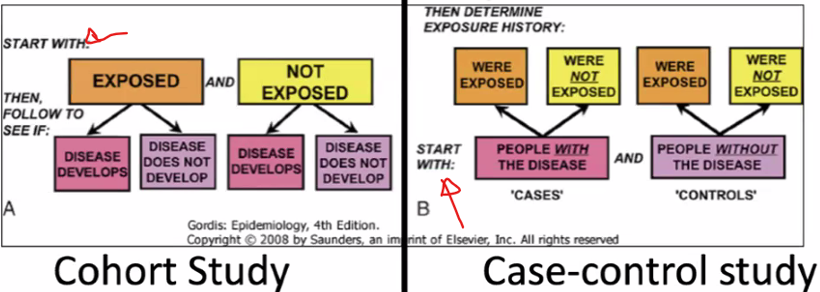
- 6Cohort HOW IT WORKSIs an observational study. It is a type of longitudinal study where participants are followed over time. Differences between pts measured + they are followed over time. Finally, differences in outcome are observed + related to the initial differences.
- 7Cohort Types of Qs it AnswersRisks— what risk factors predict disease?
Aetiology— what factors cause these outcomes?
Prognosis— what happens with this disease over time?
Diagnosis— if test is positive, what happens to the pt? - 8Case-Control Types of Qs it AnswersRisks— what risk factors predict disease?
Prognosis— what happens with this disease over time?
Diagnosis— if test is positive, what happens to the pt? - 9Case-Control HOW IT WORKSObservational Study. Pts (i.e. ‘cases’) who have experienced an outcome already (such as developing a disease). Pts ‘matched’ w/ other pts who are similar (i.e. ‘controls’)—except they do not have the outcome (e.g. the disease being studied). Differences in risk factors between the two groups of participants are then analysed.
- 10Cross-Sectional HOW IT WORKSSample a population @ particular point in time + measure to see who has the outcome. Often, associations between risk factors + outcome are analysed.
Or comparisons are made between an established test + a new candidate test. - 11Qualitative TYPES OF QsWhy do people ...?
What are the possible reasons for ...?
How do people feel about ...? - 12Qualitative HOW IT WORKSusually via:
Interviews (asking people)
Focus groups
Participant observation - 13Case-Series ANSWERS WHAT TYPE OF Q?Should we research this question? (which might be about intervention, prognosis, diagnosis, etc.)
- 14Case-Series HOW IT WORKSDescriptions of a series of pts who are exposed to the factor that is being studied. They usually do not provide definitive evidence, but more usually are ‘hypothesis-generating’.
There is no control group involved. - 15Prognostic Q Heirarchy1. Systematic R of Inception Cohort
2. Inception Cohort Study
3. Cohort Study or Control arm of RCT
4. Case-series of Case Control - 16Does this intervention help? Hierarchy of Evidence1. S Review of RCTs
2. RCT
3. Non-randomized controlled cohort
4. Case-series, case control - 17Dx Q Hierarchy of Evidence1. SR of cross-sectional studies
2. Individual cross-section study
3. Non consecutive studies
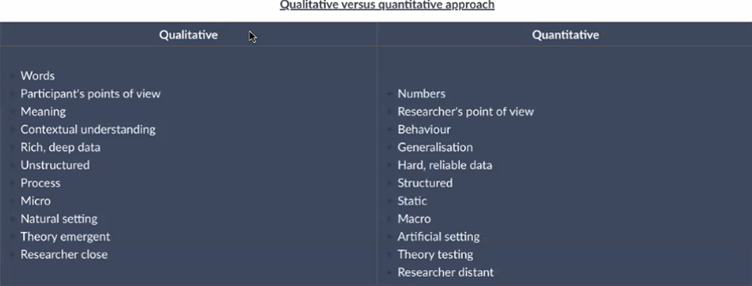
4. Case-control studies - 18Quantitative vs. Qualitative Table
- 19Prospective study start + finish? What type of studies? Direction of disease inquiry? Exposure + Dependent variables?-Starts in present + measures into future
- All trials
- Direction of disease inquiry = always measuring the outcome variable
- Exposure V = independent variable
- Dependent V = dependent variable - 20Cohort Study What type of study? Example Recruit based on? Measure what? What time direction? What is time direction of mixed cohort- Observational
- Say ‘correlate’ not cause
- E.g. observing people who already do / do not smoke + seeing if smokers are more likely to get Ca
-Recruit based on exposure & measure outcome variable
-Can b present, retrospectve, prospective
-Mixed cohort = starts in past + goes into future - 21Cross-Sectional Studies-Measure both exposure + outcome Vs
E.g. measuring students sexual behaviours AND measuring their type/incidence of HPV - 22Cross-Sectional Studies Advantages x31. Relatively quick, economical and easy
2. no follow up required
3. May suggest assoc between exposure and outcome - 23Cross-Sectional Studies Disadvantages x41. May ID assoc, but not cause/effect
2. Is only a snapshot
3. Potential for confounding
4. Cannot determine incidence - 24Systematic Error What is it? Examples x3 How to combat?When there is a systematic difference between the 2 groups being studied
EXAMPLES: Interviewer bias, recall bias, measurement bias
Combat w/ randomisation - 25How to KNOW a variable is confounding“You know you are looking at a potential confounding variable if it is causally related to the outcome variable and non-causally (associated) related to the exposure variable.”
- 26How to combat confoundingAdhering to the rules of study design mitigates the risk of systematic errors occurring.
- 27Random Error what can researchers do to minimise? If result is wrong due to random error what type of error is it? What is it related to?- The only thing a researcher can do to ↓random error is ↑sample size
-no difference between 2 groups = -ve finding. If this is wrong due to random error, = a false negative (type 2 error)
Papers should tell how many pts required for a power of 80% or greater. - 28Continuous Variables Line of No EffectIf both groups have same average = mean difference is 0 = ‘line of no effect’
- 29Dichotomous Variables What is used to analyse? What is the line of no effect?2 outcomes: yes or no
Odds ratio (OR) is used for dichotomous variables
OR of 1 means both groups are equal - 30Risk Ratio / Relative Risk Line of No Effect1
- 31—1.line of no effect (1) = Dichotomous & using a ratio to demo difference
2. Sample Size
3. Confidence intervals
4. Overall Risk Ratio &
5. Study 1 is statistically significant but 2 and 3 are not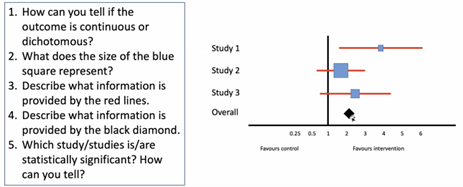
- 32Absolute Risk Reduction What is it? Usually Expressed as? Line of No Effect?The Absolute Arithmetic difference in event rates between the experimental (intervention) and control groups.
Usually expressed as a %age.
Line of no effect = 0 - 33Relative Risk Reduction Line of No Effect0
- 34Relative Risk Line of No Effect1
- 35What does it mean when there are multiple diamonds on forest plot? How do we analyse?• Means studies have been broken into subgroups and one diamond per subgroup
• Bottom diamond is all we need to evaluate with dotted line going up it – it’s the TOTAL diamond for both groups - 36—• None of the studies are clinically significant as Cis cross line of clinical significance
• Diamond is stat and clinically significant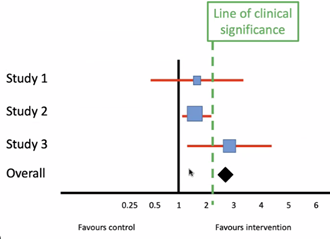
- 37GRADE stands forgrading of recommendations assessment, Development and Evaluation
- 38GRADE 4 categories for certainty of evidenceHIGH = further research very unlikely to change out confidence in the estimate of the effect
MODERATE: further research is likely to have an important impact on our confidence in the estimate of effect
LOW = fruther researcg is very likely to have an important impact on our confidence in the estimate of effect
VERY LOW = any estimate of effect is uncertain - 39GRADE 2 Levels of Recommendation StrengthSTRONG: there is considerable certainty that the benefits of intervention do/don't outweigh risks + burdens
WEAK: there is considerable uncertainty about the magnitude of benefits + risks - 40CASP ChecklistCritical Appraisal of Qualitative Studies???
- 41components of EBP modelo Clinical expertise
o Pts values/circumstances
o Evidence - 425 A’s of EBP1. ASK
2. Access – nothing on exam about databases
3. Appraise
4. Apply
5. Audit - 43Prospective Cohortprospective cohort study is better because it ensures all participants have the same baseline (inception cohort)
- 44Inception Cohortall participants at the same early stage in their disease
- 45Types of Analytical Studies and whether they are experimental or observational x41. RCT (exp)
2. Cohort Study (obs)
3. Case Control Study (obs)
4. Cross-sectional (obs) (can b descriptive) - 46Types of Descriptive Studies and whether they are experimental or observational x3Cross-Sectional (can b analytical)
Ecological
Case Reports/ Case Series
All Observational - 47What is the difference between Descriptive + Analytical Studies?Descriptive only investigates 1 variable
(E.g. How many QUT students have flu?)
Analytical Studies investigate 2 variables
(E.g. is there a relationship between QUT students eating at the Gabba café + having influenza?) - 48RCT What time direction? What type of study? Obs/Anal Direction of disease inquiry- Prospective
- Experimental study
- Direction of disease inquiry:
recruit on exposure -> measure outcome - 49Cohort Study What time direction? What type of study? Obs/Anal Direction of disease inquiryCan be retro, prospective, or both
Analytical
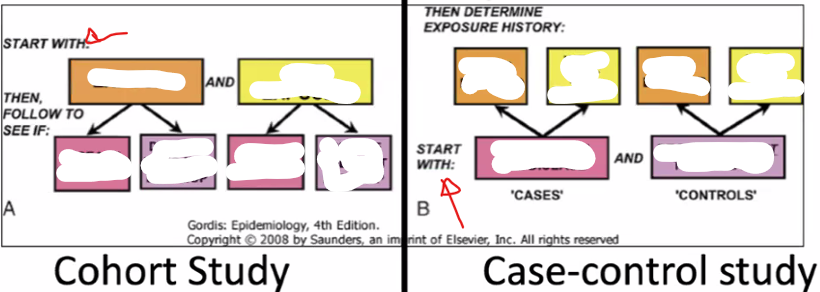
Sequence : exposure -> recruit based on exposure -> measure outcome - 50Case-CONTROL What time direction? Direction of disease inquiryAlways retrospective
Start with ppl with the disease + look at risk factors for them getting disease
Risk factors/exposure (measure) <- Disease/outcome (recruit) - 51—
- 52Cross-Sectional Studies What time direction? Direction of disease inquiry- 1 point in time
-Measure both exposure AND outcome
- Just recruit a bunch of ppl not defined by the exposure or the outcome - 53ANALYTICAL VS DESCRIPTIVE CROSS-SECTIONAL STUDIES- The oral HPV infection – random sample of QUT students and measured if they had oral HPV and if they had developed cancer from that HPV – analytical cross sectional
- random sample of QUT students and measured if they had oral HPV = descriptive cross sectional - 54Can you determine stat significance from a CI alone or do you require a p-value as well?Yes, you can determine it solely from CI and solely from p
- 55—
Informationen
- Beschreibung
- Karteikarten am CSH600 Tutorials, erstellt von Annika Muller am 09/11/2024.
- Erstellt von
- Annika Muller
- Aufrufe
- 0
- Bewertung