
Karteikarten
Data-link layer
Karten in diesem Stapel (34)
- 1What layer is the data-link layer and what does it do?Second lowers of the OSI reference model
Interfaces with layer 1 and layer 3.
Provides services by encapsulating data in frames
Provides services including Error detection, addressing and synchronisation - 2How does the data-link layer split up a message?Splits it into frames, then adds a header to each frame. Then does the opposite on the receiver end, removing the header, and merging the frames
- 3What does IEEE 802 do?Defines the operation of the physical and data-link layers!
- 4What is MAC address and what does it do?Media Access control. Every physical network interface has a unique 6 byte address. 2^48 addressable interfaces
- Used to identify machines on the same local netwrok - 5Difference between random access and scheduled (controller) accessRandom Access: Works like a meeting without a chairperson
There will be collisions but the protocol does something to enable the corrupted data to be retransmitted
Scheduled Access: Works like a meeting with a chairperson. Data transmissions are organised so that devices take turns - 6What is ALOHA?First form of channel access developed in the 1970s. It is random access. Strategy, if you have data, send it!
Stations detect collisions by waiting for an ACK.
If a message collides with another transmission, resend the original data later.
For light traffic, there is a low probability of collision. - 7Problems with Aloha and solutions?A collision involves two or more unsynchronised stations. If they all try to resend their frames after the same time-out period, the frames will collide again.
Solution! Each station waits a random amount of time before resending, known as back off time (TB) - 8Is the likelihood of a collision post collision higher or lower?Higher as the frames must be resent!
- 9What is slotted ALOHA?Improves efficiency of pure ALOHA by dividing the time into slots of Tfr seconds. Allow stations to transmit only at the beginning of each time slot.
- 10What is CSMA and what does it do?Carrier Sense multiple access. further minimises the chance of collisions, by checking the state of the medium before transmitting. Sense before transmit or listen before talk. Reduces but does not eliminate the chance of collisions, due to signal propagation delay.
- 11What is CSMA 1-Persistent?Transmitting station continuously senses the chanel. When the channel is found to be idle, the frame is sent immediately.
- 12What is Non-persistent?Prevents stations from continuously sensing the medium to further reduce the probability of a collision occurring.
Transmitting station senses the channel:
If the channel is busy wait a random amount of time before checking again
If the channel is idle send frame immediately. - 13Problems with 1- Persistent?If multiple transmitting stations are sensing the channel, when the channel suddenly becomes idle, multiple stations will simultaneously transmit.
- 14Problems with Non-persistent?Efficiency is reduced because the medium remains idles when there may be stations with frames to transmit
- 15What is p-persistent?This approach is used if the channel has time slots with a slot duration equal or greater than the maximum propagation time.
At the beginning of the slot, the transmitter sense the medium. If the channel is busy wait a random number of time slots and sense the medium again ( standard back-off procedure) - 16IEEE 802.3 Ethernet networks use 1-persistend CSMA/CD what does it do?- The station continually senses the channel whilst transmitting
- The station should only detect the reflection of its own signals to check whether there have been any modified signals, if so the transmission is aborted. - 17What is Binary Exponential Backoff?- For the first retransmission, wait a random amount of time between retransmissions
- For the next 9 attempts double the mean value of the random delay
- For the next 6 attempts, the back off time remains the same.
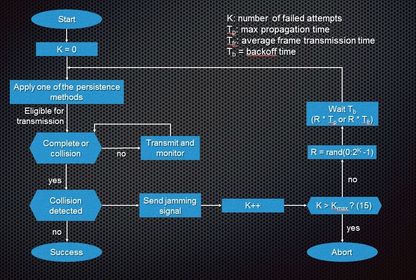
- If the frame has still not been successfully transmitted give up and repot the error - 18What does this image represent?CSMA/CD: Procedure
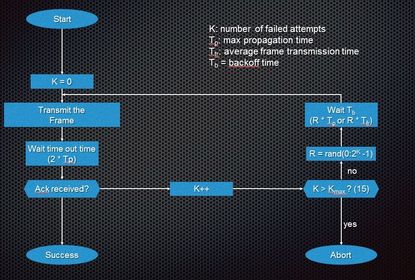
- 19—Aloha Procedure
- 20What is an adhoc network?Its a network which doesn't have an access point, just a bunch of hosts utilising 802.11
- 21What is BSSBase station subsystem!The base station subsystem (BSS) is the section of a traditional cellular telephone network which is responsible for handling traffic and signaling between a mobile phone and the network switching subsystem
- 22Is wireless Full duplex, Half duplex or multi duplex?Half duplex.
- 23What is DCFDistributed Coordination function:
Is an extension of CSMA which defines a method of collision avoidance. ALL 802.11 implement this.
We cannot directly detect collisions, we must therefore try to avoid them.
CSMA/CA achieves this by using CSMA with the following additions:
- Interframe space (IFS)
- Contention Windows
- Acknowledgements (ACK) - 24What is CSMA/CA Interframe spaceIs a period of time that station waits before transmitting after the channel is detected idle.
Even if the channel appears idle another station may have began transmission.
If the station is still idle after the IFS, the station can send after waiting a further period call the contention time ( or contention window ) higher priority stations have a shorter IFS - 25What is CSMA/CACarrier Sense Multiple Access / Collision Avoidance
- 26What is Contention windowAfter the IFS (interframe SPACE) the contention window is the length of time a station must wait before commencing transmission, and is defined by the number of slots.
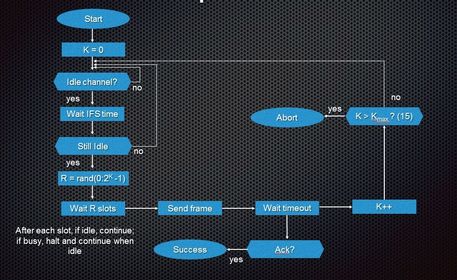
The number of slots in the window changes according to the binary exponential back-off strategy. - 27—CSMA/CA procedure
- 28What is the FCS?Frame check sequence!!
- 29What is RTS and CTSRequest to send and clear to send!
The DCF additionally specifies that stations must request access to the medium before transmitting.
- Broadcast a RTS
- wait to receive a CTS
- Send data - 30What is the NAV?Network allocation vector.
If a station receives a RTS or CTS packet unsolicited. Makes an entry on the NAV and remainds idle for the requested transmission time. - 31What is the Point Coordination Function?- Turn based collision avoidance system
- Each station only transmits when it is their turn
- 802.11 devices may optionally allow this method of operation
- NO COLLISIONS EVER OCCUR
- So the access point distributes CTS to each station one at a time. - 32Explain the hidden station problem!Suppose station B is sending data to station A
During transmission, station C wants to send data to station A also
However, station C is out of B’s range so C thinks the medium is free to use
Station C sends data to A which results in a collision at A.
Stations B and C are hidden from each other - 33How is the hidden station problem solved?With RTS and CTS frames of course!
- 34—Inverse of the Hidden Station Problem
Station C wants to send data to D but refrains as station B is transmitting to A
Too conservative: D is out of range of B so could go ahead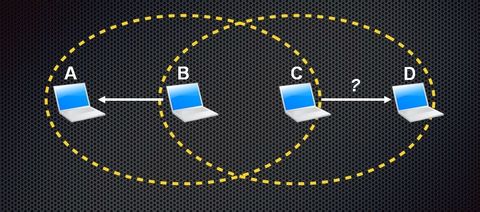
Informationen
- Beschreibung
- Karteikarten am Data-link layer, erstellt von Luke Garrigan am 07/05/2016.
- Erstellt von
- Luke Garrigan
- Aufrufe
- 2
- Bewertung