
Karteikarten
P1
Karten in diesem Stapel (89)
- 1how can heat be transferred?by conduction, convection and radiation
- 2explain conductionthe transfer of heat energy through a material. metals are good conductor because they contain free electrons where as non-metals do not. conduction transfers heat from the hot end to the cool end
- 3what are the factors affecting conduction?temp difference
surface contact
cross-sectional area - 4explain convectionconvection is the transfer of heat energy when the particles with lots of heat energy take the place of particles with less h.e. this creates a circular movement called convection currents
- 5which two states of matter does convection exist with?liquids and gases
- 6explain condensationcondensation is when a gas turns into a liquid. when the gas cools, the particles loses kinetic energy meaning that they come close together and bonds form. energy is released when this happens which turns the gas into a liquid
- 7explain evapourationevaporation is when a liquid turns into a gas because the liquids particles escape. the remaining particles will have a lower average kinetic energy therefore the liquid will cool down as evaporation happens.
- 8what is infared radiation?a type of electromagnetic radiation which involves waves rather than particles. this means that it can pass through the vacuum of space. the hotter an object, the more infared radiation it emits.
- 9name 4 good thermal insulatorsplastic, wood, ceramics, air
- 10how can heat loss be reduced through: a) window b) roof c) radiator d) walla) double glazing
b) loft insulation
c) aluminium foil behind the radiator
d) cavity wall insulation - 11what do u-values tell us?how much energy per second passes through different materials
- 12name the STORED/POTENTIAL energy transfersnuclear, gravitational potential, elastic, chemical, magnetic
- 13name the ACTIVE/KINETIC energy transferslight, sound, kinetic, electrical, thermal
- 14what is the conservation of energy principleenergy can be transffered usefully from one form to another, it can be stored or dissipated but it can never be created or destroyed. energy is only useful when converted from one form to another
- 15what is the efficiency of a device?the proportion/amount of the energy supplied that is transferred in useful ways.
- 16how many joules in 1kw?1000
- 17how many watts in 1kw?1000
- 18equation for calculating the cost of electricity?total cost = number of units x cost per unit
- 19the rate of energy transferred to or from an object depends on????????the shape, size, material of object.
temp difference between object and surroundings.
the materials the object is in contact with. - 20explain how solar heating panels workthey heat up water, they DO NOT generate electricity (solar cells)
basically, cold water pumped into panel where it heats by the sun and transfers to storage tank. - 213 types of passive solar heating?????greenhouse, black pipes on roof,solar cookers
- 22what kind of current does the electricity produced from solar cells have?a direct current. it always flows in the same direction
- 23advantages and disadvantages of using solar cells?ad- renewable, no harmful gases
dis- expensive, inefficient as it does not work at night - 24describe the energy flow used to heat water in power stationschemical/nuclear energy (fuel) ---> heat energy (steam) --->kinetic energy (turbine) ---> electrical energy (generator)
- 25explain carbon captureit's a way to prevent co2 building up in the atmosphere. it involves separating carbon dioxide from waste gases. the carbon dioxide is then stored underground in old oil/gas fields.
- 26what are the main nuclear fuels?uranium and plutonium
- 27how do nuclear fuels release heat energy?they r NOT burnt ok.
nuclear FISSION reactions in the fuel release heat energy.
btw nuclear fission reactions r where the nuclei in atoms are split - 28so how is this heat energy turned into electricity??????the same way fossil fuels are (see two cards behind)
- 29advantages and disadvantages of using nuclear fuels to generate electricity?ad- does not produce carbon or sulphur dioxide
dis- non renewable, radioactive, expensive to build nuclear power stations - 30ad/dis of wind farms?renewable
no wind = no electric, noisy, ugly and visible - 31how is wind produced?as a result of giant cnvection currents in the earths atmosphere
- 32ad/dis of using hydroelectric power?renewable, not harmful
rotting vegetation underwater releases methane, a greenhouse gas - 33what indirect kinetic energy can drive turbines?steam
produced from heating water - 34name the direct turbines used to generate electrcitytidal, hydroelectric, wind
- 35Where does the heat energy for geothermal energy resources come from?radioactive decay in rocks
- 36what are the four parts of the national grid?1. step up transformer
2. high voltage transmission lines
3. step down transformers
4. consumers (homes, companies) - 37what does the step down transformer do?decreases the voltage
- 38what happens when a current flows through a wire?some energy is lost as heat
the higher the current, the more heat is lost - 39to transmit electricity at a low current, will the national grid need a high or low voltage?a high voltage is needed to transmit electric at a low current.
- 40what is a transformer?it's an electrical device that changes the voltage of an alternating current (ac) supply
- 41explain how the national grid workspower stations produce electric at 25,000 v. step up transformers increase it to either ~400,000 275,000 or 132,000~ this reduces energy losses during transmissions.
finally the step down transformer decreases the voltage to a safe level. household electricity is about 230v - 42what does ac and dc stand for?alternating and direct current
- 43So why is 'low current/high voltage' the desired choice for electrical power line transmission?power = current x voltage, so to deliver a particular power rating, you can increase one of the two variables and decrease the other.
Therefore by using a very high voltage and low current you maximise power transmission for the minimal heat loss of wasted energy. - 44what are waves?vibrations tht transfer energy from place to place without matter being transfered
- 45what is a medium?a subsance tht some waves must travel through. it can be s,l or g.
sound waves and seismic waves must travel through a medium, however light, infared, microwaves dnt have to. - 46list mechanical wavessound, water, siesmic, spring and rope waves.
- 47name electromagnetic waveslight, radio, microwaves
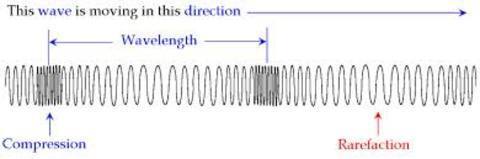
- 48what does a longitudinal wave look like?
- 49what can waves be described bytheir amplitude, wave length and frquency
- 50how is the speed of a wave calculated?freq x wave length
- 51all electromagnetic waves are what???transverse yo
- 52what is the top and bottom bit of a transverse wave called?crest and trough
- 53in a longitudinal wave, what are the compressed and long bits called?compressed --> compressions
long bits ---> rarefactions - 54in transverse waves, the vibrations are...perpendicular to the directions the waves are moving
- 55in longitudinal waves, the vibrations are...parallel to the directions the waves are moving
- 56what is the normal at a point of a mirror?it's a line drawn perpendicular (at 90 degrees) to the mirror
- 57what is the law of reflection?angle of incidence = angle of reflection
- 58the image produced in a plane mirror is...virtual, upright and laterally inverted.
- 59laterally inverted means???he 'left' of the object now appears on the 'right' side and the 'right' of the object appears to be the 'left' side of the image.
- 60what is diffraction?the effect of waves spreading out when passing through a gap or passing by a barrier.
- 61is the diffraction of a wave greater or smaller when passing through a narrow gap?greater
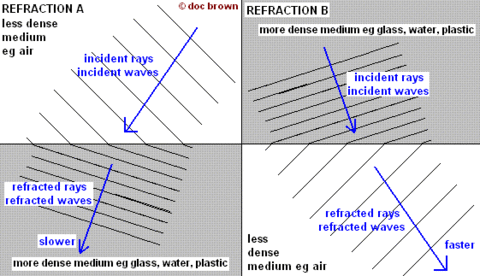
- 62what is refraction?when the waves travel across new material and change direction
- 63when a light ray refracts from AIR to GLASS, the angle of refraction is greater than the angle of incidence. True or False?\false. the aor is less than the aoi when it's air to glass but it is greater when it's glass to air
- 64shows refraction by considering what happens to waves. the parallel lines represent a series of crests of waves eg think waves on the sea or ripples in a pond.
- 65when does reflection occur?when light passes into a material w/ a lower refractive index
- 66why are radio waves used for communication?bc they have the longest wavelength on the elctromagnetic spectrum, and they are not absorbed strongly by the atmosphere or walls AND they can diffract around hills and tunnels
- 67why can Short wavelength, high frequency radio signals be received over large distancesbecause these signals can bounce of the Earth's surface AND the ionosphere
- 68what is the ionsphere???- an electrically charged layer of the Earth's upper atmosphere -
- 69are microwaves reflected by the atmosphere?no, unlike radiowaves, they can pass through which is why they're sent to satellites which can transmit them across the world
- 70why might mobile phones be a health risk?bc some of the microwaves WL's are absorbed by water molecules which heat the microwaves up
- 71what are infared waves used for?remote controls, optical fibres
- 72what can optical fibres do and how?transfer multiple telephone calls at nearly the speed of light.
The IR waves just bounces off the side of the thin strands of the glass fibres (known as 'total internal reflection') and so travels unimpeded down the optical fibre. The IR signal is transmitted into the optical fibres, travels to the ends of them, and the signal picked up by a receiver. Cable television is delivered in this way. - 73recite the elctromagnetic spectrum from the longest w.l, lowest frequency and energy to the shortest w.l, highest frquency and energyradio, micro, infared (optical), visible light, ultra violet, x-rays, gamma rays
- 74what can gamma rays do?kill cancer cells
- 75the lower the frquency of the wave the...longer the wave length
- 76do they all travel at the same speed in a vaccum?yes.
3 x 10 *lil 8 m/s
aka
300,000,000 m/s - 77do sound waves travel through a vaccum?nope.
only a medium - 78wht is the frequency range of a human ear?20- 20000 Hz
- 79what causes echos?sound waves reflected from a smooth hard surface. it would not work if the walls were covered in soft fabric bc the fabric would absorb the sound
- 80how fast does sound travel through air?about 340 m/s
- 81the warmer the air the... greater or smaller the speed of sound???greater!
- 82where does refraction of sound take place?at the boundaries between layers of air at different temperatures.
in the day, sound refracts upwards - 83wht is the doppler effect?it is where there is a change in frequency and wavelength.
look in notes - 84what is the big bang theory?a rlly fking shit tv show
but also a theory that a big bang created space, time and matter and the universe expanding - 85what is does CMBR stand 4 and explain what it iscosmic microwave background radiation.
it was created as gamma radiation just after the big bang and has been travelling through space since then. as the universe expanded, it stretched out to longer and longer wave lengths
it is now microwave radiation - 86the future of the universe depends on what?the density of the universe
- 87what is the steady state theory?that galaxies are being pushed apart from the matter entering the universe by hole holes.
- 88what is red shift?the red shift of a distant galaxy is the shift to longer w.l's of the light from it bc the galaxy is moving away from us
- 89what is blue shift?the blue shift of a distant galaxy is the shift to shorter w.l's of the light from it bc the galaxy is moving towards us
Informationen
- Beschreibung
- Karteikarten am P1, erstellt von Imaan Hasham-Moncada am 24/05/2016.
- Erstellt von
- Imaan Hasham-Moncada
- Aufrufe
- 0
- Tags
- Verlauf
-
- Erstellt von zarakrischer98 · 24 Jan 2014
- Kopiert von Imaan Hasham-Moncada · 24 Mai 2016
- Bewertung