
Karteikarten
Amino acids, proteins and DNA
Karten in diesem Stapel (16)
- 1Define substrateThe reacting molecule/s that will fit the specific active site
- 2Define stereospecificAn enzyme which is so selective, only one enantiomer of a pair will fit in its active site
- 3What is an enzymeProtein-based catalyst found in living things. Extremely specific. Speeds up a reaction by lowering the activation energy required for the reaction to occur.
- 4How does an enzyme work?The substrate fits in the active site of the enzyme where it is temporarily bonded. This holds it in the right orientation for the reaction to occur. The intermolecular forces which temporarily bond the enzyme-substrate complex promotes movement of electrons, causing the activation energy of the reaction to lower.
- 5How does a competitive inhibitor work?The inhibitor has a similar shape to the substrate and fits in the active site of the enzyme instead of the substrate, thus reducing the number of substrates available to form enzyme-substrate complexes, so the reaction is slowed down/stopped.
- 6How does a non-competitive inhibitor work?These molecules are not neccesarily the same shape as the substrate. They bind at an allosteric site and change the shape of the active site, denaturing the enzyme. This reduces the number of active sites available to form enzyme-substrate complexes so slows/stops the reaction.
- 7Explain how computers can be used in 'intelligent drug design'Sophisticated computer modelling techniques to predict shapes of proteins even before they have been synthesised, and therefore predicts their properties. This helps design drugs.
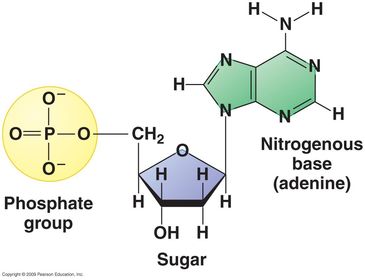
- 8Draw a nucleotide monomerRemember the O- on the phosphate group can also be OH. This is important in the condensation reaction.
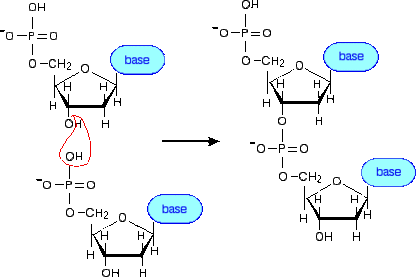
- 9Draw the condensation of 2 nucleotide monomers
- 10Which bases pair with which base? How many H bonds do they make?A and T (2 H bonds), G and C (3 H bonds)
- 11What does the sequence of bases on a DNA chain do?Acts as a template for arranging amino acids into protein chains. Every triplet of bases on the sequence is called a codon. A codon represents a particular amino acid in a protein sequence.
- 12Explain why DNA is acidicThe phosphate groups which forms the backbone of the DNA have P-O-H groups. These can donate the H atom as a proton ie P-O-H becomes PO- + H+
- 13Draw the structure of cisplatin
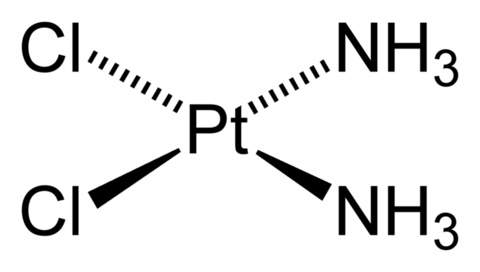
- 14What is the oxidation state of platinum in the cisplatin complex?Total oxidation state must =0
H= +1, N= -3, Cl= -1
(refer to the structure of cisplatin if in doubt of below calcs)
2((+1x3)+(-3))+2(-1)+Pt=0
-2+Pt=0
Pt=+2 oxidation state - 15How does cisplatin prevent DNA replication?Cisplatin prevents DNA replication in cancer cells by a ligand replacement reaction with DNA in which a dative covalent bond is formed between platinum and a nitrogen atom on guanine
- 16Draw a diagram to show how cisplatin binds to a single strand of DNA
Informationen
- Beschreibung
- A level Chemistry (Organic Chemistry) Karteikarten am Amino acids, proteins and DNA, erstellt von Anushka John am 02/12/2016.
- Erstellt von
- Anushka John
- Aufrufe
- 4
- Tags
- Bewertung