
Karteikarten
12.) Syntax 2
Karten in diesem Stapel (45)
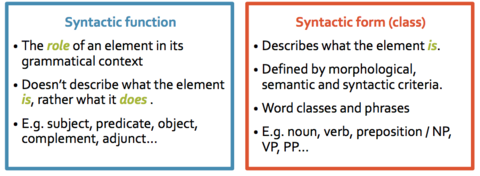
- 1Syntactic function vs. form What is the difference between syntactic function and syntactic form? defined by?
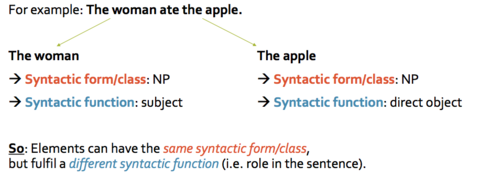
- 2syntactic function vs. form For example: The woman ate the apple.
- 3What syntactic functions are there?• Subject
• Predicate
• Verb / Predicator
• Complement
• Adjunct - 4Syntactic functions: Subject Formal properties? Word order?Some formal properties:
• Agreement (i.e. She likes grammar vs. She *like grammar)
• Case (i.e. She likes grammar vs. *Her likes grammar)
Word order (for English):
The subject precedes the verb (i.e. She likes grammar vs. *Grammar likes she) - 5Syntactic functions Predicate Verb (Predicator)• The verb phrase (including the verb)
• In a standard main clause, it is everything after the subject
• E.g. The child [wanted the delicious ice-cream.]
VERB (PREDICATOR)
• The verb itself that introduces the predicate
• E.g. The child wanted the delicious ice-cream. - 6Syntactic functions Complement What is it? Different types?An obligatory non-subject constituent. (= cannot be left out without messing up syntax)
Different types:
• Direct object
• Indirect object
• Prepositional object
• Subject complement • Object complement - 7Syntactic functions: complement direct vs. indirect object What? (synonym?) Where in the phrase? example
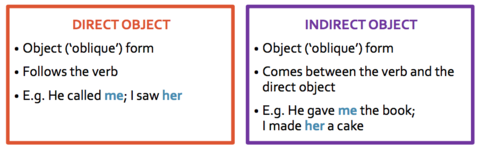
- 8Syntactic functions: complement Prepositional complement where in the phrase? rememeber!
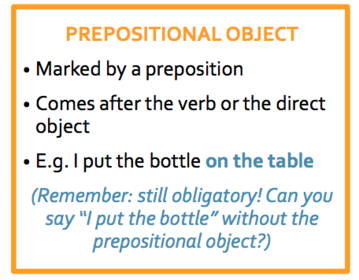
- 9Syntactic functions: complement Subject complement Object complement where in phrase?
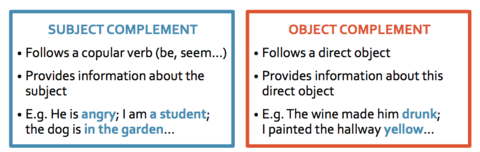
- 10Syntactic functions: complement some complement tipsBe careful not to confuse subject and object complements!
• If there is NO DIRECT OBJECT and the SUBJECT is being described
--> SUBJECT COMPLEMENT
• If there is a DIRECT OBJECT and this OBJECT is being described
--> OBJECT COMPLEMENT - 11Syntactic functions: Adjunct 2 characteristics What are they? What do they do? 2 types
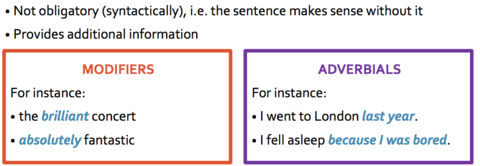
- 12Syntactic functions: Adjunct What’s the difference between the two ''last week''s. 1) The concert was last week. 2) I went to the concert last week.In sentence 1) --> Obligatory! (cannot say *”The concert was.”) --> Complement!
In sentence 2)--> Not obligatory! (can say “I went to the concert.”) --> Adjunct! - 13Different syntactic functions can take on different forms: eg. Subject• As a noun phrase: The bird flew up high.
• As a clause: Sleeping through my exam was not a good idea.
• As a prepositional phrase: From my flat to uni is a long journey. •... - 14Different syntactic functions can take on different forms: eg. Adjunct• As an adverbial phrase: She was playing the trumpet very loudly.
• As a prepositional phrase: I did my homework in the living room.
• As a noun phrase: He went to see his friends last night.
• As a clause: I enjoy fishing whenever I get the time.
•... - 15When we talk about complementation patterns we are talking about .. ?.. the type of sentence in terms of the complements that occur.
For instance:
The verb ‘put’ requires a direct object and a prepositional object.
• He put the book on the table.
• *He put on the table.
• *He put the book. - 16Complementation patterns symbols we use for Subject, Verb, Direct Object, Indirect Object, Prepositional Object, Subject complement, Object complementS = Subject
V = Verb
Od = Direct object
Oi = Indirect object
Op = Prepositional object
Cs = Subject complement
Co = Object complement - 17normal: Intransitive:No direct object, no indirect object, no complements... (S V)
It rained. He laughed. She slept. The leaves fell. - 18normal: Monotransitive:Monotransitive: There is a direct object, and nothing more. (S V Od)
John ate the apple. Mary read the book. We bought a new car. - 19normal: Ditransitive:There is an indirect object and a direct object. (S V Oi Od)
He gave me a book. She baked him a cake. I sent my teacher an e-mail. - 20PP complement verbs: Intransitive:There is a prepositional object, and nothing more. (S V Op)
I hoped for a break. She went to school. We live in Vienna. - 21PP complement verbs: TransitiveThere is a direct object and a prepositional object. (S V Od Op)
I put the bottle on the desk. He threw the computer out the window. - 22complement-patterns: CopularThere is a subject complement (with copular verb). (S V Cs)
The tree is in the garden. He seemed restless. The cake tastes good. - 23complement-patterns: With object complement:There is a direct object and an object complement. (S V Od Op)
She considers him worthy. The story made me sad. He called James a liar. - 24Then identify the complementation pattern of the sentences/clauses. The wine made Fred drunk.With object complement (complex transitive) (S V Od Co)
- 25The dog bit my arm.Monotransitive (S V Od)
- 26You told me a lovely story.Ditransitive (S V Oi Od)
- 27She’s on the phone.Intransitive (with prepositional object) (S V Op)
- 28The taxi driver took me to the airport.Transitive (with prepositional object) (S V Od Op)
- 29I laughed because the joke was funny.Intransitive (S V)
Copular (with subject complement) (S V Cs) - 30We can distinguish between lexical and functional elements -What can they be? -What do they have? -Can they be modified? -open/closed class? -name some! special case: lexical elements
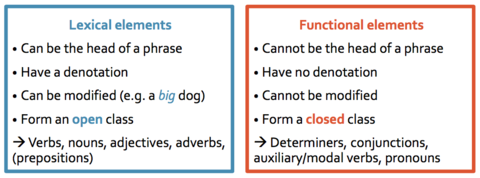
- 31yes, also prepositions are lexical elements 3 criteria for yes 2 criteria for no
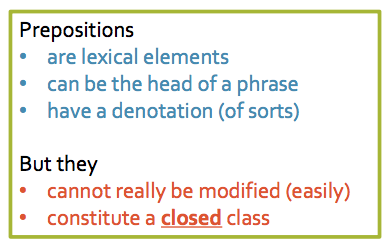
- 32The small dog started barking loudly because a cat had jumped into the garden and stolen the dog’s favourite toy. which elements are lexical, which are functional?lexical:
small
dog
started
barking
loudly
cat
jumped
into
garden
stolen
dog's
favorite
toy
functional:
The
because
a
had
the
and
the - 33What is language typology?--> The study and classification of languages according to their structural and
functional features. - 34How can we classify languages?According to morphosyntax and word order
- 35What different kinds of language are there?
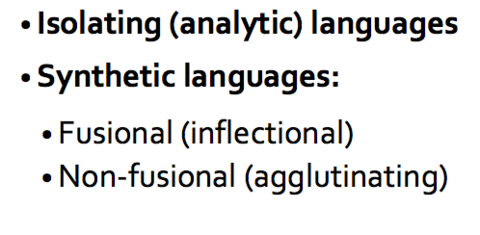
- 36Isolating (analytic) languages• One word = one morpheme
• Remember a morpheme can also be a marker for tense! In some languages this is a separate word
• Semantically transparent (= easy to work out the meaning from the parts)
• E.g. (Mandarin) Chinese, Papiamentu...
- 37Synthetic languages: fusional / inflectional• One word = multiple morphemes (polymorphemic words)
• A morpheme can contain more than one element of meaning
• For example: Spanish hablé – this ending means first person, singular, preterite tense, indicative, active...)
• Semantically non-transparent (= more difficult to get the meaning from the parts)
• E.g. Spanish, Latin, Russian...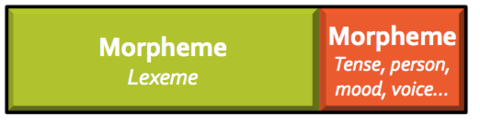
- 38Synthetic languages: non-fusional / agglutinating• One word = multiple morphemes (polymorphemic words)
• Each morpheme has just one element of meaning
i.e. one morpheme for tense, one morpheme for person, one morpheme for voice etc.
• Semantically transparent
• E.g. Turkish, Basque...
- 39Language typology: What about English?• English, like most languages, is mixed
• Mostly analytic (isolating), some synthetic elements (inflectional/fusional)
• Analytic: I will have been contacted by the end of the day.
• Synthetic: I ate my sandwich.
• English used to be more synthetic in the past, but has become more analytic - 40How does this affect the word order of Isolating (analytic) and synthetic languages? inflection?
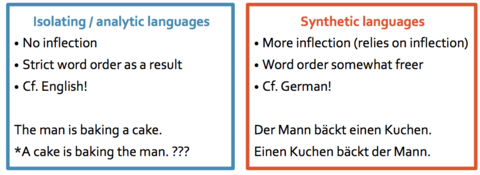
- 41Word order on the clause level: There are some cross-linguistic tendencies: Major types? Minor types?• Verb and object tend to occur adjacently
• Subject tends to precede the object (in non-marked utterances)
• Major types: SVO (English, Indonesian...), SOV (Japanese, Turkish...)
• Minor types: VSO, VOS, OVS, OSV... - 42Word order on the phrase levelThere are head-initial and head-final languages.
- 43head initial languagesThere are head-initial languages...
-> This means the head comes at the beginning of the phrase
->Other elements in the phrase come after the head
->i.e. in a noun phrase: N A Det
pays riches (N A) - 44head-final languages->This means the head comes at the end of the phrase
->Other elements in the phrase come before the head
->i.e. in a noun phrase: Det A N - 45Word order on the phrase level English? Fronting?Again, English is mixed!
SVO order: “I can do that!”
But then: “Now THAT I can do!” ( we call this ‘fronting’)
Informationen
- Beschreibung
- Linguistics (Syntax) Karteikarten am 12.) Syntax 2, erstellt von Lisza Neumeier am 03/12/2016.
- Erstellt von
- Lisza Neumeier
- Aufrufe
- 45
- Bewertung