
Karteikarten
unit 1 module 2
Karten in diesem Stapel (18)
- 1Ionizationis a process in which atoms lose or gain electrons and become ions.
- 2The first ionization (I1) energyis the energy required to remove one electron from a gaseous atom.
M(g) → M+(g) + e-(g) - 3The second ionization (I2) energyinvolves the removal of a second electron. M+(g) → M2+(g) + e-(g)
- 4Factors affecting ionisation energyElectrons are held in their shells due to their negativity and attraction to the positive nucleus.
Therefore, to form an ion, energy must be supplied to remove an electron to leave a positive ion.
The outer shell electrons are the easiest to remove since they are the furthest from the nucleus and experience the least attraction.
These electrons therefore have the lowest ionisation energies. Atomic radius
Nuclear charge
Electron shielding or screening - 5Evidence for energy levelssuccessive ionization energies of magnesium clearly shows the existence of different energy levels, and the number of electrons at each level.
Successive ionization energies increase as more electrons are removed.
Large jumps in the ionization energy reveal where electrons are being removed from the next principal energy level - 6Sub- levelss-> 2 electrons
P-> 6 electrons
D-> 10 electrons
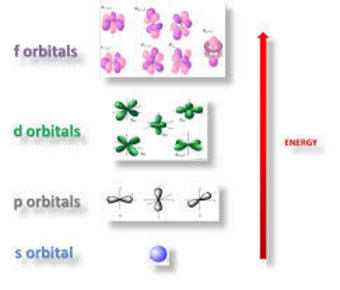
f-> 14 - 7Electron orbitals
- 8Pauli exclusion principlestates that each orbital may contain no more than two electrons.
- 9Spina property of electrons called spin, which has two states: ‘up’ and ‘down’. The spins of electrons in the same orbital must be opposite, i.e. one ‘up’ and one ‘down’.
- 10Hund’s rulestates that single electrons occupy all empty orbitals within a sub-level before they start to form pairs in orbitals.If two electrons enter the same orbital there is repulsion between them due to their negative charges. The most stable configuration is with single electrons in different orbitals
- 11evidence for hund's ruleThe first ionization energies for the elements in period 3 show a general increase. However, sulfur’s value is below that of phosphorus. As the highest energy electrons of both are in the 3p sub-level this is evidence for Hund’s rule.
- 12The Aufbau principleprinciple states that the lowest energy sub-levels are occupied first. This means the 1s sub-level is filled first, followed by 2s, 2p, 3s and 3p. However, the 4s sub-level is lower in energy than the 3d, so this will fill first.
- 13Electron configuration of transition metalsAlthough the 3d sub-level is in a lower principal energy level than the 4s sub-level, it is actually higher in energy. This means that the 4s sub-level is filled before the 3d sub-level. When transition metals form ions, it is the 4s electrons that are removed before the 3d electrons.
- 14ionic bondan ionic bond occurs between a metal and non-metal atom (e.g. NaCl)
- 15covalent bonda covalent bond occurs between two non-metal atoms (e.g. I2, CH4)
- 16metalic bonda metallic bond occurs between atoms in a metal (e.g. Cu)
- 17Charge on the ionsMetals lose electrons to form positive ions while non-metals gain electrons to form negative ions
- 18Ionic chargesThe charge on an element’s ion can be predicted from its position in the Periodic Table
Molecular ions have a charge equal to the sum of all ionic charges of the constituent elemental ions.
An ionic compound has an overall charge of 0 and so the formula can be deduced.
Informationen
- Beschreibung
- Karteikarten am unit 1 module 2, erstellt von Hennique am 08/04/2014.
- Erstellt von
- Hennique · Apr 2014
- Aktualisiert
- 19 Feb 2016
- Aufrufe
- 11
- Bewertung