
Atomic Structure
543 resources created by 476 users
This Atomic Structure page on GoConqr gathers community-made quizzes, mind maps, flashcards and notes, from early atomic models and subatomic particles to orbitals, electron configuration and mass spectrometry. It's built for school students revising a topic and teachers after ready-made material. There are over 3,400 resources here, including more than 300 quizzes, over 1,500 mind maps and more than 1,200 flashcards, mostly aimed at GCSE, A-level, IB and AP Chemistry. Pick a resource, try a quiz to find your gaps, then build your own.
Top Atomic Structure resources
-
Mind map Structure and Properties of Matter This is a mind map about the structures and properties of matter unit learned in grade 12 university chemistry
-
151 cardsChem second semester final
-
32 questionsThe Nature of matter, atomic structure and the periodic table A solid's particles are:
-
Mind map 2.2 Electrons, Bonding and Structure Electrons, Bonding and Structure
-
33 questionsChemistry - C1 - AQA - GCSe - CGP C1a Quiz In the nucleus of an atom, there are...
-
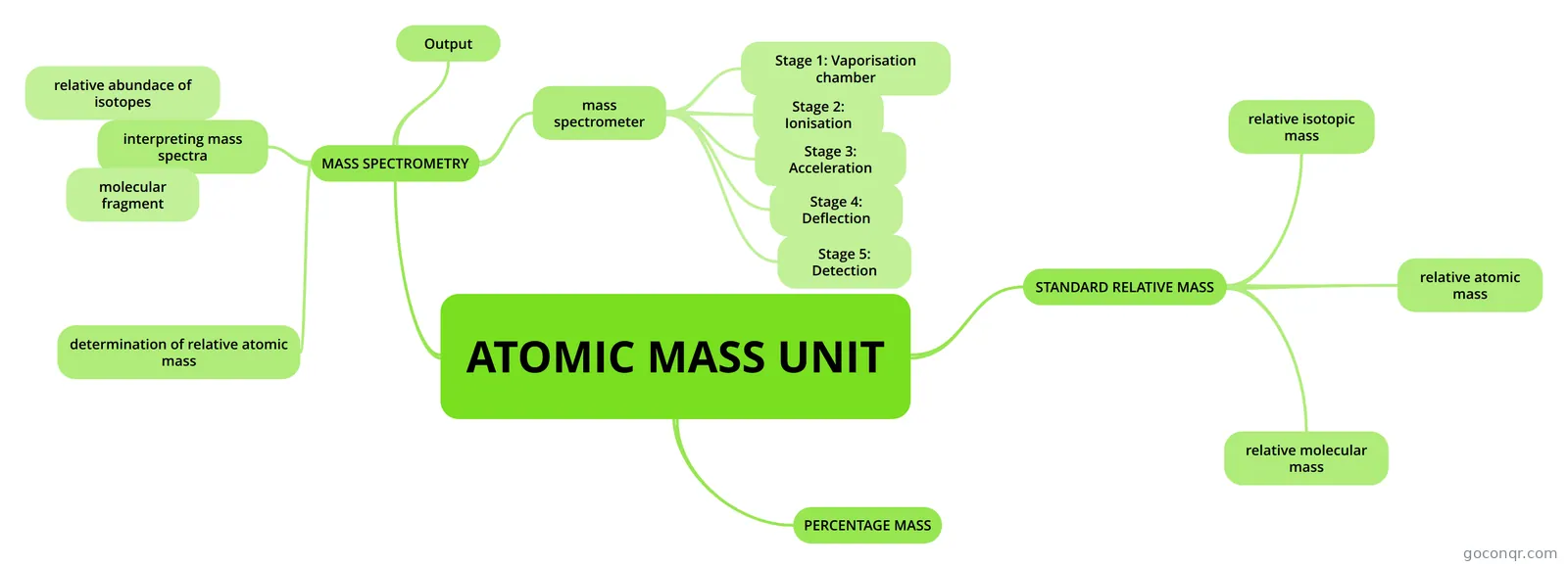 Mind map ATOMIC MASS UNIT
-
Mind map GCSE AQA Chemistry Atomic Structure and Bonding A mixture of Unit 1 and Unit 2 AQA Chemistry for GCSE level
-
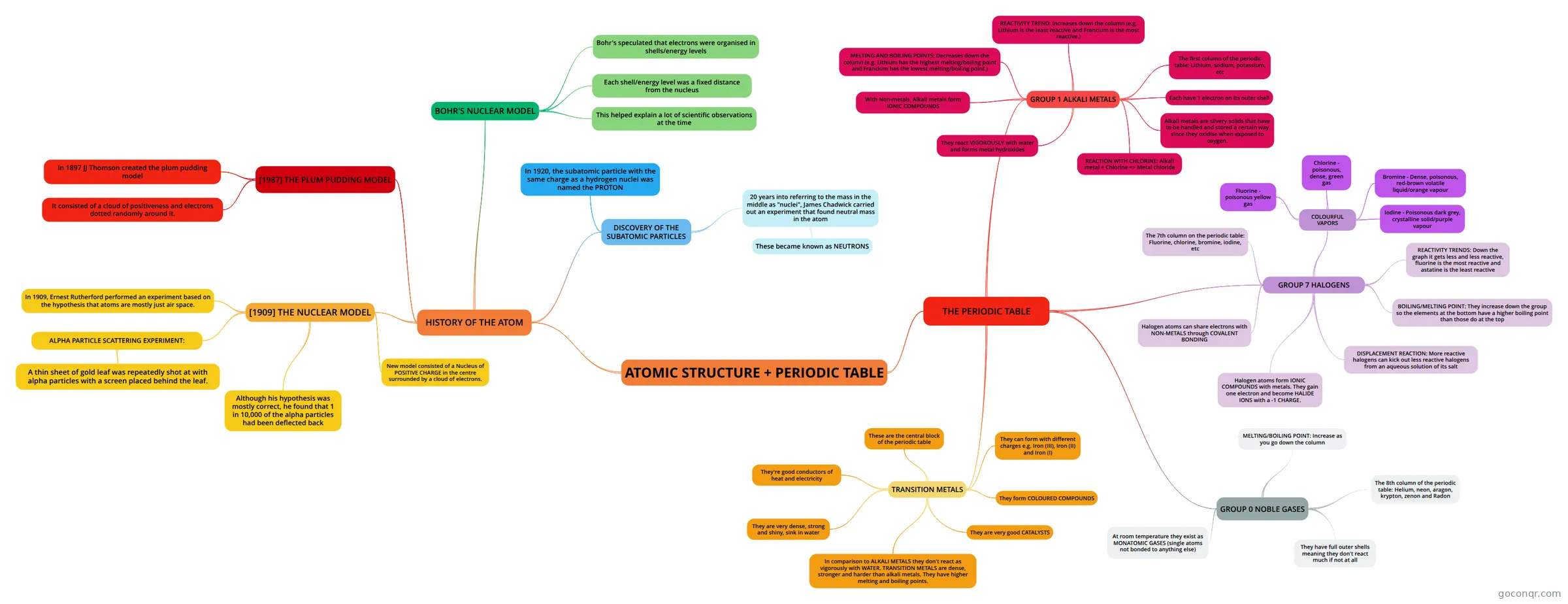 Mind map ATOMIC STRUCTURE + PERIODIC TABLE For me to revise, or not idk
Quizzes
See all 94 quizzes-
32 questionsThe Nature of matter, atomic structure and the periodic table A solid's particles are:
-
33 questionsChemistry - C1 - AQA - GCSe - CGP C1a Quiz In the nucleus of an atom, there are...
-
24 questionsQuantum Numbers The principal quantum number denotes the…
-
13 questionsElectron Configurations Which element does this electron configuration depict? 1s2 2s2 2p6 3s2 3p6 4s2 3d7
-
11 questionsChapter 8 Grade 12 SABIS Chemistry Atomic Structure and Periodicity Chapter 8 Grade 12 SABIS Chemistry Atomic Structure and Periodicity
-
12 questionsElectronic Configuration The 4 main sub-shells are S, P, D and E?
-
11 questionsAQA (9-1) Topic 1 How many neutrons does a sodium atom have?
-
15 questionsAtomic Orbitals Which scientist discovered the electron? Also responsible for the Plumb Pudding model of the atom.
Mind maps
See all 152 mind maps-
Structure and Properties of Matter This is a mind map about the structures and properties of matter unit learned in grade 12 university chemistry
-
2.2 Electrons, Bonding and Structure Electrons, Bonding and Structure
-
ATOMIC MASS UNIT
-
GCSE AQA Chemistry Atomic Structure and Bonding A mixture of Unit 1 and Unit 2 AQA Chemistry for GCSE level
-
ATOMIC STRUCTURE + PERIODIC TABLE For me to revise, or not idk
-
C1 Atomic structure Each element is made of one type of atom. The periodic table is arranged in columns, called groups. Element...
-
Atomic Structure Overview of atomic structure. Classical and Quantum view.
-
C1- States of Matter. C1.1- The particle model C1.2- Atomic structure
Flashcards
See all 233 flashcards-
151 cardsChem second semester final
-
30 cardsAtomic structure and the periodic table revision flash cards GCSE AQA
-
14 cardsChemistry past paper - June 2009 Chemistry Past Paper - June 2009
-
11 cardsOCR AS Chemistry Flash Cards AS OCR Chemistry Notes
-
25 cardsGCSE Chemistry: Atomic structure and the periodic table (Keywords) It covers the structure of atoms, reactions of elements, the periodic table and mixtures.
-
16 cardsAtomic Structure Name the three subatomic particles of an atom.
-
14 cardsScience- Chemistry Definitions
-
20 cardsChemistry Paper 1 Keywords Some keywords in Chemistry Paper 1
Flowcharts
Notes
See all 47 notes-
MCAT Chemistry - Atomic Structure Overview Fundamentals:An atom consists of a nucleus of protons and neutrons, surrounded by electrons. Each of the elements in the periodic table is classified according to its atomic number, which is the number of protons in t...
-
C1 Atoms, elements and compoundsThere are about 100 different elements from which all substances are made. The periodic table is a list of the elements.Each element is made of one type of atom. Atoms are represented by c...
-
Chemistry:Atoms and Molecules Notes Definitions Atom - The smallest unit of matter that can exist of an element. Compound - A molecule containing two or more different atoms bound together. Element - A fundamental substance that has a unique atomic numb...
-
AS-Level Chemistry: Unit 1:The Atom - created from Mind Map The Structure of an Atom atoms form everything in our universe. They consist of three particles: the proton, neutron and electron. electrons have a -1 charge. protons have a +1 charge neutrons don't have a charge! ele...
-
Atomic Theory Dalton's Atomic Theory English chemist John Dalton (1766-1844) completed the first attempt at describing all matter in terms of atoms and properties. Dalton's atomic theory was the first complete attempt to describe a...
-
Atomic Structure Ionic Bonding: Metals always have a positive charge. Non-metals always have a negative charge. How do I calculate the Overall Mass Number?The Overall Mass Number for an element can worked out by adding the fraction of...
-
C1 Revision C1 Revision: States of Matter: States of matter depend on the forces between particles. Solids: There are strong forces of attraction between particles. This means they are in a fixed, vibrating posi...
-
Atomic Structure Quantum Theory Development of the Atomic Theories of Matter Democritus - first had the theory, Greek philosopher Dalton - revived the idea J.J. Thompson - found positive and negative areas of the atom, using a cathode...
Slides
See all 15 slidesMore Chemistry topics
About Atomic Structure
GoConqr OriginalWhat the resources cover
The page sits in the Atoms, Bonding and the Periodic Table strand of Chemistry. It starts with the basics: protons, neutrons and electrons, atomic number and mass number. It then moves to orbitals, quantum numbers, electron configuration, ionisation energies and mass spectrometry.
Where to start
Begin with the mind map Structure and Properties of Matter. It follows the scientists behind the atomic model: Dalton and his billiard ball model, Thomson and the raisin bun model, then Rutherford and the gold foil experiment. It gives you the story before the detail.
Next, read the note MCAT Chemistry - Atomic Structure Overview. It explains that an atom has a nucleus of protons and neutrons, surrounded by electrons, and that elements are classified by atomic number.
Moving on to orbitals and configuration
- Open the Orbitals mind map to see quantum numbers, s and p shapes, nodes and boundary surface diagrams.
- Use the Electron Configuration mind map to see how electrons fill from the lowest energy up.
- Try the Quantum Numbers quiz to check the main ideas.
Using quizzes and maps together
Read a map first, then take a quiz on the same idea. The Atomic numbers and mass numbers quiz asks, for example, how many neutrons helium has, and shows the working: mass number minus atomic number. The Atoms, Protons, Neutrons & Electrons quiz adds charges, the Aufbau principle and the capacity of the p orbital.
If you miss a question, go back to the matching map and look at that branch again. Then retry the quiz.
Exam-style practice
Some resources suit particular courses. The quiz Chemistry - C1 - AQA - GCSe - CGP C1a Quiz covers relative masses and charges of particles. The flashcard deck Chemistry past paper - June 2009 starts with magnesium isotopes. Teachers can pick from the many maps, decks and notes to set revision tasks.
Choose one resource that matches your course, try it today, and then make your own maps and flashcards for the parts that need more work.
Frequently asked questions
Which resource should I open first?
Start with the Structure and Properties of Matter mind map. It walks through Dalton, Thomson and Rutherford and how each changed the atomic model. After that, take the Atomic numbers and mass numbers quiz to check you can work out protons, neutrons and electrons.
What do the mind maps on this page cover?
They cover atomic models, subatomic particles, isotopes, orbitals, quantum numbers, electron configuration, ionisation energies, absorption and emission spectra and mass spectrometry. Some are tied to courses, such as the GCSE AQA Chemistry map on atomic structure and bonding and the AP CHEM chapter maps.
Are the resources free to use?
Yes. Every resource listed here is free to open, study and take, with no account needed. They were made by GoConqr users, not by GoConqr itself. A free account also saves your quiz scores and lets you make your own quizzes, maps, flashcards and notes.
Which exams do these resources suit?
The resources mention GCSE, IGCSE, AS and A-level Chemistry, including AQA, OCR and Edexcel, as well as IB, AP Chemistry and MCAT. Most are aimed at school students, so check the title or excerpt to see whether a resource fits your course.
Is there anything for quick vocabulary revision?
Yes. The flashcard decks include Atomic Vocabulary, Quantum Numbers, First Ionisation Energy and Mass Spectrometry. There are also keyword decks for GCSE Chemistry on atomic structure and the periodic table, which work well for short daily practice.
What if I can't find the topic I need?
Try a nearby resource first, such as the Isotopes or Electronic Structure mind maps, since topics often overlap. If your topic is still missing, you can make your own notes, quiz or flashcards with a free account and use them alongside the ones here.