
Karteikarten
Quant - Numbers
Karten in diesem Stapel (37)
- 1ODD / EVEN INTEGERS (Operations) Division O / O = ? O / E = ? E / E = ? E / O = ?O / O = O
O / E = Non-integral
E / E = E
E / O = E
Note: Take denominator to RHS to understand the example. - 2FACTORS - 1 of n Can factors be both +ve and -ve?No
Only +ve - 3FACTORS - 2 of n x is a factor of y, and y is a factor of z Is x a factor of z?Yes
- 4FACTORS - n of n x is a factor of y, and y is a factor of x Then?x = y, or
x = - y - 5MULTIPLICANTS What are they? Example?a x b = c
a & b are multiplicants.
c is a multiple of a
c is a multiple of b - 6PRIME NUMBERS - 1 of n How many even prime numbers are there?Only one.
2 - 7PRIME NUMBERS - 2 of n Is the PRODUCT of 2 prime numbers even or odd?Odd
Except when one of the prime numbers is 2. - 8PRIME NUMBERS - 3 of n Is the SUM of 2 prime numbers even or odd?Even
Except when one of the prime numbers is 2. - 9PRIME NUMBERS - 4 of n How to identify whether a number is prime or not?1. Find # of factors - must have only 2 factors
2. SQUARE ROOT METHOD
i. Find approx. sq. root of the integer (17 – square root is approx. 4.something)
ii. Divide the integer (17) by all integers < its sq. root (1,2,3,4)
iii. If the integer (17) is not divisible by any of these numbers then it is a prime number - 10PRIME NUMBERS - 5 of n Prime numbers > 3 can be expressed as?6k ± 1 (k ≥ 1)
Note: All number of the form 6k±1 need not be prime - 11PRIME NUMBERS - 6 of n What can be the last digits of all prime numbers (except 2 & 5)?1, 3, 7, 9
- 12PRIME NUMBERS - 7 of n If the square of a number has exactly 3 factors, then the number is a Prime NumberEx. 11
Factors of (11)^2
= 1, 11, 121 - 13PRIME NUMBERS - n of n How many prime numbers are there in between 1 and 100?25 prime numbers
2, 3, 5, 7,
11, 13, 17, 19,
23, 29,
31, 37,
41, 43, 47,
53, 59,
61, 67,
71, 73, 79,
83, 89, and
97 - 14PRIME FACTORIZATION - 1 of n (Advantages) 1. Identify total # of factors 2. Total # of odd factors for a number 3. Whether the given number is Prime or not 4. Whether the given number is Perfect Square1. Identify total # of factors
2. Total # of odd factors for a number
3. Whether the given number is Prime or not
4. Whether the given number is Perfect Square - 15PRIME FACTORIZATION - 2 of n How to find total # of factors of a number?Do prime factorization
(Prime Factor 1)^p * (Prime Factor 1)^q....
# of factors = (p + 1) * (q + 1) .....
Ex. 72 = (2)^3 * (3)^2
# of factors = (3 + 1) * (2 + 1) = 12 - 16PRIME FACTORIZATION - 3 of n How to find # of ODD factors?(2)^p * (Prime Factor 2)^q * (Prime Factor 3)^r....
# of factors = (q + 1) * (r + 1) .....
Ex. 1200 = 2^4 * 3^1 * 5^2
Odd factors = (1 + 1) * (2 + 1) = 6 - 17PRIME FACTORIZATION - n of n How to find # of EVEN factors?# of Even factors
= (Total # of factors) - (# of Odd factors) - 18PERFECT SQUARE - 1 of n # of factors = Even / Odd?ALWAYS odd.
Note: Vice-versa might not be true. - 19PERFECT SQUARE - n of n Sum of the first n perfect squares?[n (n+1) (2n+1)] / 6
- 20CO-PRIME NUMBERS?2 integers a and b are co-primes if the only positive integer (factor) that divides both of them is 1.
Consequently, any prime number that divides one does not divide the other.
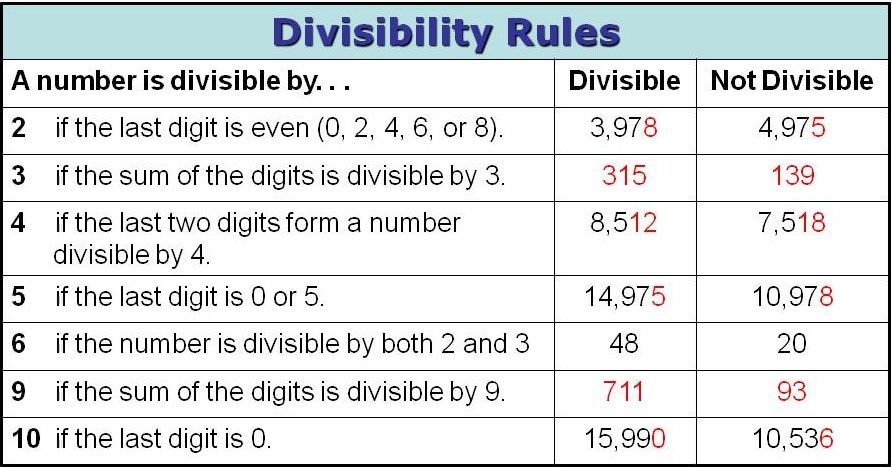
This is equivalent to their greatest common divisor being 1. - 21DIVISIBILITY TESTS
- 22REMAINDER PROBLEMS - 1 of n (when remainders are SAME) n = 4 (Q1) + 2 n = 5 (Q2) + 2 Smallest n?1. Find LCM of divisors, 5 and 4 = 20
2. n = LCM + Remainder
= 20 + 2 = 22
Other greater values of n
= LCM * k + Remainder (k ≥ 1) - 23REMAINDER PROBLEMS - 2 of n (when remainders are DIFFERENT) n = 5 (Q1) + 2 n = 7 (Q2) + 4 Smallest n?1. Find -ve remainders
+ve Remainder - Divisor = -ve Remainder
(Ex. 8/5, R = 3 or -2)
2. n = 5 (Q3) - 3
n = 7 (Q4) - 3
3. Find LCM of divisors, 5 and 7 = 35
4. n = LCM + (-ve Remainder)
= 35 - 3 = 32 - 24LCM & HCF - 1 of n (Properties) LCM * HCF = ?LCM * HCF = Product of the 2 numbers
- 25LCM & HCF - n of n (Properties) How to identify whether question is of LCM or HCF type?LCM Question -->
‘numbers when divided by’
HCF Question
--> ‘number divides’ - 26FACTORIAL - 1 of n (Finding highest powers) Highest power of a PRIME number?Consider, 100! and prime number as 3
1. Divide 100 by 3
2. Take integer value of all the quotients
3. Add all the integers
In this case, 33 + 11 + 3 + 1 = 48 - 27FACTORIAL - 2 of n (Finding highest powers) Highest power of a COMPOSITE number?Consider, 100! and composite number as 10
1. Divide 100 by prime factors (individually) of the composite number
2. Take integer value of all the quotients
3. Add all the integers
4. Consider the maximum exponent value
In this case, prime factors are 2 & 5
In case of 2, 50 + 25 + 12 + 6 + 3 + 1 = 97
In case of 2, 20 + 4 = 24
Hence, (10)^24. - 28PROPERTIES OF CONSECUTIVE INTEGERS - 1 of n Sum of ODD # of consecutive integers is always divisible by?that odd number.
Ex. Consider 4, 5, 6
Sum = 15 --> divisible by 3
Similar property for EVEN is NOT valid. - 29PROPERTIES OF CONSECUTIVE INTEGERS - 2 of n Product of n consecutive integers is always divisible by?n and (n!)
Consider 4 consecutive integers = 4, 5, 6, 7
Product = 20 x 42 = 840
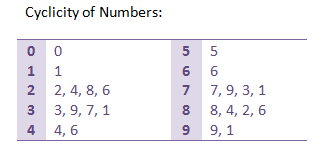
840 / (4!) = 35 - 30CYCLICITY (Power Cycle)Any number to the power (4k+1) will always end in the same digit as the last digit of the number
- 31TERMINATING DECIMALIf denominator can be expressed as
(2)^m * (5)^n
(where, m & n are non-negative integers) - 32MISC - 1 of n 6^3 7^3 8^3 9^3 11^36^3 = 216
7^3 = 343
8^3 = 512
9^3 = 729
11^3 = 1331 - 33MISC - 2 of n Sum of first n positive integers?n (n+1) / 2
- 34MISC - 3 of n (a)^n ± (b)^nCASE 1: (a)^n - (b)^n
i. ALWAYS divisible by (a - b)
ii. ALWAYS divisible by (a + b) if n is EVEN
CASE 2: (a)^n + (b)^n
Divisible by (a + b) ONLY if n is ODD - 35MISC - 4 of n In a 4 digit number, the unit digit is a multiple of 3. What are its possible values?0, 3, 6, and 9
Don't forget 0.
0 is a multiple of every number. - 36MISC - n of n Consider for a number to be both a Perfect Square and Perfect Cube?After prime factorization, power should be divisible by 6.
- 37REMAINDER PROBLEMS - n of n The remainder of (a x b) is always equal to?(Remainder of A) x (Remainder of B)
i.e.
R (A x B) = R (A) x R (B)
Similarly, R (A + B) = R (A) + R (B)
Ex. Remainder of (15 x 15) / 7?
Ans. 1
Informationen
- Beschreibung
- Karteikarten am Quant - Numbers, erstellt von Nishant Jain am 06/11/2017.
- Erstellt von
- Nishant Jain · Nov 2017
- Aktualisiert
- 13 Nov 2017
- Aufrufe
- 1
- Tags
- Bewertung