
Karteikarten
Micro-Architecture
Karten in diesem Stapel (20)
- 1What is a microarchitecture and what is it made up of?- How to implement an architecture in hardware
-Made up of datapath (functional blocks and registers), and control (control signals) - 2What is a MIPS?-32-Bit RISH processor
-~80 instructions in instruction set
-32 general purpose registers $0-$31
-$0 is special and always contains value 0
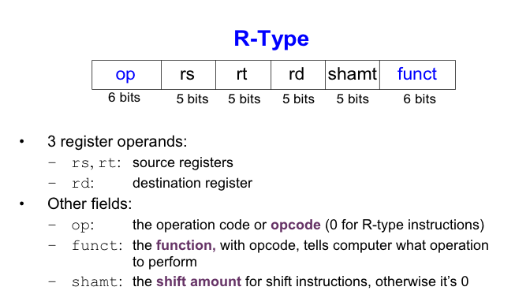
-Has super-pipelined architecture: each instruction is broken down into a sequence of micro instructions - 3What do R-type instructions consists of?
- 4What do the following do: add $16, $17, $18 sub $8, $11, $131. add values in registers 17 and 18 and put the result in 16
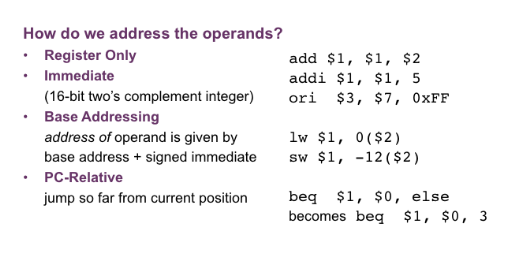
2. Subtract value in registers 13 from 11 and put the answer in register 8 - 5How do we address the operands in R-type instructions?
- 6What are the other registers in MIPS?-further 32 registers in floating point unit (each holds single precision FP number, 32 bits, pairs can use used to store 64 biit numbers)
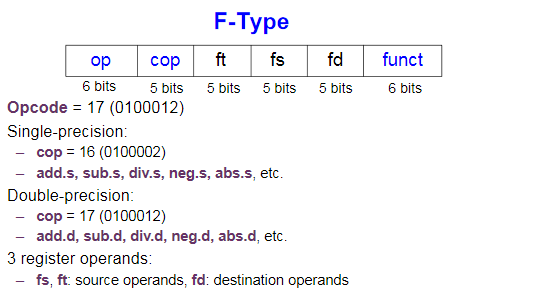
-ALso exception and interrupt handling registers - 7How is an F-Type instruction constructed?
- 8What is casting?Converting from int into singe FP
- 9What are casting errors?-FP only has 23 bits to store mantissa but floating point number may be more than that
-So juts lose the last few - 10What is MMIO?Memory mapped input/output
-Devices connected to the same address bus as main memory
-Devices are each allocated address space
-CPU does not see difference between memory and IO.
-Input devices are allocated specific address space that can be read like any other memory
-Output devices can be written to like any other memory - 11What is an exception and what is it caused by?-ANything that causes an unscheduled function call in the middle of a user program.
Caused by: hardware (also caused an interrupt, eg keyboard), software (also called traps, eg undefined instruction). - 12What does the processor do when an exception occurs?-Records the cause of the exception
-Jumpts to the exception handler
-Returns to program
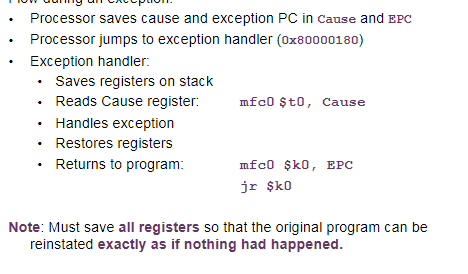
-Special registers are used in exceptions, part of Coprocessor 0. - 13What is the flow during an exception?
- 14What are GPUs and what do they do?-Special massively parallel computing units
-Hold two buffers for the screen/image pixels: a live and a working buffer
-Do updates on the working buffer then swap the display to that (making it hte live buffer), and start working on the now unused buffer
-Can be very fast for true SIMD operations eg updating brightness
-Not very flexible and not able to cope with branching. - 15What are SIMDs?-Single Instruction Multiple Data
-Single instruction acts on multiple pieces of data at once
-Perofrm short arithmetic operations (aka packed arithmetic) - 16How does parallelism in CPUs work?-CPUs can use task parallelism
-Multiple tasks map to multiple threads
-Tasks run different instructions
-Each thread managed and scheduled explicitly
-Each thread individually programmed - 17How does parallelism in GPUs work?-Data parallelism
-SIMD model
-Many lightweight threads on 100s of cores
-Threads are managed and scheduled by hardware
-Programming done for batches of threads (eg one pixel shader per group of pixels) - 18What are the sizes of ALUs in a GPU compared to a CPU?-GPUs are single purpose and high latency, soo don't need a lot of cache and thus can dedicate more space to many small ALUs.
- 19How does threading work in a traditional CPU?-One thread ones at once
-When one thread stalls, state of that thread is stored and the st ate of a waiting thread is loaded into a processor and it runs
-Known as context switching
-Appears to user like all threads are running simultaneously - 20How does multithreading work?-Have multiple copies of architectural state
-Multiple threads active at once
-When one thread stalls, another runs immediately
-Can save significant time in saving and restoring architectural states
-Increases throughput
Informationen
- Beschreibung
- Karteikarten am Micro-Architecture, erstellt von SEZ McKelvey am 11/04/2018.
- Erstellt von
- SEZ McKelvey · Apr 2018
- Aktualisiert
- 11 Apr 2018
- Aufrufe
- 1
- Bewertung