
Karteikarten
Physics Topic 4 Atomic Structure

Karten in diesem Stapel (75)
- 1Some atomic nuclei are unstable. The nucleus gives out radiation as it changes to become more stable. This is a random process called ____________________?Radioactive Decay
- 2Radioactivity: "Activity" is defined as...The rate at which a source of unstable nuclei decays.
- 3Radioactivity: Activity is measured in __________Becquerel (Bq)
- 4Radioactivity: "Count-rate" is defined as...The number of decays recorded each second by a detector
(eg Geiger-Muller tube) - 5An alpha particle (α) consists of...2 neutrons & 2 protons
(same as a helium nucleus) - 6A beta particle (β) is...A high speed electron ejected from the nucleus as a neutron turns into a proton
- 7A gamma ray (γ) is...Electromagnetic radiation from the nucleus
- 8Name 4 things that may be emitted during radioactive decay• an alpha particle (α)
• a beta particle (β)
• a gamma ray (γ)
• a neutron (n) - 9How has model of atom changed?1. Plum pudding model
2 Nuclear model
3. Niels Bohr (electrons orbit at specific distances)
4. Positive charge of nucleus divided into protons
5. James Chadwick - existence of neutrons - 10Describe the "plum pudding model"Atom being a ball of positive charge
with negative electrons embedded in it - 11What experiment led to "The Nuclear Model"? Describe the nuclear model1) Alpha particle scattering
2) a) The mass of an atom is in the nucleus
b) the nucleus is charged - 12How did Niels Bohr adapt the nuclear model?Electrons orbit nucleus at specific distances.
Later idea...positive charge of nucleus subdivided into smaller particles, each with same amount of positive charge.
Named "protons". - 13James Chadwick provided evidence for...?Showed the existence of neutrons within nucleus
(...20 years after the nucleus became an accepted scientific idea) - 14Define Nuclear FISSIONThe splitting of a large & unstable nucleus (eg uranium or plutonium).
- 15Define Nuclear FUSIONThe joining of two light nuclei to form a heavier nucleus.
(In this process some of the mass may be converted into the energy of
radiation.) - 16What has to happen for fission to occur?the unstable
nucleus must first absorb a neutron - 17True or false? Fission is usually spontaneousTrue
- 18What do all the products of fission have?Kinetic energy
- 19What might the neutrons from fission cause...?They may start a chain reaction.
- 20How often does spontaneous fission occur?It is rare
- 21What happens to the nucleus undergoing fission?It splits into 2 smaller nuclei,
(roughly equal in size) & emits 2 or 3 neutrons plus gamma rays. - 22Which releases more energy, nuclear fission or fusionNuclear fusion
- 23Describe the difference in CHAIN REACTIONS between a nuclear reactor and a nuclear weapon.IN A NUCLEAR REACTOR:
= controlled energy release
IN A NUCLEAR WEAPON
= uncontrolled - 24What happens to an electron in an atom if it releases EM radiationElectrons move closer to the nucleus
(to a lower energy level) - 25What happens to an electron in an atom if it absorbs EM radiationElectrons move further from the nucleus
(to a higher energy level) - 26Do atoms have an overall charge?No
(but "ions" do!) - 27Which number defines what element an atom is?Atomic / proton number
- 28What is the atomic number of an atom?Number of protons
- 29What is the mass number of an atom?The total number of neutrons and protons added together
- 30What is an isotope? Are they usually stable?Atoms of the same element with have different numbers of neutrons;
- 31What is an isotope? Are they usually stable?Atoms of the same element with different numbers of neutrons
Most are unstable. - 32What is the atomic number of an atom?The number of protons
- 33What is the mass number of an atom?The total number of neutrons + protons added together
- 34Do atoms have a charge?no overall charge
- 35How do atoms turn into positive ions?Atoms turn into positive ions if they lose one or more outer electron(s).
- 36What happens to the electrons if an atom absorbs EM radiation?They move further from the nucleus
(to a higher energy level) - 37What happens to the electrons if an atom emits EM radiation?Electrons move closer to the nucleus
(To a lower energy level) - 38Describe radioactive decayA random process.
Happens to atomic nuclei that re unstable.
Nucleus emits radiation as
it changes to become more stable. - 39Order the 3 types of ionising radiation in terms of... ionising poweralpha (α)
beta (β)
gamma (γ) - 40Order the 3 types of ionising radiation in terms of... range in airgamma (γ)
beta (β)
alpha (α) - 41Explain why alpha radiation can't be used to check the thickness of metal sheets?Because it won't go through paper or metal
(Use beta to test for aluminum or gamma for lead) - 42Draw the symbol for alpha particles
- 43Draw the symbol for beta particles

- 44What type of nuclear decay does not change the mass or charge of the nucleus?Gamma rays
- 45Which type of decay causes BOTH the mass & charge of the nucleus to DECREASE?alpha decay
- 46Which type of decay... INCREASES CHARGE of nucleus but does NOT change MASS ?beta decay
- 47Which type of decay does NOT CHANGE the mass or charge of the nucleus ?Gamma rays
- 48What is the activity of a source?the rate at which a source of unstable nuclei decays
- 49Define half-lifeTime it takes for the number
of nuclei of the isotope to halve,
or
time it takes for the
count rate to half - 50True of false? A short half-life means a small proportion of atoms are decaying per secondFalse
- 51What is radioactive contamination ?the unwanted presence of materials
containing radioactive atoms on other materials. - 52What is the hazard from contamination is due to...?It is due to the decay of the contaminating atoms.
- 53What is "irradiation"?The process of exposing an object to nuclear radiation.
- 54Does an irradiated object become radioactive?No
- 55Where does background radiation come from?• natural sources such as rocks & cosmic rays from space
• man-made sources such as the fallout from nuclear weapons testing
and nuclear accidents. - 56The level of background radiation and radiation dose may be affected by...?occupation and/or location
- 57What is radiation dose measured in?sieverts (Sv)
- 58Explain the dangers of a radioactive source with a long half-lifeKeep emitting radiation for a long time.
Nearby areas are exposed to radiation for millions of years. - 59Define radiation doseMeasure of the risk of harm from the body being exposed to radiation
- 60Which radiation sources are MOST dangerous OUTSIDE the body? Why?Beta & gamma
because they can penetrate the body and get to the delicate organs - 61Which radiation sources are LEAST dangerous OUTSIDE the body? Why?Alpha because it can't penetrate the skin and is easily blocked by a small air gap
- 62Which IRRADIATION sources are MOST dangerous OUTSIDE the body? Why?ALL!!
...but especially from ones that emit beta and gamma - 63Which radiation sources are MOST dangerous INSIDE the body? Why?Alpha
..because they do all their damage in a very localised area - 64Which radiation sources are LEAST dangerous INSIDE the body?Beta and gamma
- 65When comparign BETA and GAMMA, which is the least dangerous source inside the body? Why?Beta is less damaging than alpha as radiation is absorbed over a wider area and some passes out of the body altogether.
Gamma is least dangerous as mostly pass straight out. they have the lowest ionising power - 66Describe how to measure half life using a graph1) plot graph of activity against time
2) Find the time interval corresponding to a halving of the activity on the vertical axis - 672 ways that radiation is used in medicine1) Medical tracers
2) Radiotheraphy (treating cancer with radiation) - 68Describe how gamma sources are used in medical tracers1) Inject/swallow
2) an external detector follows it around the body
3) computer converts reading to a display - 69Why is it ok to use gamma as a tracer inside the body?Radiation passes out of the body without causing much damage.
- 70Give an example of a medical tracerIodine-123 which is absorbed by the thyroid gland like normal iodine -127 but gives out radiation which can be detected to indicate whether the thyroid gland is taking in iodine as it should
- 71Describe how to treat cancer with radiation1) direct gamma rays at the cancer cells
2) use the right dosage to kills the cancer cells but not too many healthy cells - 72Where are wavelength and amplitude measured?
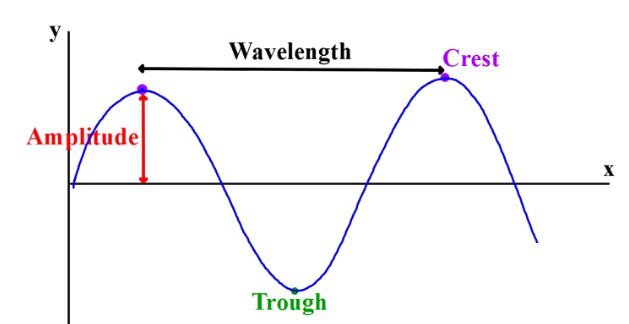
- 73What is "frequency" of a wave?the number of waves passing a point
each second - 74The amplitude of a wave is......the maximum displacement of a point on
a wave away from its undisturbed position. - 75The wavelength of a wave is...the distance from a point on one wave
to the equivalent point on the adjacent wave.
Informationen
- Beschreibung
- Year 11 Physics Karteikarten am Physics Topic 4 Atomic Structure, erstellt von Matthew Bradley am 16/05/2018.
- Erstellt von
- Matthew Bradley
- Aufrufe
- 0
- Verlauf
-
- Erstellt von Matthew Bradley · 12 Mär 2018
- Kopiert von Matthew Bradley · 16 Mai 2018
- Bewertung