
Karteikarten
Chapter 9-10
Karten in diesem Stapel (200)
- 11. Process Model (Disadvantage)- Slow (fork is expensive, context switching overhead)
- Difficult to perform optimizations that rely on global information (e.g. cache URLs) - 21. Process Model (Bild)
- 32. Thread Model (Use threads instead of processes) (Motivation)- Thread creation and destruction cheaper
- Sharing data between threads easier than between processes, but synchronization required for shared data - 42. Thread Model (Use threads instead of processes) (Problem)- OS support required (otherwise one blocked thread blocks whole address space)
=> Examples: JAWS, IIS, Apache (Windows) - 52. Thread Model (Advantages)- Faster than processes
- Sharing enabled by default - 62. Thread Model (Disadvantages)- Requires OS support
- Can exhaust per-process limits (e.g. max. number of open file descriptors)
- Limited control over scheduling decisions - 73. In-kernel Model
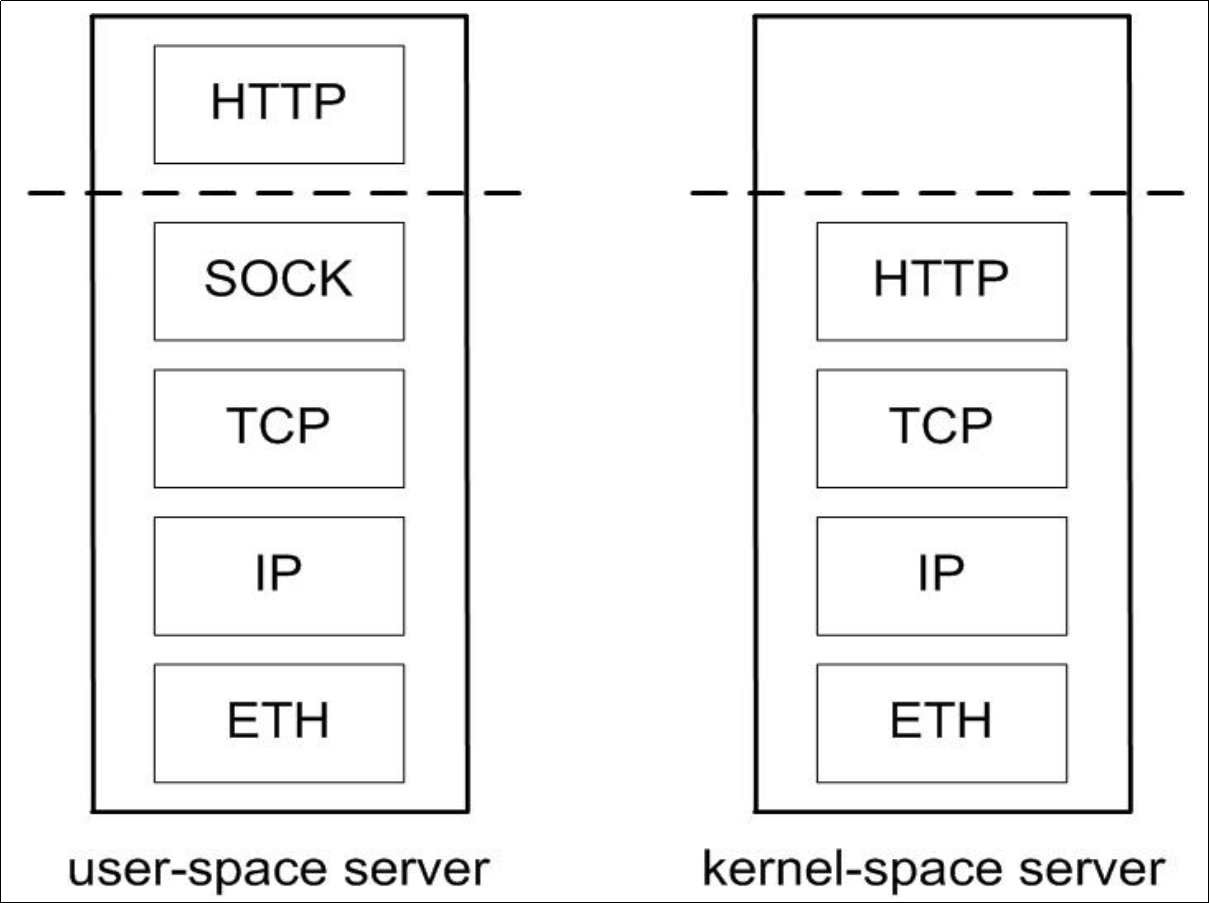
- 83. In-kernel Model (One option)- whole server in the kernel
- 93. In-kernel Model (Most often)- Only static files served from kernel, other requests go to regular user-space server (khttpd, AFPA)
- Dedicated kernel thread of HTTP requests - 103. In-kernel Model (Advantages)- Avoids copies to/from user space
- Very fast, if tightly integrated with kernel (khttpd is not) - 113. In-kernel Model (Disadvantages)- Bugs can crash whole machine
- Harder to debug and extend
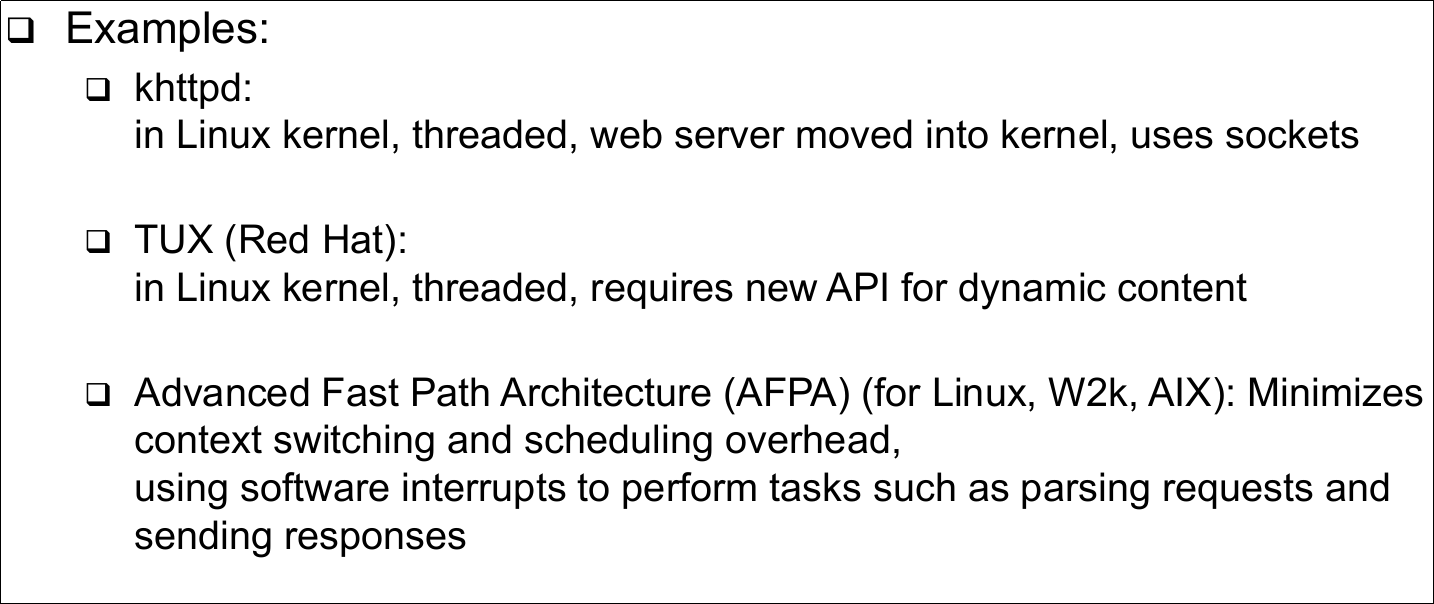
- Inherently OS-specific - 123. In-kernel Model (Examples)
- 134. Event-driven Model (1)
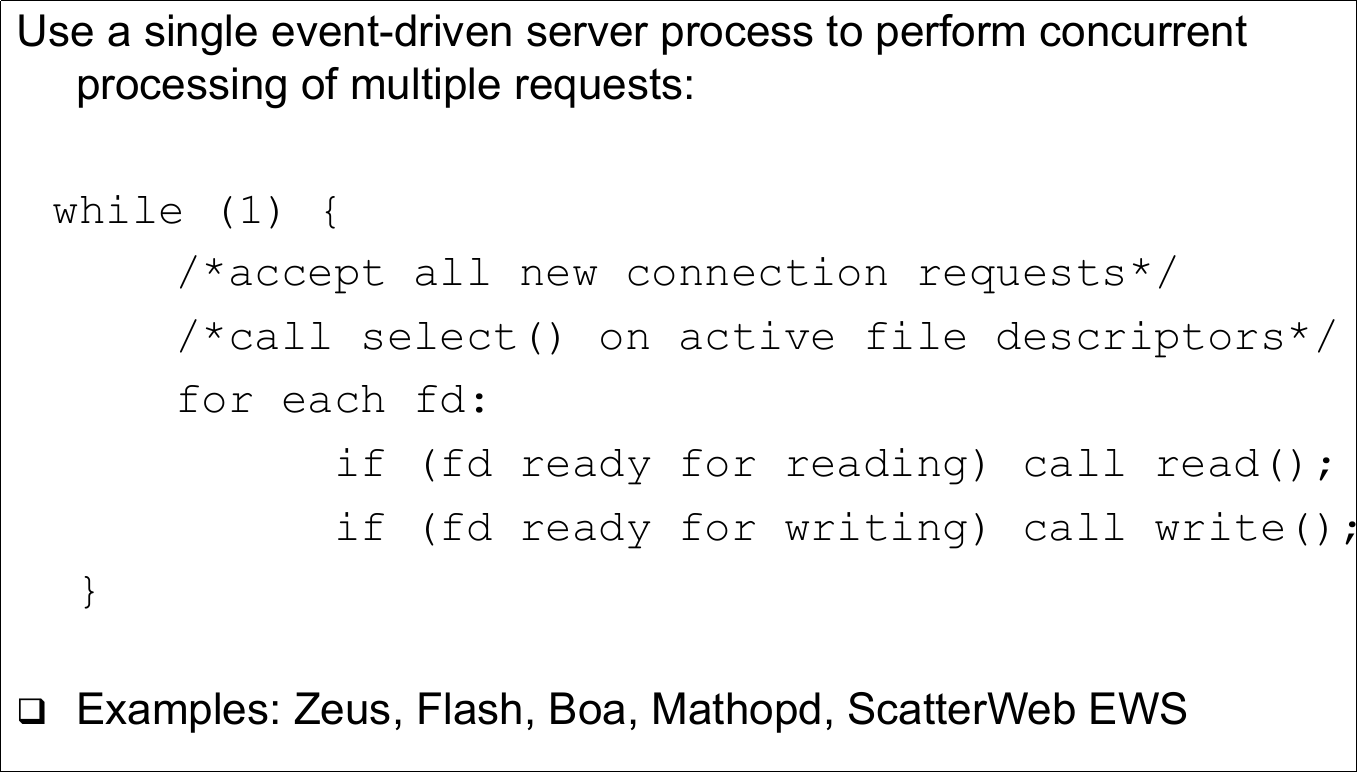
- 144. Event-driven Model (2)
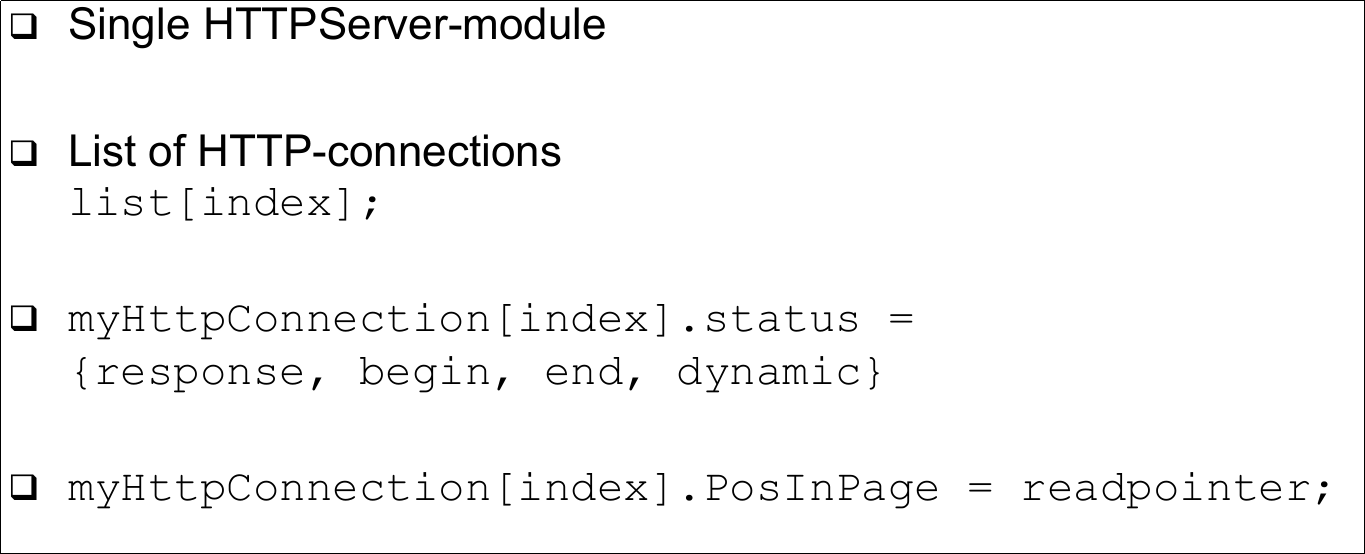
- 154. Event-driven Model (Advantages)- Very fast, no context switches
- Sharing inherent (only one process), no locks needed
- Complete control over scheduling decisions
- No complex OS support needed - 164. Event-driven Model (Disadvantages)- Per-process resource limits
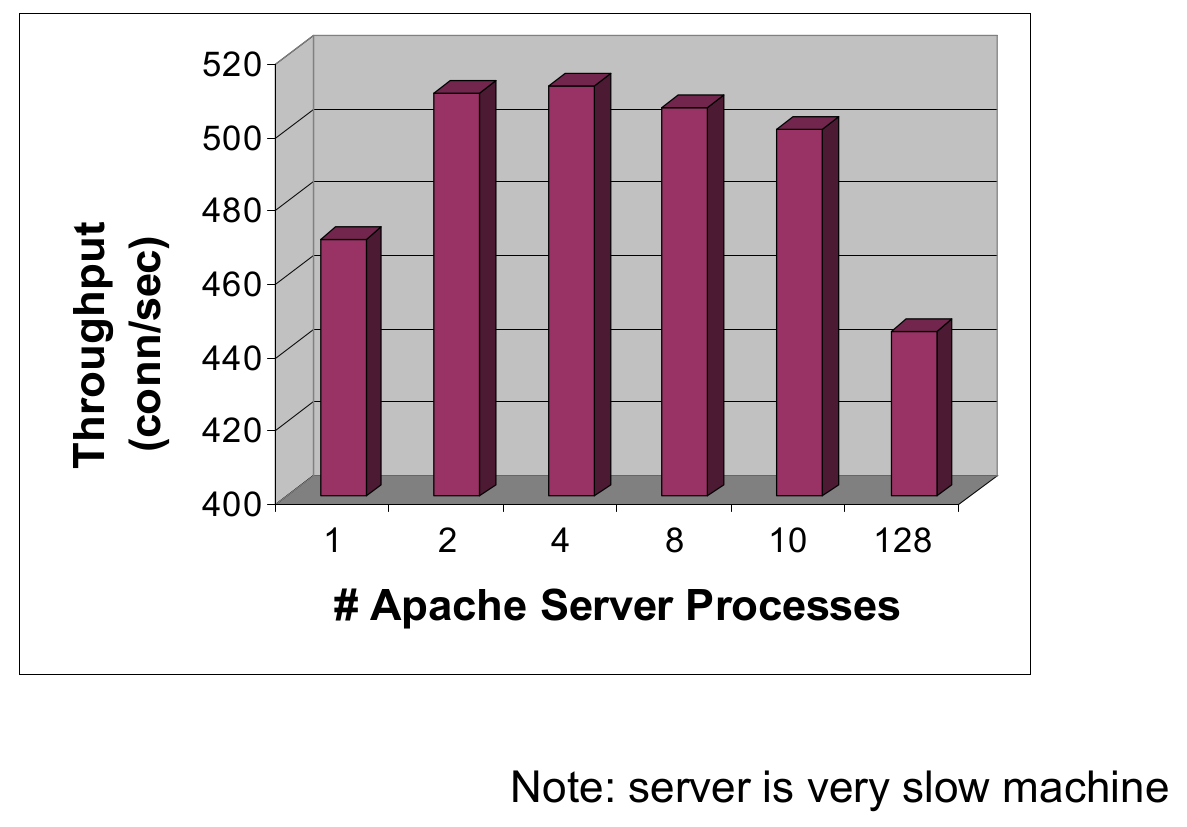
- Not every OS has full asynchronous I/O, so can still block on read. Flash uses helper processes to avoid this. - 17Performance Comparison
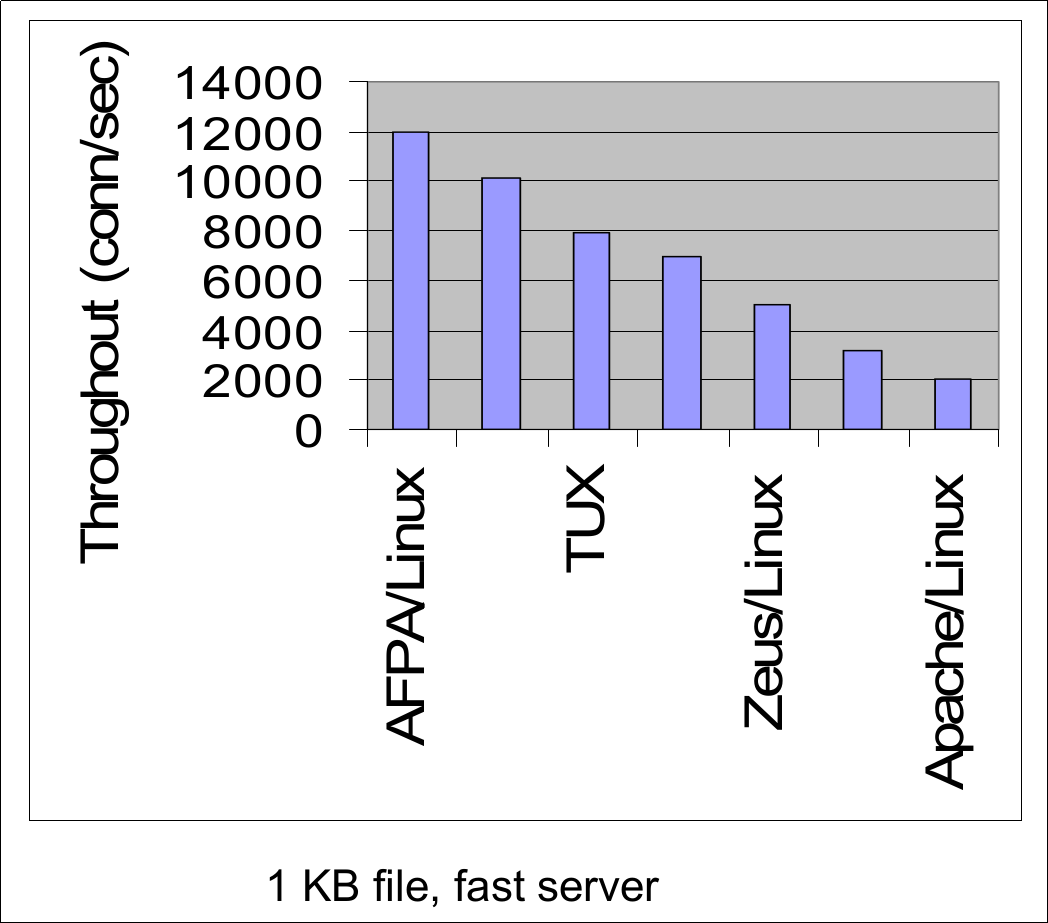
- 18Web Server Cluster (Two ways of increasing capacity)- Single larger machine
- Cluster of cheap standard machines, e.g. PCs - 19Web Server Clusters (Latter approach currently dominating)- Scalability
- High availability
- Cost - 20Web Server Clusters (Typical architecture)
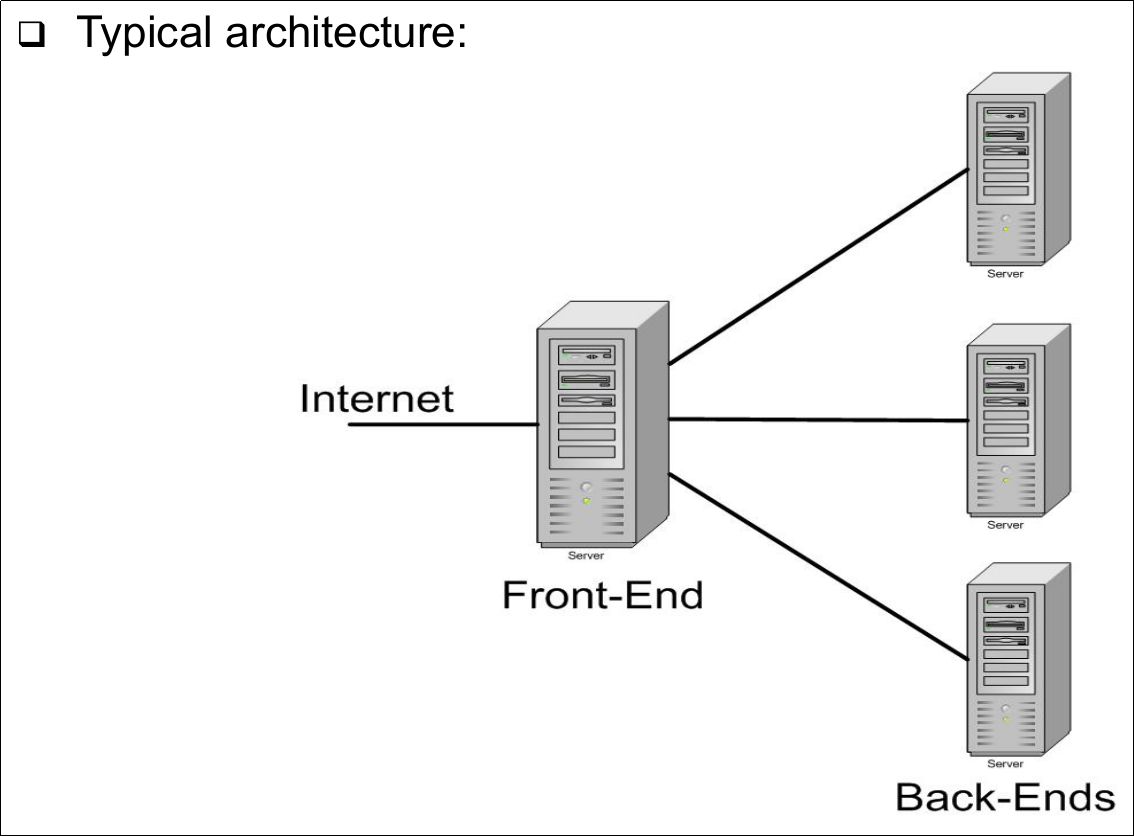
- 21Web Server Clusters
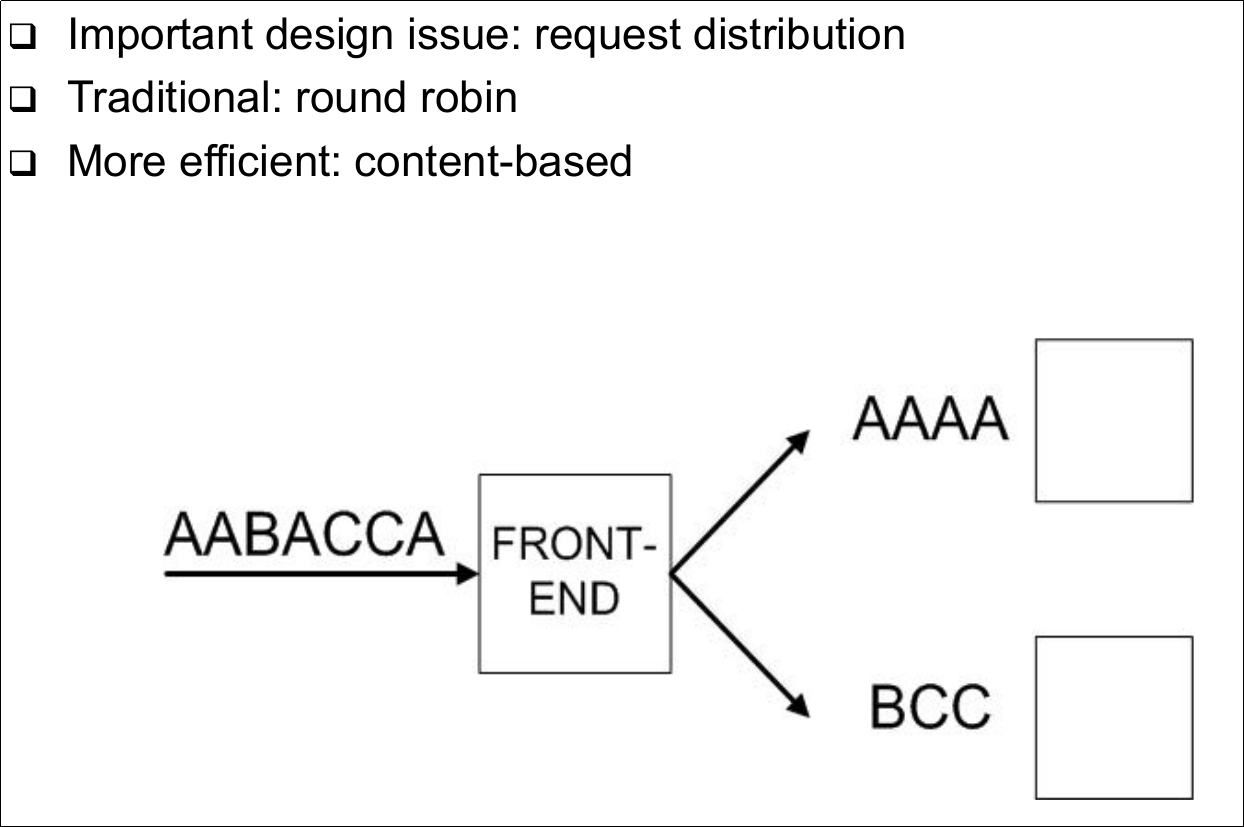
- 22FTP: The File Transfer Protocol
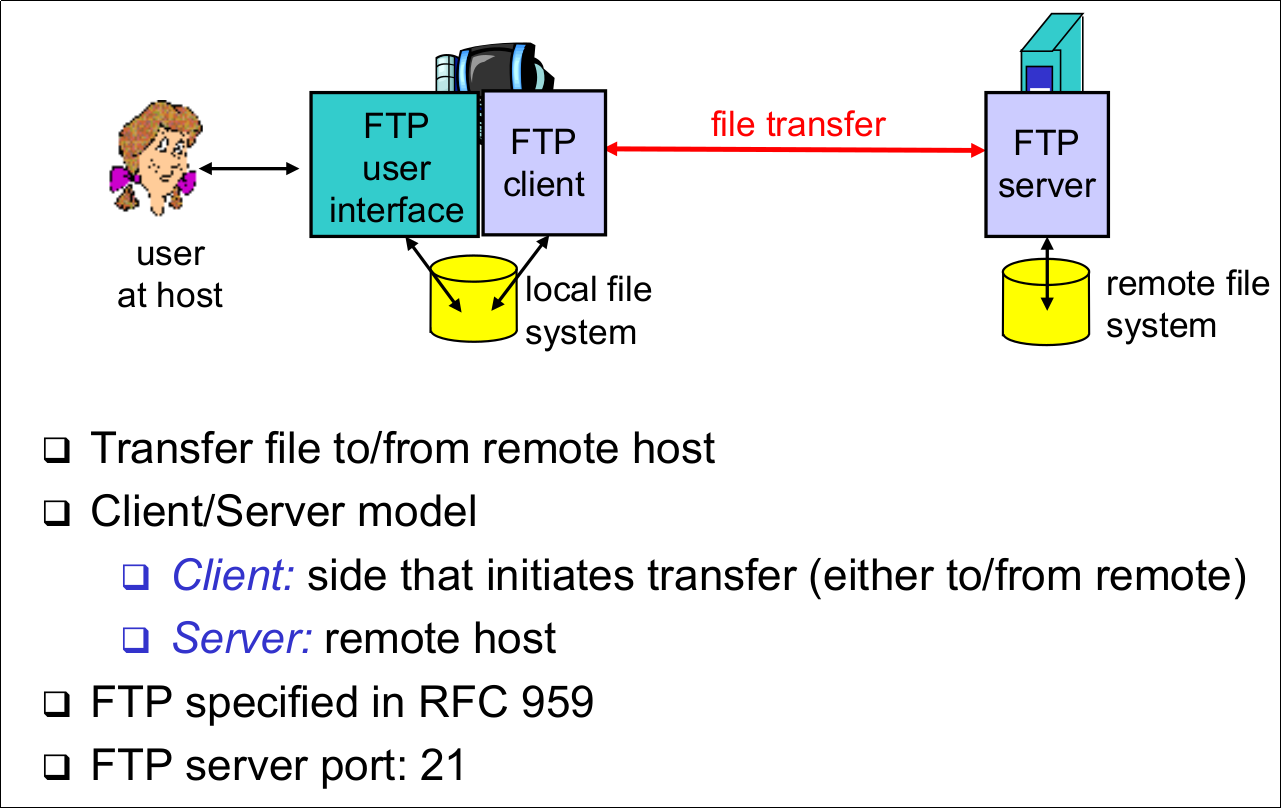
- 23FTP: Separate Control & Data Connections
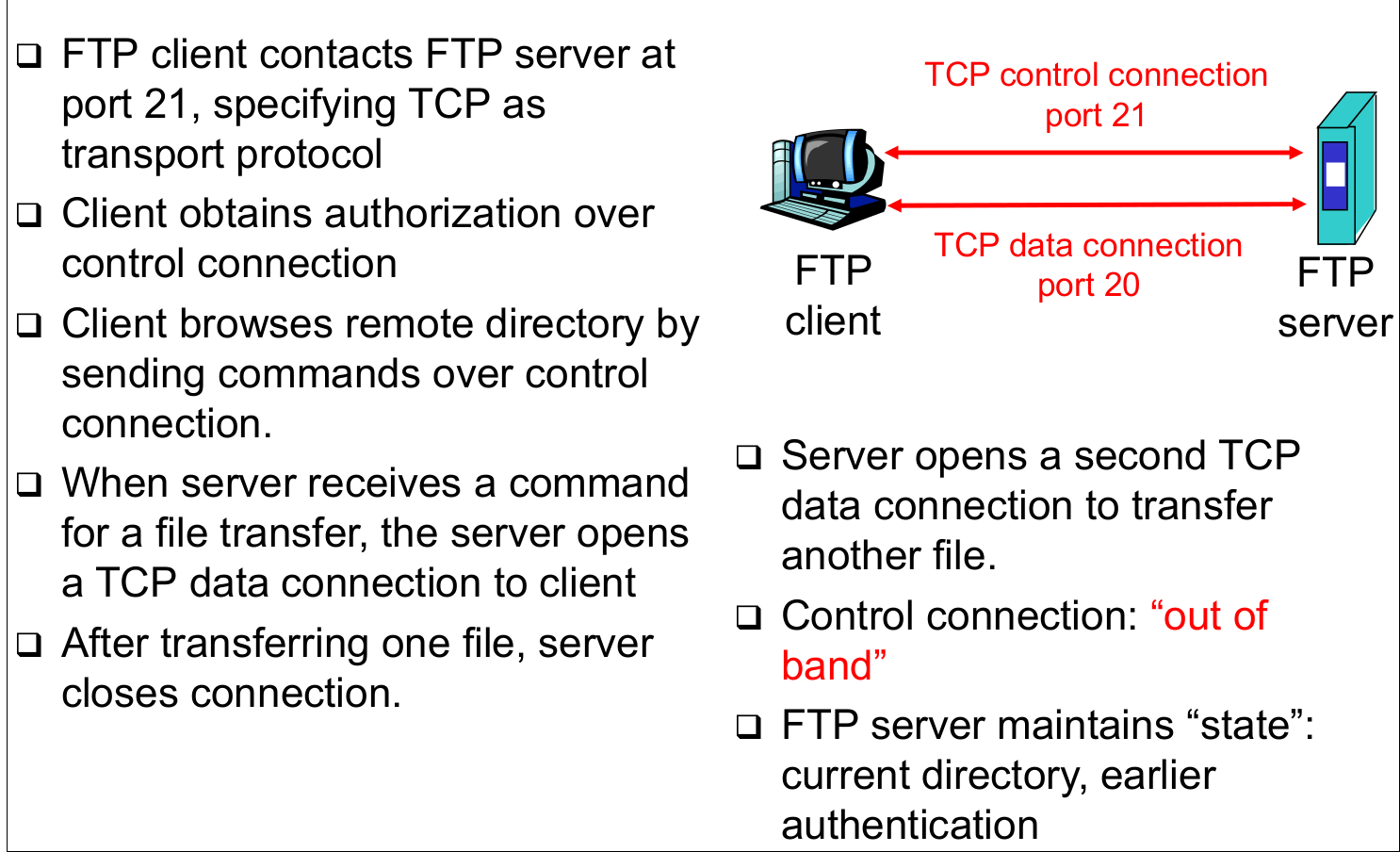
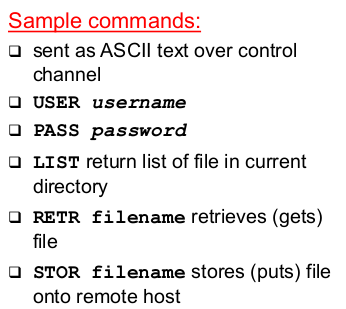
- 24FTP Commands, Responses (Sample commands)
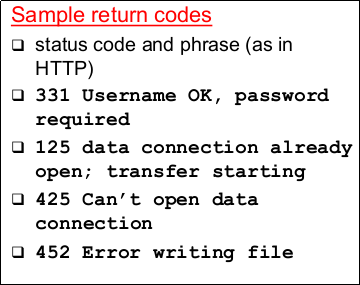
- 25FTP Commands, Responses (Sample return codes)
- 26Electronic Mail (Three major components)- User agents
- Mail servers
- Simple mail transfer protocol: SMTP - 27Electronic Mail (User Agent)- A.k.a. "mail reader"
- Composing, editing, reading mail messages
- E.g., Outlook, Mozilla Thunderbird, mail client on mobile phone etc.
- Outgoing, incoming messages stores on server - 28Electronic Mail (Bild)
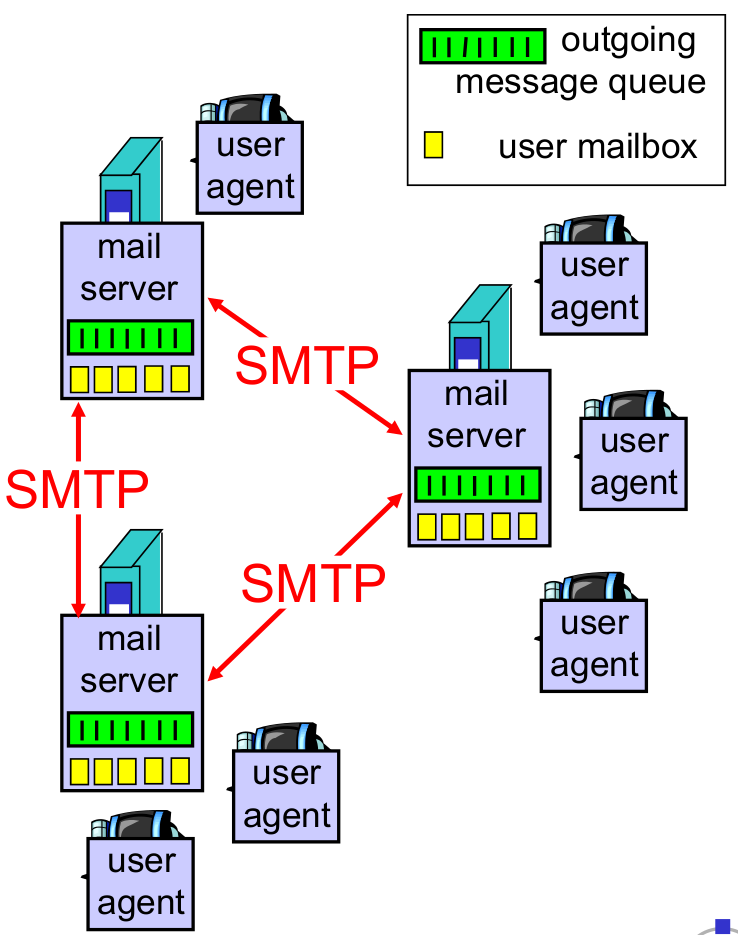
- 29Electronic Mail: Mail Servers (Mailservers) (Mailbox)- Mailbox contains incoming messages for user
- 30Electronic Mail: Mail Servers (Mailservers) (Message queue)- Message queue of outgoing (to be sent) mail messages
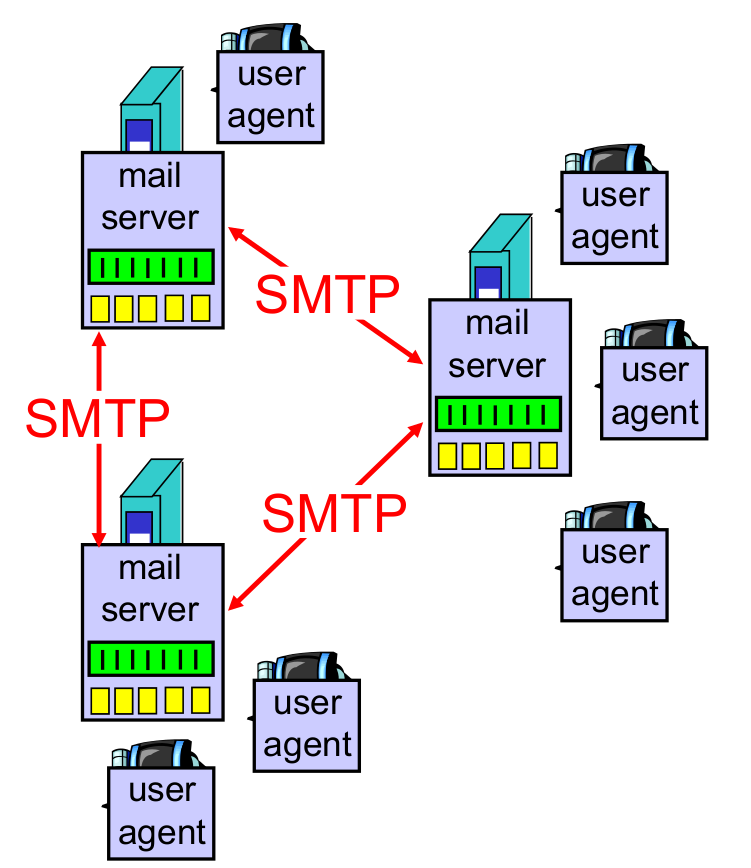
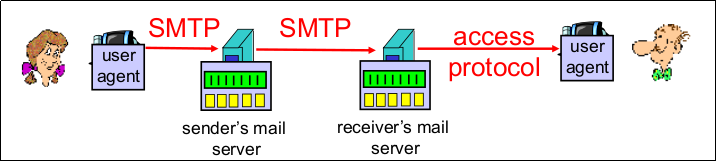
- 31Electronic Mail: Mail Servers (Mailservers) (SMTP protocol)- SMTP protocol between mail servers to send email messages
-> Client: sending mail server
-> "server": receiving mail server - 32Electronic Mail: Mail Servers (Bild)
- 33Electronic Mail: SMTP [RFC 2821]
- 34Scenario: Alice Sends Message to Bob
- 35Sample SMTP interaction
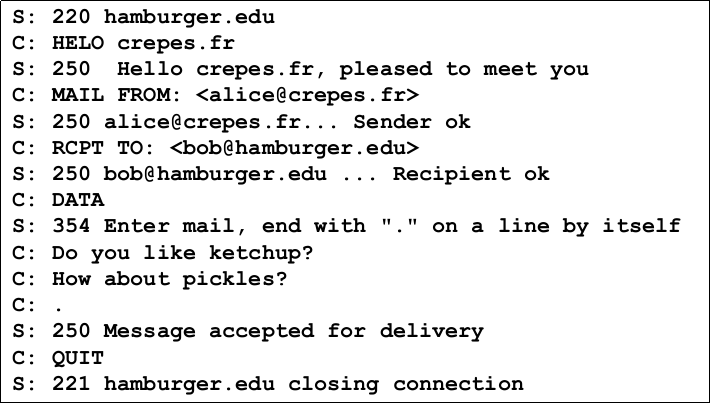
- 36Try SMTP Interaction for Yourself
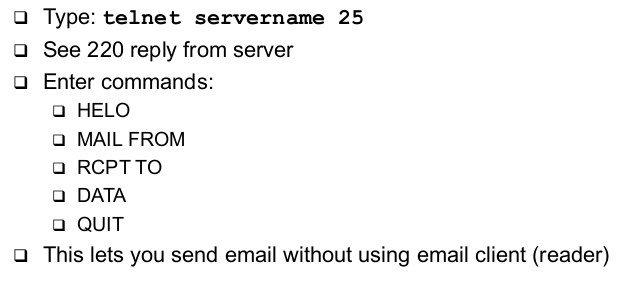
- 37SMTP: Final Words
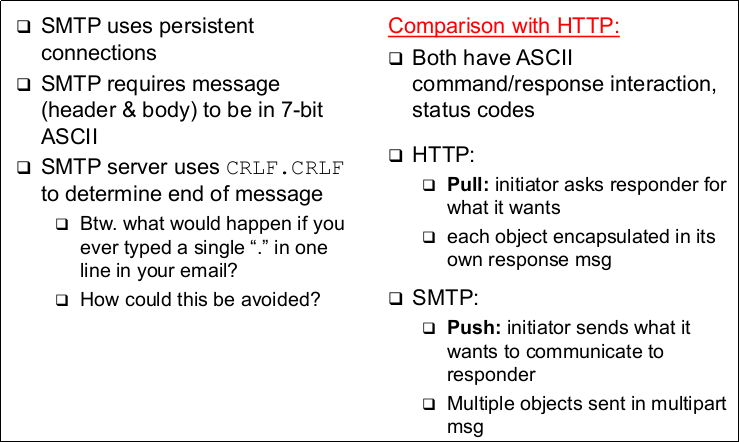
- 38Mail Message Format
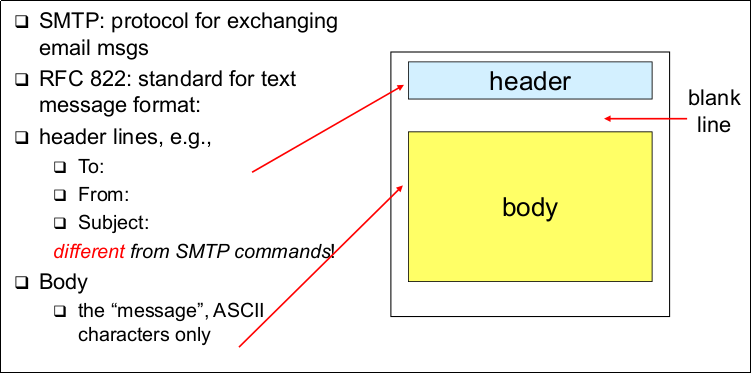
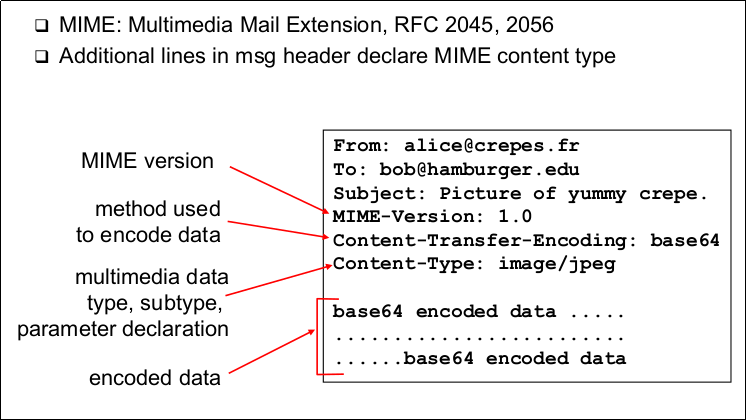
- 39Message Format: Multimedia Extensions
- 40Mail Access Protocols (SMTP)- Delivery/storage to receiver's server
- 41Mail Access Protocols (Mail access protocol)- Retrieval from server
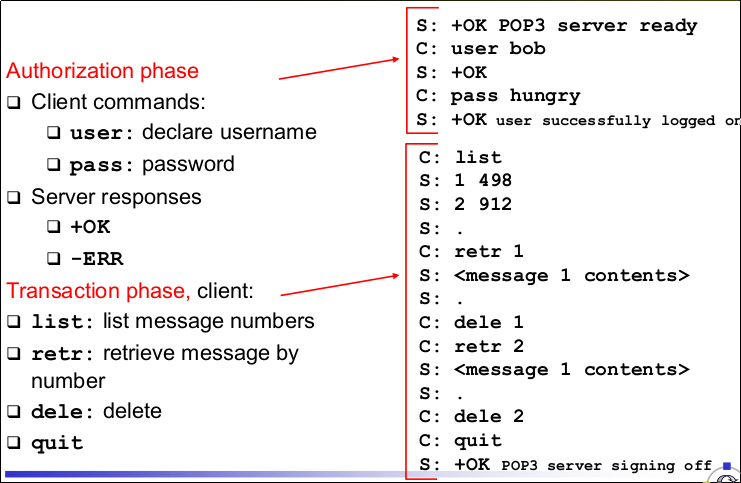
-> POP: Post Office Protocol [RFC 1939]
--> Authorization (agent <--> server) and download
-> IMAP: Internet Mail Access Protocol [RFC 1730]
--> More features (more complex)
--> Manipulation of stored msgs on server
-> HTTP: Hotmail, Yahoo! Mail, etc. - 42Mail Access Protocol (Bild)
- 43POP3 Protocol
- 44POP3 and IMAP (More about POP3)- Previous example uses "download and deletes" mode
- Bob cannot re-read e-mail if he changes client
- "Download-and-keep": enables copies of messages on different clients (requires to organize on each client)
- POP3 is stateless across sessions - 45POP3 and IMAP (IMAP- Keep all messages in one place: the server
- Allows user to organize messages in folders
- IMAP keeps user state across sessions:
-> names of folders and mapping between message IDs and folder name - 46DNS: Domain Name System (People)- many identifiers:
-> SSN, name, passport # - 47DNS: Domain Name System (Internet hosts, routers)- IP address (32 bit) - used for addressing datagrams
- "Name", e.g., www.yahoo.com - used by humans - 48DNS: Domain Name System (Domain Name System) (Distributed database)- implemented in hierarchy of many name servers
- 49DNS: Domain Name System (Domain Name System) (Application-layer protocol)- Application-layer protocol for hosts, routers, name server to communicate to resolve names (address/name translation)
-> Note: core Internet function, implemented as application-layer protocol
-> Complexity at network's "edge" - 50DNS (DNS services)- Hostname to IP address translation
- Host aliasing
-> Canonical and alias names
- Mail server aliasing
- Load distribution
-> Replicated Web servers: set of IP addresses for one canonical name - 51DNS (Why not centralize DNS?)- Single point failure
- Traffic volume
- Distant centralized database
- One central authority for worldwide name resolution undesirable ("who owns the Internet?")
- Maintenance
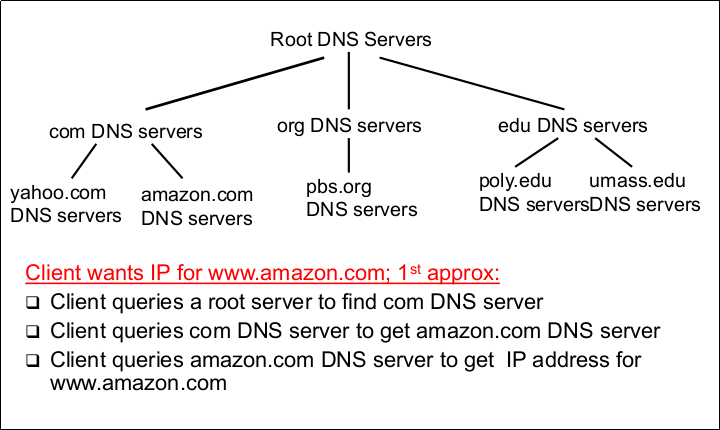
=> does not scale! - 52Distributed, Hierarchical Database
- 53DNS: Root Name Servers- Contacted by local name server that cannot resolve name
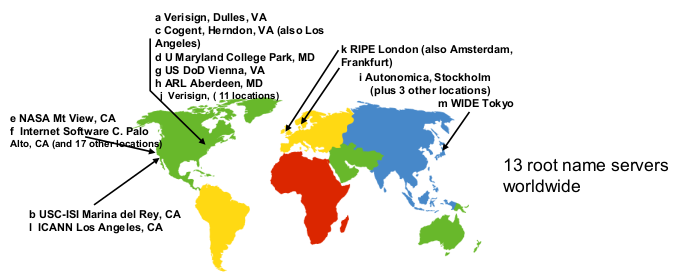
- 54DNS: Root Name Servers (Root name server)- Contacts authoritative name server if name mapping not known
- Gets mapping
- Returns mapping to local name server - 55TLD, Authoritative and Local DNS Servers (Top-level domain (TLD) servers)- responsible for com, org, net, edu, etc, and all top-level country domains uk, fr, ca, jp
- Network solutions maintain servers for com TLD
- Educause for edu TLD - 56TLD, Authoritative and Local DNS Server (Authoritative DNS servers)- organization's DNS servers, providing authoritative hostname to IP mappings for organization's servers (e.g., Web and mail)
- Can be maintained by organization or server provider - 57TLD, Authoritative and Local DNS Server (Local DNS servers)- Does not strictly belong to hierarchy
- Each ISP (residential ISP, company, university) has one
-> Also called "default name server"
- When a host makes a DNS query, query is sent to its local DNS server
-> Acts as a proxy, forwards query into hierarchy - 58Iterative Queries: Example (Bild)
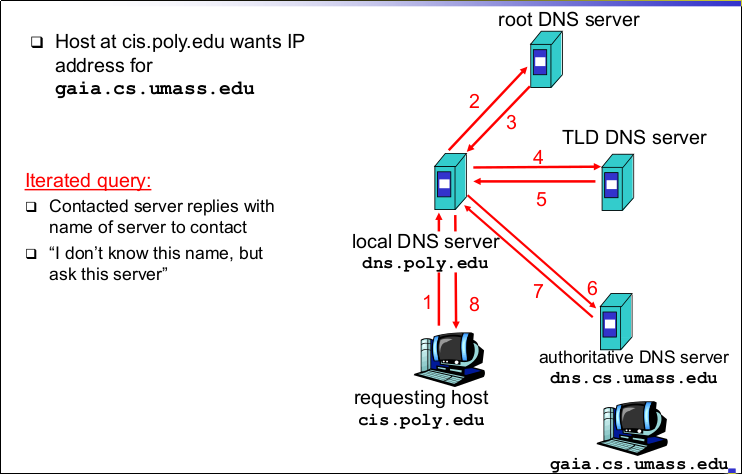
- 59Iterative Queries: Example (Iterated query)- Contacted server replies with name of server to contact
- "I don't know this name, but ask this server" - 60Recursive Queries: Example (Bild)
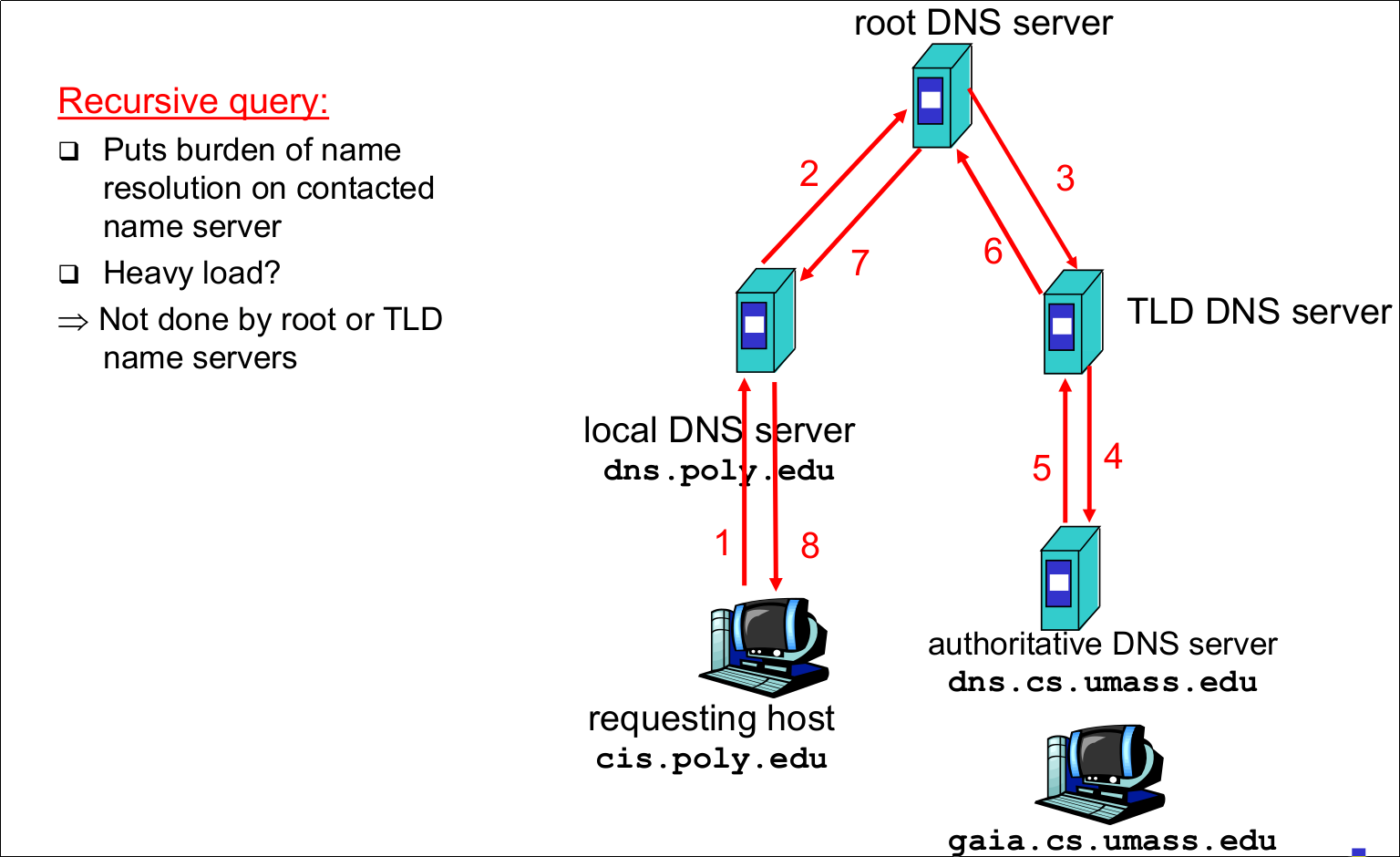
- 61Recursive Queries: Example (Recursive query)- Puts burden of name resolution on contacted name server
- Heavy load?
=> Not done by root or TLD name servers - 62DNS: Caching and Updating Records
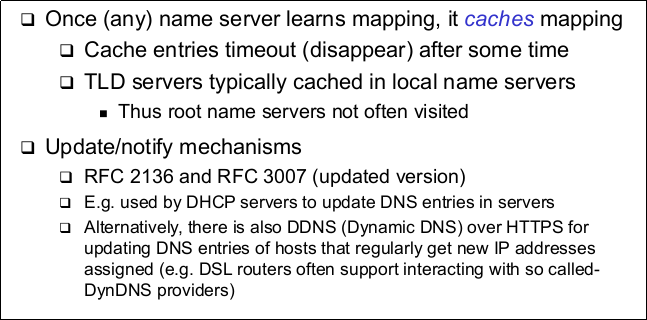
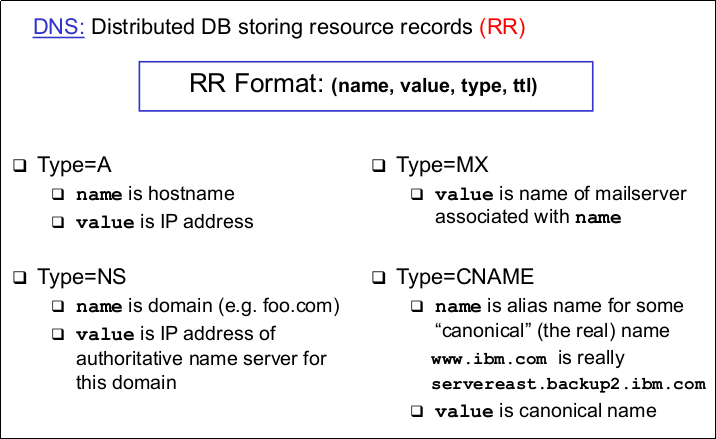
- 63DNS Records
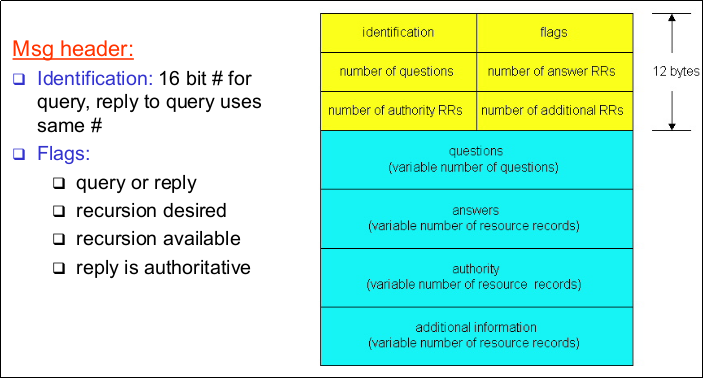
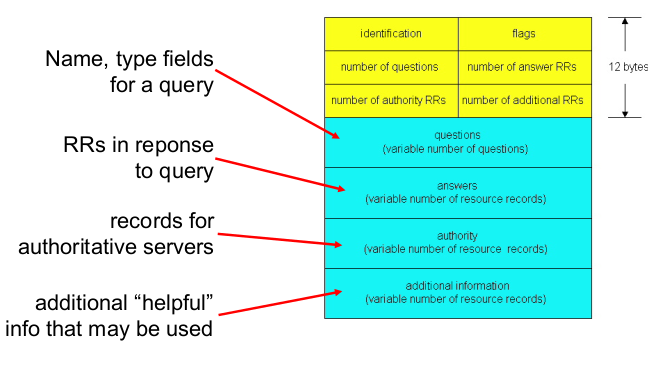
- 64DNS Protocol, Messages (DNS protocol)- query and reply messages, both with same message format
- 65DNS Protocol, Messages (Bild - 1)
- 66DNS Protocol, Messages (Bild - 2)
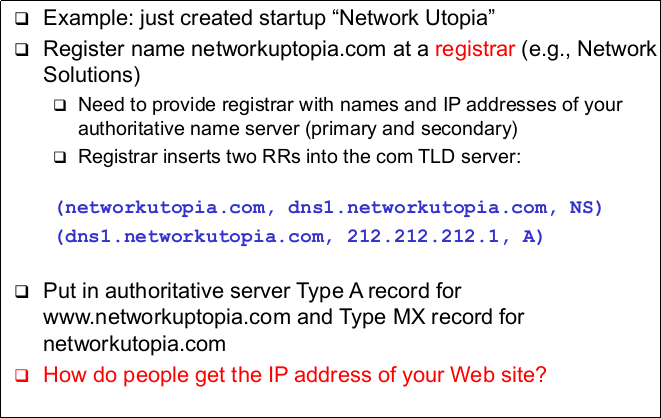
- 67Inserting Records Into DNS
- 68P2P File Sharing
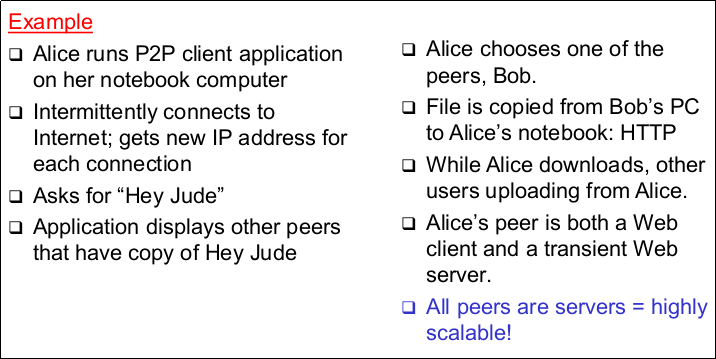
- 69P2P: Centralized Directory- Original "Napster" design
-> 1) When peer connects, it informs central server:
--> IP address
--> Content
-> 2) Alice queries for "Hey Jude"
-> 3) Alice requests file from Bob - 70P2P: Centralized Directory (Bild)
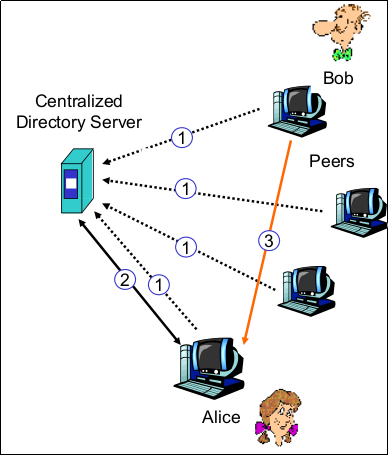
- 71P2P: Problems With Centralized Directory- Single point of failure
- Performance bottleneck
- Copyright infringement
=> File transfer is decentralized, but locating content is highly centralized - 72Query Flooding: Gnutella (General Properties)- Full distributed
-> No central server
- Public domain protocol
- Many Gnutella clients implementing protocol - 73Query Flooding: Gnutella (Overlay network: graph)- Edge between peer X and Y if there's a TCP connection
- All active peers and edges in overlay net
- Edge is not a physical link
- Given peer will typically be connected with < 10 overlay neighbours - 74Gnutella: Protocol
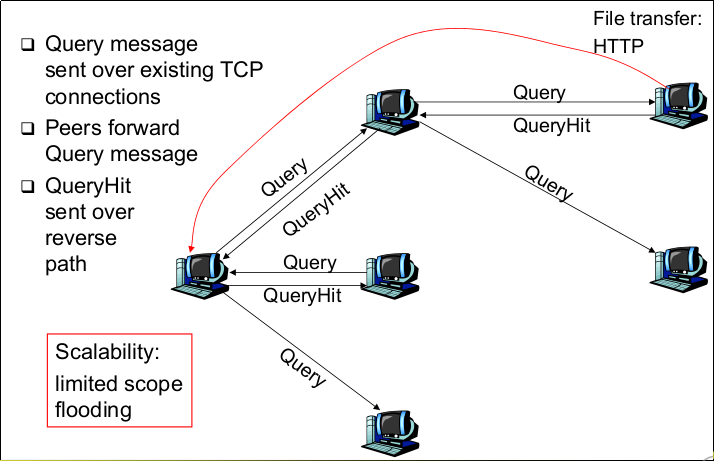
- 75Gnutella: Peer Joingf
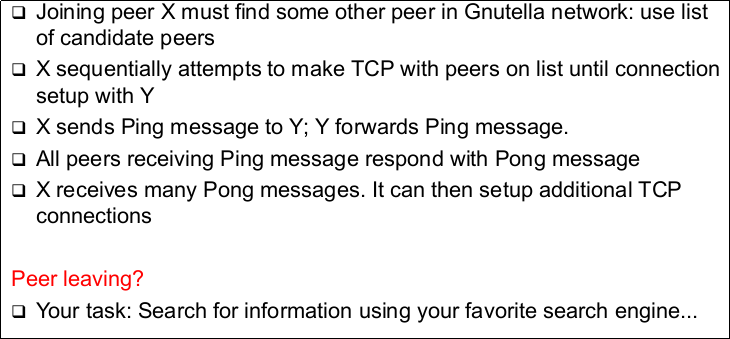
- 76Socket Programming (Goal)- Learn how to build client/server application that communicates using sockets
- 77Socket Programming (Socket API)- Introduced in BSD4.1 UNIX, 1981
- Sockets are explicitly created, used, released by applications
- Client/Server paradigm
- Two types of transport service via socket API:
-> Unreliable datagram
-> Reliable, byte stream-oriented - 78Socket Programming (Socket)- A host-local, application-created, OS-controlled interface (a "door") into which application process can both send and receive messages to/from another application process
- 79Socket-Programming Using TCP (Socket)- a door between application process and end-end-transport protocol (UCP or TCP)
- 80Socket-Programming Using TCP (TCP service)- reliable transfer of bytes from one process to another
- 81Socket-Programming Using TCP (Bild)
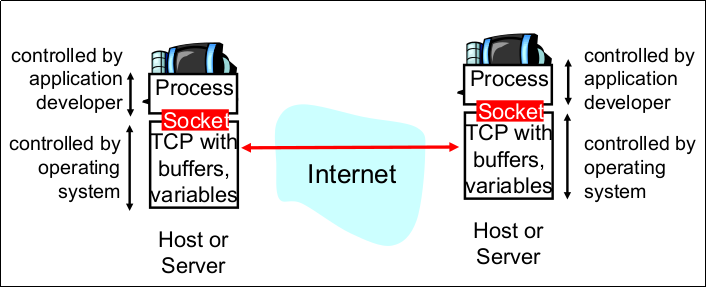
- 82Socket Programming With TCP (Client must contact server)- Server process must first be running
- Server must have created socket (door) that welcomes client's contact - 83Socket Programming With TCP (Client contacts server by)- Creating client-local TCP socket
- Specifying IP address, port number of server process
- When client creates socket:
-> Client TCP establishes connection to server TCP - 84Socket Programming With TCP- When contacted by client, server TCP creates new socket for server process to communicate with client
-> Allows server to talk with multiple clients
-> Source port numbers used to distinguish clients - 85Socket Programming With TCP (application viewpoint)- TCP provides reliable, in-order transfer of bytes ("pipe") between client and server
- 86Stream Jargon (Stream)- A stream is a sequence of characters that flow into or out of a process
- 87Stream Jargon (Input Stream)- An input stream is attached to some input source for the process, e.g., keyboard or socket
- 88Stream Jargon (Output Stream)- An output stream is attached to an output source, e.g., monitor or socket
- 89Socket Programming With TCP (Example Client-Server application)- 1) Client reads line from standard input (inFromUser stream), sends to server via socket (outToServer stream)
- 2) Server reads line from socket
- 3) Server converts line to uppercase, sends back to client
- 4) Client reads, prints modified line from socket (inFromServer stream) - 90Socket Programming With TCP (Bild)
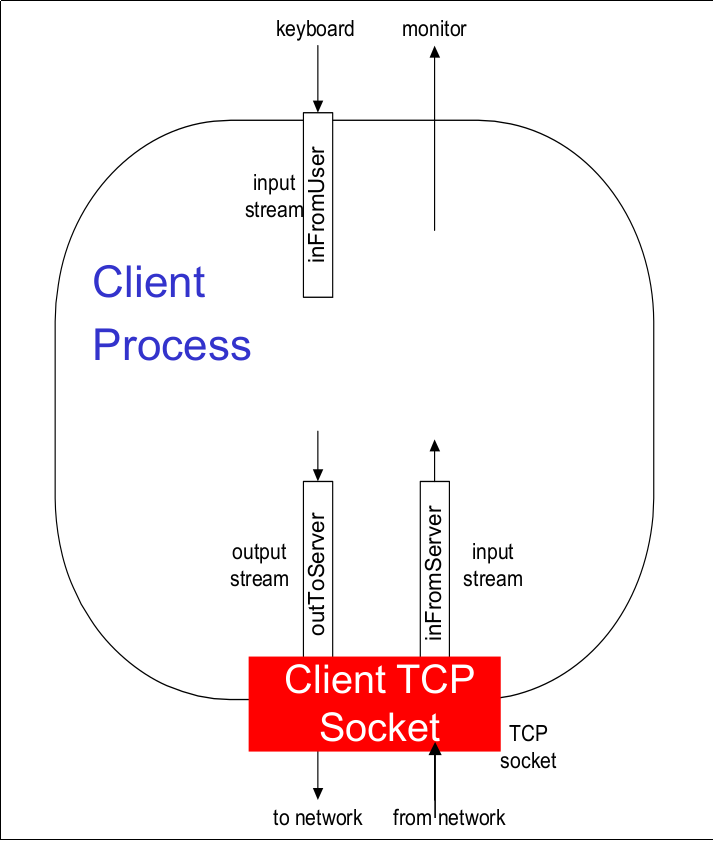
- 91Client/Server Socket Interaction: TCP
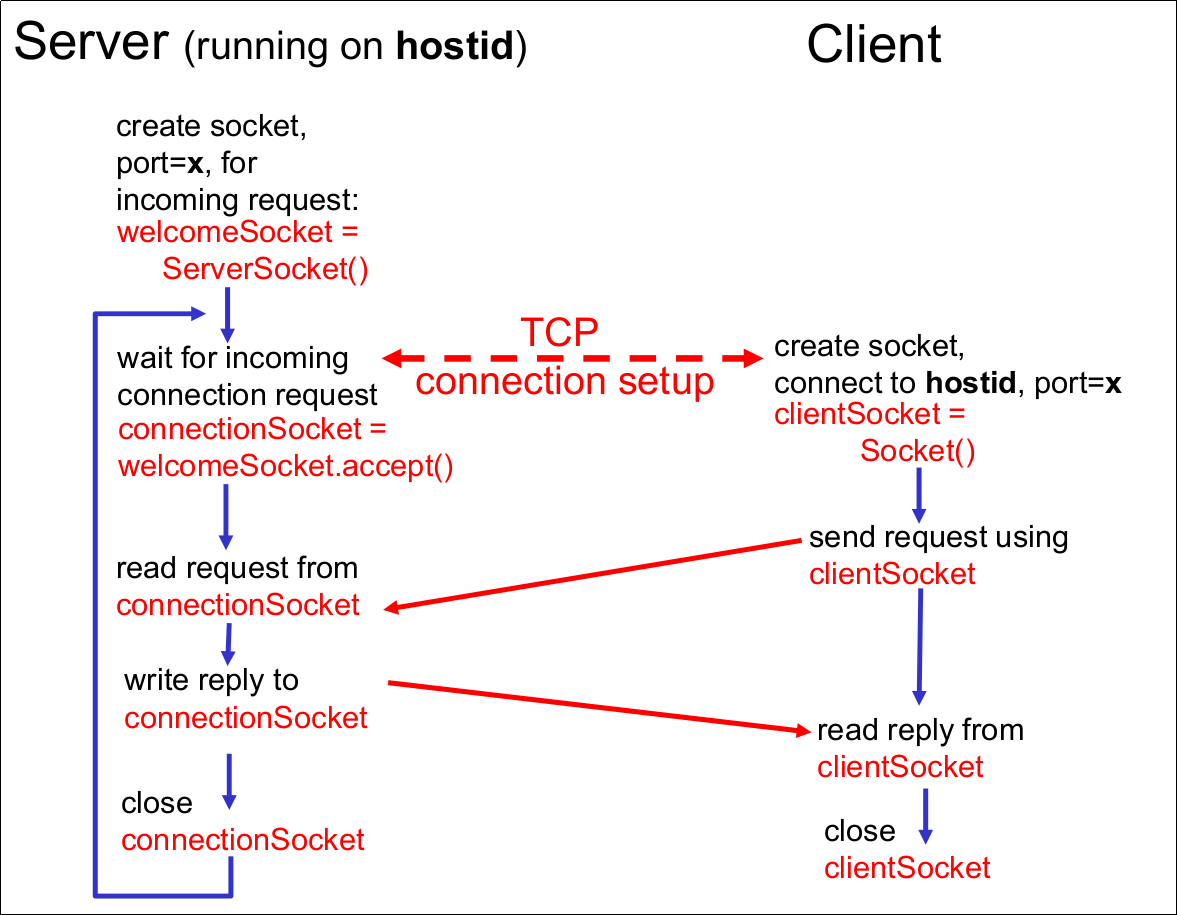
- 92Example: Java Client (TCP) (1)
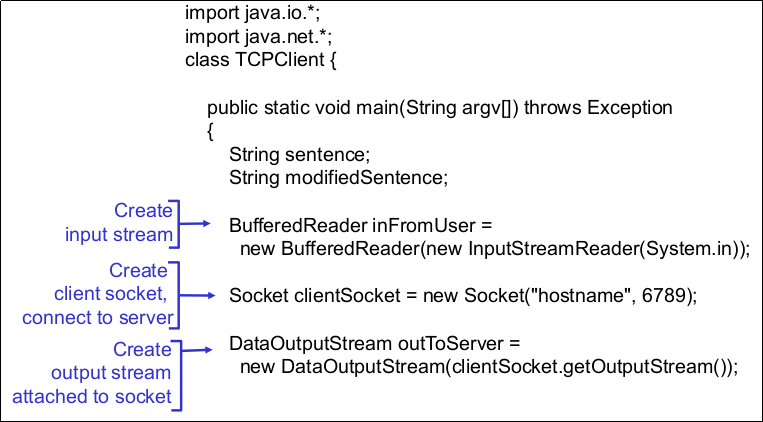
- 93Example: Java Client (TCP) (2)
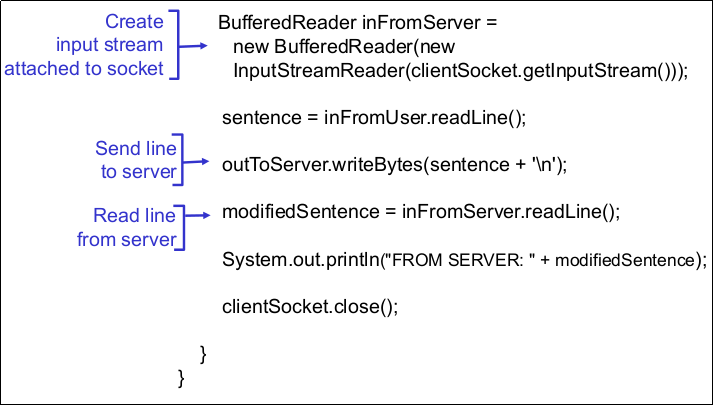
- 94Example: Java Server (TCP) (1)
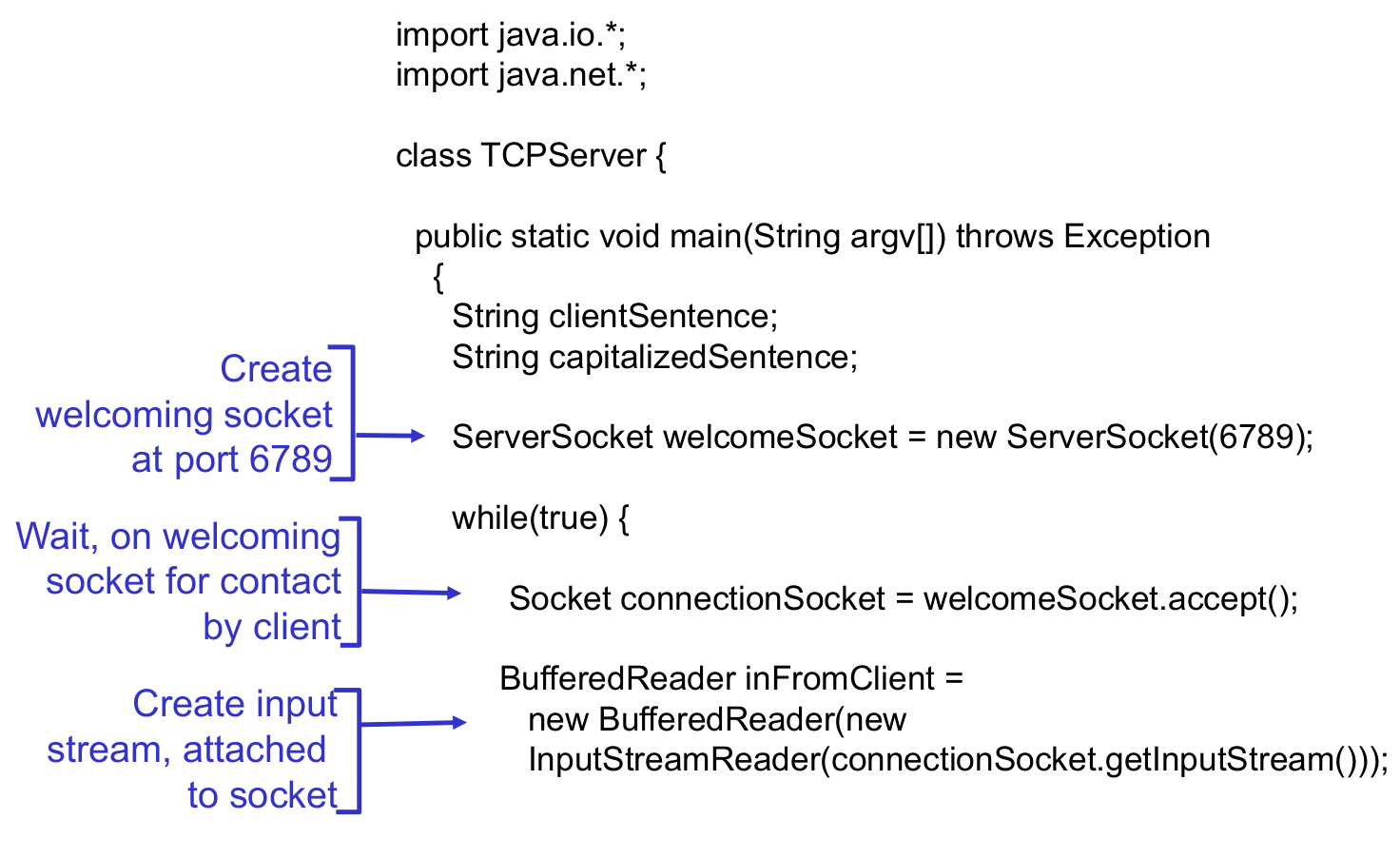
- 95Example: Java Server (TCP) (2)
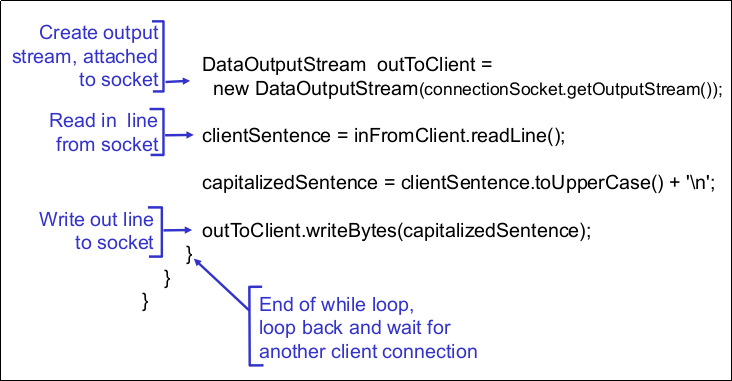
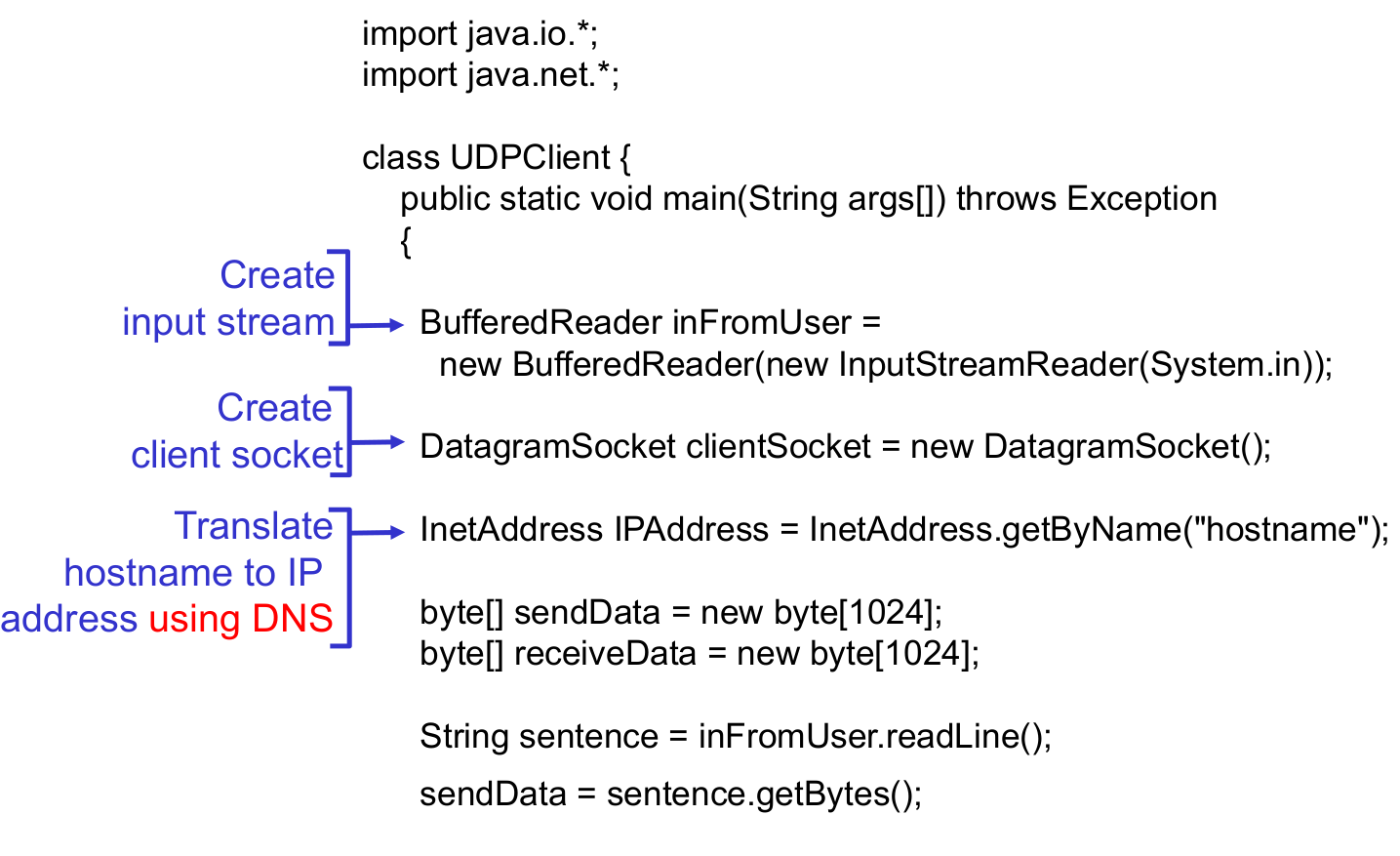
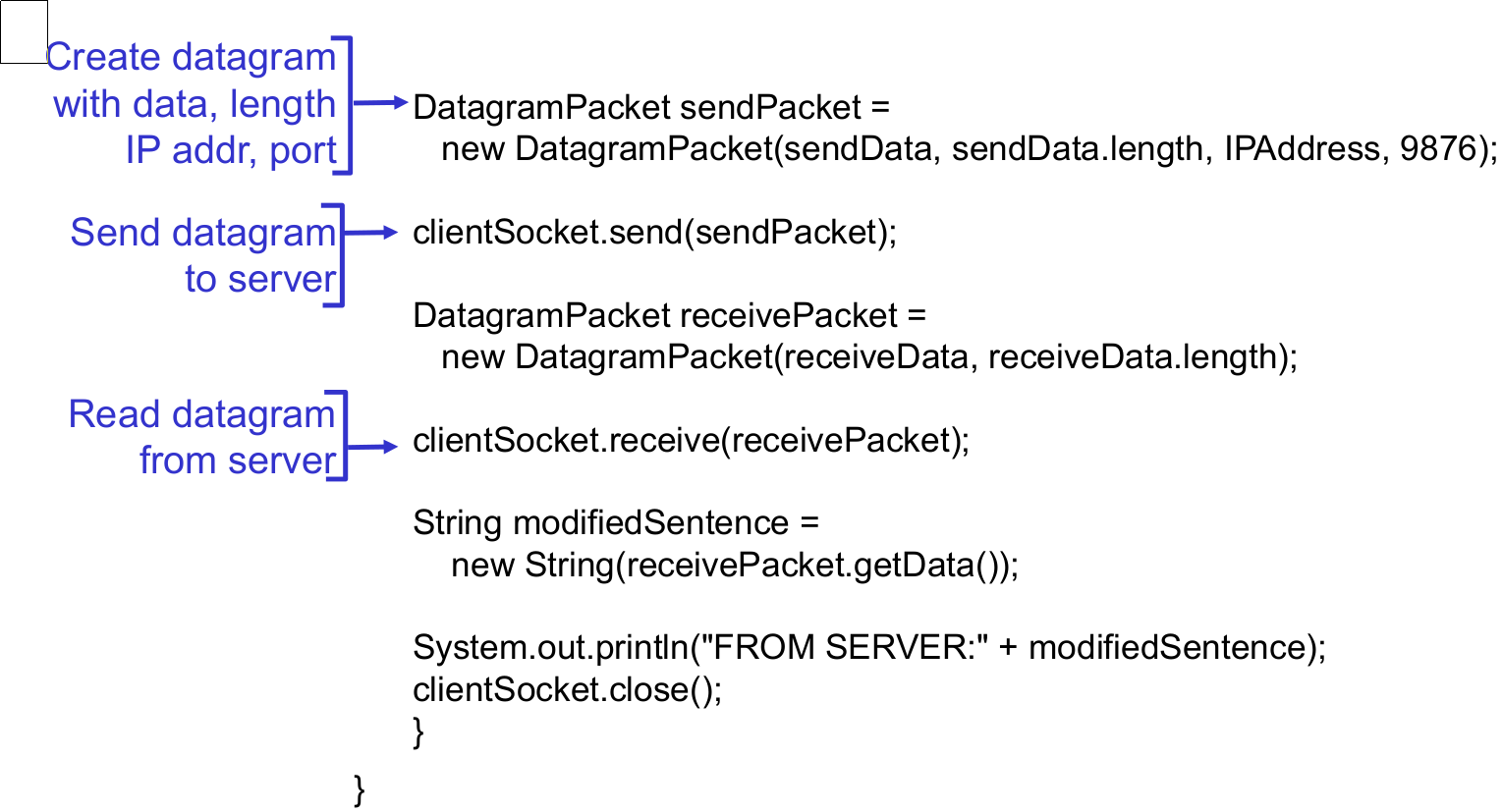
- 96Socket Programming With UDP- UDP: No "connection" between client and server
- No handshaking
- Sender explicitly attaches IP address and port of destination to each packet
- Server must extract IP address, port of sender from received packet
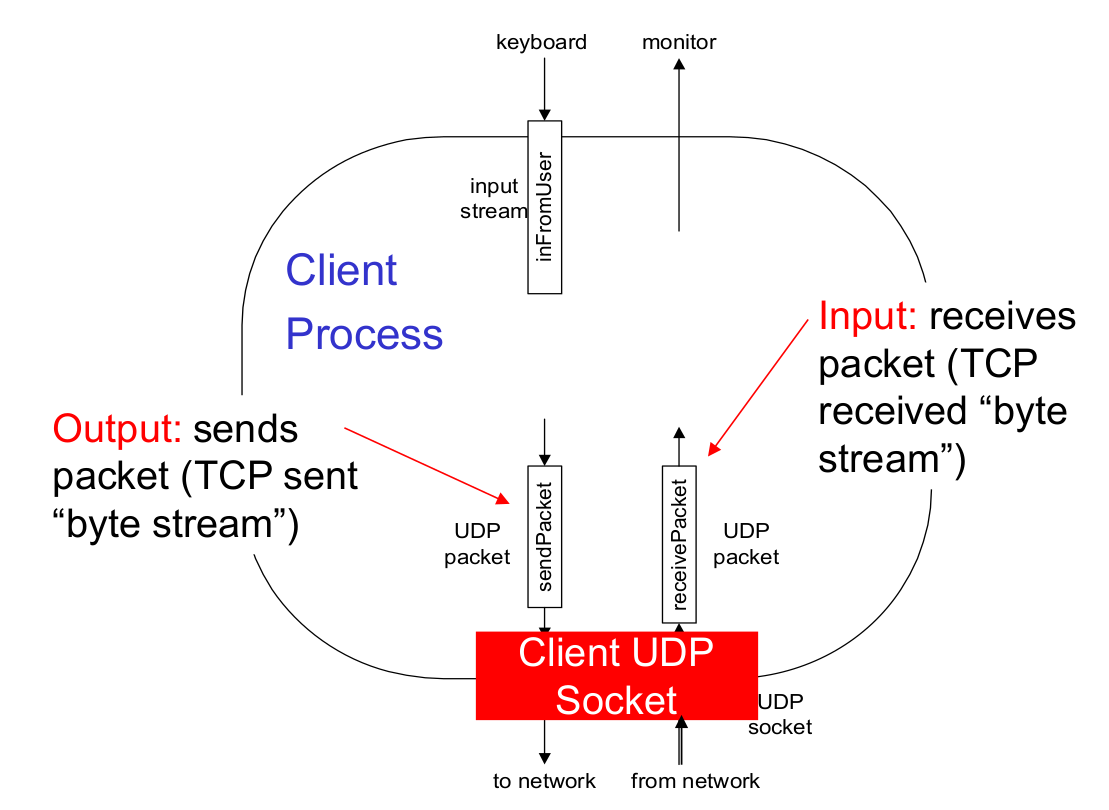
- UDP: Transmitted data may be received out of order, or lost - 97Socket Programming With UDP (Application viewpoint)- UDP provides unreliable transfer of groups of bytes ("datagrams") between client and server
- 98Client/Server Socket Interaction: UDP
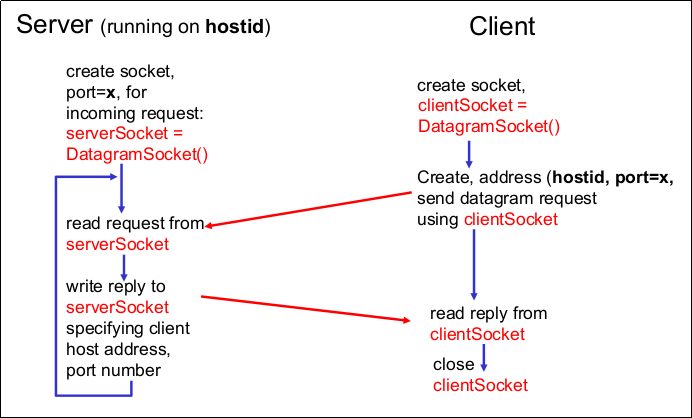
- 99Example: Java Client (UDP)
- 100Example: Java Client (UDP)
- 101Example: Java Client (UDP)
- 102Example: Java Sender (UDP) (1)
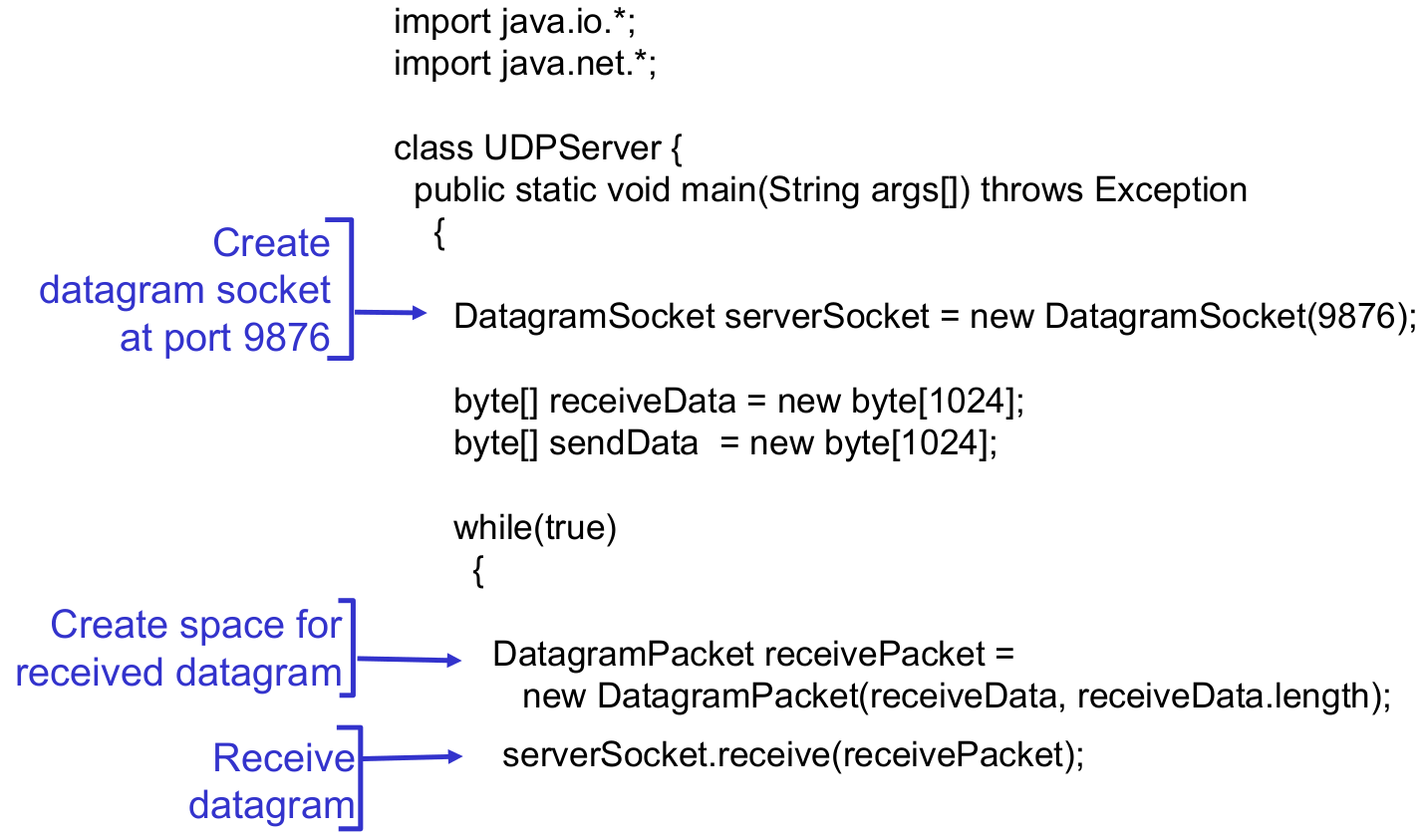
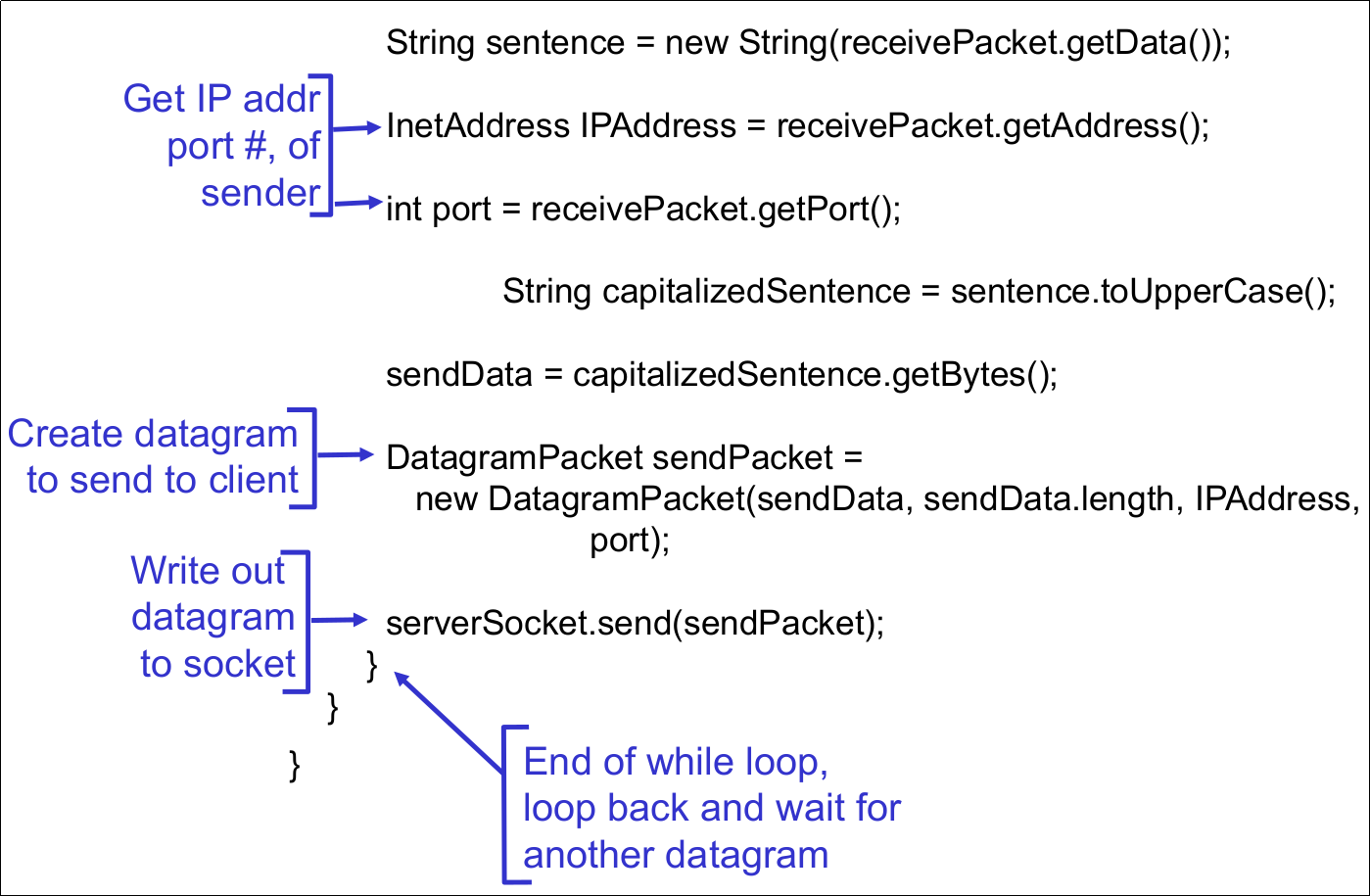
- 103Example: Java Server (UDP) (2)
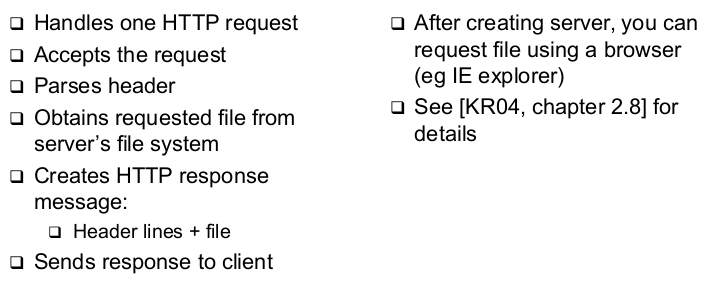
- 104Building a Simple Web Server
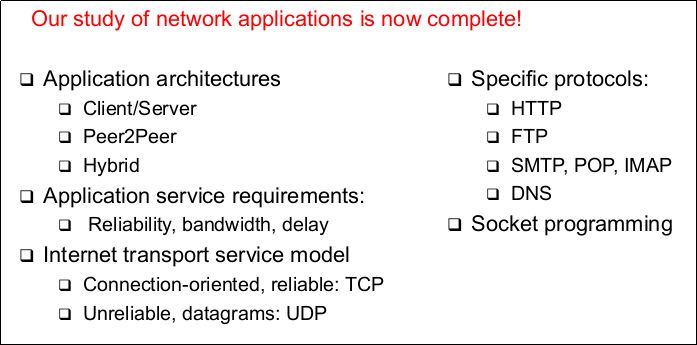
- 105Chapter 1: Summary (1)
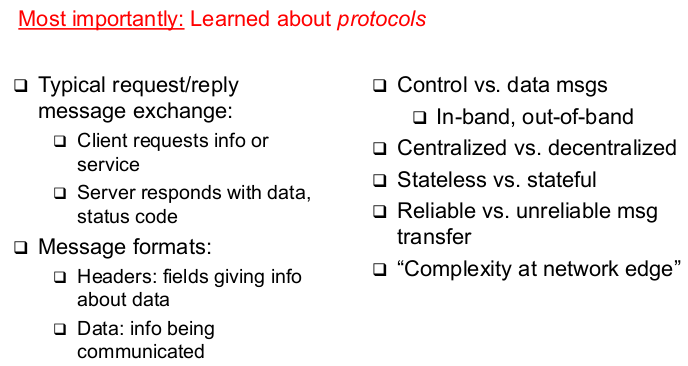
- 106Chapter 1: Summary (2)
- 107Appendix: Socket Programming with C
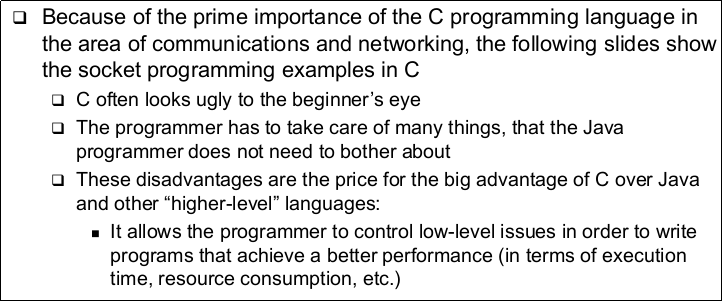
- 108Example: C Client (TCP) (1)
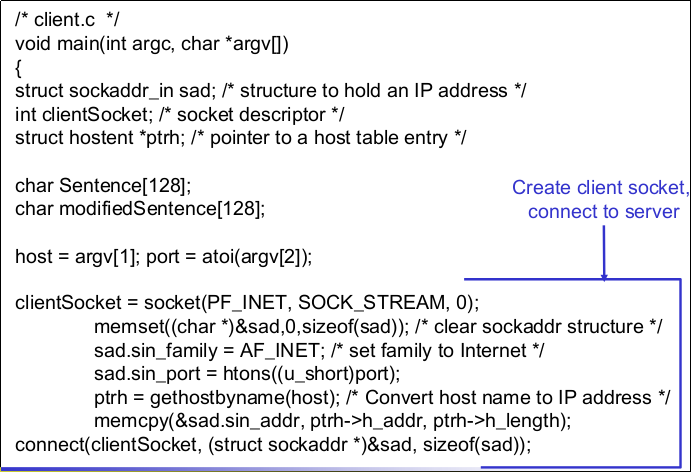
- 109Example: C Client (TCP) (2)
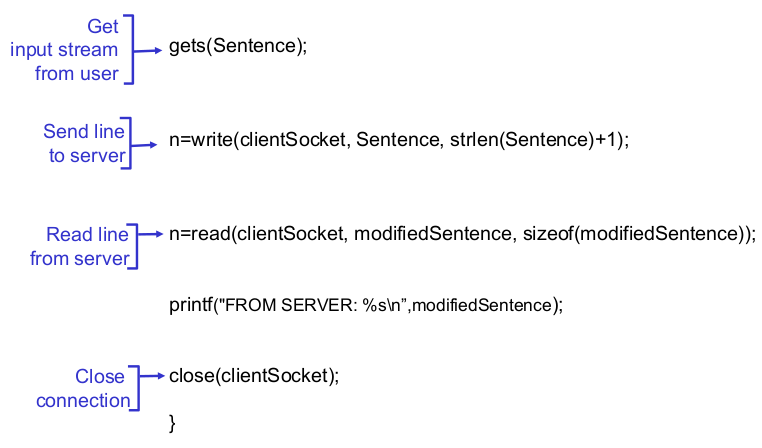
- 110Example: C Client (TCP) (1)
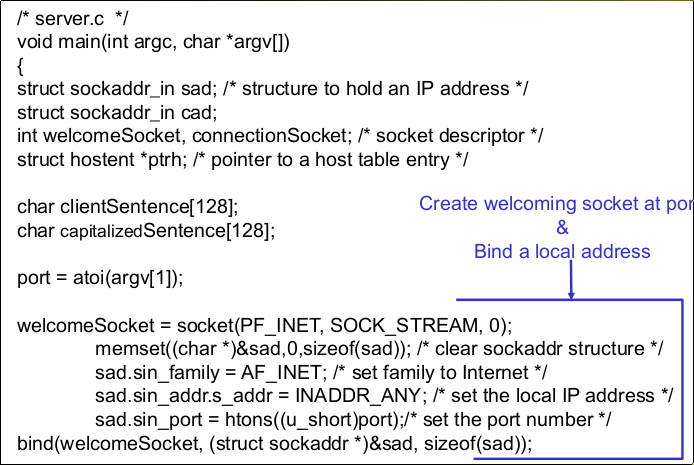
- 111Example: C Server (TCP) (2)
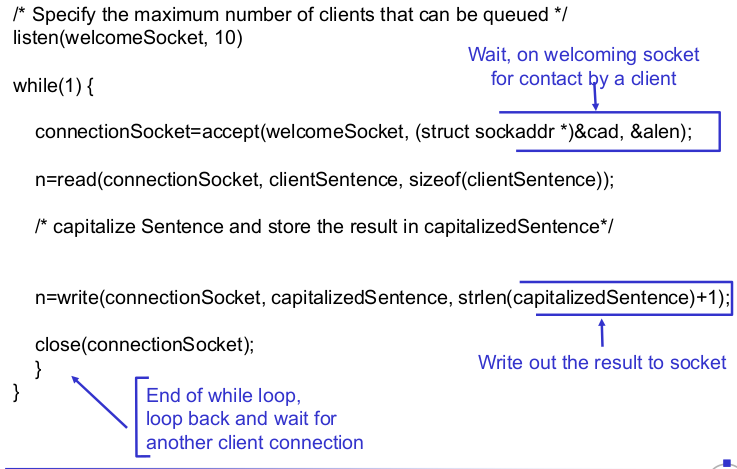
- 112Example: C Client (UDP) (1)
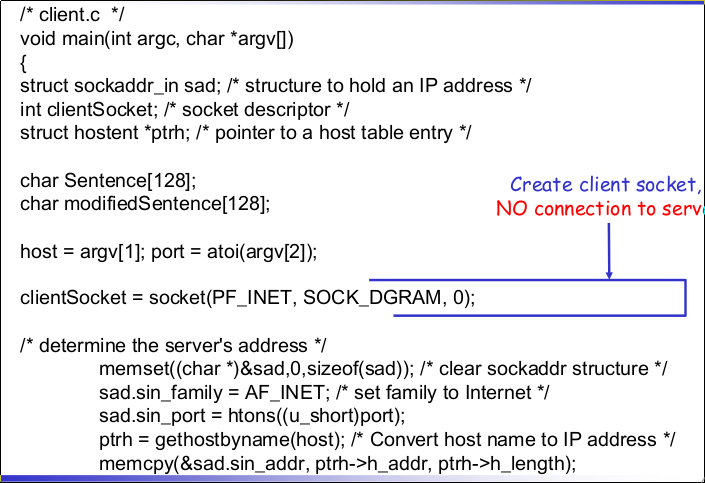
- 113Example: C Client (UDP) (2)
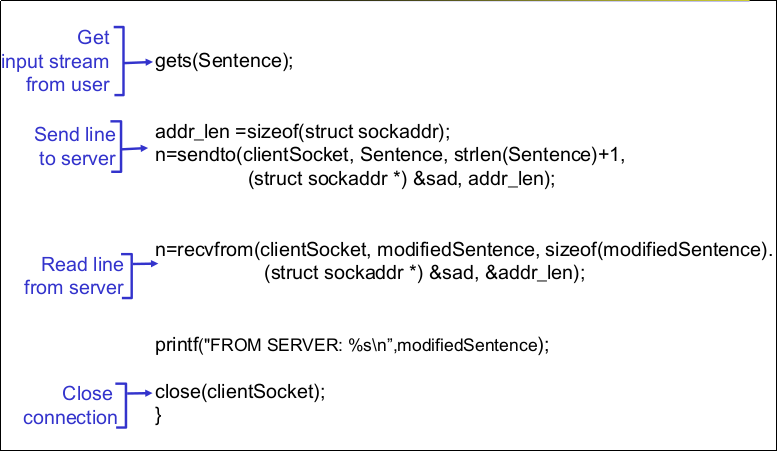
- 114Example: C Server (UDP) (1)
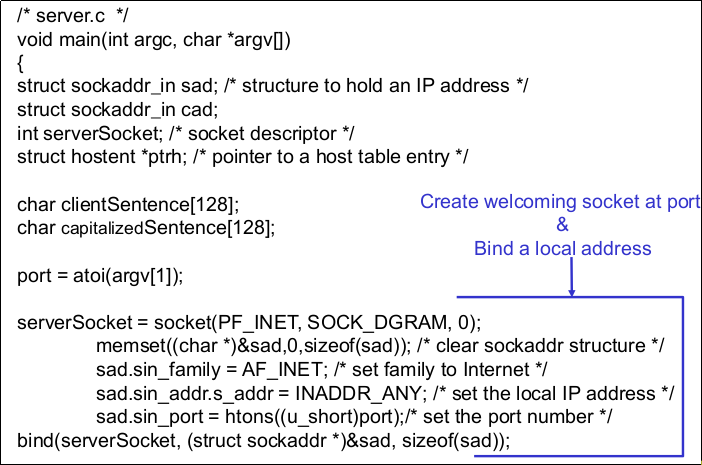
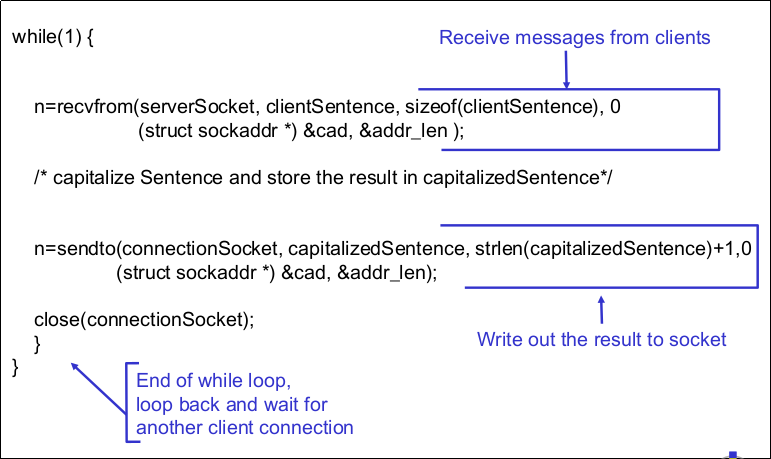
- 115Example: C Server (UDP) (2)
- 116What is a Threat in a Communication Network (Abstract Definition)- A threat in a communication network is any possible event or sequence of actions that might lead to a violation of one or more security goal
- The actual realization of a threat is called an attack - 117What is a Threat in a Communication Network? (Examples)- A hacker breaking into a corporate computer
- Disclosure of emails in transit
- Someone changing financial accounting data
- A hacker temporarily shutting down a website
- Someone using services or ordering goods in the name of others - 118What is a Threat in a Communication Network? (What are security goals)- Security goals can be defined:
-> Depending on the on the application environment, or
-> in a more general, technical way - 119Security goals depending on the application environment 1 (Banking)- Protect against fraudulent or accidental modification of transactions
- Identify retail transaction customers
- Protect PINs from disclosure
- Ensure customers privacy - 120Security goals depending on the application environment 1 (Electronic trading)- Assure source and integrity of transactions
- Protect corporate privacy
- Provide legally binding electronic signatures on transactions - 121Security goals depending on the application environment 1 (Government)- Protect against disclosure of sensitive information
- Provide electronic signatures on government documents - 122Security goals depending on the application environment 2 (Public Telecommunication Providers)- Restrict access to administrative functions to authorized personnel
- Protect against service interruptions
- Protect subscribers privacy - 123Security goals depending on the application environment 2 (Corporate / Private Networks)- Protect corporate / individual privacy
- Ensure message authenticity - 124Security goals depending on the application environment 2 (All Networks)- Prevent outside penetrations (who wants hackers?)
- 125Security goal depending on the application environment=> Sometimes security goals are also called security objectives
- 126Security Goals Technically Defined (Confidentiality)- Data transmitted or stored should only be revealed to an intended audience
- Confidentiality of entities is also referred to as anonymity - 127Security Goals Technically Defined (Data Integrity)- It should be possible to detect any modification of data
- This requires to be able to identify the creator of some data - 128Security Goals Technically Defined (Accountability)- It should be possible to identify the entity responsible for any communication event
- 129Security Goals Technically Defined (Controlled Access)- Only authorized entities should be able to access certain services or information
- 130Threats Technically Defined (Masquerade)- An entity claims to be another entity
- 131Threats Technically Defined (Eavesdropping)- An entity reads information it is not intended to read
- 132Threats Technically Defined (Authorization Violation)- An entity uses a service or resources it is not intended to use
- 133Threats Technically Defined (Loss or Modification of (transmitted) Information)- Data is being altered or destroyed
- 134Threats Technically Defined (Denial of Communication Acts (Repudiation))- An entity falsely denies its participation in a communication act
- 135Threats Technically Defined (Forgery of Information)- An entity creates a new information in the name of another entity
- 136Threats Technically Defined (Sabotage)- Any action that aims to reduce the availability and/or correct functioning of services or systems
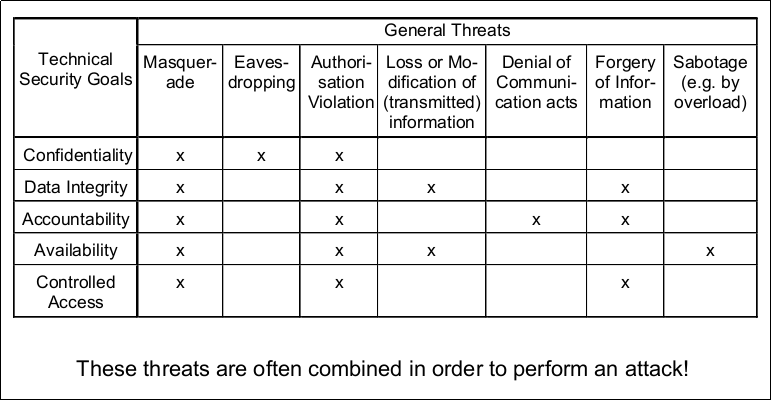
- 137Threats and Technical Security Goals
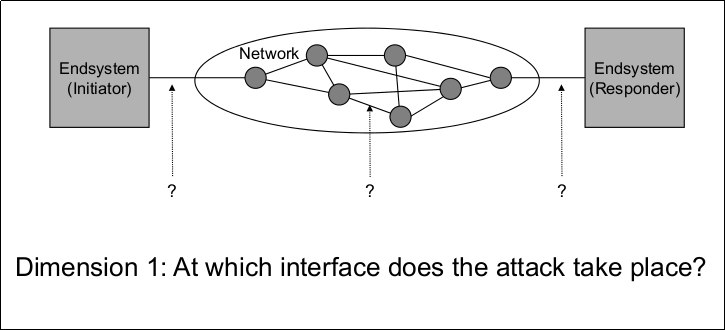
- 138Security Analysis of Layered Protocol Architectures 1
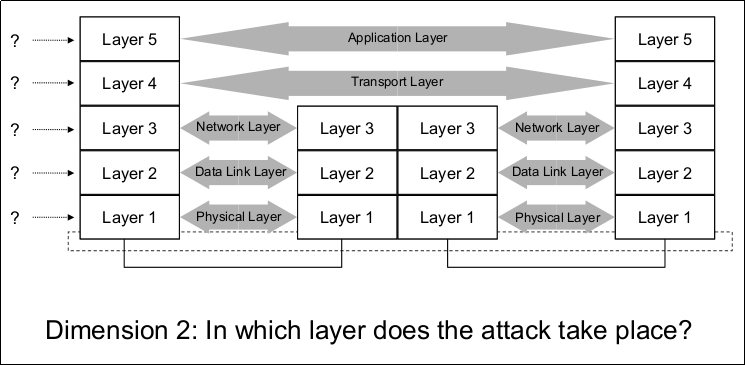
- 139Security Analysis of Layered Protocol Architectures 2
- 140Attacking Communications on the Message Level (Passive attacks)- Eavesdropping
- 141Attacking Communications on the Message Level (Active attacks)- Delay of PDUs (Protocol Data Units)
- Replay of PDUs
- Deletion of PDUs
- Modification of PDUs
- Insertion of PDUs - 142Attacking Communications on the Message Level (Successful launch of one of the above attacks requires)- There are no detectable side effects to other communications (connections/connectionless transmissions)
- There are no side effects to other PDUs of the same connection/connectionless data transmission between the same entities - 143Attacking Communications on the Message Level- A security analysis of a protocol architecture has to analyse these attacks according to the architecture's layers
- 144Safeguards Against Information Security Threats 1 (Physical Security)- Locks or other physical access control
- Tamper-proofing of sensitive equipment
- Environmental controls - 145Safeguards Against Information Security Threats 1 (Personnel Security)- Identification of position sensitivity
- Employee screening processes
- Security training and awareness - 146Safeguards Against Information Security Threats 1 (Administrative Security)- Controlling import of foreign software
- Procedures for investigating security breaches
- Reviewing audit trails
- REviewing accountability controls - 147Safeguards Against Information Security Threats 1 (Emanations Security)- Radio Frequency and other electromagnetic emanations controls
- 148Safeguards Against Information Security Threats 2 (Media Security)- Safeguarding storage of information
- Controlling marking, reproduction and destruction of information
- Ensuring that media containing information are destroyed securely
- Scanning media for viruses - 149Safeguards Against Information Security Threats 2 (Lifecycle Controls)- Trusted system design, implementation, evaluation and endorsement
- Programming standards and controls
- Documentation controls - 150Safeguards Against Information Security Threats 2 (Computer Security)- Protection of information while stored/processed in a computer system
- Protection of the computing devices itself - 151Safeguards Against Information Security Threats 2 (Communications Security)- Protection of information during transport from one system to another
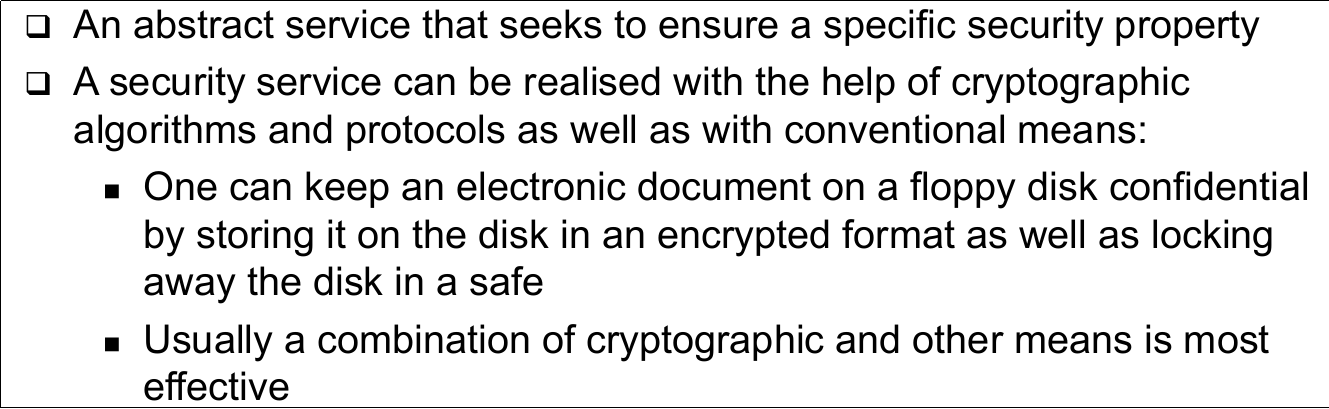
- Protection of the communication infrastructure itself - 152Communications Security: Some Terminology (Security Service)
- 153Communications Security: Some Terminology (Cryptographic Algorithm)- A mathematical transformation of input data (e.g. data key) to output data
- Cryptographic algorithms are used in cryptographic protocols - 154Communications Security: Some Terminology (Cryptographic Protocol)- A series of steps and message exchanges between multiple entities in order to achieve a specific security object
- 155Security Services - Overview (Authentication)- The most fundamental security service which ensures, that an entity has in fact the identity it claims to have
- 156Security Services - Overview (Integrity)- In some kind, the "small brother" of the authentication service, as it ensures, that data created by specific entities may not be modified without detection
- 157Security Services - Overview (Confidentiality)- The most popular security service, ensuring secrecy of protected data
- 158Security Services - Overview (Access Control)- Controls that each identity accesses only those services and information it is entitled to
- 159Security Services - Overview (Non-Repudiation)- Protects against that entities participating in a communication exchange can later falsely deny that the exchange occurred
- 160Cryptology - Definition and Terminology (Cryptology)- Science concerned with communications in secure and usually secret form
- The term is derived from the Greek kryptos (hidden) and logos (word) - 161Cryptology - Definition and Terminology (Cryptology) (Cryptology encompasses) (Cryptography (graphein = to write))- The study of the principles and techniques by which information can be concealed in ciphertext an later revealed by legitimate user employing a secret key
- 162Cryptology - Definition and Terminology (Cryptology) (Cryptology encompasses) (Cryptoanalysis (analyein = to loosen, to untie))- The science (and art) of recovering information from ciphers without knowledge of the key
- 163Cryptology - Definition and Terminology (Cipher)- Method of transforming a message (plaintext) to conceal its meaning
- Also used as synonym for the concealed ciphertext
- Ciphers are one class of cryptographic algorithms
- The transformation usually takes the message and a (secret) key as input - 164Cryptographic Algorithms (Encryption of data)- transforms plaintext data into ciphertext in order to conceal its' meaning
- 165Cryptographic Algorithms (Signing of data)- computes a check value or digital signature to a given plain- or ciphertext, that can be verified by some or all entities being able to access the signed data
- 166Cryptographic Algorithms- Some cryptographic algorithms can be used for both purposes, some are only secure and/or efficient for one of them
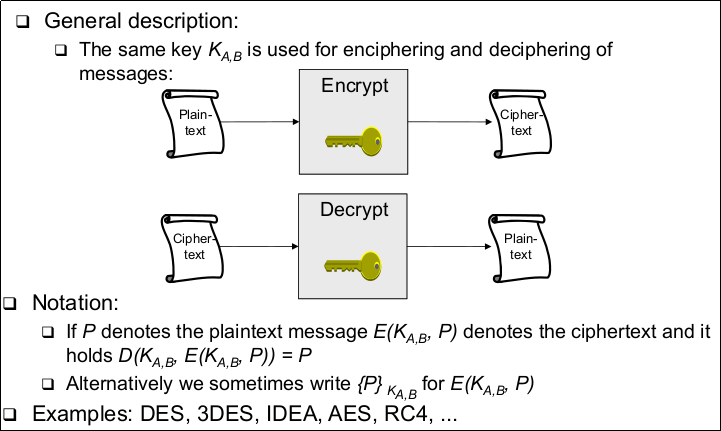
- 167Cryptographic Algorithms (Symmetric cryptography)- Symmetric cryptography using 1 key for en-/decryption or signing/checking
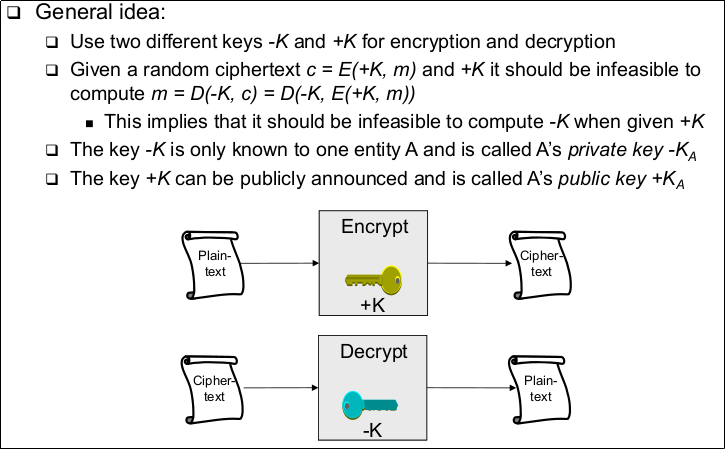
- 168Cryptographic Algorithms (Asymmetric cryptography)- Asymmetric cryptography using 2 different keys for en-/decryption or signing/checking
- 169Cryptographic Algorithms (Cryptographic hash functions)- Cryptographic hash functions using 0 keys (the "key" is not a separate input but "appended" to or "mixed" with the data)
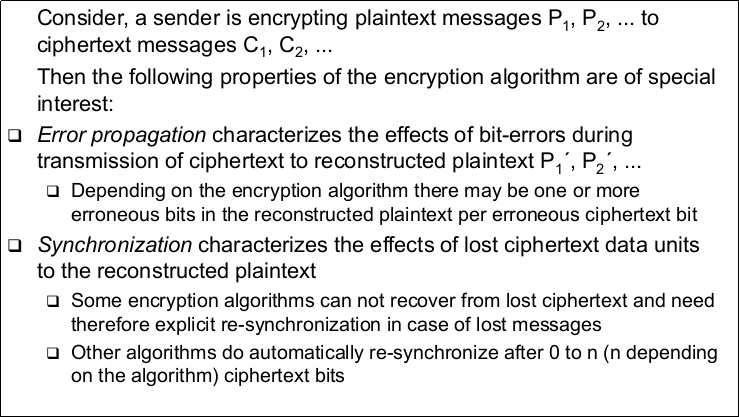
- 170Important Properties of Encryption Algorithms
- 171Symmetric Encryption
- 172Asymmetric Cryptography (General idea)-
- 173Asymmetric Cryptography (Applications) (Encryption)

- 174Asymmetric Cryptography (Applications) (Signing)

- 175Asymmetric Cryptography (Applications) (Attention)- It is crucial, that everyone can verify that he really knows A's public key and not the key of an adversary!
- 176Asymmetric Cryptography (Practical considerations)- Asymmetric cryptographic operations are about magnitudes slower than symmetric ones
- Therefore, they are often not used for encrypting/signing bulk data
- Symmetric techniques are used to encrypt/compute a cryptographic hash value and asymmetric cryptography is just used to encrypt a key/hash value - 177Detection of Message Modifications (Motivation)- An error detection code over a message enables the receiver to check if a message was altered during transmission
-> Examples: Parity, Bit-Interleaved Parity, Cyclic Redundancy Check (CRC)
- This leads to the wish of having a similar value called modification check value that allows to check, if a message has been modified during transmission - 178Detection of Message Modifications (Realization of modification check values) (Cryptographic Hash Functions)- These are either combined with asymmetric cryptography to obtain a signed modification detection code (MDC) or already include a shared secret mixed with the message
- 179Detection of Message Modifications (Realization of modification check values) (Message Authentication Codes)- Common message authentication codes (MAC) are constructed from a symmetric block cipher
- 180Cryptographic Protocols (Definition)- A cryptographic protocol is defined as a series of steps and message exchanges between multiple entities in order to achieve a specific security objective
- 181Cryptographic Protocols (Applications of cryptographic protocols)- Key exchange
- Combined authentication and key exchange - 182Cryptographic Protocols (Applications of cryptographic protocols) (Authentication) (Data origin authentication)- The security service, that enables a receiver to verify by whom a message was created and that it has not been modified
- 183Cryptographic Protocols (Applications of cryptographic protocols) (Authentication) (Entity authentication)- The security service, that enables communication partners to verify the identity of their peer entities
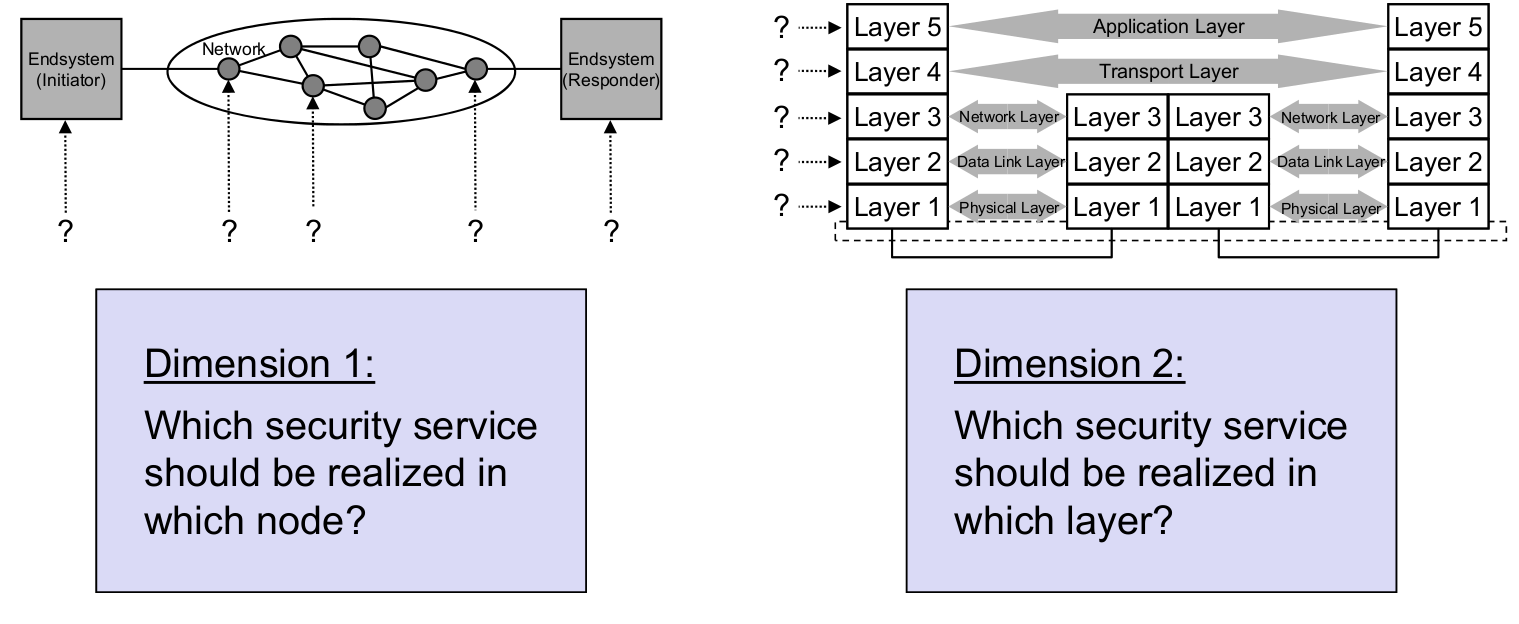
- 184Security in Networks: What to do where?- Analogous to the methodology of security analysis, there are two dimensions guiding the integration of security services into communication architectures
- 185Security in Networks: What to do where? (Bild)
- 186A Pragmatic Model for Secured & Networked Computing
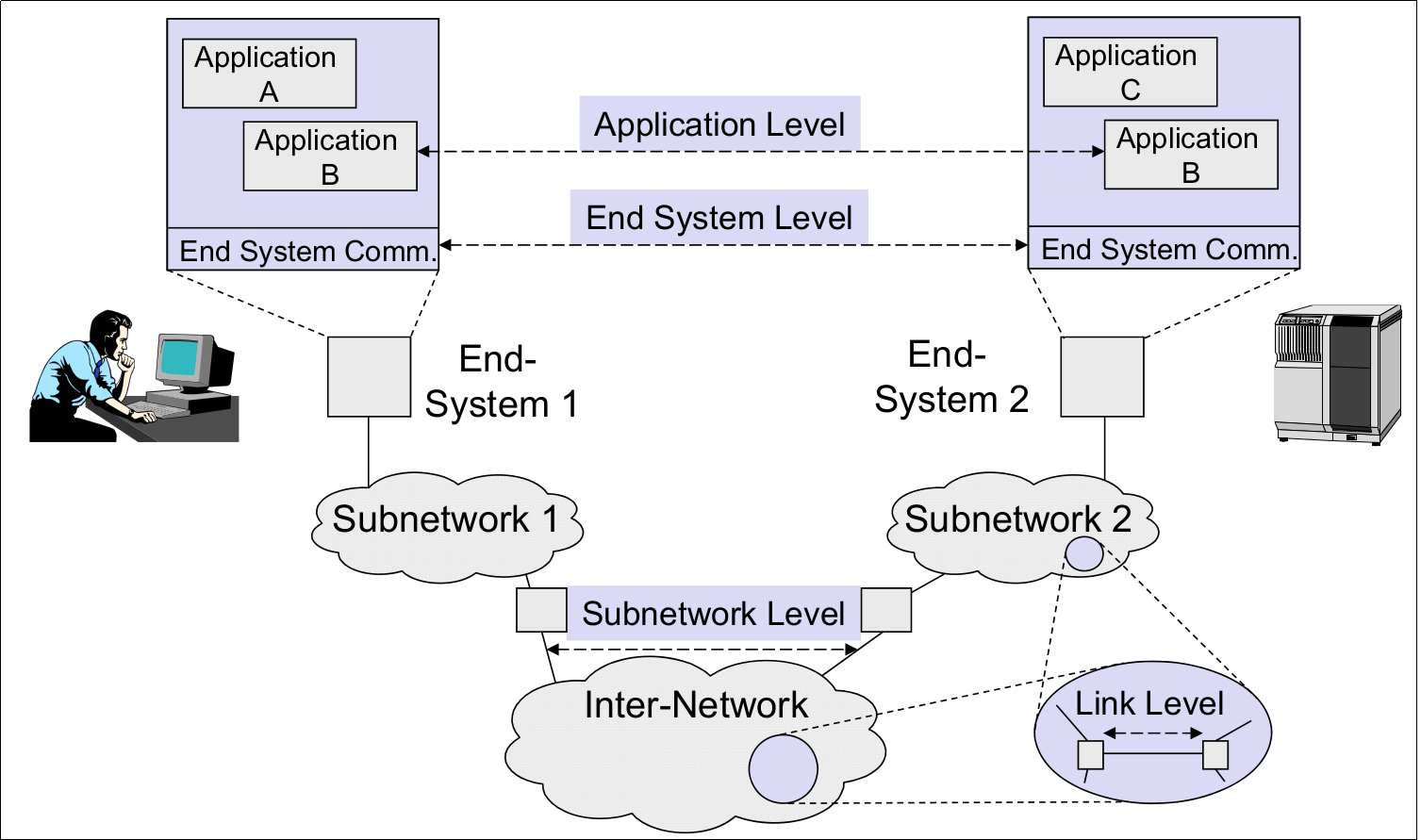
- 187A Pragmatic Model for Secured & Networked Computing (Application)- A piece of software that accomplishes some specific task, e.g. electronic email, web service, word processing, data storage, etc.
- 188A Pragmatic Model for Secured & Networked Computing (End System)- One piece of equipment, anywhere in the range from personal computer to server to mainframe computer
- For security purposes one end system usually has one policy authority - 189A Pragmatic Model for Secured & Networked Computing (Subnetwork)- A collection of communication facilities being under the control of one administrative organization, e.g. a LAN, campus network, WAN, etc.
- For security purposes one subnetwork usually has one policy authority - 190A Pragmatic Model for Secured & Networked Computing (Inter-Network)- A collection of inter-connected subnetworks
- In general, the subnets connected in an inter-network have different policy authorities - 191A Pragmatic Model for Secured & Networked Computing- There are four levels at which distinct requirements for security protocol elements arise:
-> Application level
-> End system level
-> Subnetwork level
-> Link level - 192A Pragmatic Model for Secured & Networked Computing (Application level)- Security protocol elements that are application dependent
- 193A Pragmatic Model for Secured & Networked Computing (End system level)- Provision of protection on an end system to end system basis
- 194A Pragmatic Model for Secured & Networked Computing (Subnetwork level)- Provision of protection over a subnetwork on an inter-network which is considered less secure than other parts of the network environment
- 195A Pragmatic Model for Secured & Networked Computing (Link level)- Provision of protection internal to a subnetwork, e.g. over a link which is considered less trusted than other parts of the subnetwork environment
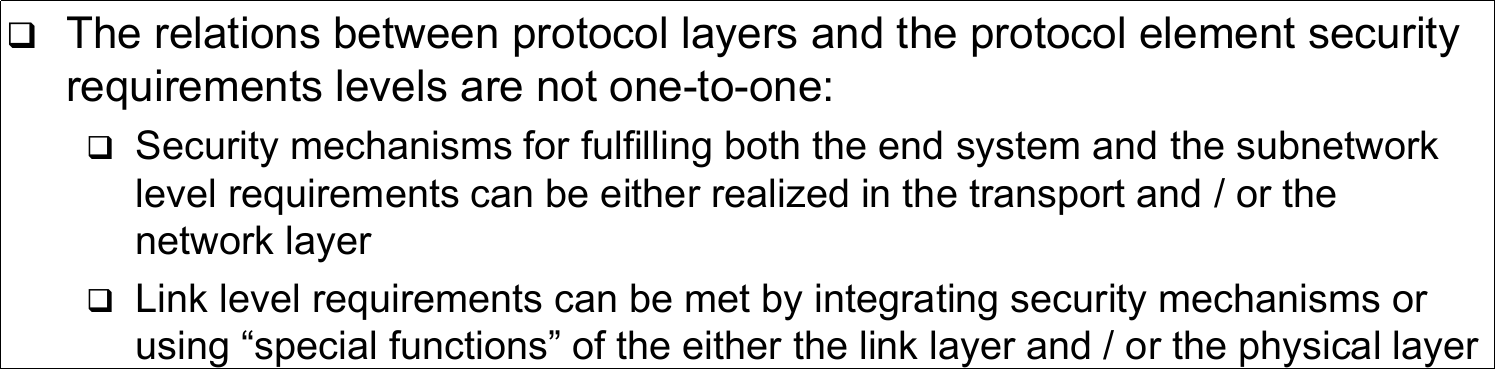
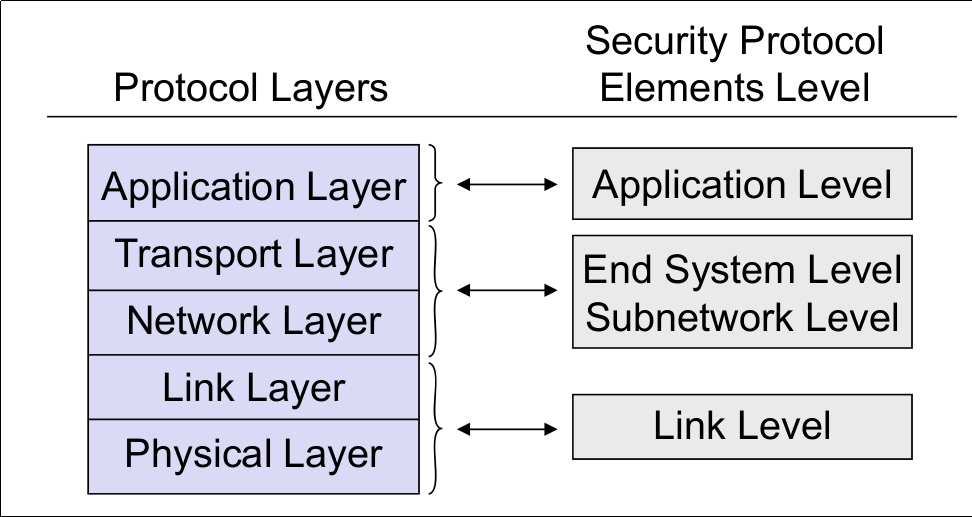
- 196Relationships Between Layers & Requirements Levels
- 197Relationships Between Layers & Requirements Levels (Bild)
- 198Security Problems of the Internet Protocol (When an entity receives an IP packet, it has no assurance of) (Data origin authentication/data integrity)- The packet has actually been send by the entity which is referenced by the source address of the packet
- The packet contains the original content the sender placed into it, so that it has not been modified during transport
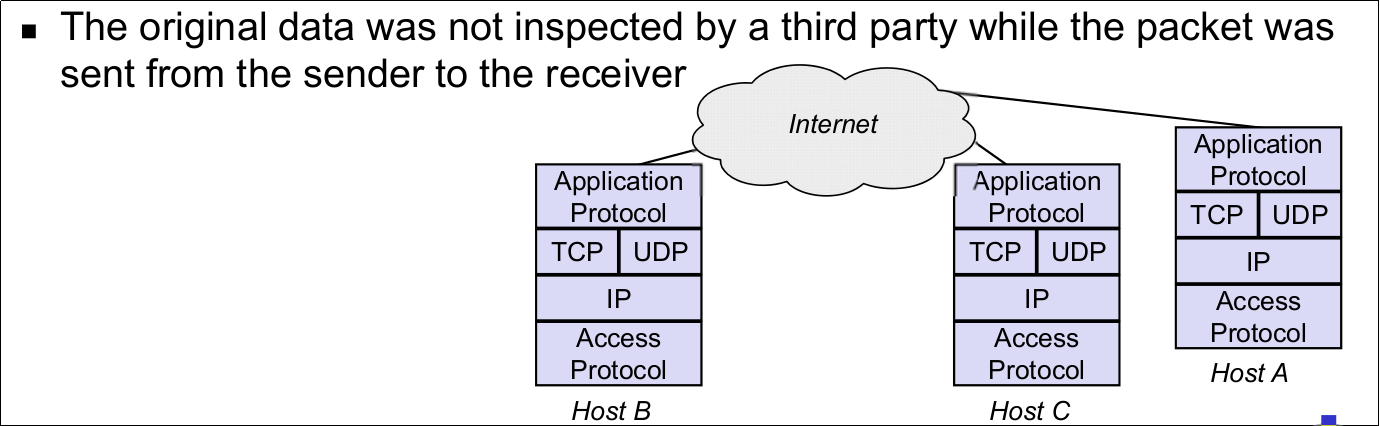
- The receiving entity is in fact the entity to which the sender wanted to send the packet - 199Security Problems of the Internet Protocol (When an entity receives an IP packet, it has no assurance of) (Confidentiality)
- 200Security Objectives of IPSec (IPSec aims to ensure the following security objectives) (Data origin authentication/connectionless data integrity)- It is not possible to send an IP datagram with neither a masqueraded IP source nor destination address without the receiver being able to detect this
- It is not possible to modify an IP datagram in transit, without the receiver being able to detect the modification
Informationen
- Beschreibung
- Karteikarten am Chapter 9-10, erstellt von Julian Rottenberg am 24/06/2018.
- Erstellt von
- Julian Rottenberg · Jun 2018
- Aktualisiert
- 25 Jun 2018
- Aufrufe
- 3
- Tags
- Bewertung