
Karteikarten
B&B - TB8 - Tutorial
Karten in diesem Stapel (29)
- 1Amnesia.A deficit in memory caused by brain damage, disease, or psychological trauma.
- 2Retrograde Amnesia.Loss of memory access to events that occurred or information learnt, before an injury or onset of disease.
- Loss of new memories from before the injury. - 3Anterograde Amnesia.Loss of the ability to create new memories after the event that caused the amnesia.
Leading to partial or complete inability to recall the recent past, while long-term memories from before the event remain in tact.
- Inability to acquire new memories. - 4Semantic Memory.Factual knowledge.
- 5Working Memory.Keeping information active by repeatedly thinking about it.
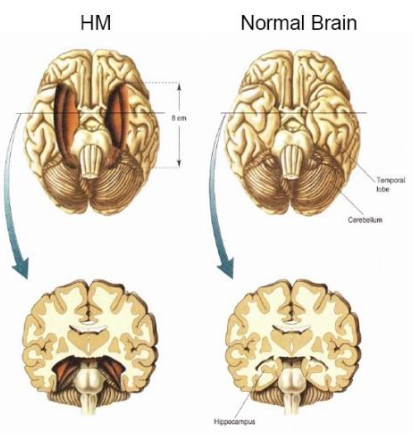
- 6Patient HM (Henry Molaison).Bilateral removal of the hippocampus to treat epilepsy.
- 7Patient HM. Severe Amnesia:- Unable to remember events since the operation - Anterograde amnesia.
- Loss of personal memories up to 11 years prior - Retrograde amnesia. - 8Patient HM. Preserved:- Short term memory.
-Knowledge of previously acquired facts - Semantic memory.
- Motor skill learning.
- Perceptual learning.
- Non-declarative (non-conscious) memory. - 9Patient HM's Brain.Virtually all anterior hippocampus and surrounding cortex removed bilaterally, plus amygdala.
- Anterior temporal lobe= Problems with semantic memory and language.
-Prefrontal damage = Problems with retrieval and personality. - 10—-Hippocampus is a key part of the network.
-Damage to these associated structures (starred areas) - also cause amnesia.
-There must be bilateral damage to these structures in both hemispheres.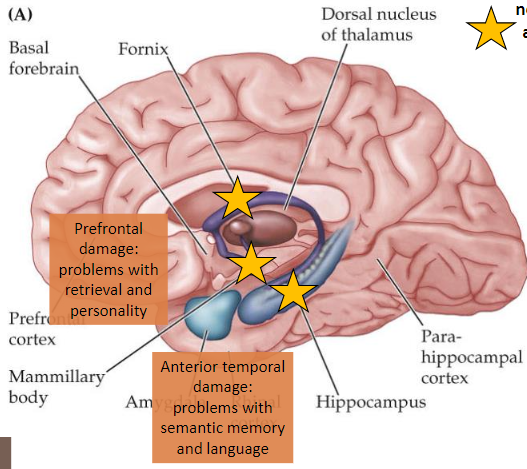
- 11Herpes Simplex Encephalitis. Clive Waring and Patient EP - Examples of pure cases of amnesia following HSE.The infection is typically focused in medial and anterior areas (including the hippocampus).
Often damage to anterior temporal and inferior medial cortex.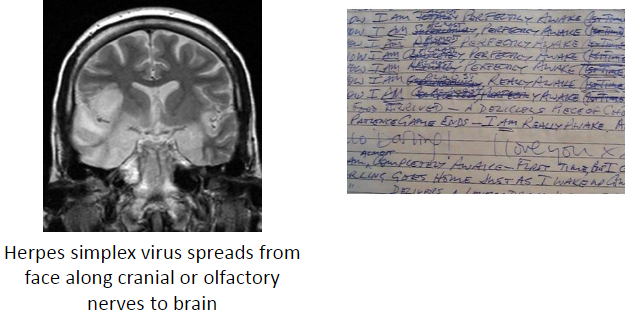
- 12Hpoxic Brain Injury.- Brain cells start to die after 4-6 minutes of oxygen deprivation - Hypoxia episode.
- The effects of hypoxia are severe in the hippocampus as the cells use a lot of oxygen.
- Individuals who survive a hypoxia episode often have amnesia. - 13Hypoxia Brain Injury. Patient RB (Zola Morgan et al. 1986).- Carbon monoxide poisoning.
- Hypoxia episode.
- Other causes of amnesia include respiratory failure and disruption in blood flow to the brain. E.g. a haemorrhage. - 14Korsakoff's Syndrome.Amnesia associated with long-term alcoholism.
Caused by thiamine (vitamin B1) deficiency:
- Drinkers may neglect their diet.
- Alcohol interferes with conversation of thiamine into active form.
- Alcohol reduced absorption and storage of vitamins. - 15Korsakoff's Syndrome. Widespread damage to brain:Mammillary bodies are severely affected, plus the prefrontal cortex.
PFC damage produces problems beyond 'pure amnesia':
- Behavioural changes - e.g. apthy.
- Deficits in attention and executive control.
- Problem with retrieval as well as formation of memory - retrieval can be cued.
- May be changes to personality and emotional processing. - 16Alzheimer's Disease.- Early-stage symptoms include problems with memory, language, decision making, and planning/reasoning.
- Some overlap with 'pure' amnesia but there is also a deficit in ntellectual funtion.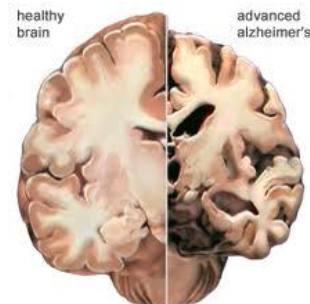
- 17Face Recognition.- Wechsler Memory Scale - Patient shown sequence of 60 faces at one time.
- Shown 2nd sequence and have to decide if they've seen the photos before.
- This is a test of recognition (as opposed to recall).
- Both recognition and recall are impaired in amnesia.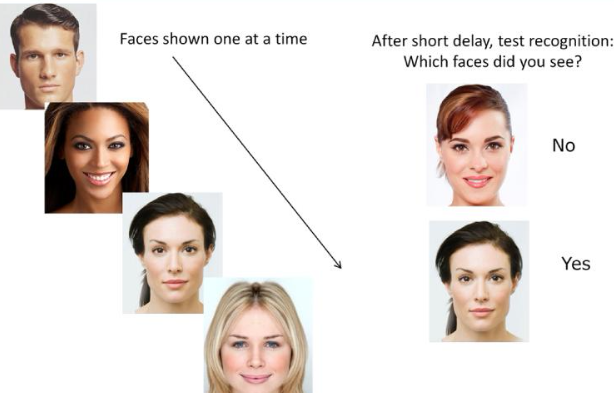
- 18Picture Naming.- Shown picture and asked to name it.
- Some patients show a different degree of impairment for animals and man-made objects (i.e. category specific).
- May reflect knowledge of animals is drawn heavily on visual features, while man-made objects have more manipulable features that we feel and move.
- Healthy participants name the majority of these pictures/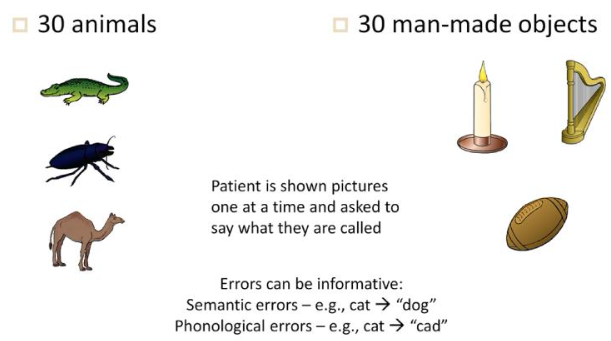
- 19Rey Figure Copy.- Patient first copies complex figure in front of them - This is the 'immediate' condition.
- 15 mins later, asked to reproduce figure from memory.
- They have to remember what they are seeing, patients with severe amnesia often cannot attempt the delayed copy.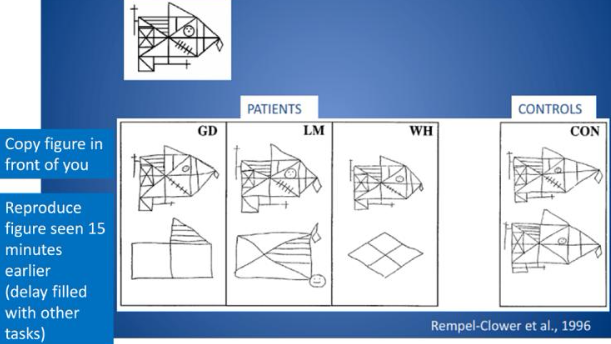
- 20Corsi Block Test.- Examiner sat looking at numbers, patient cannot see the numbers, examiner taps out a sequence - e.g. 2-8-3.
- Patient tries to tap out the same order. Sequences start short, get longer.
- Testing stops once patient reliably makes errors, and sequence length is the 'span'.
- Healthy participants often 5-7.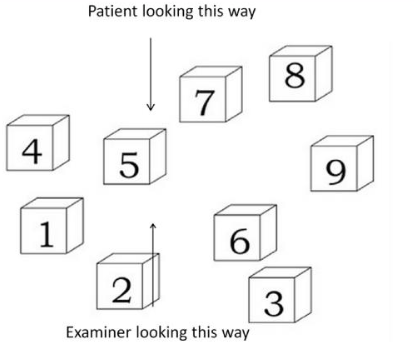
- 21Paired-Associate Learning.- Measures verbal learning and forms core part of Wechsler Memory Scale (WMS).
- Test phase - Hear series of 12 pairs.
- Then hear one of the words and asked to say what the pair is.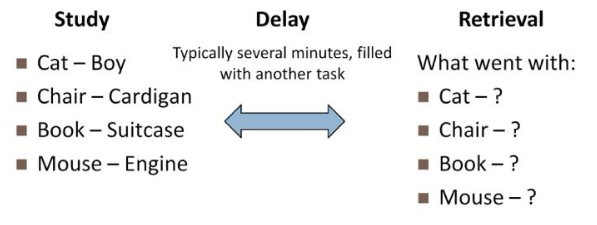
- 22Paired-Associate Learning. Test can be used to distinguish between memory disorders than result from...1. Encoding/storage deficits.
2. Retrieval difficulties.
- If encoding and storage are profoundly impaired, information cannot be recovered even if cues are provided.
- These cues are helpful if patients are having difficulty retrieving the right word. - 23Pyramids and Palm Trees (PPT).- Patient asked to decide which of the to items at the bottom of the page goes with which top item.
- Trials are presented as either pictures or words.
- Typically patients complete both versions of this on different days.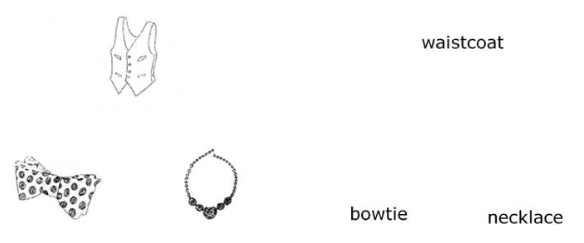
- 24Logical Memory.- The story is read aloud to the patient, they attempt to reproduce it.
- Since we don’t tend to recall stories verbatim with exactly the same words, this test is scored in terms of “idea units”.
- The original story is longer and has 30 idea units.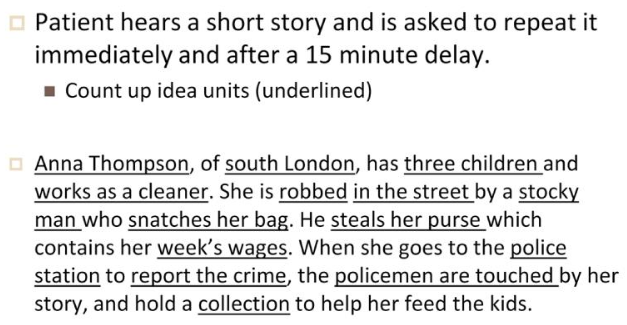
- 25Autobiographical Memory.- Patient asked to describe a memory which is jogged by each word.
- Attempt to figure out when the memory is from - Patient's family may help.
- Memories from different decades are added up.
- Healthy people tend to remember more recent memories.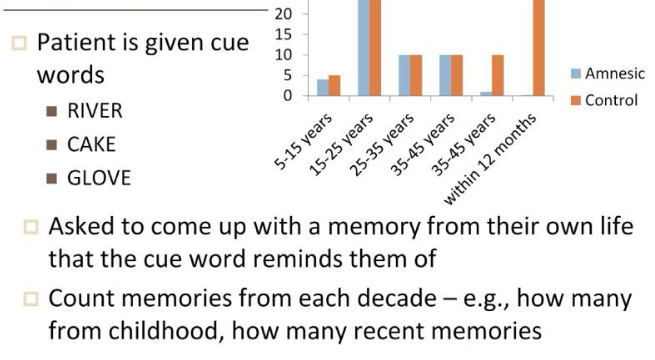
- 26Case Study 1: - Memory problems after an episode of confusion and disorientation. - Poor balance and difficulties with control of eye movements. - Fails to recognise nursing staff. - Knows names and faces of family. - Heavy drinker. - Given intravenous thiamine.Korsakoff's Syndrome.
- 27Case Study 2: - Recovering from major heart attack. - Conversation is repetitive and seems to have little recollection of what is said to them. - Problems with personal memories. - State of cardiac arrest, had CPR. - Unresponsive and in a coma for 48 hours. - Long time for brain cells to survive with shortage of oxygen.Hypoxia.
- 28Case Study 3: - Ill with fever, headache, nausea, drowsy, confused and eventually lost consciousness. - Difficulties with language and memory. - Cannot remember specific words they need. -Confused about things that have happened. - Forgets the names of people that they know. - Given anti-viral medication.Herpes Simplex Encephalitis (HSE).
- 29Case Study 4: - Losing track of thoughts, plans and appointments. - Forgetting what was being discussed. - Trouble remembering names. - Forgetful asking same questions in a row. - Difficulty sleeping. - Memory slowly deteriorating for some time. - Memory problems are more pronounced.Alzheimer's Disease.
Informationen
- Beschreibung
- Amnesia: A case-study analysis
- Erstellt von
- Bethan Williams
- Aufrufe
- 3
- Bewertung