
Karteikarten
Ohne Titel
Karten in diesem Stapel (24)
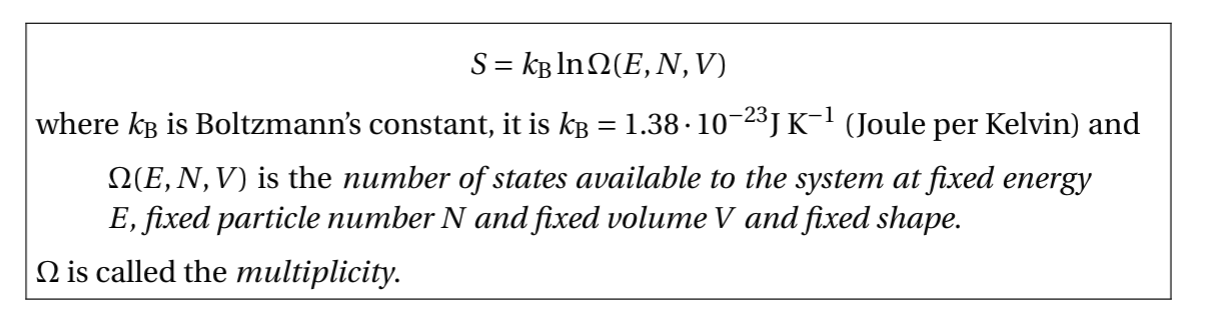
- 1What is the link between thermodynamcis and Statistics?Statistics attempts to explain the microphysics behind the macroscopic events of thermodymanics.
They are linked by Entropy. - 2What is a closed/isolated system? How can you change the volume of a closed system?A closed system is one where no particles or energy can enter or leave the system.
If you are careful, you can maintain a constant energy yet change Q and W to balance. - 3What is the entropy of a closed system?
- 4How do you count the number of configerations available for a paramagent of N particles with N(spin-up) particles?
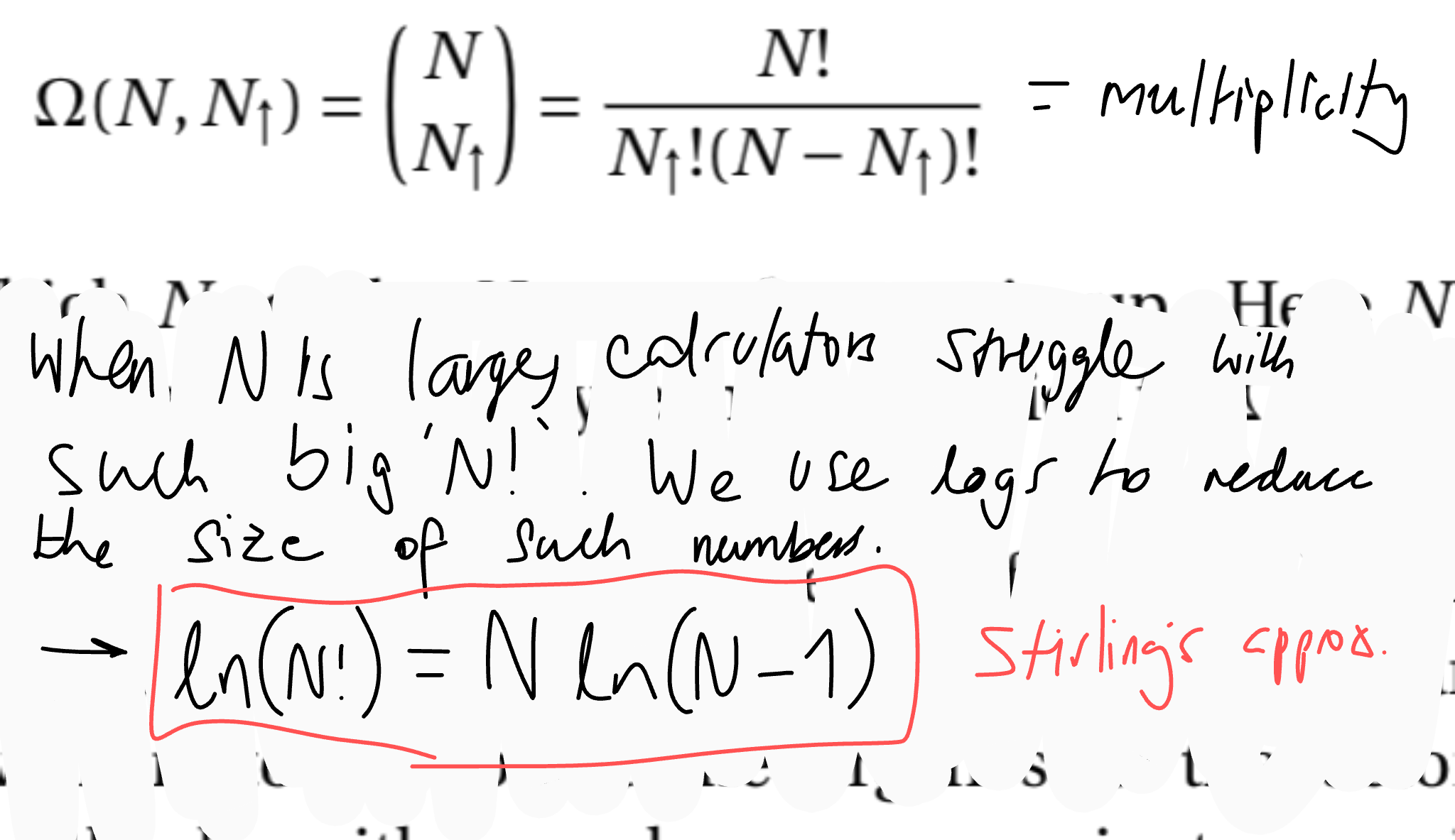
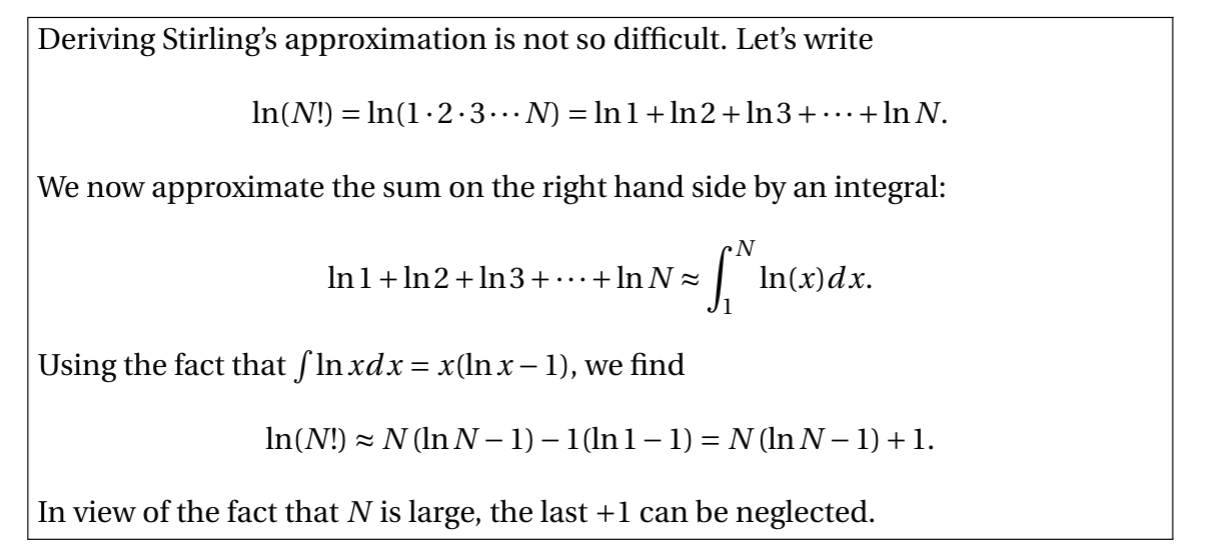
- 5Derive Stirling's approximation
- 6What is the thermodynamic limit? When does multiplicity peak?The term used to describe when N is very large.
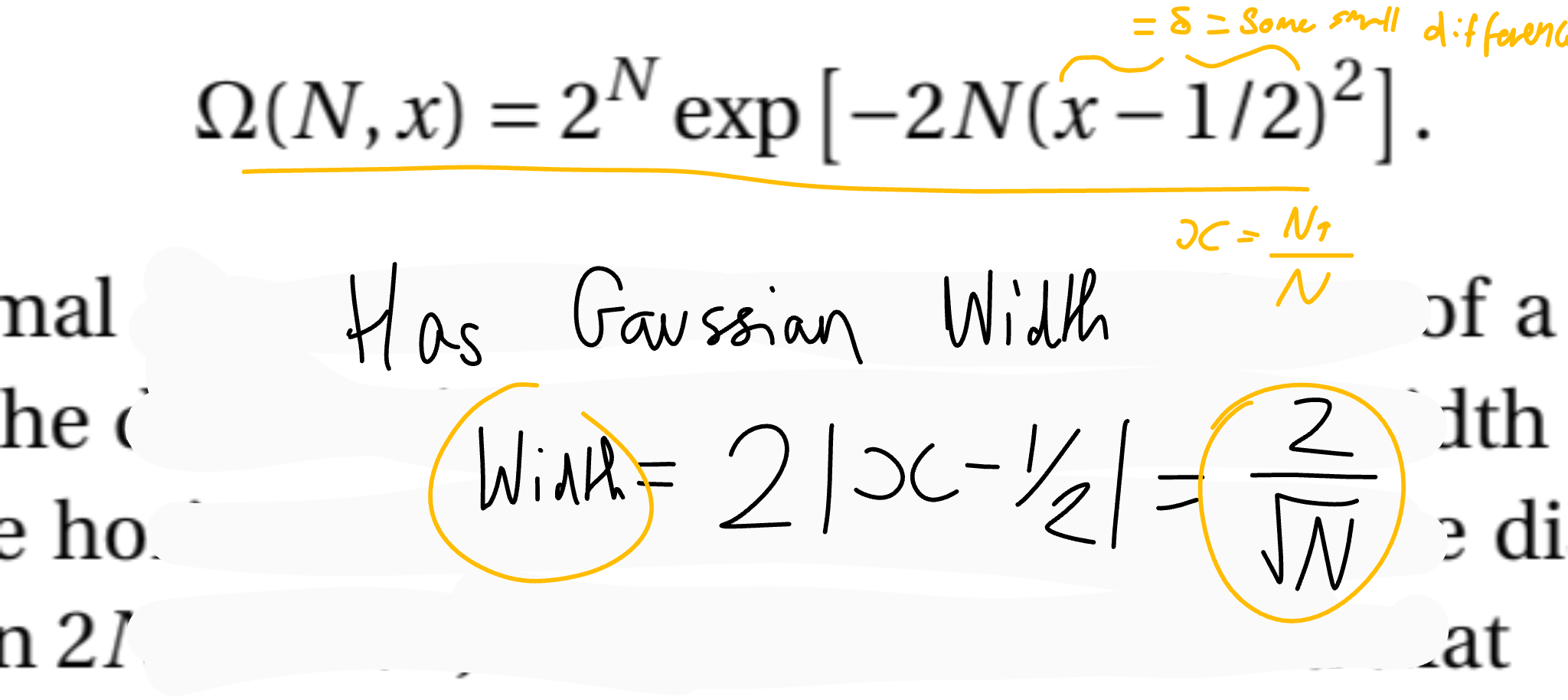
Peaks when the N-N1 ~= N/2 for N(N1,N2), i.e. equal distribution between the two possible states. This distribution will then be in the the normal/gaussian distribution. - 7How is Gaussian width calculated?The distance between the two points on the gaussian curve where the curve is at 1/e time its maximum.
- 8What is the formula for the multiplicity at a maximum for a 2 state system? (derivations in notes pg 17-18)
- 9What is a microstate? How many microstates are possible for N particles which each have either spin up/down? (if the probability for each of the states is equal)A microstate is a configeration of the system, so there for the paramegnet example, there is only one microstate where all spins are up, and one where all spins are down, then there are N microstates for where there is one spin up and rest spin down.
There are 2^N possible configuration for N particles. - 10Why does the thermodynamic limit happen?For systems of large N, and therfore many many microstates, the gaussian/normal distribution becomes sharply peaked, so much so that the wings of the function are aribitrarly small, this gives a built in defence from fluctuatuions to thermodynamic properties. At small N systems however, the fluctuations have a more significan effect as the gaussian width is larger.
Think analogy of flipping coins, the more coin flips you do, youre more likely to have an approximate equal distribution.
The equilibrium is the thermodynamic state that is demonstrated in the macroscopic world - 11What is a thermodynamic quantity?The equilibrium value of a microcanonical ensemble for large number of particles so that the statistical fluctuations can be ignored.
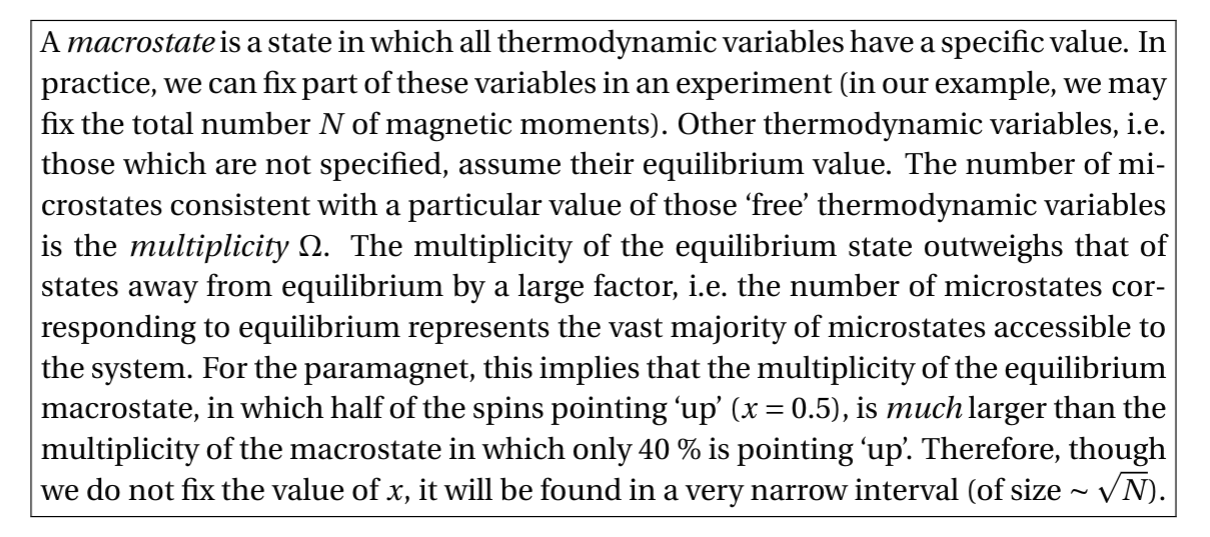
- 12What is a macrostate?
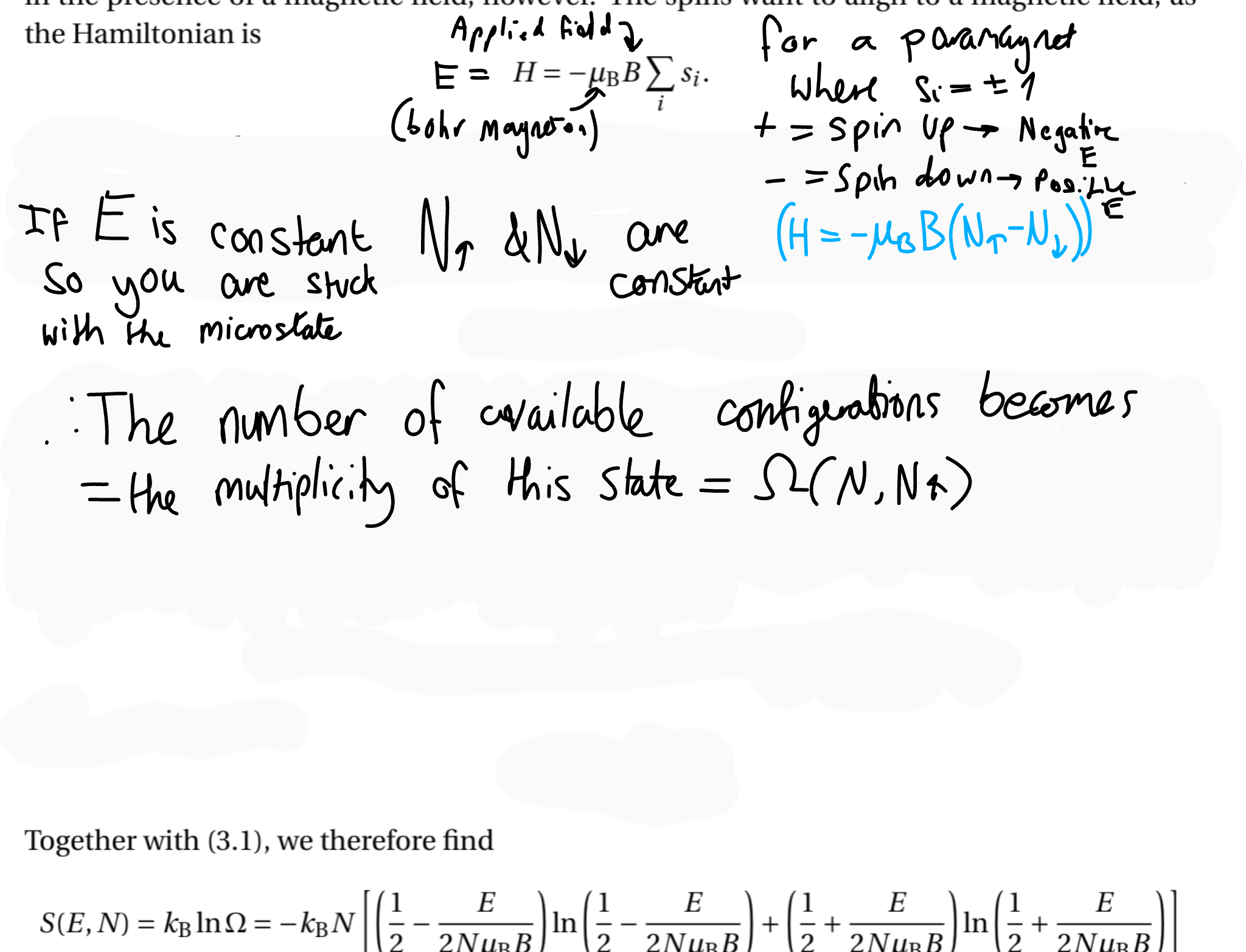
- 13How many configerations are there for a paramagnet in a magnetic field which can't exchange its energy to the environment?
- 14What is the approximation of multipliticity using x?x=N(up)/N (=~1/2 for equilibrium of random two state system)

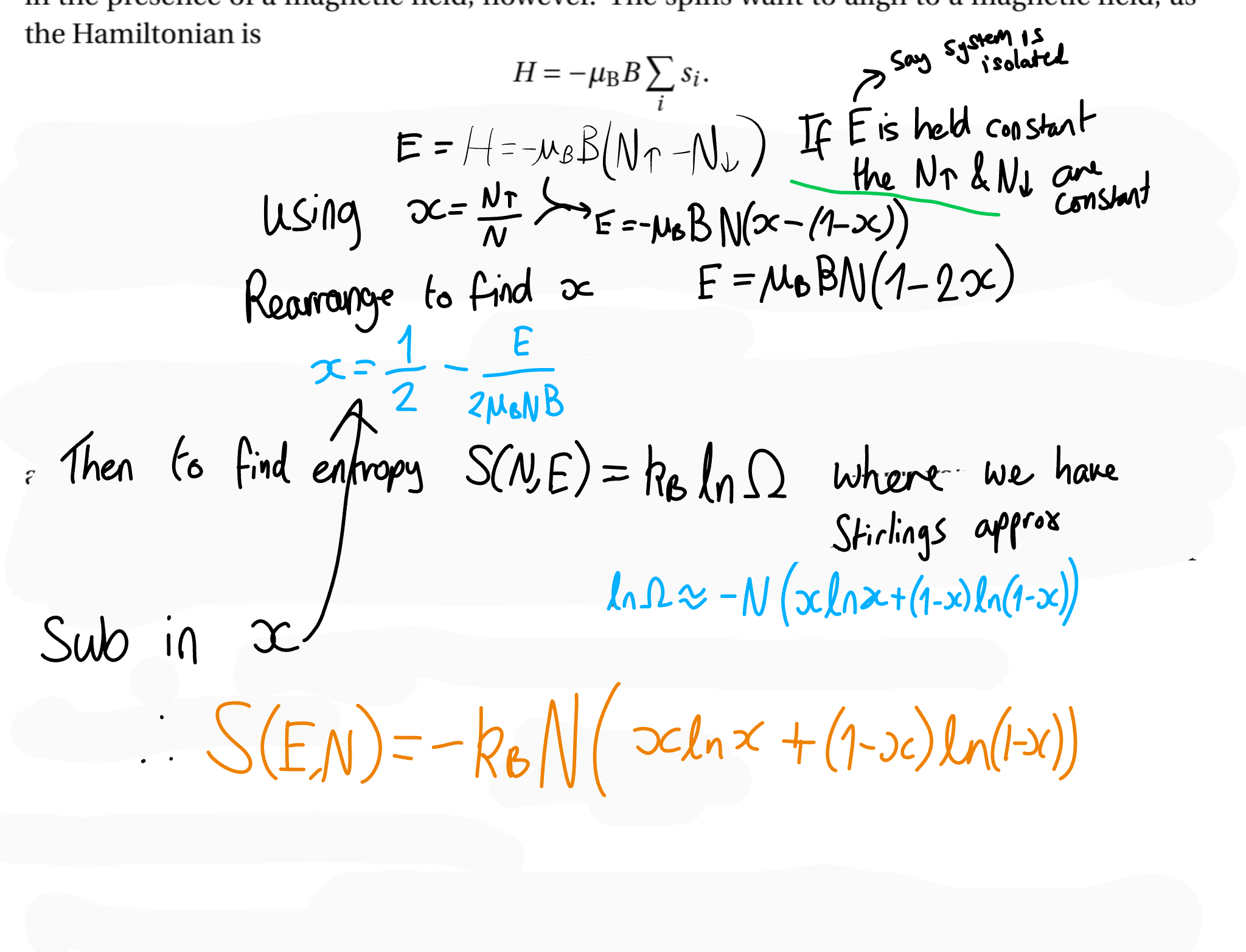
- 15How do you derive the entropy of a paramagnet with N particles,
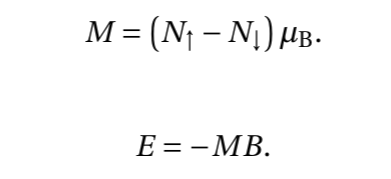
- 16What is the relation between energy and magnetisation?
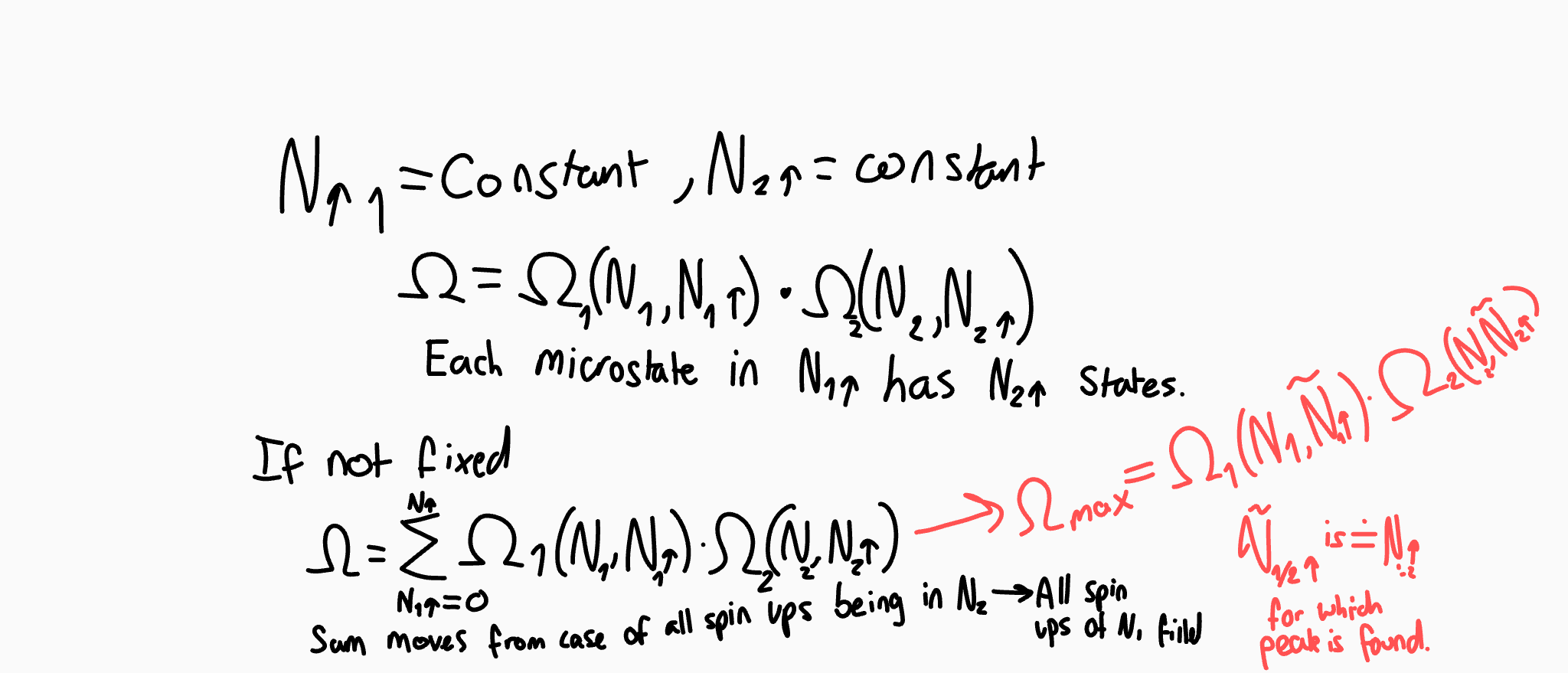
- 17For a pair paramagnets that can exchange energy, but are otherwise isolated from the system, what behaviour do we expect them to follow (If N1 and N2 are fixed (number of atoms in both paramagnets are constant))They are able to exchange energy between each other, but their total energy must be constant so N1(up)+N2(up) = constant
but N1(up)=/=constant.
We would expect then the multiplicity to be maximised for when the states are evenly distributed between N1 and N2 AND evenly distributed between N(up) ~N(down) - 18What does the maximum of Multiplicity tell us?Since every state is equally probable to be filled, the more states with same energy means it will have an overall heavier weight. And so the multiplicity tells us the macroscopic state/ equilibrium state. (since entropy will seek to be the most disorder and so favours the state with the most configerations.
- 19In a pair of paramagnets that are otherwise isolated and if we fix N1(up) and N2(up) to be constant, what is the multiplicity? How does this change if we don't fix the N1(up) and N2(up)?
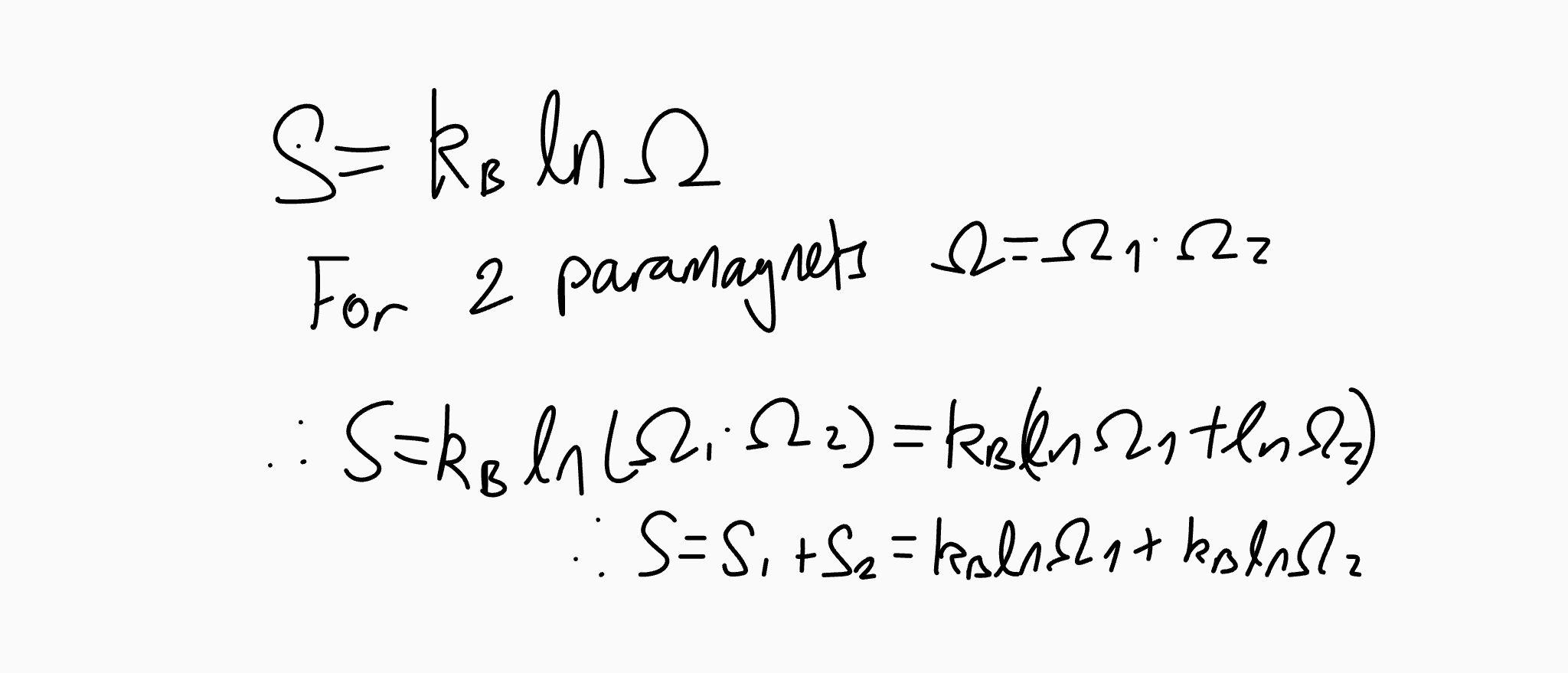
- 20What is the entropy of a 2 paramagnet system?
- 21What is an einstein solid?Einsting approximated a solid lattice to have approximatley equal spring constants for the lattice vibrations. We can then describe the solid with the frequency of this spring constant, w=2*pi*f where f is natural frequency
- 22What is the ground state energy of an einstein solid? What is the energy of an einstein solid generally?Eg=hbar*w*3/2 (for 3d lattice)
We ignore the ground state energy and just talk about the relative energy compared to the ground state
E=Hbar*w(Sum(n(i)))
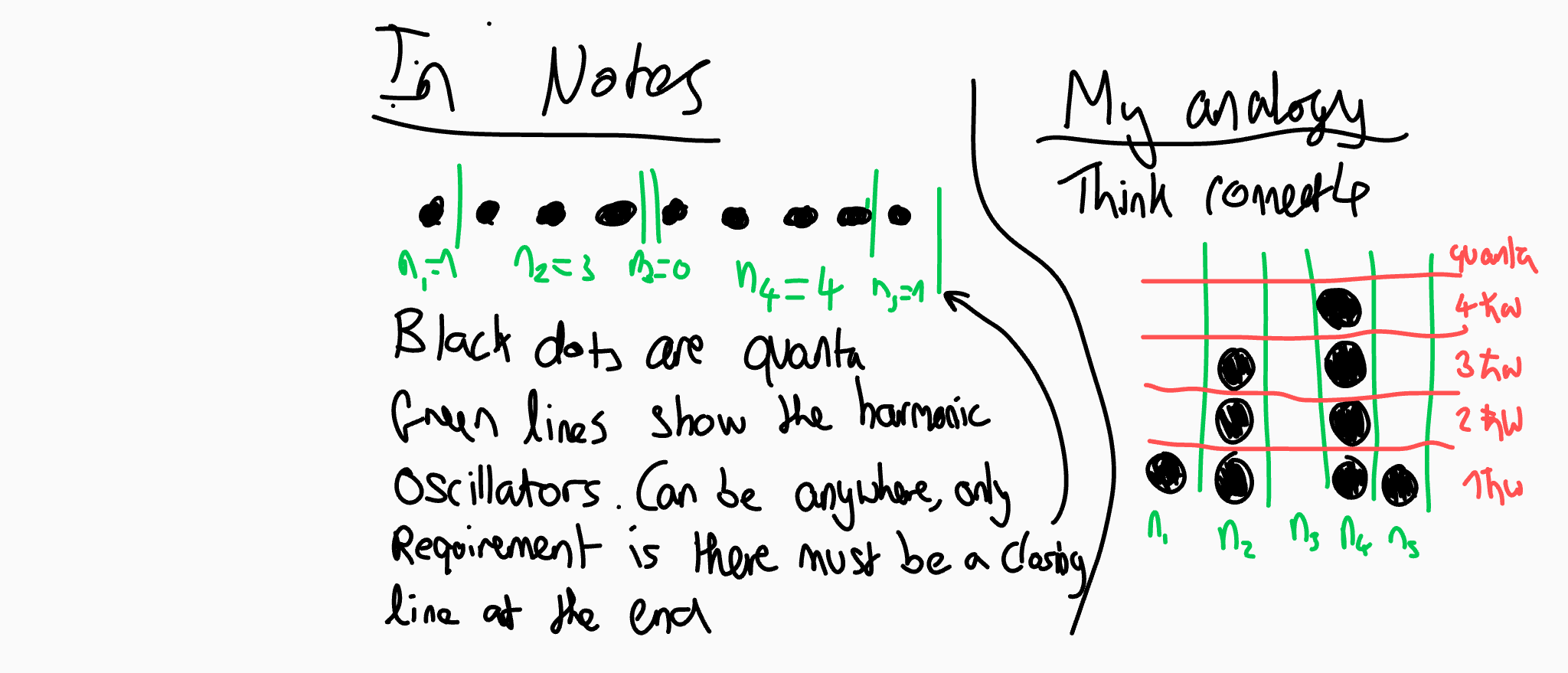
Where n(i) is the quanta, and i index the different oscilators. Each quanta =Hbar*w - 23How do we count multiplicity of an einstein solid? (Not equation the diagram)
- 24How do you derive the multiplicity of states

Informationen
- Beschreibung
- Karteikarten am Ohne Titel, erstellt von Elliot Bryce am 08/11/2018.
- Erstellt von
- Elliot Bryce
- Aufrufe
- 0
- Bewertung