
Thermodynamics
48 resources created by 39 users
This Thermodynamics page on GoConqr gathers community-made mind maps, flashcards, quizzes, notes and slide sets, from the laws of thermodynamics and heat transfer to Carnot engines and statistical mechanics. It's built for university students and professional candidates, school students, and teachers after ready-made material. There are over 280 resources here, including more than 29 quizzes and over 140 mind maps, made by over 230 contributors. Pick a mind map to get your bearings, then test yourself with a quiz.
Top Thermodynamics resources
-
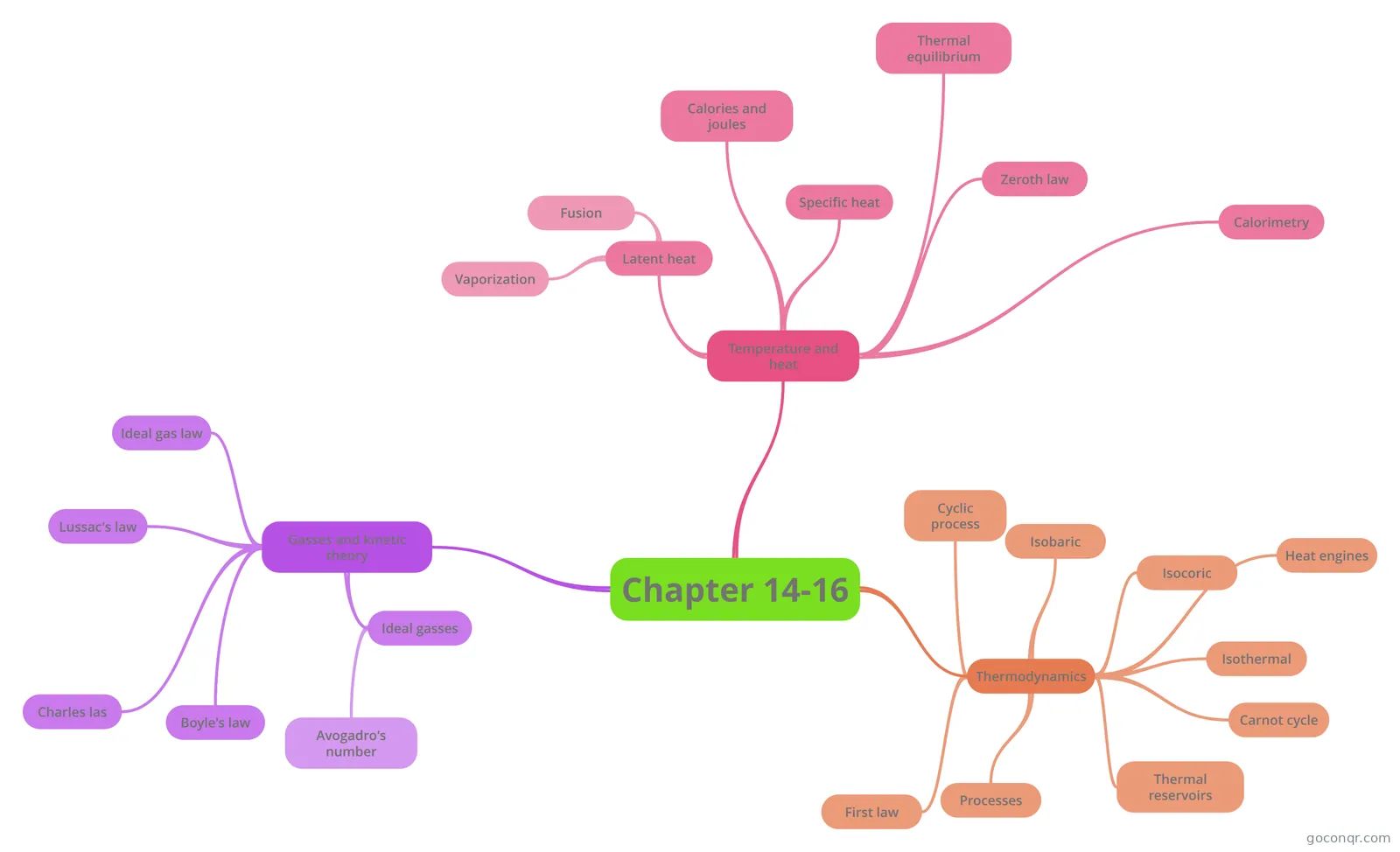
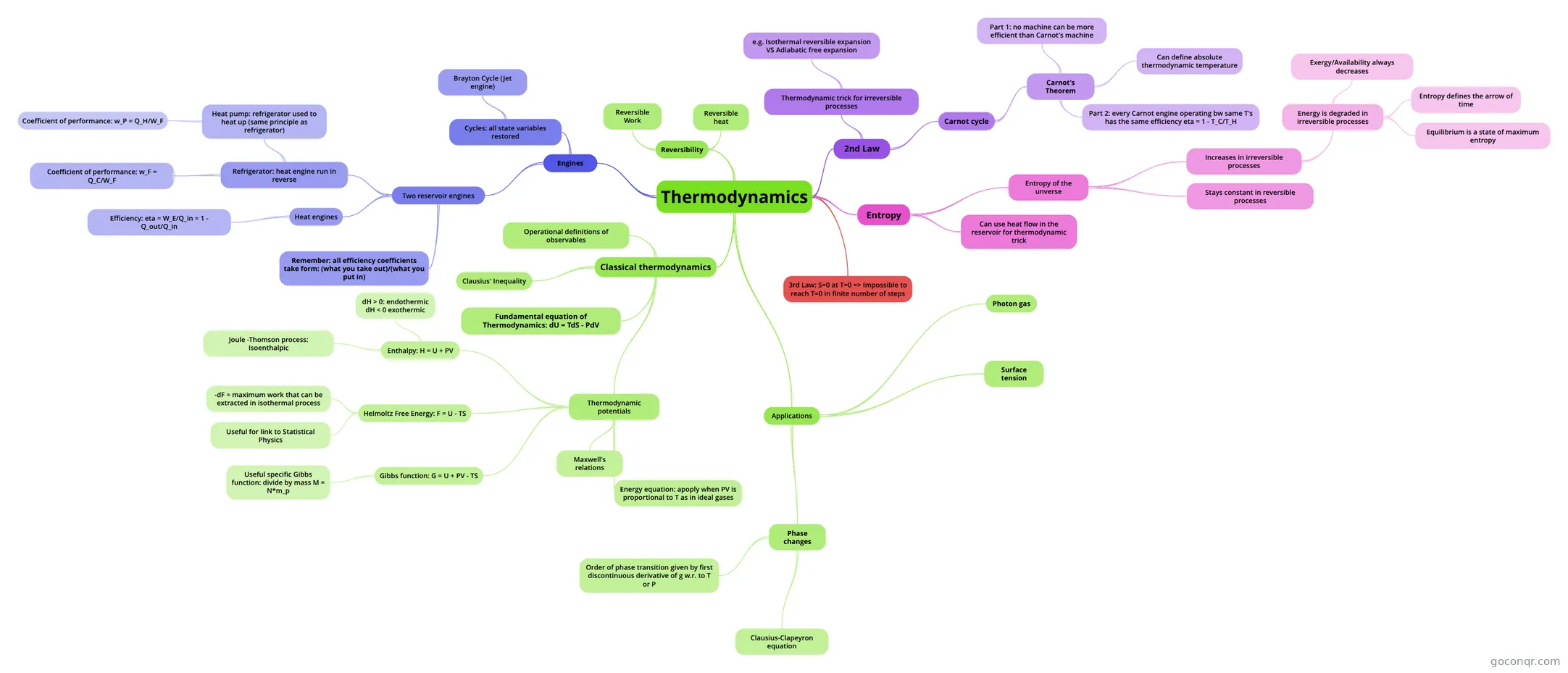 Mind map Thermodynamics
-
32 questionsCh. 15 & 16 Temperature is most closely related to molecular
-
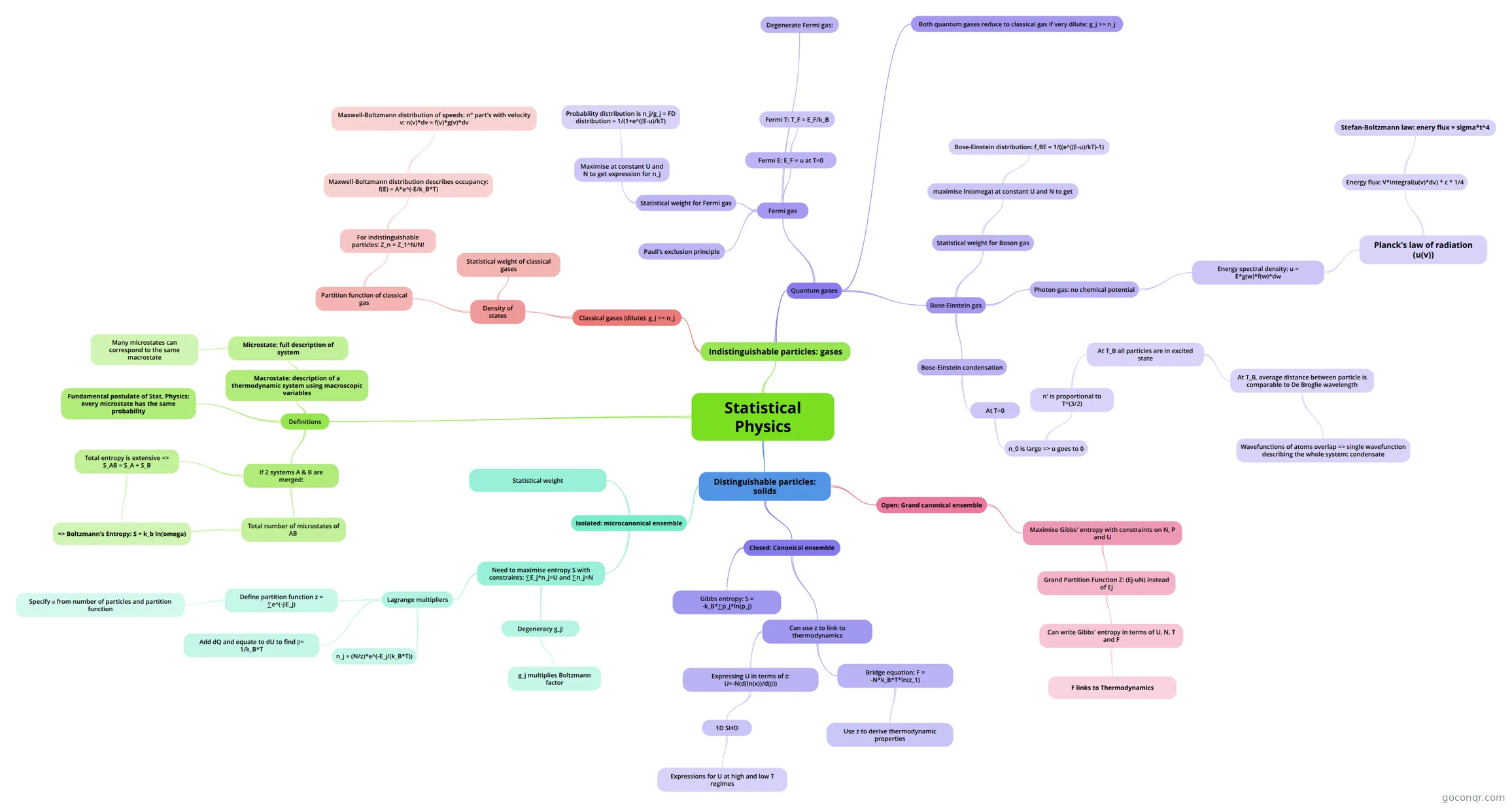 Mind map Statistical Physics
-
21 cardsStatistical Mechanics Spring 2020 Vahala
-
7 cardsThermodynamics (Quiz 3) An air-conditioning system operating on the reversed Carnot cycle is required to remove heat from the house...
-
Mind map The Laws of Thermodynamics
-
58 cardsPhysics GRE
-
38 cardsIntroduction to thermodynamics 2 What is a property?
Quizzes
-
32 questionsCh. 15 & 16 Temperature is most closely related to molecular
-
28 questionsCh. 17 - 19 When you walk barefoot on red-hot wooden coals it is best if
-
19 questionsTemperature & Heat What direction does heat flow spontaneously (happening apparently)?
-
12 questionsquick quiz What is the first law of thermodynamics
-
5 questionsQuizz 1 The temperature of a cup of water drops by 44oF when it is placed in a refrigerator for 45 minutes. How muc...
Mind maps
See all 11 mind maps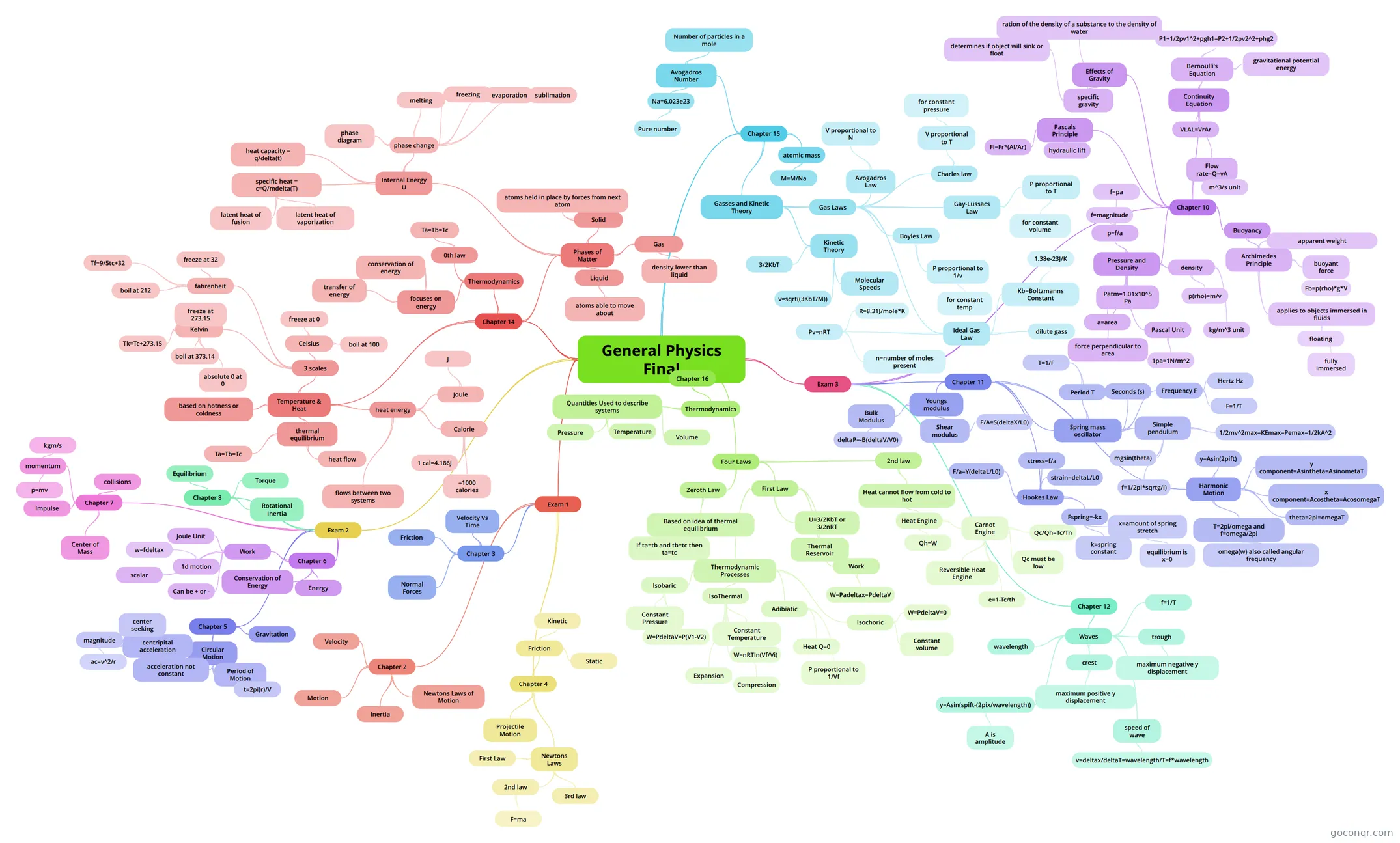
Flashcards
See all 21 flashcards-
21 cardsStatistical Mechanics Spring 2020 Vahala
-
7 cardsThermodynamics (Quiz 3) An air-conditioning system operating on the reversed Carnot cycle is required to remove heat from the house...
-
58 cardsPhysics GRE
-
38 cardsIntroduction to thermodynamics 2 What is a property?
-
15 cardsThermodynamics Explain equilibrium of a system in terms of thermodynamics
-
35 cardsPhysics Facts Flash Cards Facts for physics without information relating to the diagrams.
-
9 cardsLecture 1 - Information theory & Statistical Mechanics
-
20 cardsUnit 1.3 Energy Losses In what form does the energy from the sun reach the earth as?
Notes
-
Physics: Heat In physics and chemistry, especially in thermodynamics, heat refers to a process of transfer of energy between a system and its surroundings other than by work or transfer of matter.It is measured as the quantity of e...
-
thermodynamics THE UNIVERSITY of EDINBURGH SCHOOL OF PHYSICS University Homepage School of Physics Homepage Graeme Ackland's Front Page Thermodynamics Thermodynamics 2013-14 Welcome to the homepage for Junior Hon...
-
Thermodynamics - Lecture 4 Evaporation of sweat can be prevented if the existing VAPOUR PRESSURE of water in the atmosphere is too high. Water Vapour in the air-there is a fixed maximum amount of WATER VAPOUR that volume can hold at a particula...
-
Thermodynamics - Lecture 1 Temperature - Measure of how hot/cold something is (molecular state)-you MEASURE it with a thermometer - Constant volume gas thermometer -units K Kelvin-nothing colder than 0 kelvinThermal Equilibrium When systems in ...
-
Laws of Thermodynamics Laws of Thermodynamics An infrared camera is measuring infrared heat. It captures the heat release, and it gives you the shape. Thermodynamics is a branch of science that studies heat. Thermo (heat) and dynamics ...
-
Thermodynamics - Lecture 5 Heat Transfer - in an isolated system when two objects are in thermal contact TOTAL THERMAL ENERGY is conserved.Q1+Q2+Q3=0 -always hot to coldConduction - Contact heat transfer- when moving electrons/molecules exchang...
-
Thermodynamics - Lecture 3 Real gases-when temp too low and V too small-the attractive forces between atoms cause them to stick together, thus its CONDENSES to solid/liquid which is a PHASE CHANGESudden phase change doesn't occur when T exceeds...
-
Bulk Materials - Molecular Transport Phenomena Free Diffusion -SLOW process of movement of substance due to RANDOM thermal motion- moves from HIGH to LOW Xrms= average distance moved by moleculesDab = diffusion constant for molecules A in SUBSTANCE B. (ink molecul...
Slides
More Physics topics
About Thermodynamics
GoConqr OriginalWhat the unit covers
The resources run from basic ideas of temperature and heat to engines, cycles and statistical physics. The mind map The Laws of Thermodynamics sets out the Zeroth, First, Second and Third Laws side by side. The top-listed Thermodynamics mind map goes further into reversibility, reversible work and heat, efficiency (eta = W_E/Q_in = 1 - Q_out/Q_in), the Brayton cycle and two-reservoir engines.
Where to start
Begin with the basics. The notes Physics: Heat explain heat as a transfer of energy between a system and its surroundings. Then open the mind maps Heat and Temperature and Heat, and try the quiz Temperature & Heat. Once those feel familiar, move to The Laws of Thermodynamics.
Engines, cycles and gases
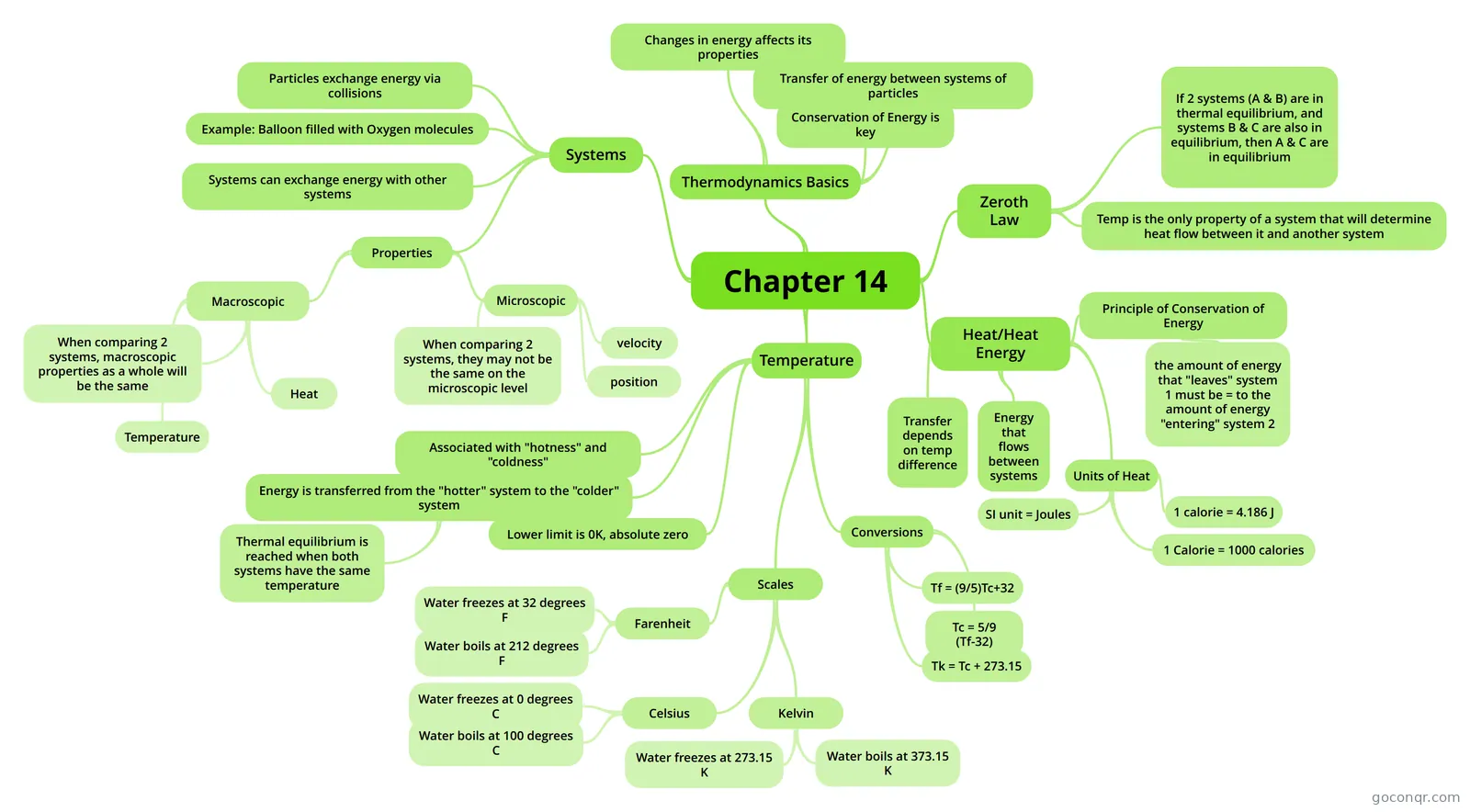
Next, look at the notes carnot engine and the mind map Thermodynamic Processes. The flashcard deck Thermodynamics (Quiz 3) includes a worked-style question on a reversed Carnot air-conditioning system. The mind map Chapter 16 links kinetic theory to the First Law, with internal energy as translational and rotational energy of gas molecules. The slide set Kinetic Theory of Gases covers the same ground in slides.
Statistical physics and exam prep
The Statistical Physics mind map separates macrostates from microstates. The Statistical Mechanics flashcards drill counting questions with the symbol Omega. For exam practice, the Physics GRE flashcards list constants such as the Boltzmann constant and the gas constant, and the deck MCAT Physics Chapter 1-4 is there for MCAT candidates.
Using maps and quizzes together
Read a map first, then take a quiz on the same topic, such as Heat Transfer or Thermodynamics Equations. Note what you got wrong and go back to that branch of the map. When you are ready, choose a resource and give it a go.
Frequently asked questions
Which resource should I open first?
Start with the notes Physics: Heat or the mind map Heat if temperature and energy transfer are new to you. If you already know the basics, open The Laws of Thermodynamics mind map, then check yourself with the Temperature & Heat quiz.
What do the mind maps cover?
They cover the four laws, reversibility, engine efficiency, cycles such as the Brayton cycle, heat pumps, kinetic theory, and the difference between macrostates and microstates. Several are also built around final exam chapters, so they work as quick revision overviews.
Are the resources free to use?
Yes. Every resource on this page is free to open, study and take, with no account needed. They were made by GoConqr users, not by GoConqr. A free account lets you save quiz scores and make your own quizzes, mind maps, flashcards and notes.
Which exams are mentioned?
Some listed resources mention the MCAT and the Physics GRE. The Physics GRE flashcards cover constants such as the Boltzmann constant, Avogadro's number and Planck's constant, while the MCAT Physics Chapter 1-4 deck covers early physics chapters.
Who are these resources for?
Mostly university students and professional candidates, with a good share for school students too. Teachers can use the ready-made slide sets, notes and quizzes. Because the resources came from different contributors, check that each one matches your own course.
What if I can't find the topic I need?
Try a nearby term such as heat transfer, entropy, Carnot engine or kinetic theory, since resources are titled in different ways. If nothing fits, you can make your own mind map, flashcards or quiz with a free account.