
Karteikarten
Text 5
Karten in diesem Stapel (10)
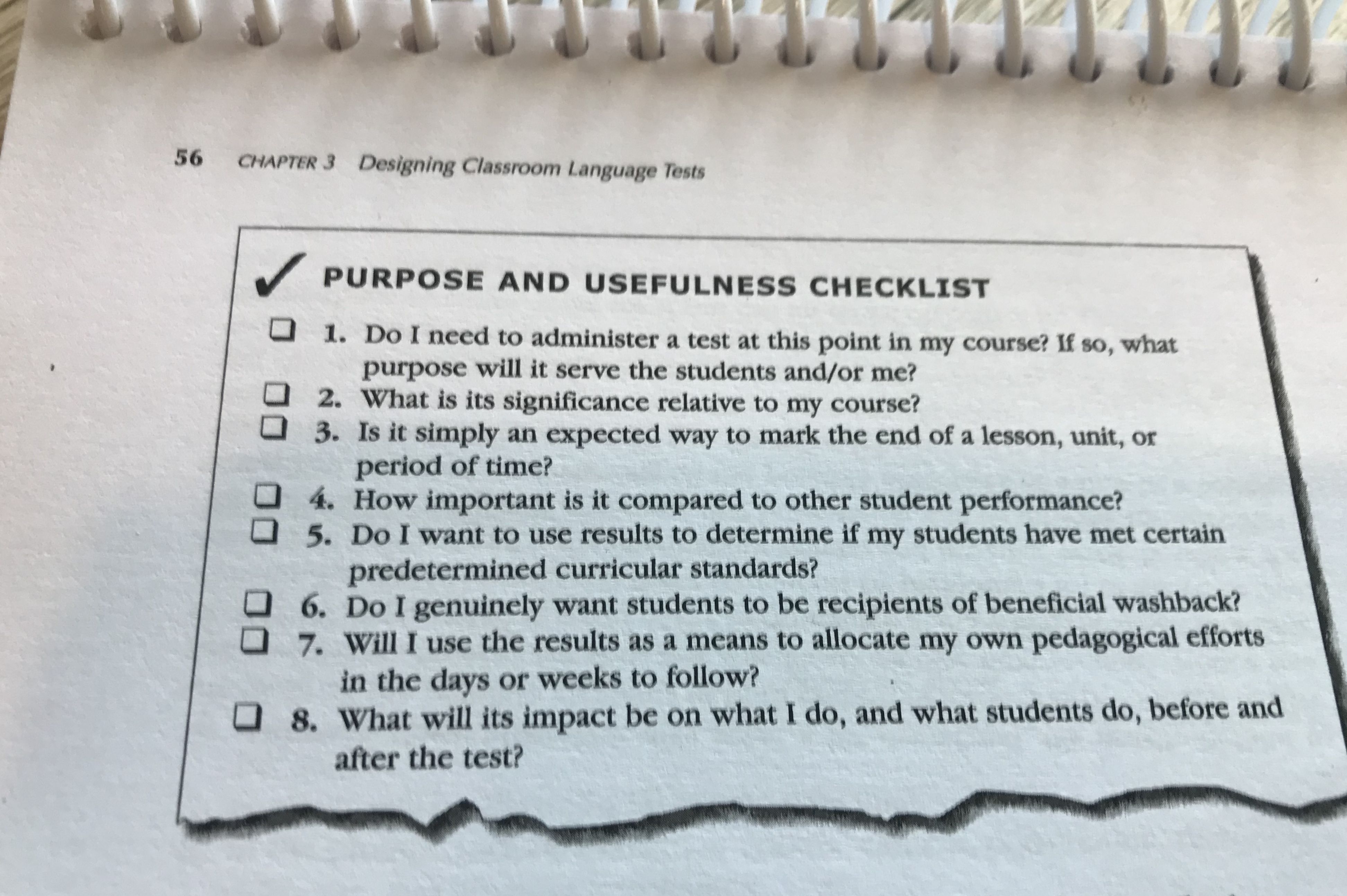
- 1Six questions to designing, ... a test1.) What is the purpose of the test?
2.) What are the objectives of the test?
3.) How will the test specifications reflect both the purpose and the objectives?
4.) How will the test item types (tasks) be selected and the separate items arranged?
5.) In administering the test, what details should I attend to in order to help students achieve optimal performance?
6.) What kind of scoring, grading, and/or feedback is expected ? - 2Determining purpose of a testpurpose of test is test usefulness, or to what use will you put an assessment?
- 3Purpose checklist
- 4Designing clear, unambiguous objectiveseg grammar uni test: either they are already formulated at beginning of chapter or you have to formulate yourself:
eg. Students will understan and produce the following verb tenses in appropriate oral and written contexts
1.) simple present (review from Level 1)
2.) present continuous
3.) simple past
4.) present perfect
to achieve content validity, the objectives should reflect all four modes of performance and sample all four verb tenses
you can divide the objectives into comprehension and production to give an instant checklist for your test specifications - 5Drawing up test specificationsspecs for classroom use can be an outline of your test - what it will ''look like''. Think of your test specs as a blueprint of the test that include the following
-a description of its content
-item types (methods, eg. cloze)
-tasks (eg. essay)
-skills to be included
-how the test will be scored
-how it will be reported to students
specs are not the actual test items or tasks but rather a description of limitations, boundaries, directions, and other details what you will adhere to - 6Devising test items-the implied elicitation and response formats for items
-the objectives you will cover
-the number of items in each section
-the time to be allocated for each - 7Designing multiple choice items which pricinples stand aout?practicality and reliability
- 8weaknesses of multiple choice items-the techniques tests only recognition knowleddge
-guessing may have a considerable effect on test scores
-the technique severely restricts what can be tested
-it is very difficult to write successful items
-beneficial washback may be minimal
-cheating may be facilitated - 9What are all multiple choice items?1.) MC items are all receptive, or selective response, items in that the test-taker chooses from a set of responses (commonly called a supply type of response) rather than creating a response. Other receptive item types include true/false questions and matching lists
2.) Every MC item has a stem (the body of the item that presents a stimulus) and several (usually between three and five) options or alternatives to choose from.
3.) One of those options, the key, is the correct response, whereas the others serve as distractors - 10Tips!Design each item to measure a single objective
State both stem and options as simply and directly as possible
Make certain that the intended answer is clearly the only correct one
Informationen
- Beschreibung
- Testing and Assessment Karteikarten am Text 5, erstellt von Lisza Neumeier am 17/05/2019.
- Erstellt von
- Lisza Neumeier
- Aufrufe
- 0
- Bewertung