
Language Assessment and Testing
436 resources created by 343 users
This Language Assessment and Testing page on GoConqr gathers community-made mind maps, flashcards, flowcharts and notes, from the principles of assessment and stages of test construction to assessing grammar, listening, reading and speaking. It's built for university students working through assessment theory, and for teachers after ready-made material. There are over 400 resources here, including more than 390 mind maps, almost all at university level. Pick a map, read it through, then build your own flashcards to test yourself.
Select topic
- History of Language Testing9
- Principles of Language Assessment63
- Language Proficiency Frameworks10
- Types and Approaches to Language Testing45
- Formative and Summative Assessment7
- Alternative and Authentic Assessment18
- Assessment Process and Test Design45
- Assessment, Teaching and Washback15
- Assessing Language Learners17
- Assessing Listening15
- Assessing Speaking18
- Assessing Reading10
- Assessing Writing14
- Assessing Grammar and Vocabulary15
- Assessing Integrated Language Skills8
Top Language Assessment and Testing resources
-
 Mind map The Alternatives in Language Assessment (Brown & Hudson, 1998)
-
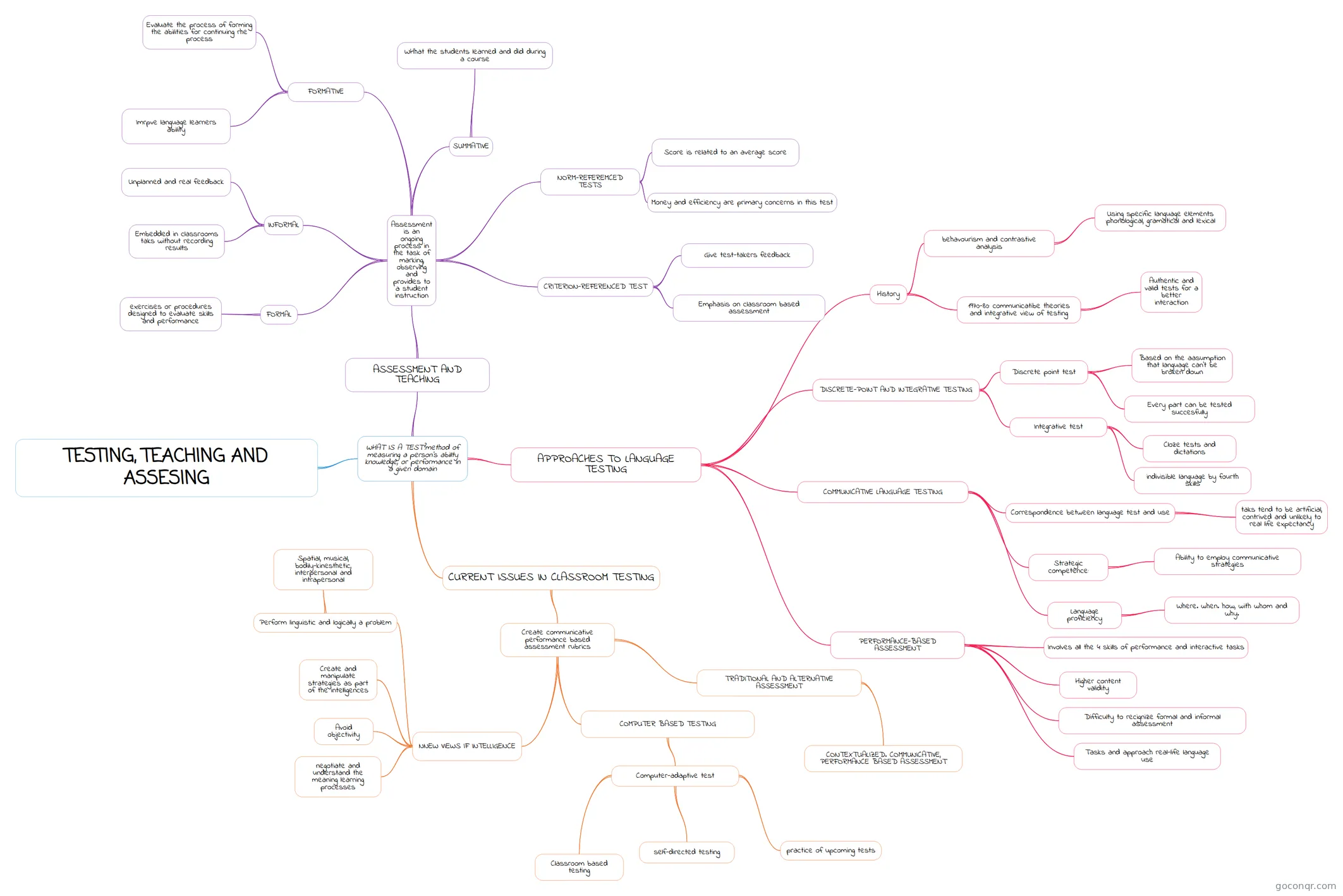 Mind map TESTING, TEACHING AND ASSESING Brown, H. D. (2004) Language Assessment: Principles and classroom practices. Longman. Chapter 1: Testing, A...
-
Mind map Principles of assessments Araceli
-
Mind map Assessing grammar Assessing grammar acording to Brown,
-
Mind map Assesment & Testing
-
Mind map How may assessment as learning be promoted/ implemented with a group of EFL learners.
-
Mind map ACTFL Proficiency Guidelines 2012
-
25 cardsText 2
Quizzes
Mind maps
See all 398 mind maps-
The Alternatives in Language Assessment (Brown & Hudson, 1998)
-
TESTING, TEACHING AND ASSESING Brown, H. D. (2004) Language Assessment: Principles and classroom practices. Longman. Chapter 1: Testing, A...
-
Principles of assessments Araceli
-
Assessing grammar Assessing grammar acording to Brown,
-
Assesment & Testing
-
How may assessment as learning be promoted/ implemented with a group of EFL learners.
-
ACTFL Proficiency Guidelines 2012
-
5 principles of Language Assessement
Flashcards
See all 12 flashcards-
25 cardsText 2
-
23 cardsGeneral Test method facets
-
19 cardsText 1a
-
10 cardsText 5 Six questions to designing, ... a test
-
7 cardsAssessment of Language Skills definition of language
-
5 cards6 - Assessing and Evaluating Language Competence
-
12 cardsstandarized tests Standarized tests adavatages
-
7 cardsText 6 different skills intertwined or seen separately?
Flowcharts
See all 21 flowchartsNotes
-
APPROACHES TO ASSESSING LISTENING - creado desde un Mapa Mental the discrete point approach: it is the common approach to language texting Language a system of habits which operates largely it is posible to identify and isolate the seperate elements of a language and test them sep...
-
LEARNING EVALUATION - created from Mind Map WHAT IS? Students are evaluate in different points and how to give more importance to the percents HOW?
-
What are the benefits and difficulties in assessments of English Learners? - created from Mind Map DIFFICULTY: English Learners may know the material, but struggle with the language. BENEFIT: Teachers can use the standards to focus on what students need to know DIFFICULTY: Measuring success according to specific cr...
-
Classroom Testing - created from Mind Map Testing Reading Listening
Topics in Language Assessment and Testing
More Education and pedagogy (incl. teaching methods, curriculum, educational psychology) topics
About Language Assessment and Testing
GoConqr OriginalWhat this page covers
The page is made up almost entirely of mind maps, with a smaller set of flashcard decks, flowcharts and notes. Together they follow language testing from first definitions through to the assessment of individual skills.
Where to start
Begin with the basics. The mind map Assesment & Testing defines a test as a method of measuring a person's ability, knowledge or performance in a given domain, and says the method must be explicit and structured. TESTING, TEACHING AND ASSESING then places assessment as an ongoing process within teaching.
Next, move to the principles. Principles of assessments and Principles of Language Assessment cover validity, reliability, practicality, authenticity and washback. The flowchart the five principles gives a second view of the same ideas, which helps if you like to compare layouts.
Building on the principles
- Stages of Test Construction walks through writing specifications, writing the test and pretesting.
- The Alternatives in Language Assessment (Brown & Hudson, 1998) looks at alternative assessments and their characteristics.
- Assessing grammar splits grammatical competence into forms, meaning and pragmatic meaning.
- Assessing listening, Assessing reading and Assessing Speaking deal with the individual skills.
For research-style examples, look at the maps on computerising an English language placement test and on washback in ESOL teaching and learning.
Using maps and flashcards together
Read a map first, then close it and try to rebuild its branches from memory. The flashcard deck Assessment of Language Skills suits a quick check afterwards. There is one quiz here, so use the maps and decks for most of your practice. Teachers can borrow a map as a starting point for a lesson or a staff discussion.
Where it fits
This unit sits in the Assessment and Evaluation strand of Education and pedagogy. Choose one map today and see how far you get.
Frequently asked questions
Which resource should I open first?
Start with the mind map Assesment & Testing, which sets out what a test is and what makes a method count as one. Then read TESTING, TEACHING AND ASSESING to see how assessment sits inside teaching, and move on to the maps on principles.
What do the mind maps cover?
There are over 390 of them. They cover the principles of assessment, types of tests and test questions, the stages of test construction, alternative assessment, and assessing grammar, listening, reading and speaking. Some also look at assessing English learners and at placement tests.
Are the resources free to use?
Yes. Every resource listed here is free to open, study and take, with no account needed. They were made by GoConqr users rather than by GoConqr itself, so it is worth comparing two maps on the same topic when you study.
Who is this page for?
It is aimed mainly at university students, since nearly all the resources are at that level, and at teachers looking for ready-made material. Students can use the maps to revise assessment principles, and teachers can adapt them for their own sessions.
Is there a quiz to test myself?
There is one quiz on the page, alongside over 10 flashcard decks. Use the quiz to spot gaps after reading the principles maps, then work through decks such as Assessment of Language Skills. A free account saves your quiz scores and lets you make your own.
What if I cannot find a topic I need?
Look at the related maps first, because several cover the same idea from different angles, such as the many versions of the principles of language assessment. If a topic is still missing, you can make your own map, flashcards or notes.