
Karteikarten
Physics 4: Atomic structure

Karten in diesem Stapel (71)
- 1What is the radius of an atom?
- 2How does the radius of the nucleus compare to the radius of the whole atom?
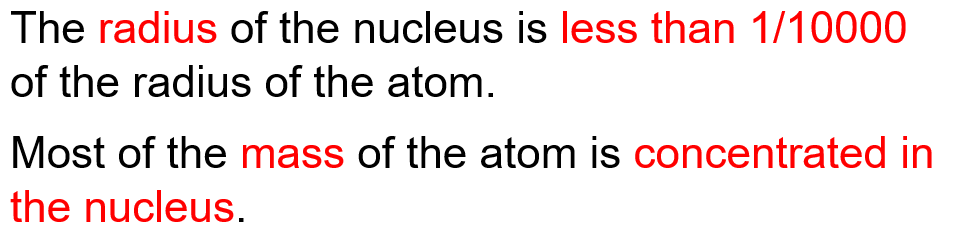
- 3Describe simply the structure of the atom (the current model)

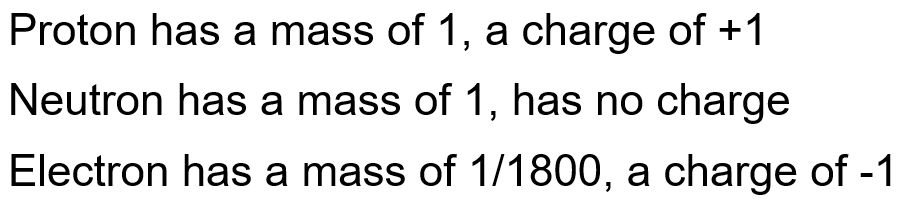
- 4Compare the proton, neutron and electron
- 5What does the mass number mean?

- 6What does the atomic number mean?

- 7An atom of sodium (Na) has 11 protons and 12 neutrons. What is the symbol for this atom? How many electrons does the atom have?

- 8What happens if an atom loses one or more outer electrons?

- 9An atom has no overall charge – what does this mean?

- 10Define what isotopes are

- 11Describe how electrons are arranged in the atom

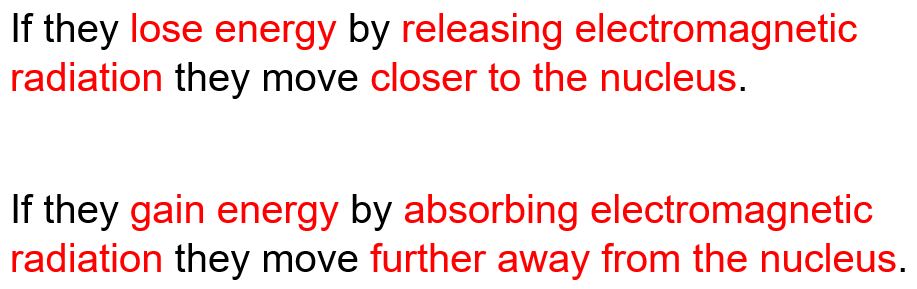
- 12How can an electron move to a shell closer, or further away from the nucleus?
- 13What causes a new scientific model to be change or replaced?

- 14Who suggested the Plum Pudding model of the atom?

- 15Describe the plum pudding model

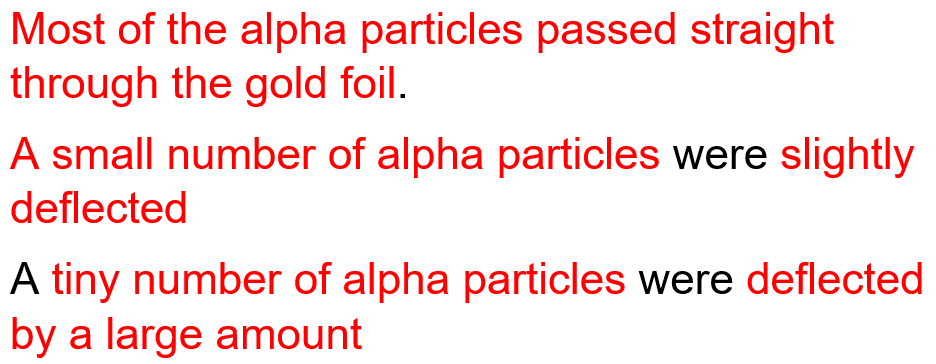
- 16State the results of the alpha scattering experiment
- 17What were the names of the scientists carrying out the alpha scattering experiment?

- 18What conclusions where made about the nucleus from the alpha scattering experiment?Most of the alpha particles went straight through the foil - most of the atom must be empty space; the nucleus is very small.
Some of the alpha particles were deflected - The nucleus must be positively charged.
A small number were deflected back to where they came from - the nucleus must be dense. Most of the mass of the atom must be concentrated in the nucleus. - 19What conclusions where made about the nucleus from the alpha scattering experiment?Most of the alpha particles went straight through the foil - most of the atom must be empty space; the nucleus is very small.
Some of the alpha particles were deflected - The nucleus must be positively charged.
A small number were deflected back to where they came from - the nucleus must be dense. Most of the mass of the atom must be concentrated in the nucleus. - 20What did Niels Bohr suggest about the atom in (1913)?Electrons orbit at different specific distances from the nucleus.
- 21What did Niels Bohr suggest about the atom in (1913)?Electrons orbit at different specific distances from the nucleus.
- 22What did James Chadwick discover about the structure of the atom in (1932)?He discovered the neurton.
- 23What did James Chadwick discover about the structure of the atom in (1932)?He discovered the neurton.
- 24What is an alpha particle?2 neutrons and 2 protons. (the same as a helium nucleus).
- 25What is an alpha particle?2 neutrons and 2 protons. (the same as a helium nucleus).
- 26What is a beta particle?A high speed electron emitted from the nucleus.
- 27What is a beta particle?A high speed electron emitted from the nucleus.
- 28What is a gamma ray?Electromagnetic radiation from the nucleus.
- 29What is a gamma ray?Electromagnetic radiation from the nucleus.
- 30What does count rate mean? What is it measured in?Number of decays per second recorded by a Gieger muller tube.
- 31What does count rate mean? What is it measured in?Number of decays per second recorded by a Gieger muller tube.
- 32What does activity mean? What is it measured in?Rate at which a source of unstable nuclei decays.
Becquerels, Bq - 33What does activity mean? What is it measured in?Rate at which a source of unstable nuclei decays.
Becquerels, Bq - 34Compare the properties of alpha, beta and gamma. (Their penetration through materials, range in air and ionising power)

- 35What equipment is used to detect nucleur radiation?A Geiger-Muller tube. (GM tube)
- 36What equipment is used to detect nucleur radiation?A Geiger-Muller tube. (GM tube)
- 37Describe what happens to a nucleus when it emits a alpha particle?The nucleus loses two protons and two neutrons.
- 38Describe what happens to a nucleus when it emits a alpha particle?The nucleus loses two protons and two neutrons.
- 39Describe what happens to a nucleus when it emits a beta particle?A neutron from the nucleus turns into a proton and an electron. The electron is released. The proton gets added back into the nucleus.
- 40Describe what happens to a nucleus when it emits a beta particle?A neutron from the nucleus turns into a proton and an electron. The electron is released. The proton gets added back into the nucleus.
- 41Describe what happens to a nucleus when it emits a gamma?It loses energy.
- 42Describe what happens to a nucleus when it emits a gamma?It loses energy.
- 43Write the full decay equation for radon-219 decaying by alpha emission.

- 44Write the full decay equation for carbon-14 decaying by beta emission.

- 45What happens to the mass and charge of the nucleus when it decays by alpha?The mass and charge both decrease.
- 46What happens to the mass and charge of the nucleus when it decays by alpha?The mass and charge both decrease.
- 47What happens to the mass and charge of the nucleus when it decays by beta?The mass does not change.
The charge increases. - 48What happens to the mass and charge of the nucleus when it decays by beta?The mass does not change.
The charge increases. - 49What happens to the mass and charge of the nucleus when it decays by gamma?The mass and charge do not change.
- 50What happens to the mass and charge of the nucleus when it decays by gamma?The mass and charge do not change.
- 51Define what half life is?The time it takes for the number of nuclei in a sample to halve, or the timw it takes for the count rate/actuvity to fall to half of its original level.
- 52Define what half life is?The time it takes for the number of nuclei in a sample to halve, or the timw it takes for the count rate/actuvity to fall to half of its original level.
- 53How can you find half-life from a graph?

- 54An isotope has an initial count rate of 8000 counts. What is the net decline after 3 half lives (HT)?After 3 half lives = 1000
Therefore net decline is 1/8. (1/2 × 1/2 × 1/2) - 55An isotope has an initial count rate of 8000 counts. What is the net decline after 3 half lives (HT)?After 3 half lives = 1000
Therefore net decline is 1/8. (1/2 × 1/2 × 1/2) - 56Why can radioactivity be harmful?It is ionising.
Low doses can cause cells to mutate and divide, causes cancer.
Hight doses can kill cells. - 57Why can radioactivity be harmful?It is ionising.
Low doses can cause cells to mutate and divide, causes cancer.
Hight doses can kill cells. - 58What is radioactive contamimation?Unwanted radioactive atoms get into or on an object. The contaminating atoms continue to emit nuclear radiation, which could end up inside the body.
- 59What is radioactive contamimation?Unwanted radioactive atoms get into or on an object. The contaminating atoms continue to emit nuclear radiation, which could end up inside the body.
- 60What is radioactive irradiation?Exposing an object to nucleur radiation means it is irradiated. It will not emit radiation afterwards as it does not have contaminating atoms on or in it.
- 61What is radioactive irradiation?Exposing an object to nucleur radiation means it is irradiated. It will not emit radiation afterwards as it does not have contaminating atoms on or in it.
- 62What is the main difference between irradiation and contamination?A contaminated object will emit radioactivity afterwards.
An irradiated object will not. - 63What is the main difference between irradiation and contamination?A contaminated object will emit radioactivity afterwards.
An irradiated object will not. - 64List precautions that could be taken to protect against contamination.Gloves, tongs, radiation suits, masks.
These all prevent getting contaminating atoms on the skin or inside the body. - 65List precautions that could be taken to protect against contamination.Gloves, tongs, radiation suits, masks.
These all prevent getting contaminating atoms on the skin or inside the body. - 66List the precautions that could be taken to protect against irradiation.Keep sources in lead lined boxes, use tongs to hold at arms length, use lead sheilding/ stand behind a lead barrier.
- 67List the precautions that could be taken to protect against irradiation.Keep sources in lead lined boxes, use tongs to hold at arms length, use lead sheilding/ stand behind a lead barrier.
- 68What factors can affect how harmful a radioactive source is?- If the source is alpha, beta or gamma and its half life.
- Alpha is the most ionising, so the most damaging inside the body. It is the least harmful outside the body as it is blocked by the sun.
-Outside the body beta and gamma or the most dangerous as they can penetrate the skin. - 69What factors can affect how harmful a radioactive source is?- If the source is alpha, beta or gamma and its half life.
- Alpha is the most ionising, so the most damaging inside the body. It is the least harmful outside the body as it is blocked by the sun.
-Outside the body beta and gamma or the most dangerous as they can penetrate the skin. - 70What is peer review, and why is it important?When other scientists check experiments and results to make sure that the experiments have been carried out correctly and results are valid.
- 71What is peer review, and why is it important?When other scientists check experiments and results to make sure that the experiments have been carried out correctly and results are valid.
Informationen
- Beschreibung
- GCSE Physics Karteikarten am Physics 4: Atomic structure, erstellt von AsimAli Rehman am 27/05/2019.
- Erstellt von
- AsimAli Rehman
- Aufrufe
- 0
- Verlauf
-
- Erstellt von Isleworth Physics · 21 Mai 2018
- Kopiert von AsimAli Rehman · 27 Mai 2019
- Bewertung