
Karteikarten
Mission Statements, aims and objectives and stakeholders
Karten in diesem Stapel (23)
- 1Mission Statement definitionA mission statement is a qualitative statement of an organisations aims. It uses language intended to motivate employees and convince customers, suppliers and those outside the organisation of its sincerity and commitment.
- 2ObjectiveGoals to be achieved in a set period of time
e.g.
-Increase sales revenue
- Decrease unit cost - 3SWOT AnalysisInternal :
Strength
Weakness
External:
Opportunity
Threat - 4P.E.S.I.L.E- Political
- Economic
- Social
- Technology
- Legal
- Environment - 5Mission Statement intended for:Stakeholders:
- Employees
- Customers
- Suppliers
- Shareholders
- Community - 6Characteristics of a good mission statement- Clear and concise
- Positive
- Outline core values and beliefs
- Easy to communicate - 7Criticisms of mission statements- Sometimes doesn't mean anything
- Too long
- Overly optimistic
- Might not be realistic and reliable - 8Mission :A qualitative statement of the business' aims
- 9Aims:A long term plan from which a companies objectives are derived
- 10Objectives:- Target that must be achieved in order to realise the stated aim
- A time assigned targets derived from the goals and set in advance of strategy - 11Corporate Strategy:Is concerned with deciding what business the organisation should be in, where it wants to be, and how it is going to get there
- 12Corporate strategy is a game plan for:- Satisfying customers
- running the business
- beating the competition
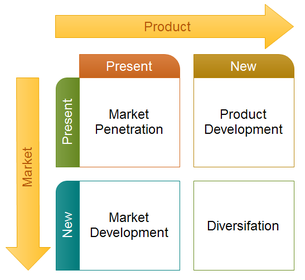
- achieving corporate objective - 13Ansoff MatrixConsists of:
-Market penetration
- Product development
- Market development
- Diverifacation - 14Ansoff Matrix Diagram:
- 15Market Penetration:Least risk strategy because you are in both an existing market and selling an existing product.
e.g. of businesses:
- Subway
- Coca-Cola
- Cadbury Dairy Milk - 16Product Development:This has a potential risk as the company would be selling a new product.
e.g. of businesses
- Rolls Royce (SUV)
- Cadburys
- Apple - 17Market Development:Potential risk as the company would be selling in a new market.
e.g. of businesses
- Tesco moving into the china and USA market (now have pulled out)
- Rolls Royce moving into Europe, Middle East and the USA. - 18DiversifacationHighest risk as you are selling a new product in a new market - therefore may require a lot of research and development.
e.g
- Apple iWatch
- Virgin (airlines, trains, TV etc.)
There is RELATED such as BMW creating other vehicles.
However there is UNRELATED which would be BMW creting a clothing range. - 19DiversifacationHighest risk as you are selling a new product in a new market - therefore may require a lot of research and development.
e.g
- Apple iWatch
- Virgin (airlines, trains, TV etc.)
- Lego Games (PS/Xbox)
There is RELATED such as BMW creating other vehicles.
However there is UNRELATED which would be BMW creting a clothing range. - 20Porters matrixConsists of:
- Cost leadership
- Defferfentiation
- Focused cost leadership
- Focused Differentiation - 21Porters Matrix Diagram
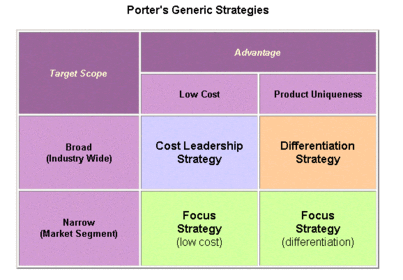
- 22Cost Leadershipe.g.
- Primark
- Lidl
- Pound Land
(all stores that sell products for the cheapest price - strategy being cost minimisation) - 23Differentiatione.g.
- Apple
- Sainsbury's
- Top Shop
- Jaguar/Landrover
(They are differentiated meaning that they have something of a USP)