
Karteikarten
Modern Blockciphers
Karten in diesem Stapel (13)
- 1What are iterated ciphers?There are states that are split up, all having the length of block length.
You have a round function that manipulates the state and then xor's a key. - 2What is key whitening?Initializing the state before the first round by xoring the 0th round key with the plaintext.
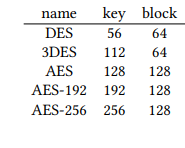
- 3What are the key sizes and block lengths for DES and AES variants?
- 4What is an SP Network an example of and what's it's diagram?AES
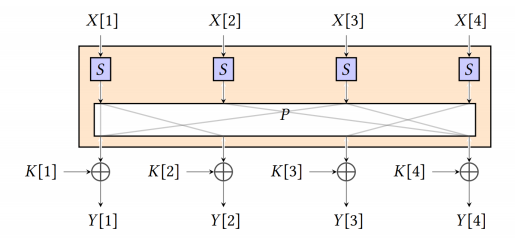
- 5What does the S layer do in the SP Network?Manipulates the states that have been split up into very small sizes and uses an operation called an S-box which is used using lookup tables so it can be complex without big computation.
- 6What does the P layer do in the SP Network?Manipulates the entire state not just chunks using an F2 linear function (linear function of any amount of bytes)
- 7What makes a good P layer?A small change in a plaintext would percolate to the entire ciphertext (diffusion), that way the quicker it percolates the less rounds you need
- 8What is a Feistel Network an example of and what's it's diagram?DES where F is a mixing function, where the inverse is on the right
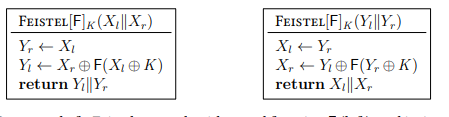
- 9Difference between SP and Feistel Networks?In Feistel mixing function F need not be invertible since deciphering uses the forward direction of F
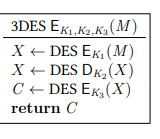
- 10Why do we use 3DES?Since 2DES selects 2 keys and enciphers twice but recovering a 112 bit key is the same as recovering 2 56 bit keys
- 11What is 3DES?Three keys are used, key 1 to encode M to get X. Key 2 deciphers X and then key 3 encodes it again to give C.
- 12If a key/block is 64 bits how many permutations/keys are there?2^64
- 13How many bits does a (C,M) pair fix for it's key?64
Informationen
- Beschreibung
- Cryptography Karteikarten am Modern Blockciphers, erstellt von Philip Masters am 09/01/2020.
- Erstellt von
- Philip Masters
- Aufrufe
- 0
- Bewertung