
Cryptography and Encryption
254 resources created by 175 users
This Cryptography and Encryption page on GoConqr gathers community-made quizzes, mind maps, flashcards and notes, from block cipher modes and hash functions to key management, certificates and SSL. It's built for university students and professional candidates practising for exams such as Security+ and CISSP, and for teachers after ready-made material. There are over 240 resources here, including more than 50 quizzes, over 100 mind maps and over 60 flashcard decks. Pick a topic, try a quiz to find your gaps, then make your own study sets.
Select topic
- Symmetric and Asymmetric Encryption19
- Symmetric Encryption14
- Block and Stream Ciphers12
- Public Key Cryptography10
- Hash Functions and Message Authentication17
- Digital Signatures7
- Key Management10
- Public Key Infrastructure and Digital Certificates16
- Cryptographic Protocols and Secure Communication13
- Cryptanalysis and Attacks8
Top Cryptography and Encryption resources
-
41 questionsCh 4 - Advanced Cryptography A certificate repository (CR) is a publicly accessible centralized directory of digital certificates
-
40 questionsCh 3 - Basic Cryptography A collision attack is an attempt to find two input strings of a hash function that produce the same hash re...
-
25 questionsQuiz 7 The process of transforming ciphertext to plaintext is known as:
-
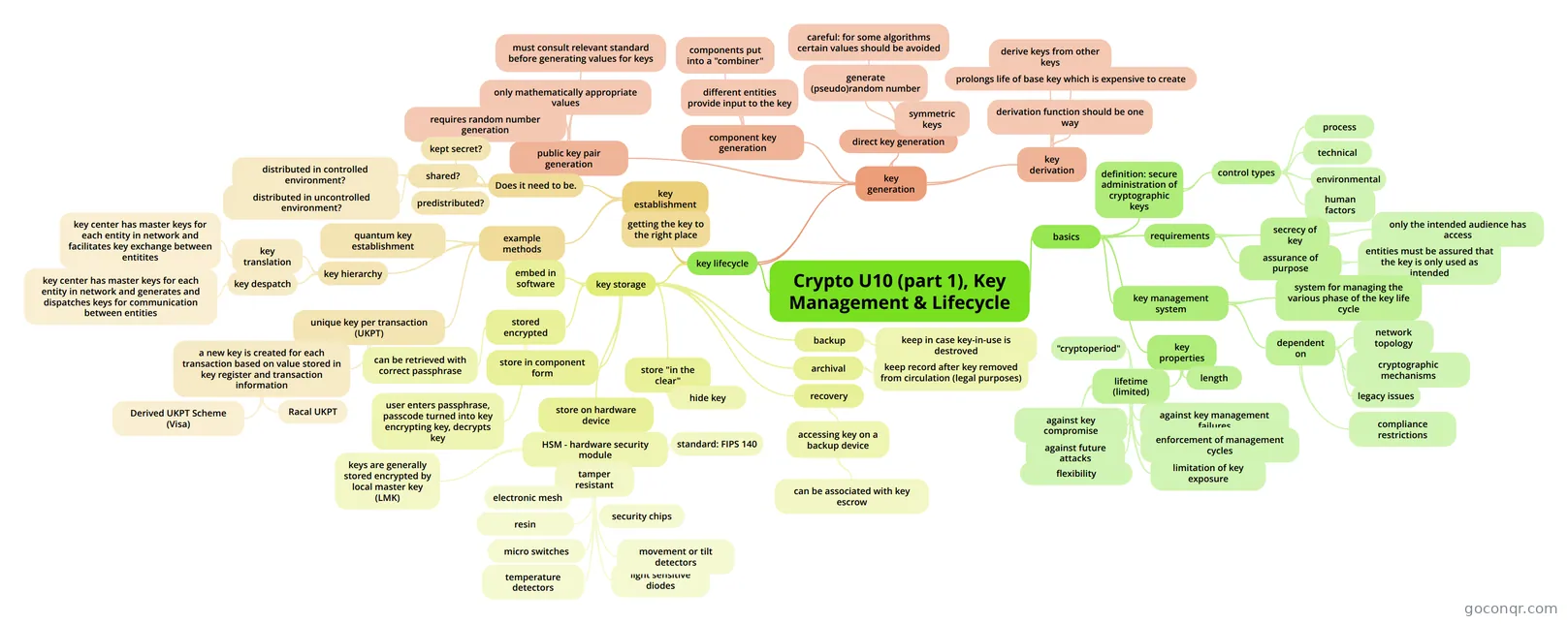 Mind map Crypto U10 (part 1), Key Management & Lifecycle
-
20 cardsChapter 6 Review Questions For exam 2
-
10 questionsCriptography Check the statement that is not part of the design principles for the JCA and JCE:
-
29 cardsSystem Admin - Intro to cryptography What is cryptography?
-
13 cardsOne-Time Cryptosystems What is a one-time pad?
Quizzes
See all 60 quizzes-
41 questionsCh 4 - Advanced Cryptography A certificate repository (CR) is a publicly accessible centralized directory of digital certificates
-
40 questionsCh 3 - Basic Cryptography A collision attack is an attempt to find two input strings of a hash function that produce the same hash re...
-
25 questionsQuiz 7 The process of transforming ciphertext to plaintext is known as:
-
10 questionsCriptography Check the statement that is not part of the design principles for the JCA and JCE:
-
91 questionsSecurity + Domain 6 Practice Test - Cryptography and PKI A manager has told you she is concerned about her employees writing their passwords for websites, network f...
-
102 questionsMidterm review 6-8 Why is the binary mathematical operation that is used for simple encryption not secure?
-
113 questionsoku_kerek_tagy_byr_ret A message is authentic and digitally signed if sent with:
-
99 questionsECES Study Material Test What is the block size of Blowfish?
Mind maps
See all 104 mind maps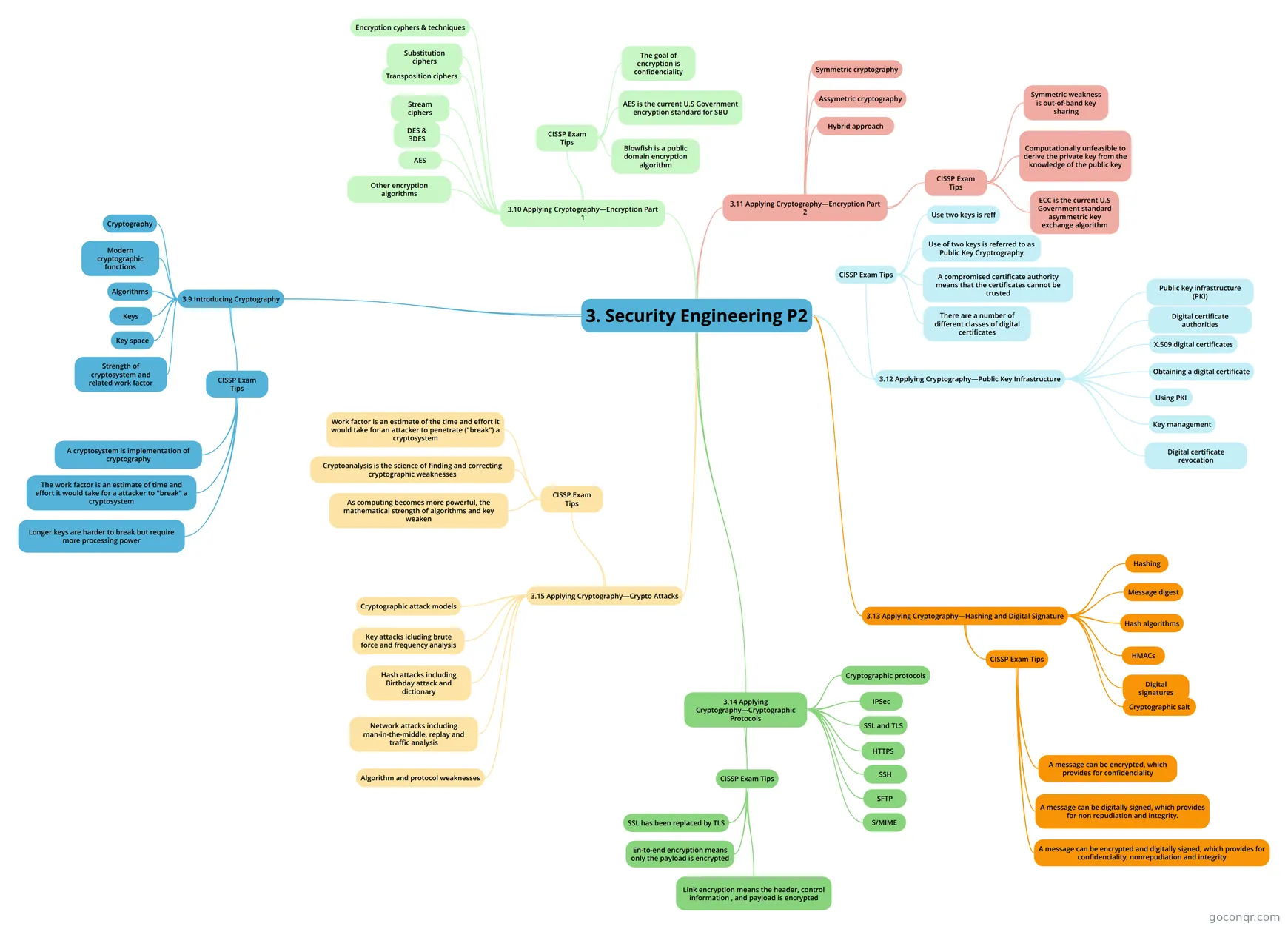
Flashcards
See all 63 flashcards-
20 cardsChapter 6 Review Questions For exam 2
-
29 cardsSystem Admin - Intro to cryptography What is cryptography?
-
13 cardsOne-Time Cryptosystems What is a one-time pad?
-
14 cards2. Block Ciphers What is padding?
-
184 cards363 What is probability?
-
130 cards363 Security and Risk L1-9 What is the equation for a Lemma (if A and B are mutually exclusive)
-
97 cardsIntro to computer security What is RC4 and where is it used?
-
69 cards1.1 Cryptographic Concepts and Techniques What is key stretching
Flowcharts
Notes
See all 19 notes-
Crypto U4, Block Cipher, Cipher Feedback Mode (CFB) Encryption Start with an initialization vector (IV). Pass IV and key to the encryption function. XOR the result of the encryption function with the first plaintext block. The result is the first ciphertext block. Pass...
-
Identification and Authentication Identification Definition ensures that an entity requesting access to resources by using a certain set of credentials is the true owner of the credentials associates a particular user (or software process) with an act...
-
Cryptography Encryption- Encoding a message such that only authorised users may read it Cipher- Encryption algorithm- Takes string of plaintext and converts it into string of ciphertext Encryption can provide: Confidentiality Inte...
-
What is Cryptographic Hashing? MD5, SHA, and More! WHAT IS CRYPTOGRAPHIC HASH? When you hear the term hashing in the digital world, it’s usually referring to a cryptographic hash. This is essentially the “fingerprint” of some data. A hash is a string of random-looking...
-
SYMMETRIC ENCRYPTION Process of converting one binary string to another binary stringINPUT - sequence of plaintext bitsPROCESS - perform series of operationsOUTPUT - series of cyphertext bits STREAM CIPHERINPUT - one bit of plai...
-
PUBLIC KEY ENCRYPTION TRAPDOOR ONEWAY FUNCTIONAnybody should be able to compute as its a public key and has two properties function should be Easy to compute function should be Hard to reverse Hence, the function that has above properties ...
-
Hash Functions Introduction One way hash functions are easy to compute, but hard to reverse Sometimes they have no inverse at all One way hash functions are usually a lot smaller than the origional input Examples Brute force can be ...
-
Crypto U4, Block Cipher, Cipher Block Chaining Mode (CBC) Encryption Start with an initialization vector (IV). XOR the IV with the first block of plaintext. Pass the result and the key to the encryption function. The result of the operation is the first ciphertext block. XOR...
Slides
Topics in Cryptography and Encryption
More Cybersecurity topics
About Cryptography and Encryption
GoConqr OriginalWhat this unit covers
The resources here follow cryptography from first principles to practical use. Notes such as Crypto U4, Stream Cipher sit alongside notes on block cipher modes: Electronic Codebook, Cipher Block Chaining, Cipher Feedback and Counter. The Cipher Feedback note walks through starting with an initialisation vector, passing it and the key to the encryption function, then combining the result with the first plaintext block.
Where to start
Begin with the basics. The mind map Crypto U1, Basic Principles and the flashcard deck 1. Introduction to Cryptography cover plaintext, ciphertext and the two ways of turning one into the other. Then move to Crypto U3, Theoretical vs. Practical Security and the One-Time Cryptosystems flashcards, which ask about the one-time pad and Shannon's Theorem.
Keys, certificates and protocols
Once ciphers feel familiar, look at how keys and identities are handled. The mind map Crypto U10 (part 1), Key Management & Lifecycle breaks key administration into technical, process, environmental and human factors. Crypto U9, Cryptographic Protocols and Crypto U12, SSL follow. The quiz Ch 4 - Advanced Cryptography tests certificate repositories and digital certificates, and the Chapter 6 Review Questions flashcards cover certificate authorities.
Using quizzes and maps together
- Read a mind map to see how a topic fits together.
- Take a quiz on the same topic, such as Ch 3 - Basic Cryptography, which covers collision attacks and the move on from DES.
- Note what you missed and return to the matching notes or flashcards.
- Repeat until the answers come without hesitation.
If you are preparing for an exam, the page also lists material mentioning Security+, CISSP, CEH and CCNA, including CISSP Cryptography and Symmetric Key Algorithms and CCNA Security Chapter 7 Quiz & Exam.
Where it fits
This unit belongs to the Cryptography and Identity strand of Cybersecurity. Choose one mind map today, then see how much of its quiz you can answer.
Frequently asked questions
Which resource should I open first?
Start with the mind map Crypto U1, Basic Principles, or the flashcard deck 1. Introduction to Cryptography. Both cover the basic vocabulary. After that, try Ch 3 - Basic Cryptography, a quiz that checks hashing and encryption ideas before you move on to certificates and keys.
What do the mind maps cover?
There are over 100 mind maps. They range from basic principles and randomness to cryptographic protocols, key management and lifecycle, SSL and mobile telecom cryptography. Others cover hash functions, DES, certificates and symmetric ciphers, so you can see how each topic connects to the next.
Are these resources free to use?
Yes. Every resource on this page is free to open, study and take, with no account needed. They were made by GoConqr users, not by GoConqr itself. A free account also saves your quiz scores and lets you make your own quizzes, mind maps, flashcards and notes.
Which exams do the resources mention?
The listed resources mention Security+, CISSP, CEH and CCNA. Examples include Security + Domain 6 Practice Test - Cryptography and PKI, CISSP Cryptography and Symmetric Key Algorithms, and CCNA Security Chapter 7 Quiz & Exam. Check the content against your own syllabus.
Who is this page for?
It mainly suits university students and professional candidates who want to practise cryptography topics with quizzes, flashcards and maps. Teachers can use the ready-made material too. Most resources are at university level, with a smaller share aimed at professional study.
What if I can't find a topic I need?
Browse the notes, flashcards and quizzes by name, as many use chapter or week titles rather than topic names. If something is still missing, you can make your own notes, maps or flashcards for it.