
Karteikarten
Leg Ulcers
Karten in diesem Stapel (24)
- 1Define a leg ulcer.Full thickness skin loss on the leg or foot due to any cause.
--> loss of skin below the knee on the leg or foot, which takes >2 weeks to heal. - 2What are the main types of ulcer?Arterial, venous, mixed, neuropathic/diabetic, pressure sores.
Other = malignancy, infections (TB), trauma (osteomyelitis) - 3What type of ulcer is more common on the leg?Venous (65%)
Arterial (15%)
Other (20%) - 4What type of ulcer is more common on the foot?Arterial (70%)
Venous (5%)
Other (15%) - 5What are the risk factors for developing an arterial ulcer?- Coronary heart disease
- Stroke/TIA
- Peripheral arterial disease (intermittent claudication)
- Obesity
- Diabetes
- Immobility - 6What are the risk factors for developing a venous ulcer?- Varicose veins
- Previous history of trauma/injury
- FHx venous disease
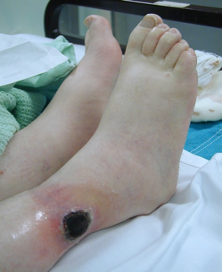
- Previous DVT/phlebitis - 7Where are venous ulcers typically found?Lower calf/ankle region
- 8What are the signs and symptoms of venous ulcers?Relatively painless unless infected
Associated with aching, swollen lower legs that feel more comfortable when elevated.
May be surrounded by mottled brown/black staining and/or dry, itchy and reddened skin (venous eczema)
Can be associated with varicose veins (incompetence of superficial venous system) - 9What pathophysiological factors can increase the risk of venous ulcers?Thrombophlebitis - venous inflammation and clots
Venous stasis (poor blood flow through veins) - 10What are the symptoms of venous insufficiency?Pain and heaviness, poor mobility, restless leg syndrome, leg cramps/spasms, itch (can be problematic as already have thin skin - scratching may cause entry point for infections).
- 11What is venous insufficiency?A condition that occurs when the venous wall and/or valves don't work properly, therefore blood pools in the legs (venous stasis).
- 12What are the causes of venous insufficiency?Overweight
Pregnancy
Family history
Injury/trauma
Previous DVT
Sitting or standing for long periods over time
Lack of exercise
Smoking
Phlebitis - 13Where are arterial ulcers generally found?More distal than venous - dorsum of feet/toes
- 14What are the causes of arterial ulcers?Arterial occlusion/PVD
(atherosclerosis, vasospasm, inflammatory vascular disease) - loss of nutrients and oxygen lead to tissue break down. - 15What are the signs and symptoms of arterial ulcers?Nocturnal pain - worse when supine and relieved by dangling legs out of bed.
Associated features of chronic ischaemia (hairlessness, pale skin, absent pulses, nail dystrophy and wasting of calf muscles) - 16What do arterial ulcers look like?'Punched out border' - ulcer base contains greyish granulation tissue.
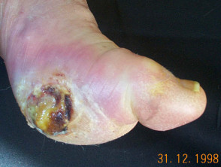
- 17Where are neuropathic ulcers generally found?Often under calluses or over pressure points.
- 18What are the causes of neuropathic ulcers?Diabetes
Peripheral neuropathy
This is due to loss of sensation due to sensory neuropathy which makes patients vulnerable to physical/chemical/thermal trauma. - 19What are the signs and symptoms of neuropathic ulcers?Usually painless ulcer, with surrounding area having reduced sensation.
Probing or debriding may lead to brisk bleeding. - 20What do neuropathic ulcers look like?Punched-out appearance with a deep sinus. Often surrounded by chronic inflammatory tissue.
- 21How do you investigate ulcers?Bloods (raised CRP/WCC ?infection, HBA1c/glucose)
Swab if evidence of infection (culture and sensitivities
ABPI (<0.9 suggests arterial disease)
Doppler US (evidence of thrombophlebitis? Underlying DVT?)
Medical photography - 22How are arterial ulcers managed?General advice - stop smoking, good nutrition, attention to hygiene, limit risk factors.
Treat underlying arterial insufficiency
Refer to vascular
Medical (statin, antiplatelets) vs surgical management (angioplasty, bypass grafting) - 23How are venous ulcers managed?General advice - stop smoking, good nutrition, attention to hygiene, limit risk factors.
Good nursing care
Dressings/compression bandages
Refer to tissue viability/district nurses - 24How are neuropathic ulcers managed?General advice - stop smoking, good nutrition, attention to hygiene, limit risk factors.
Investigate cause
Optimise management of underling care (e.g. improve HbA1c)
Regular foot checks (CPR)
Bespoke footwear to off load pressure
Informationen
- Beschreibung
- Dermatology Karteikarten am Leg Ulcers, erstellt von Jenna Paterson am 09/10/2020.
- Erstellt von
- Jenna Paterson
- Aufrufe
- 11
- Tags
- Bewertung