
Karteikarten
Electrical Engineering Interview Questions
Karten in diesem Stapel (30)
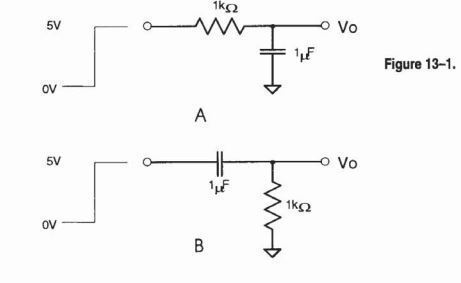
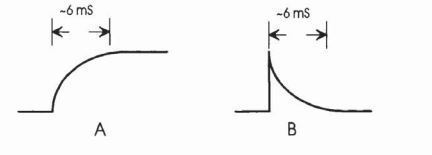
- 1If you put a 0-5 voltstep voltage referenced to ground into the circuits shown, what would you expect the wave forms to look like at the output?Voltage across a capacitor cannot change instantaneously.
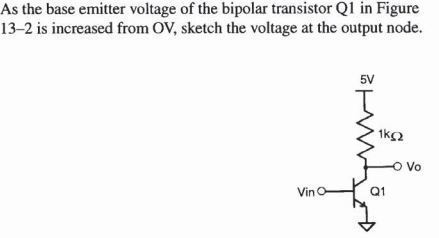
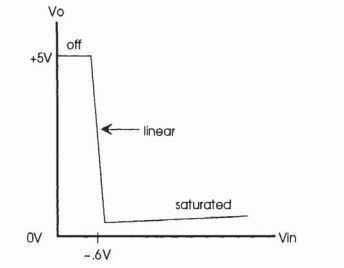
- 2—The output voltage has 3 distinct regions, Q1 off, Q1 in linear, saturation.
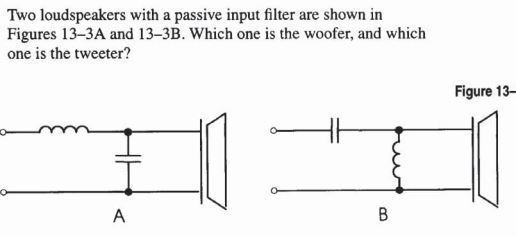
- 3—A woofer is for low frequency sounds and a tweeter is for high frequency sounds. A is the woofer and B is the tweeter.
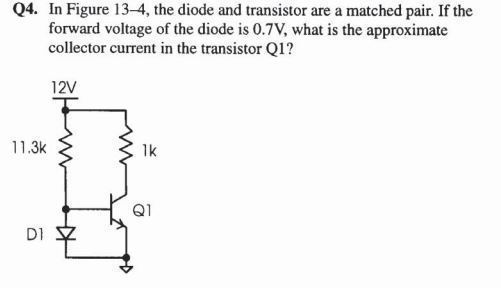
- 4—the current through the diode is (12V-0.7V)/ 11.3k Ohms = 1mA. If the diode and transistor are a matched pair, the circuit works as a current mirror and the collector current will be 1mA.
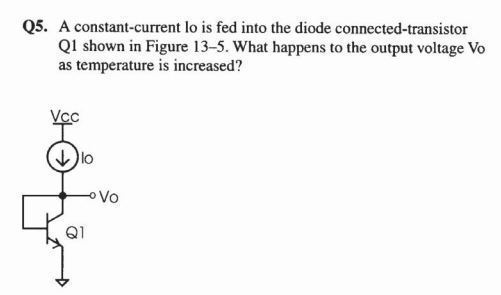
- 5—For a BJT, a diode connected transistor is always in the active region. The output will show a slop of about -2mV/degree C
- 6—A: -R2/R1
B: 1+ R1/R2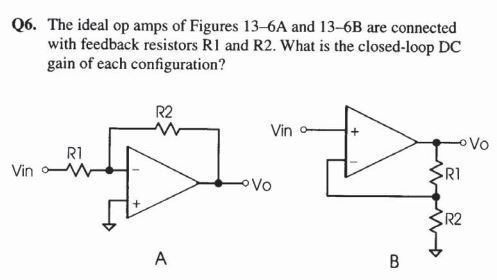
- 7Assume these op-amps have finite gain Ao, what are the closed-loop gains?A: 1/[1/Ao + R1/Ao - R1/R2]
B: (R2+R1)/[(R2+R1)/Ao + R2]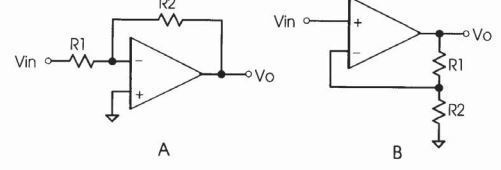
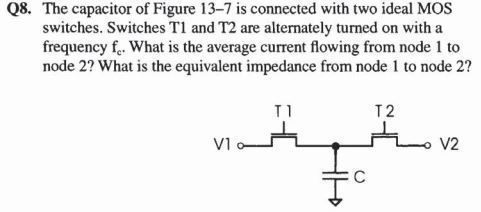
- 8—Every clock cycle, a charge of C(V1-V2) goes through the capacitor. Current is charge/time. So, average current is C(fc)(V1-V2). Equivalent impedance is found using Ohm's law, = 1/Cfc
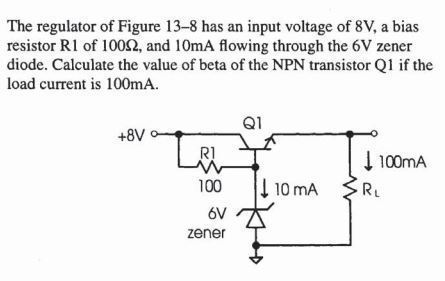
- 9—Current in R1 is (8-6)/100=20mA. The Zener needs 10mA to sustain the 6V, so the base current is 20mA-10mA = 10mA. Beta =Ie/Ib - 1=100mA/10mA -1 = 9
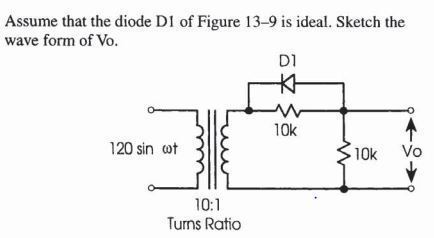
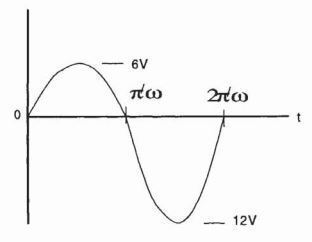
- 10—With a 10:1 turn ratio, the peak Vo is 120 * 1/10=12V. On positive half cycle, diode doesn't conduct so output voltage is 6V. On negative half cycle, diode conducts and output is 12V.
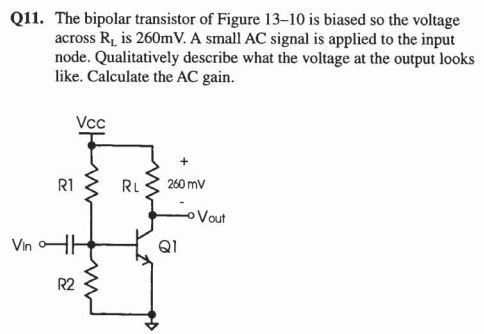
- 11—the output voltage would look like an amplified sinusoidal wave with polarity opposite of the input signal. The gain = -gm*RL, gm = Ic/Vt. So, gain = IcRL/Vt. IcRL = 260mV, so gain = -10
- 12—

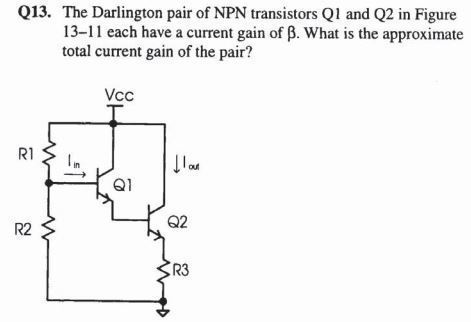
- 13—Beta(Beta + 1)
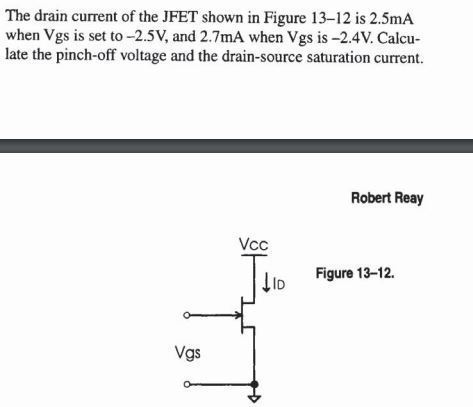
- 14—Drain current Id=Idss(1-Vgs/Vp)^2. Use the two cases given to get two equations and use them to find Idss and Vp. Idss=9.8mA and Vp=-2.45V
- 15—

- 16For a passive RC low pass filter, is the output voltage across the resistor or capacitor?Capacitor
- 17Is an RC integrator circuit a low or high pass filter?low pass
- 18In a RC high pass filter, is the output voltage across the resistor or capacitor?Resistor
- 19Is a RC differentiator circuit low or high pass?high pass
- 20Explain a linear voltage regulatorUses a transistor controlled by a differential amplifier to compare the output voltage with a reference voltage and adjusts transistor to maintain the desired constant output
- 21Explain switching voltage regulator.It converts dc input voltage to a pulsed voltage applied to a power transistor. Output is fed back into a circuit that controls the power transistor's on and off times to maintain constant output voltage
- 22In Verilog, write code that swaps contents of 2 registers with and without a temporary register.With temp reg ;
always @ (posedge clock)
begin
temp=b;
b=a;
a=temp;
end
Without temp reg;
always @ (posedge clock)
begin
a <= b;
b <= a;
end - 23In Verilog, what is the difference between blocking and non-blocking statements?A blocking statement uses = and it evaluates that single statement before moving on the other statements. A non blocking statement uses <= and it evaluates the right hand sides of all the non blocking statements before updating the left hand sides
- 24How does switching frequency impact regulator designs?Higher switching frequency means it can use smaller capacitors and inductors but it also brings more noise in circuit.
- 25In Verilog, how do you open a file for reading and writing?Reading: file = $fopenr("filename");
Writing: file = $fopenw("filename"); - 26What's a common function of a differential amplifier?For a differential pair, it multiplies the voltage difference between 2 inputs by the differential gain
- 27What is a class in C++?A class is a user defined data type, that contains its own properties and functions. Syntax:
class student {
//data members;
//function members;
} - 28For a current mirror, should the output impedance be low or high? What about input impedance?Output impedance should be high and input impedance should be low
- 29In Verilog, what are different ways to close a file?Closing file for input: r = $fcloser(file);
Closing file for output: r = $fclosew(file); - 30What is an object?An object is an instance of a class and can operate on the class's data and functions. Syntax:
Student s = new Student();
Informationen
- Beschreibung
- Mainly analog and digital electronics.
- Erstellt von
- Moustafa Hassen
- Aufrufe
- 7
- Bewertung