
Karteikarten
Ohne Titel
Karten in diesem Stapel (94)
- 1What are Polya’s 4 Principles of problem solving?1. Understand the problem
2. Devise a plan
3. Carry out the plan
4. Looking back - 2What is an algorithm as defined in the lecture?We define an algorithm to be a set of rules that precisely defines a sequence of operations such that each rule is
effective and definite and such that the sequence terminates in a finite time. - 3What are 4 ways of representing algorithms?- Flowcharts
- Pseudo-code
- Natural Language
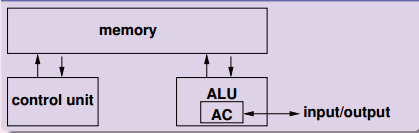
- Programming Language - 4What is The Von Neumann Architecture? Draw a picture
- 5Name the components of Von Neumann Architecture?Central Processing Unit (CPU)
Memory
Bus - Data, Address and Control
Program Counter (PC)
Arithmetic and Logic Unit (ALU)
Registers - instruction, status, index,
Input/Output (I/O) Devices - 6What is a first generation computing language?Machine Language
- Processor dependent.
- Hard to program.
- Not portable. - 7What is a second generation programming language?Assembly Language.
More like a symbolic
version of machine language. Easier to program, but still tedious. Examples - 8086 and PDP-11 assembly languages. - 8What is a third generation programming languageSimilar to spoken language. Much
easier to program. Fairly portable.Examples - C,
Fortran. - 9What is a fourth generation programming language?Completely portable between supported
processor types. Each line of code produces significant amount
of machine instructions.
Examples - Java, Ada, C#, Matlab,
SQL. Includes Domain Specific Languages like OCL, QVT,
Eclipse Modeling Framework, Unix shell. - 10What is an imperative/procedural programming paradigm?A traditional approach. A
sequence of commands that leads to the desired output.
Examples - C, FORTRAN, COBOL and Ada. - 11What is a declarative programming paradigm?Develop a precise statement of the problem, rather than an algorithm for solving the problem. Built on an
underlying general problem-solving algorithm. Formal logic
provides such an algorithm. Example - Prolog. - 12What is a functional programming paradigm?Programs written as a bunch of functions.
Recursion and nesting is natural in this approach. Example -
Haskell. - 13What is an object orientated programming paradigm?The system is specified as a collection of
objects and interactions between these objects. Examples -
Simula, Smalltalk, Java, C++, C# - 14What does MATLAB stand for?Matrix Laboratory
- 15who created matlab?Cleve Moler
- 16What type of programming paradigm does matlab use?OOP/imperative
- 17What does weakly typed mean and is matlab weakly typed?Weakly typed - converts types as required. Result of a mixed
operation (eg., 10 + ’40’) is not clear.
and Yes - 18What does dynamically typed mean and is matlab dynamically typed?most of the type checking done at
run-time.
and yes it is - 19What does IDE stand for?Integrated development environment
- 20What is a code block?A block of code treated as a single unit
- 21What is iteration?Iterates over a block of code i.e. while and for loops
- 22What is a cell array?similar to an array but can hold data of any class
- 23What is a structure?Items in a structure are stored as fields and indexed by field names.
- 24Name three conditions for recursion?1'. There must be a terminating equation
2. the function must call itself
3. The parameters called must move towards the terminating condition - 25What is the process of head recursion?1. call is made
2. calculation is done
3.result is returned - 26What is the process of tail recursion1. calculation is done
2. call is made
3.result is returned - 27What is mutual recursion?2 functions call each other recursively until terminating condition
- 28What is interpolationHaving an unknown point for an unknown function and finding a point between them
Matlab: linear or cubic - 29what is regression?Fitting a polynomial to the data
- 30Why did software engineering come about?-software crisis
-more complex software systems
-budgets and schedules going over time
-larger impact of failures - 31Software contents requirements-Functionality
-external interfaces
-performance
-attributes
-design constraints - 32Software quaility requirementsCorrect
unambiguous
complete
consistent
ranked for importance
verifiable
modifiable
traceable - 33What is a non functional requirement?Software architecture
- high level shape of the system
- big components and how they fit together - 34What is a functional design requirement?Design
- Certain elements do certain things
- The objects and functions inside the big components. - 35What is a class?An abstract concept
- 36What is an instance?A particular class/thing
- 37Name three kinds of attributes?- Descriptive
- naming
- referential - 38What is a descriptive attribute?Provides facts about a class instance
i.e persons age - 39What is a naming attribute?Provides a label
i.e. an ID code - 40What is a referential attribute?Associates one instance of one class to another
i.e. the U in your uni id connects you the the university - 41What is a composite data type?Kind of like a class but publicly accessible components
contains multiple data types. - 42What defines an attribute?-Name
-Type
-initial value (optional) - 43What does a class description contain?Why the class fits together and the background for the class
- 44What does an attribute description contain?Basic description of its characteristics
- 45What is a non cohesive class?When a class has behaviors that may never be used at once and maybe never in the same instance.
- 46What is specialization?A type of relationship
A type of thing becomes a class
Type of class becomes a subclass - 47What is version control?The management of changes to collections of information
- 48What are some useful things about version control?- maintains history of all your code
- each revision has a time stamp + user
- revisions can be restored
- no need for back ups - 49What is a repository?It stores files and directories. It records all revisions.
- 50Name two types of repositoriesCentralized
Decentrailized - 51What is a centralized repository?Where the repository is kept on a serve for all to access.
- 52What is a decentralized repository?Where each user has their own copy of the repository.
- 53Name an example of a decentralized repositoryGit
Mercurial
Bazaar - 54Explain what push and pull mean in version controlPush- to peer/server
pull - from peer/server - 55Name 3 performance aproachesBenchmarking, profiling, analisys
- 56What is bench marking?Running standard tests designed to mimic work load.
- 57What is synthetic bench marking?Using special programs created to simulate work load.
- 58What is application bench marking?Running real applications to test the program
- 59What is profilingInvestigating a programs behavior and gathering information
- 60What are the main parameters of interest during performance profiling.- overall speed
- memory requirements
-network utilization - 61Name three types of profiling- event based profiling
- statistical based profiling
- instrumenting profiling - 62What is complexity theory?The study of space/time performance
- 63In complexity theory what does a basic RAM model assume?- No parallel operations
- All basic operations take time - 64What are some examples of basic operations?addition/subtraction
assignments
comparisons
multiplications - 65What is big O notationAn indication of how long a program takes to run, where n is the number of basic operations.
e.g. O(2n) - 66What is tractable big O notation?A polynomial time solution
- 67What is intractable big O notation?An exponential time solution
- 68How does insertion sort work?Inserts new item into sorted data
if data not sorted then it will make an empty collection and put items into proper place by comparing them
O(n^2) - 69How does bubble sort work?Data is compared with next element if larger then they swap. This is repeated up the list and then repeated until all elements are sorted.
O(n^2) - 70How does quick sort work?First checks if vector size is one. Then picks a pivot element all numbers smaller than the pivot are moved to the left and vise versa. Then it recursively sorts the left and right sections.
ave O(nlogn) max n^2 - 71How does merge sort work?1. Check is size is 1
2. divides up into to lists
3. recursively sorts each list
4. merges lists
5. sorts entire vector
O(nlogn) - 72How does bucket sort work?1. sets up number of empty buckets
2. goes through and puts data into buckets
3. sorts each bucket
4. visits each bucket to reassemble to parts
O(nlogn) - 73What are 2 types of searching methods?Simple search
binary search - 74How does simple search work?Moving left to right it compares each term with the one it's trying to find until it gets a match.
O(n) - 75How does binary search work?Finds the middle element if it's the number then it returns index. If higher recurses to the right and vise versa.
O(logn) - 76Does binary search work for unsorted lists?No
- 77What are behavioral entities?Components or objects with well defined behavior in a system
- 78What is abstraction?Only focusing on what you need to focus on
- 79Define an objectAn instance or instanciation of a class
- 80Define a methodManipulation of behavior, how you interact with an object
- 81What is inheritance?When a subclass inherits attributes/methods (you can redefine the methods)
- 82What is polymorphism?The ability to take more than 1 form. i.e. objects may have different behavior when called using the same method.
- 83Name the 4 key concepts in OOPAbstraction
encapsulation
inheritance
polymorphism - 84What is a value class?A value class constructor returns an instance that is associated with the variable to which it is assigned. If you reassign this variable, MATLAB creates a copy of the original object. If you pass this variable to a function, the function must return the modified object.
- 85What is a handle class?A handle class constructor returns a handle object that is a reference to the object created. You can assign the handle object to multiple variables or pass it to functions without causing MATLAB to make a copy of the original object. A function that modifies a handle object passed as an input argument does not need to return the object.
- 86When should you use a handle class?Use a handle class when you don’t want to have identical copies of
an object in the system.
e.g a phone book - 87Name two methods of access of methodsPublic
Private - 88What is a constructor method used for?To set specific values in a class
- 89What is an overloaded constructor?A constructor that does things differently based on the number of inputs
- 90What is extrapolation?Finding a point outside the data points
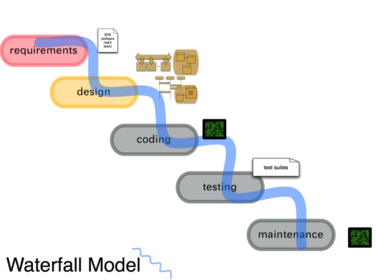
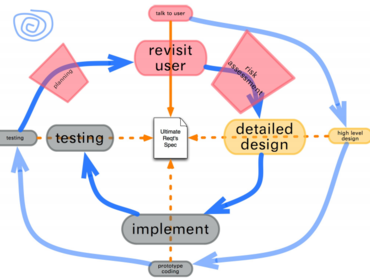
- 91What are two types of software life cycle analysis?Waterfall model
spiral model - 92What is the waterfall model
- 93What is the spiral life cycle model?
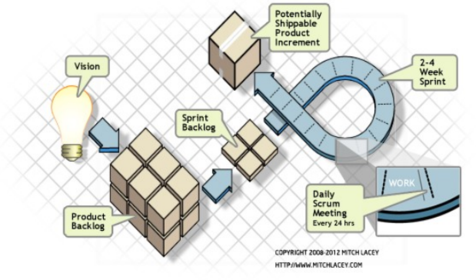
- 94What is the agile life cycle model?
Informationen
- Beschreibung
- Karteikarten am Ohne Titel, erstellt von Amy Bryan am 05/06/2015.
- Erstellt von
- Amy Bryan
- Aufrufe
- 0
- Bewertung