
Karteikarten
Ohne Titel
Karten in diesem Stapel (49)
- 1Perfectly competitive markets contain?Many buyers and sellers, perfect knowledge, and no barriers to entry and exit
- 2Goods in a perfectly competitive market are?Homogeneous
- 3When it comes to price, firms?Are price-takers, not price-makers
- 4On a S&D diagram, price is determined by?Supply and Demand
- 5Demand for the firm's, not the market's, product will be?Perfectly price elastic, at the market price
- 6The demand curve (AR and MR) for the firm will be?Horizontal
- 7If a firm is a profit maximiser, they will produce where?Marginal revenue = Marginal cost
- 8The firms total revenue will be?0P1AQ1
(Where A is the profit maximising point) - 9The firms total cost will be?0P1AQ1
- 10The firms total profit will be?0
- 11The firm will be allocatively efficient, how can we tell?Price is equal to Marginal Cost
- 12The firm will be allocatively efficient, how can we tell?The firm produces Q1 units, where MC crosses AC
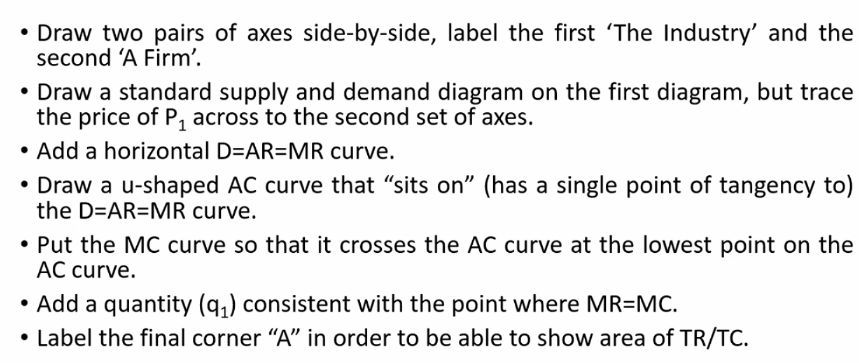
- 13How do you Draw the Diagram for Long-Run Equilibrium Under Perfect Competition
- 14How does a firm make economic profit?A firm makes economic profit when total revenue exceeds total economic costs (for example, opportunity cost)
- 15When showing Economic Profit in the Short-Run, average costs (now shown as SRAC) should be drawn where?At a 'U-Shaped' Curve, that dips under the D=AR=MR
- 16In the short-run, total revenue will be?0P1AQ1
- 17In the short-run, Average costs of producing Q1 units is? And total costs will be?C1
0C1BQ1 - 18In the short-run, total profit is therefore?C1P1AB
- 19Is the firm allocatively efficient in the Short-Run?Allocative efficiency is producing where P=MC. The horizontal demand curve means that the MR=P. Any profit-maximising firm must produce MR=MC. If P=MR and MR=MC then P=MC. The firm is therefore always allocatively efficient under perfect competition.
- 20Is the firm productively efficient in the Short-Run?MC does not cross AC at Q1, therefore the firm is productively inefficient.
- 21When a firm can make profit in the short run, other firms will?Enter the market as, due to perfect knowledge, firms will know about the profit.
- 22For the industry, supply will? What happens to price and quantity?Shift to the right
Price falls from P1 to P2, and quantity increases from Q1 to Q2. - 23For the firm, demand will? What happens to price and quantity?Shift downwards, to D2 = AR2 = MR2
Price falls to P2=C1, and output falls from q1 to q2 - 24For the firm Revenue is? Costs are? Profit is?0P2Eq2
0P2Eq2
0P2Eq2 - 0P2Eq2 = 0 - 25In order to make an economic loss, the firms must have what?Total costs exceeding total revenue, therefore average cost must exceed average revenue.
- 26In an economic loss, at the profit maximising level of output (MR=MC). What must happen?The average cost curve must be above the average revenue curve.
- 27Economic Loss in the Short-run, a profit maximiser will produce? Total Revenue = Total Cost = Profit =Where MR=MC, at q1
0P1Aq1
0C1Bq1
0P1Aq1-0C1Bq1 = Loss of P1C1BA - 28When economic loss occurs in the short run, the firm will?Exit the market
- 29When a firm exits the market, Supply for the industry will? Demand for the firm will?Supply shifts to the left
Demand shifts up, where P2=C1 - 30Due to a rise in supply, for the industry as a whole...Price increases and quantity falls
- 31Due to a rise in demand, for the firm...Cost/Revenue rises to P2=C1
Output falls from q2 to q1 - 32Total revenue and total costs are both..0P2Eq2
- 33Assessment of Perfect Competition Are perfectly competitive markets common?No, some would argue none exist at all
- 34Assessment of Perfect Competition Homogeneous products, barriers to entry, and perfect knowledge, discuss..Very few markets with homogeneous goods, no barriers to entry at all, and perfect knowledge.
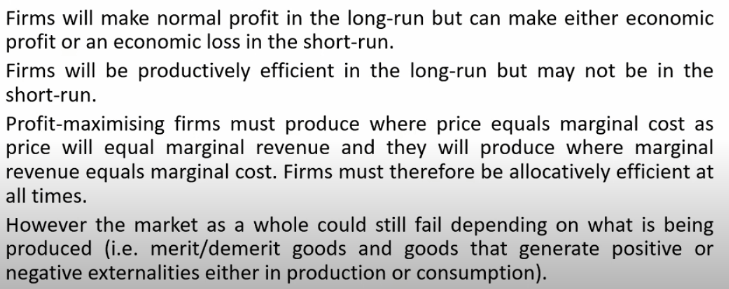
- 35Assessment of Perfect Competition When considered in theory...
- 36Which market can be used to identify what an oligopoly is?Mobile phone market
- 37In an Oligopoly market, if a competitor increases price, other firms will... PED will therefore be?Remain unchanged
Price elastic - 38In an Oligopoly market, if a competitor reduces price, other firms will... PED will therefore be?Reduce prices
Price Inelastic - 39On Sweezy's Demand Curve, price and quantity are determined by the point at which...The demand curve kinks
- 40Due to the kinked demand curve, what happens to marginal revenue?There will be a discontinuity in Marginal revenue
- 41On Sweezy's Kinked Demand Curve, Marginal cost should be drawn through which point?Through the discontinuity in Marginal Revenue
- 42Sweezy's Kinked Demand Curve, is the firm allocatively and productively inefficient?Doesn't produce where MC=AC, therefore productively inefficient.
Price doesn't equal marginal revenue, therefore allocatively inefficient. - 43Draw Sweezy's Kinked Demand Curve
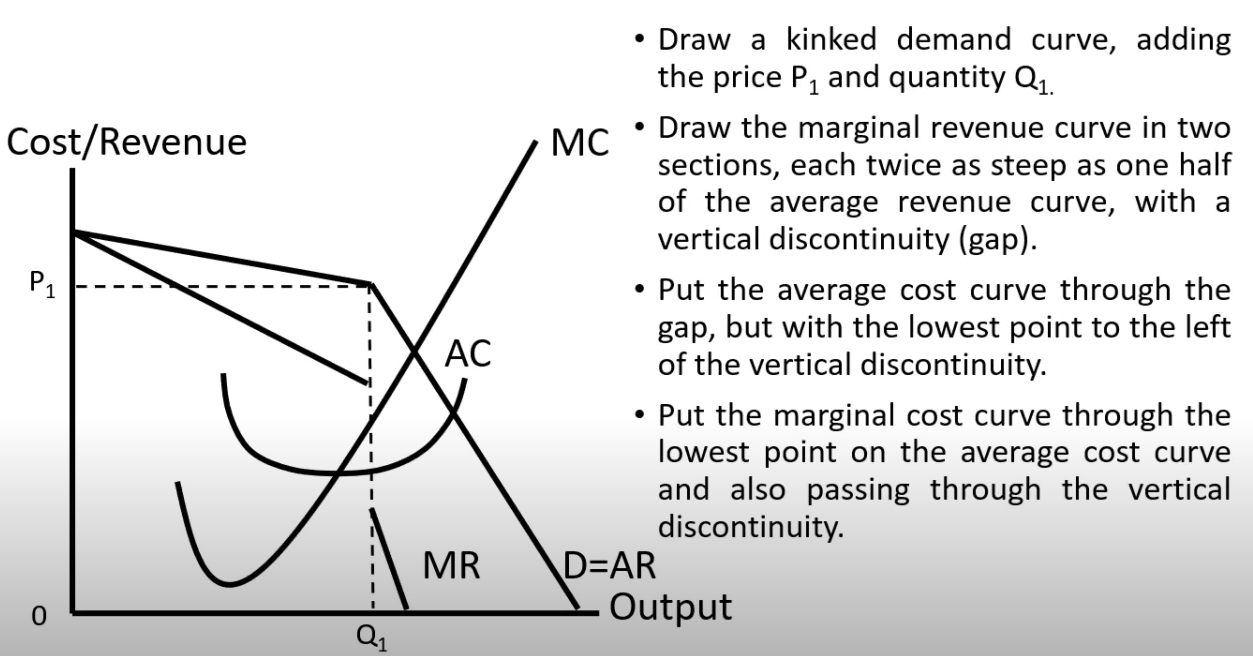
- 44What does Sweezy's Kinked Demand Curve show about price?Price should remain stable in oligopolistic markets
- 45A downside of Oligopoly is a collusive oligopoly, what is this?A collusive oligopoly is where the large firms create a cartel in order to control prices
- 46What model/diagram can be used to evaluate collusive oligopoly?A Monopoly diagram
- 47When showing Monopolistic Competition, a monopoly diagram can be used, what is the only difference between the Monopolistic Competition diagram and the Monopoly Diagram.The Demand curve for monopoly is for the market.
The demand curve for monopolistic competition is for the firms goods. - 48When showing Long Run Monopolistic Competition, the demand curve (now shown as D2=MR2) should be drawn with a tangent to which other curve?The average cost curve
- 49In the concept on Monopolistic Competition, why does demand fall?Due to perfect knowledge, firms see short-run profits, thus they join the market. Due to an increase in substitutes, demand for the firms products fall.
Informationen
- Beschreibung
- Karteikarten am Ohne Titel, erstellt von Owen Yarwood am 14/05/2021.
- Erstellt von
- Owen Yarwood
- Aufrufe
- 4
- Bewertung