
Market Structures
1,433 resources created by 1,210 users
This Market Structures page on GoConqr gathers community-made quizzes, mind maps, flashcards and notes, from perfect competition and monopoly to oligopoly, monopolistic competition and contestable markets. It's built for university students and professional candidates, school students, and teachers after ready-made material. There are over 1,400 resources here, including more than 60 quizzes and over 1,100 mind maps, pitched at both A-level and university study. Pick a topic, try a quiz to find your gaps, then revise from the maps.
Select topic
- Market competition and concentration96
- Barriers to entry and exit6
- Costs of production and economies of scale5
- Perfect competition96
- Imperfect competition79
- Monopoly83
- Price discrimination10
- Monopolistic competition26
- Oligopoly and game theory59
- Monopsony6
- Contestable markets12
- Competition and economic efficiency8
- Competition policy and monopoly regulation10
Top Market Structures resources
-
Mind map Perfect Competition
-
23 questionsEcon 3.3.3 - Concentrated Markets What are the sources of monopoly power?
-
41 cardsConcentrated Markets. The theory of oligopoly Concentrated Markets. The theory of oligopoly
-
17 cardsContestable Markets Contestable market Incumbents
-
Mind map Oligopoly
-
11 cardsAP Microeconomics: Chapter 11 - Monopoly
-
Mind map Monopolies A brief summary of some of the main points on monopolies
-
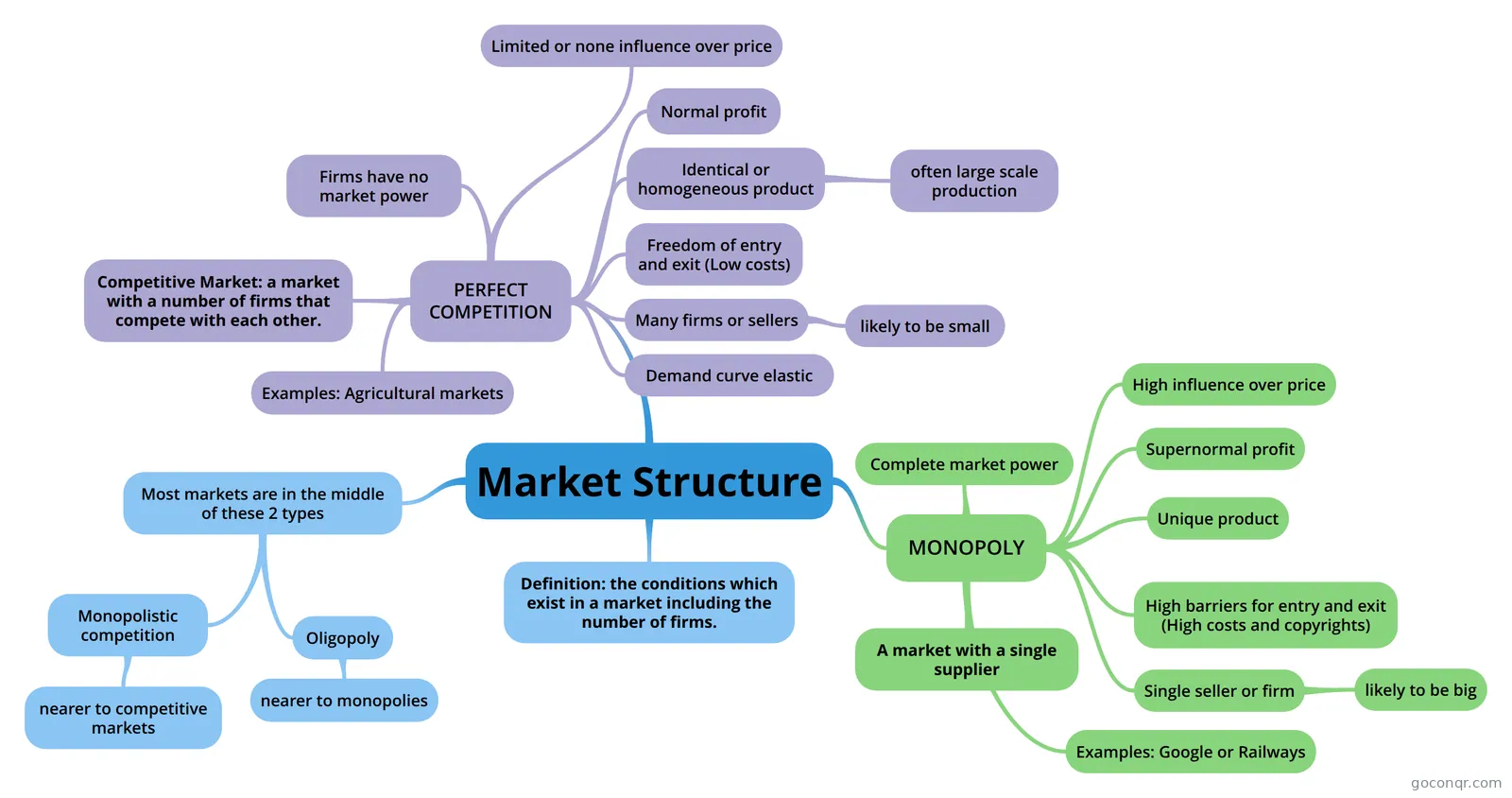 Mind map Market Structure market structure, monopoly
Quizzes
See all 65 quizzes-
23 questionsEcon 3.3.3 - Concentrated Markets What are the sources of monopoly power?
-
14 questionsECO.8 1. Monopolistic competition is characterized by which of the following attributes? (i) Many sellers (ii) Pr...
-
9 questionsIntro to AgEcon Exam 3 Chapters 6-9
-
10 questionsPerfect Competition Why doesn´t an individual have the power to affect the price of a product in a perfectly competitive market?
-
10 questionsPerfect Competition Quiz The label on the Y axis of the perfect competition graph of a firm is Revenue and Cost
-
10 questionsAP Microeconomics - 10 Questions A firm in perfect competition has zero power.
Mind maps
See all 1,183 mind maps-
Perfect Competition
-
Oligopoly
-
Monopolies A brief summary of some of the main points on monopolies
-
Market Structure market structure, monopoly
-
Allocative Efficiency Explanation of allocative efficiency for perfect competition and monopolies
-
Perfect Competition
-
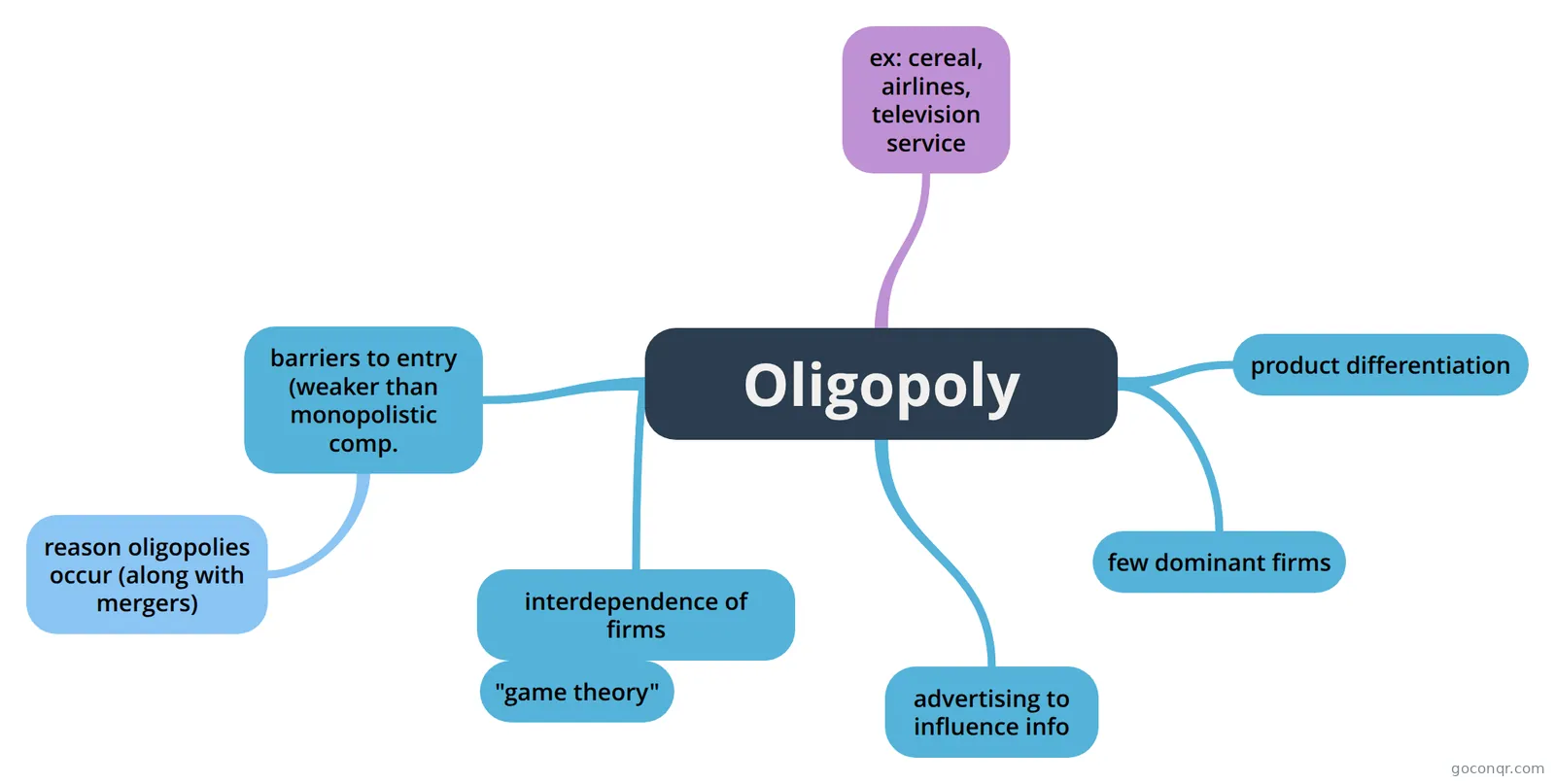 Oligopoly
-
3) Perfect Competition, Imperfectly Competitive Markets & Monopoly
Flashcards
See all 128 flashcards-
41 cardsConcentrated Markets. The theory of oligopoly Concentrated Markets. The theory of oligopoly
-
17 cardsContestable Markets Contestable market Incumbents
-
11 cardsAP Microeconomics: Chapter 11 - Monopoly
-
3 cardsMicro Economics Flash Cards Paradox of Value
-
47 cardsEcons Theory of costs
-
51 cardsMarket structure There are many small firms, each producing an identical product and each too small to affect the market price.
-
20 cardsCompetitive Markets Competitive Markets
-
31 cardsPart 1.3: Perfect competition, imperfectly competitive markets and monopoly
Notes
See all 43 notes-
Market Structures - Perfect Competition and Monopoly One of the quickest ways of determining what kind of market structure exists in a particular industry is to use concentration ratiosCONCENTRATION RATIO'S a measure of the extent to which a market is in the hands of a ...
-
General Notes for Imperfect Competition Monopoly MONOPOLY: a competitive structure where there is only 1 seller of a particular product with no close substitutes Monopolists are price-searchers. The demand curve is downward sloping, so they must lower price...
-
Imperfect Competition Comparisons (VENN) Imperfect Competition Comparisons (VENN)
-
Microeconomics Revision Notes 2.1 Markets · Definition of markets with relevant local, national and international examples A market is any place, physical or virtual, where the buyers and sells of go...
-
AP Microeconomics: Monoply Overview Introduction Oligopoly and monopolistic competition have potential monopoly power The Lerner Index (P – MC) / P used to ascertain the pricing power of potential monopolistic powers the greater the value, the...
-
Market Structures - Monopolistic Competition and Oligopoly CHARACTERISTICS OF MONOPOLISTIC COMPETITION Large number of small firms The firms seek to maximise profits where MC=MR Firms possess some ability to set price Products are differentiated Abnormal profit only in the SR...
-
MONOPOLIES MONOPOLIES one firm barriers to entry produces ONLY one product price makers little to no advertising MONOPOLY RESOURCESex: owning the only well in townGOVERNMENT- GRANTED MONOPOLIESex: patents and copyright lawECONOM...
Topics in Market Structures
More Economics topics
About Market Structures
GoConqr OriginalWhat this unit covers
This page sits in the Firms, Industries and Factor Markets strand of Economics. It collects resources on how markets are structured and how firms behave inside them. The mind maps are the biggest group, with flashcards, quizzes, notes and a few slide sets alongside.
- Perfect competition: the maps list assumptions such as many buyers and sellers, perfect information, equal access to technology and homogeneous products.
- Monopoly: barriers to entry, supernormal profits and short-run and long-run equilibrium.
- Oligopoly: a few large, interdependent firms, with collusion and cartels.
- Efficiency and concentration: allocative efficiency, concentration ratios and contestable markets.
Where to start
Begin with the Market Structure mind map, which sets perfect competition and monopoly side by side. Then open the Perfect Competition map, the Monopolies map and the Oligopoly map in turn. If you prefer reading, the notes called Market Structures - Perfect Competition and Monopoly explain how concentration ratios help you spot a market type.
Using quizzes and maps together
Read a map first, then test yourself. The Econ 3.3.3 - Concentrated Markets quiz asks about the sources of monopoly power and barriers to entry, so it suits the point after you have studied monopoly and oligopoly. Note the questions you miss, go back to the matching branch of the map, and try again.
For quick recall, the AP Microeconomics: Chapter 11 - Monopoly flashcards ask why a monopolist's demand curve slopes as it does and what unregulated and regulated monopoly can lead to. The Concentrated Markets deck covers cartels, collusion, limit pricing and predatory pricing.
Going further
Once the basics feel secure, compare structures through the Allocative Efficiency map, which sets perfect competition against monopoly. The Contestable Markets resources and the slide sets on market structure and efficiency add a wider view. There is also a written-answer note on controlling firms with monopoly power, useful for practising longer responses.
Choose one structure today, work through its map and take a quiz. Then make your own flashcards from what you found tricky.
Frequently asked questions
Where should I start on this page?
Start with the Market Structure mind map, which compares perfect competition and monopoly. Then move to the separate maps for perfect competition, monopoly and oligopoly. Once you have the key terms, try the Econ 3.3.3 - Concentrated Markets quiz to see which parts of the topic need more work.
What do the mind maps cover?
The maps cover perfect competition and its assumptions, monopoly and its barriers to entry, oligopoly and collusion, monopolistic competition, monopsony, contestable markets and market concentration. There is also a map on allocative efficiency that compares how different market structures perform.
Which exams are these resources suitable for?
The listed resources mention A-level Economics and AP Microeconomics. The page mixes school-level and university-level material, so it suits school students, university students and professional candidates. Check each resource's content against your own course before relying on it.
Are the resources free to use?
Yes. Every resource listed here is free to open, study and take, with no account needed. They were made by GoConqr users, not by GoConqr itself, so it is worth checking anything against your own course notes.
Can I make my own resources?
Yes. A free account saves your quiz scores and lets you make your own quizzes, mind maps, flashcards and notes. If a topic seems thin here, you can build your own version and use it for revision.
Are there quizzes as well as maps?
Yes. There are more than 60 quizzes on this page, alongside flashcard decks, notes and slide sets. Some focus on one structure, such as Perfect Competition, while others, like Chapter 17 Graded: Oligopoly, test a single chapter.