
Karteikarten
Lecture 13- Aggression
Karten in diesem Stapel (13)
- 1How can we describe aggression?- many forms of aggressive behaviors (ex: predatory, intermale, territorial, predatory attack, etc.)
- aggression can cause harm or displace others
- both males and females exhibit aggressive behaviors (though more complex in females)
- often built around dominance hierarchies
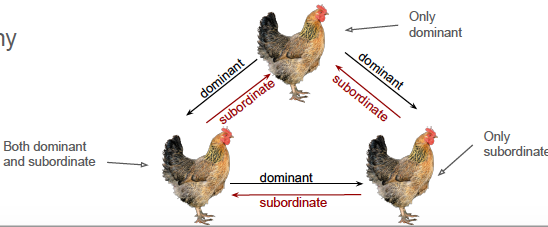
- unknown if submission and aggression exist on their own spectrums or if they exist along one continuum - 2What are dominance hierarchies/pecking orders?- pecking order: organization of social dominance that creates stability
- in a transitive system (most common in nature), an single individual can be dominant and subordinate at the same time
- perceptual factors (signaling) and individual recognition are important to rank obtainment
- the more organized the flock, the more stable the pecking order is and healthier flock (more weight gain, more eggs, less fighting)
-instability is created if a new individual is introduced but stability is achieved quickly with pecking order behavior - 3How do males display their dominance?- dominant males signal their dominance via different displays and other individuals must recognize and understand these displays
- hamadryas baboons show threat displays (in adulthood, juvenile males don't show these aggressive behaviors)
- vibrant face markings, long hair and teeth signal age and dominance in mandrill baboons
- large antlers in red deer
- key idea: testosterone can participate in activating signals of status and aggressive behaviors in males - 4Does aggression as a behavior experience organizational or activational effects?- both!
- organizational rise of testosterone during development likely lead to masculinization of aggressive circuits in brain
- activational rise of testosterone during puberty activates aggressive behaviors in males in adulthood - 5Describe the image to the right- rough and tumble and pursuit play in juvenile rhesus monkeys
- shows that before puberty there is already a difference in behavior (males show more rough and tumble and pursuit play) that will be used in aggressive contexts
- pseudohermaphrodites (treated with testosterone developmentally) show more male-like rough and tumble/pursuit play
- key idea: proof of organizational effects (rise in T in development play role in behaviors used later for aggression)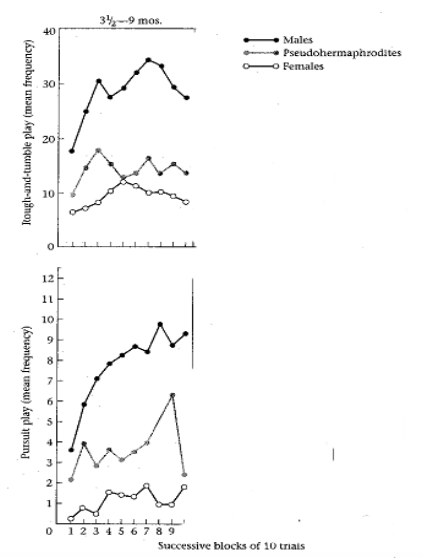
- 6Describe the image to the right- red= T levels, purple= antler growth, green= aggressive behavior, orange bar=mating season
- when T increases during mating season, so does antler growth and aggressive behaviors
- occurs during mating season to demonstrate dominance (includes aggression to fight for territory/females and establish reproductive success)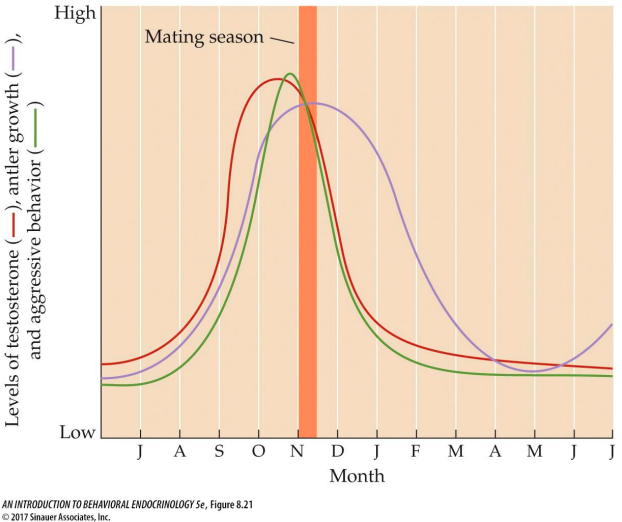
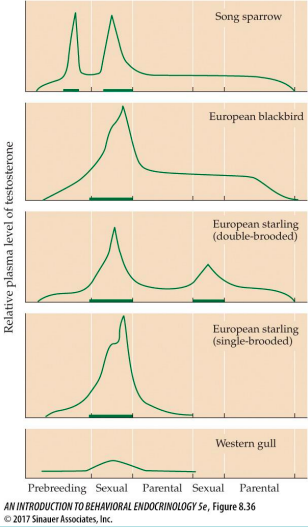
- 7Describe the image to the right- green lines= testosterone, green bars= aggressive behaviors
- shows more aggression with rising testosterone during breeding season compared to winter
-
- 8Describe the challenge hypothesis- constitutive period: non breeding season; T levels are low so there is little/no aggression or reproductive behavior
- regulated, periodic period: during breeding; make sperm (sertoli cells by T and FSH from brain to make sperm) and see male behaviors like aggression and motivation to copulate
- regulated facultative period: social systems unstable; have to defend/establish territory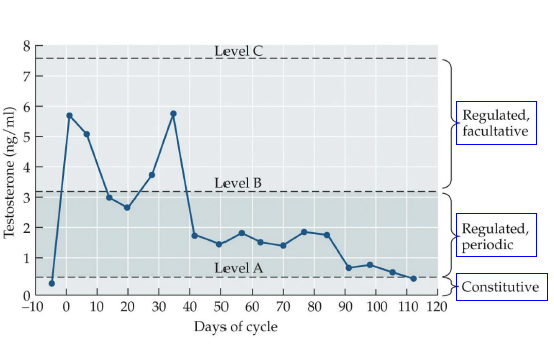
- 9Describe the image to the right- looks at effect of an intruder on testosterone concentration in resident song sparrows
- intrusion is a form of social instability so testosterone increases
- brain is secreting GnRH, which stimulates pituitary to make LH to increase testosterone production (think Leydig cells with make T and are dependent on LH)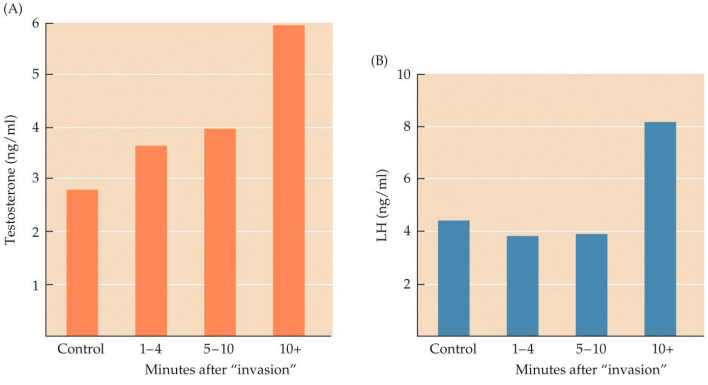
- 10Describe the image to the right- study in mice show that testosterone promotes winning and long-term consequence of this win (rats form a memory of the win and the dominance over the individual that lost)
- absence of T means that rat learns sub ordinance as associated with lower T levels
- in the rates with T where 100% were winners they attacked more quickly and had more attacks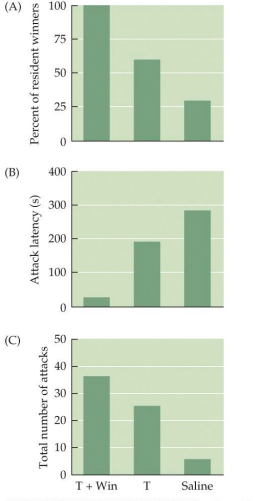
- 11What parts of the brain are involved in aggression?- aggression is involved in social network of brain in hypothalamus
- nuclei in hypothalamus receive sensory input that affects social behavior (affiliative and aggressive) - 12Describe the image to the right- shows results of optogenetic stimulation of neurons expressing light-sensitive protein (channel rhodopsin) that are also ion channels (in mice)
- so when these neurons expressing channel rhodopsin are exposed to light they can fire an action potential
- both fighting and mating in ventromedial hypothalamus
-key idea: shows overlap of sexual and aggressive behaviors in social behavior network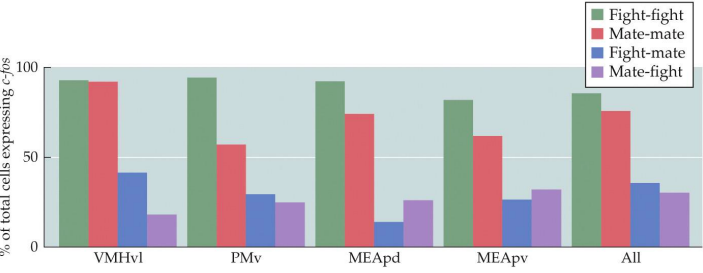
- 13Describe the image to the right- used optogenetic stimulation only on cells with estrogen receptors (channel rhodopsin only being expressed in cells with estrogen receptors)
- shining a light on these cells stimulates immediate attacks by mice
- key idea: estrogen receptor positive cells in VMH necessary and sufficient for mouse aggression (so either have aromatase/aromatase cells to convert T to estradiol)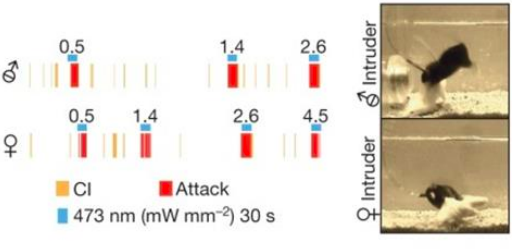
Informationen
- Beschreibung
- undergraduate PS140 Karteikarten am Lecture 13- Aggression , erstellt von Leia Salongo am 05/12/2021.
- Erstellt von
- Leia Salongo
- Aufrufe
- 3
- Bewertung