
Aggression
628 resources created by 389 users
This Aggression page on GoConqr gathers community-made quizzes, mind maps, flashcards, notes and a slide set, from social learning theory and deindividuation to genetic, neural and hormonal explanations and institutional aggression. It's built for school students revising a topic, university students and professional candidates filling gaps, and teachers after ready-made material. There are over 600 resources here, including more than 10 quizzes and over 400 mind maps, mostly at secondary level with some for university. Start with a quiz to find your gaps, then explore the maps.
Select topic
- Biological explanations of aggression40
- Neural and hormonal mechanisms of aggression60
- Genetic factors in aggression27
- Evolutionary explanations of aggression73
- Evolutionary explanations of group displays35
- Social psychological explanations of aggression20
- Social learning theory of aggression48
- Deindividuation and aggression14
- Frustration-aggression hypothesis10
- Media influences on aggression14
- Institutional aggression58
- Bullying20
- Cyberbullying14
Top Aggression resources
-
9 questionsA2 AQA Psychology Unit 3: Aggression Name two social psychological theories of aggression?
-
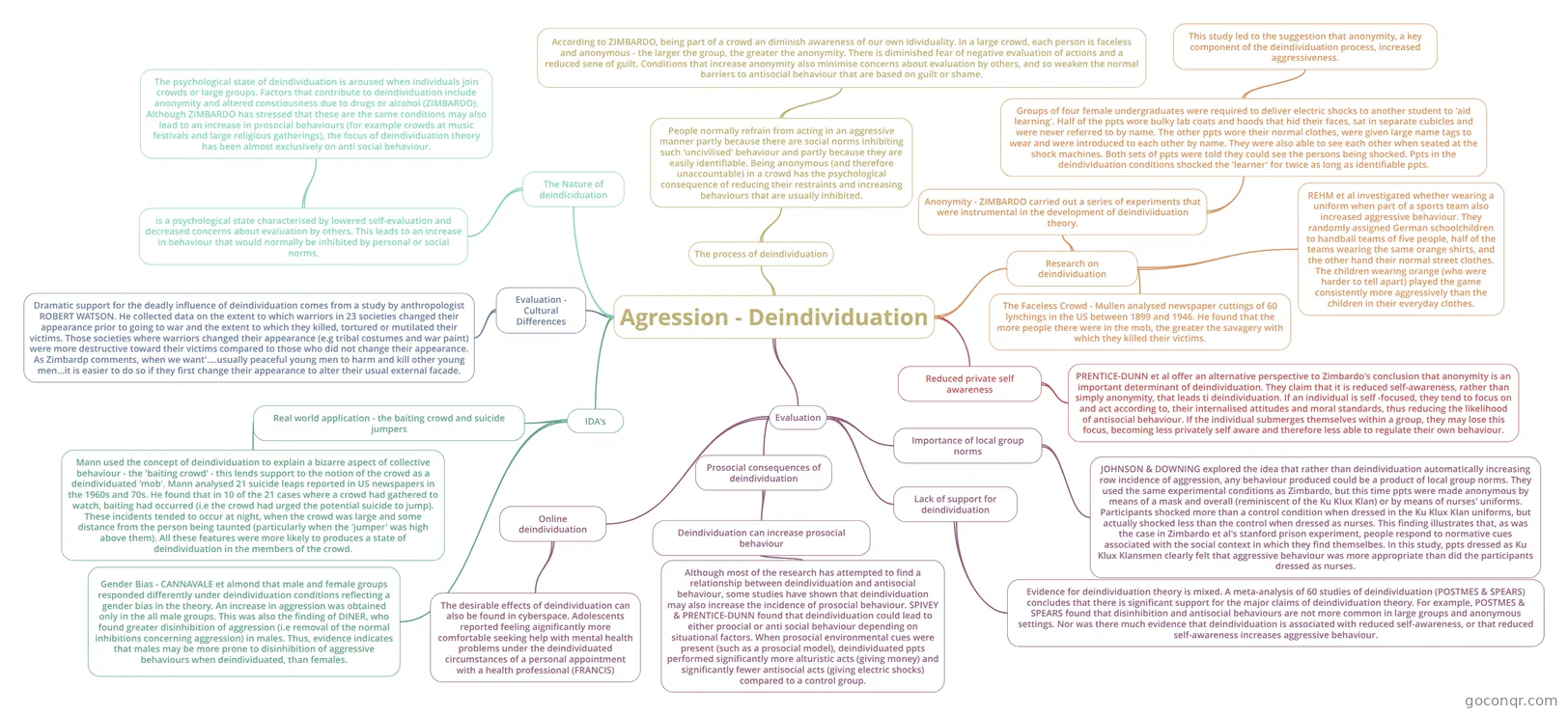 Mind map Agression - Deindividuation
-
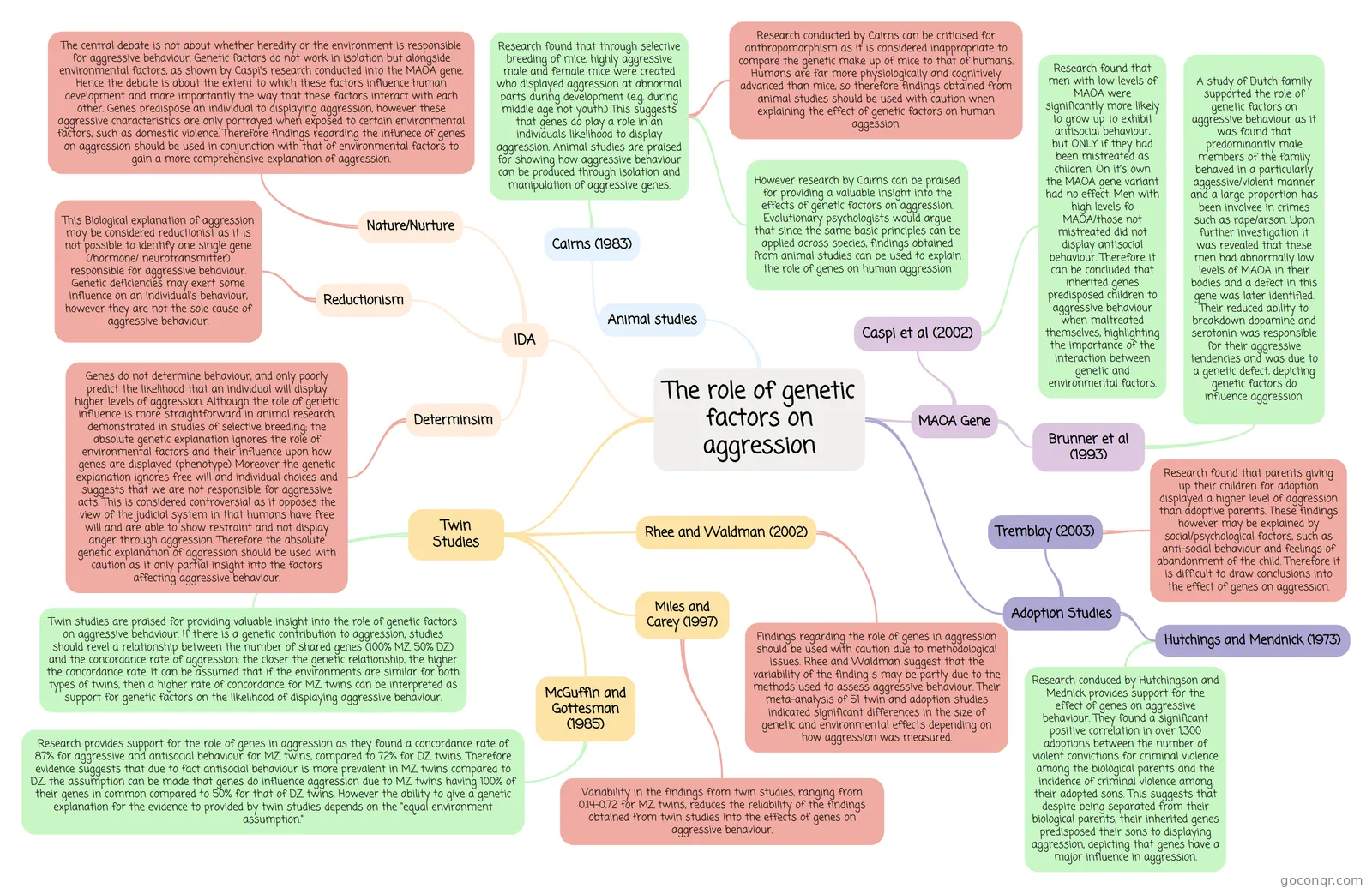 Mind map The role of genetic factors on aggression PSYA3 Psychology AQA - Genetic factors into aggression
-
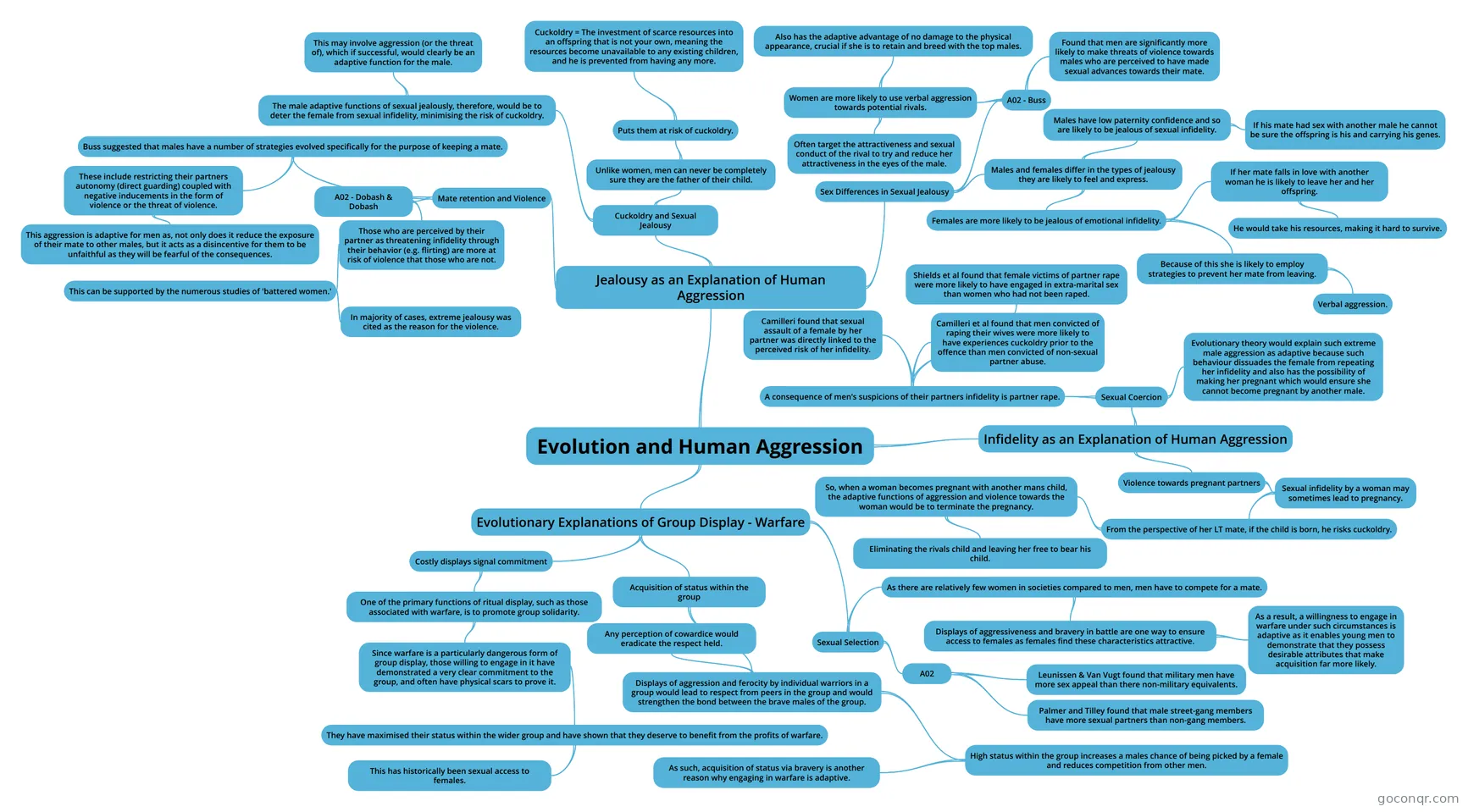 Mind map Evolution and Human Aggression Booklet 3 Aggression
-
23 questionsAggression Who conducted a study into the effects of role models
-
Mind map Aggression mind-map for A2 AQA Psychology Aggression mind-map for A2 AQA Psychology - Social learning theory - Biological explanations - Evolutionary...
-
 Mind map neural and hormonal mechanisms in aggression neural mechanisms, limbic system, serotonin, hormonal mechanisms, testosterone
-
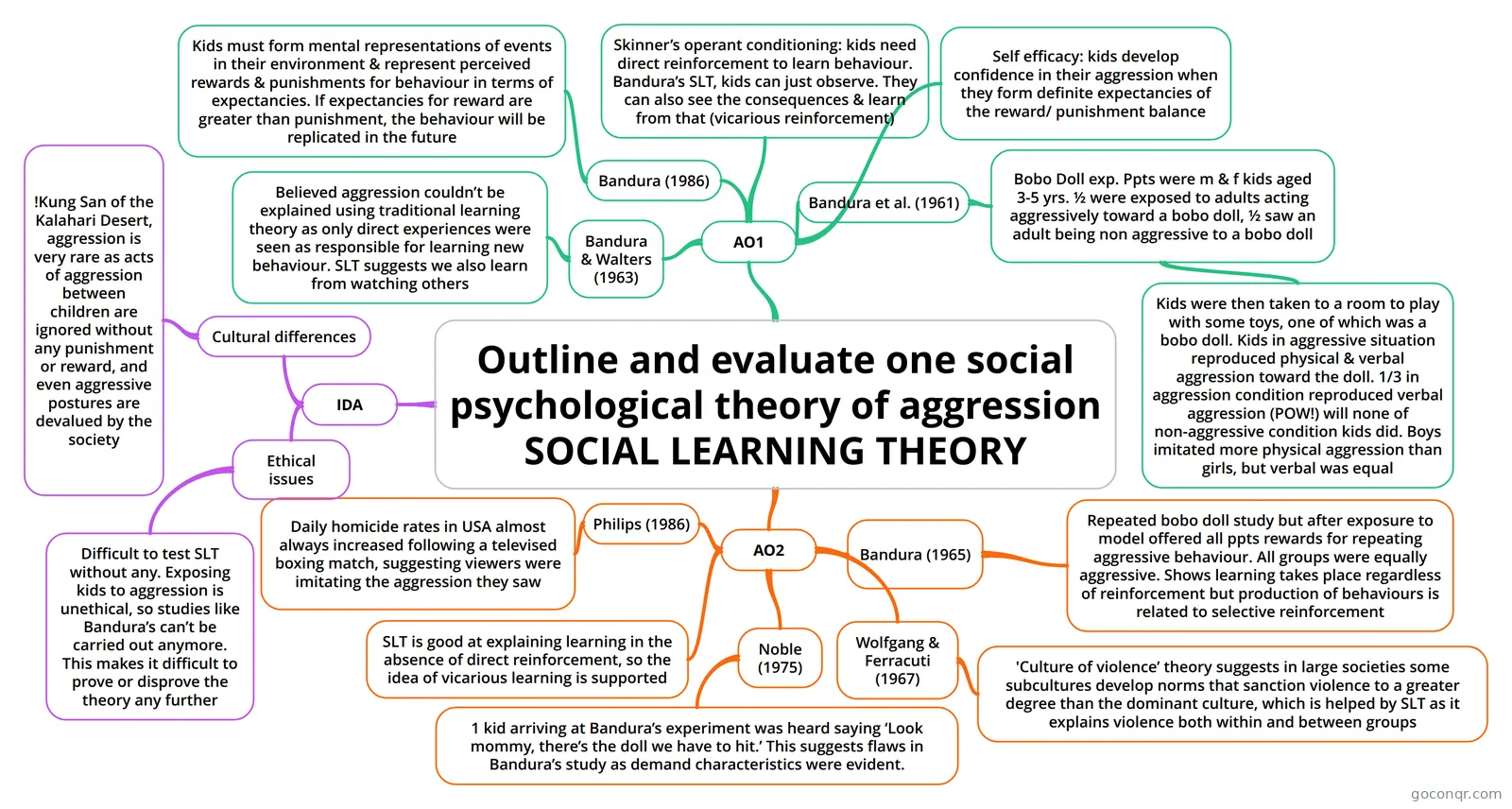 Mind map Outline and evaluate one social psychological theory of aggression SOCIAL LEARNING THEORY
Quizzes
See all 19 quizzes-
9 questionsA2 AQA Psychology Unit 3: Aggression Name two social psychological theories of aggression?
-
23 questionsAggression Who conducted a study into the effects of role models
-
6 questionsAggression Aggression is defined as a behavior that causes (or leads to) harm, damage or destruction of another organi...
-
18 questionsAggression - Evolution and human aggression INFLUENCE OF INFIDELITY AND JEALOUSY ON AGGRESSIVE BEHAVIOR The act of infidelity is advantageous for males...
-
14 questionsBiological explanations of aggression BIOLOGICAL EXPLANATIONS OF AGGRESSION AMYGDALA - NEURAL. Who found that when the temporal lobes of rhesus m...
-
16 questionsNeural and hormonal mechanisms in aggression quiz The limbic system is an area of the brain that co-ordinates behaviours including aggression. The two key st...
-
25 questionsPaper 3 Studies Soderberg et al.
-
20 questionsAggression Which of the following best defines aggression in psychology?
Mind maps
See all 421 mind maps-
Agression - Deindividuation
-
The role of genetic factors on aggression PSYA3 Psychology AQA - Genetic factors into aggression
-
Evolution and Human Aggression Booklet 3 Aggression
-
Aggression mind-map for A2 AQA Psychology Aggression mind-map for A2 AQA Psychology - Social learning theory - Biological explanations - Evolutionary...
-
neural and hormonal mechanisms in aggression neural mechanisms, limbic system, serotonin, hormonal mechanisms, testosterone
-
Outline and evaluate one social psychological theory of aggression SOCIAL LEARNING THEORY
-
Evolutionary Explanations of Aggression A2 Psychology - Aggression Evolutionary Explanations of Aggression Infidelity and Jealousy
-
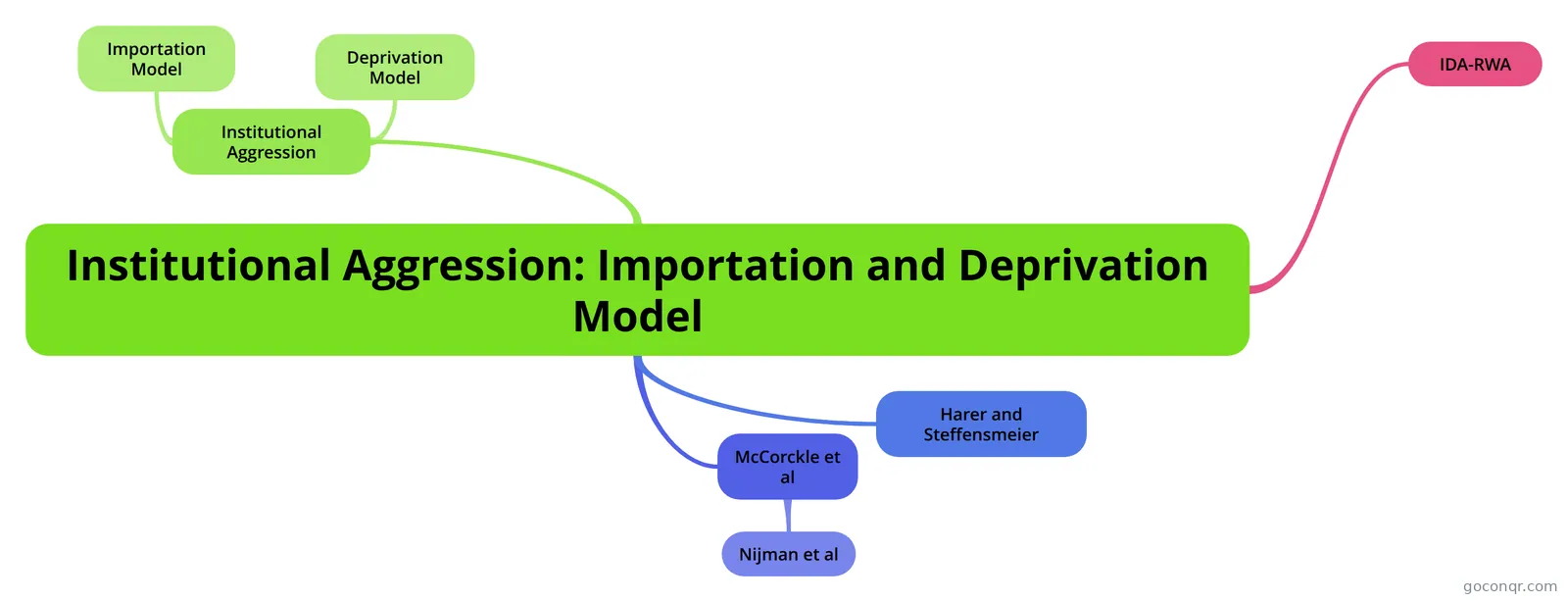 Institutional Aggression: Importation and Deprivation Model
Flashcards
See all 160 flashcards-
38 cardsGCSE AQA Psychology Aggression All you need to know (studies, definitions and explanations) for the aggression unit of GCSE AQA Psychology
-
13 cardsResearchers in Aggression The main researchers in the PSYA4 Aggression topic
-
86 cardsAggression flashcards - checklist followed
-
65 cardsDiscuss Neural and Hormonal Mechanisms in Aggressive Behaviour What does the biological approach to aggression encompass?
-
18 cardsAggression Flashcards Social learning theory AO1
-
12 cardsSOCIAL LEARNING THEORY THEORY OUTLINE (AO1)
-
11 cardsGENES/GENETIC EXPLANATIONS FOR AGGRESSION THEORY OUTLINE (AO1)
-
10 cardsNEURAL & HORMONAL EXPLANATIONS FOR AGGRESSION NEURAL & HORMONAL EXPLANATIONS FOR AGGRESSION
Flowcharts
Notes
See all 19 notes-
Aggression Revision Social Learning Theory - Observation (a child seeing their dad hit their mum), vicarious reinforcement (they don't see them being punished for the act, perhaps the violence they inflict actually has a positive affect ...
-
Aggression - created from Mind Map Social-Psychological Theories Institutional Aggression Biological Explanations
-
Social Psychological Explanations of Aggression Social Psychological Explanations of Aggression Social Learning Theory:(SLT: We learn behaviours through observing 'models' with whom we identify.) Aggressive behaviour = learnt through ...
-
Untitled the evolutionary approach argues aggression is an innate behaviour. humans are most likely to survive if they have access to resources, if they can defend their resources and protect their families and if they can att...
-
Genetic Factors in Aggression Genetic Factors in Aggression Twins:Monozygotic twi...
-
Biological Explanations of Aggression SerotoninSerotonin is thought to reduce aggression by inhibiting responses to emotional stimuli that would otherwise lead to an aggressive response. Low levels of serotonin have been associated with increased suscepti...
-
Person & Social - Week 2 - Aggression What is Aggression? Behviors performed with the goal of harming someone else physically / emotionallyBroadly broken down into two categories: INSTRUMENTAL & HOSTILE aggressionInstrumental AggressionAgressive behavior ...
-
Institutional aggression IMPORTATION MODEL Interpersonal factors - Irwin and Cressey (1962)Prisoners brings their own social histories and traits with them into the prison which influences their adaptation to the environment Gang members...
Slides
Topics in Aggression
More Psychology topics
About Aggression
GoConqr OriginalWhat this unit covers
The resources here follow the A-level Psychology style of aggression topics, and some are labelled for GCSE Psychology or AQA A-level Psychology. They fall into two broad camps: social psychological explanations and biological explanations. Each camp has its own mind maps, flashcards and notes.
Social psychological explanations
Social learning theory is well represented. The mind map Outline and evaluate one social psychological theory of aggression SOCIAL LEARNING THEORY sets out Bandura and Walters (1963) with AO1 and AO2 branches. Another map explains that, according to Bandura, aggression is learned through direct or vicarious experience. Deindividuation has its own mind map, which describes a state of lowered self-evaluation and reduced concern about evaluation by others. There are also maps on media influences and on institutional aggression, including the importation and deprivation models.
Biological explanations
The mind map on the role of genetic factors on aggression covers twin studies, including McGuffin and Gottesman (1985). The neural and hormonal maps look at the limbic system and the amygdala. The evolutionary maps cover jealousy, sex differences in sexual jealousy and group displays in sports and warfare.
Where to start
- Take the quiz A2 AQA Psychology Unit 3: Aggression to see which theories you can already name.
- Open the mind map Aggression mind-map for A2 AQA Psychology for an overview of the topic.
- Pick one theory and read its map, then try the matching flashcards, such as Aggression - Social Learning Theory.
- Return to a quiz, such as Aggression - Evolution and human aggression, to check what stuck.
Using quizzes and maps together
Use quizzes to expose gaps, then go to the map for that topic and read the AO1 description before the AO2 evaluation. Flashcard decks on researcher names and key studies are handy for quick recall. This unit sits in the Social Psychology strand of Psychology, so you can also browse neighbouring topics. Pick a topic today and make a map of your own to sum it up.
Frequently asked questions
Which resource should I open first?
Try the quiz A2 AQA Psychology Unit 3: Aggression. It asks you to name two social psychological theories, who proposed social learning theory and the four basic processes of modelling. Then open the mind map Aggression mind-map for A2 AQA Psychology to fill any gaps.
What do the mind maps cover?
They cover social learning theory, deindividuation, institutional aggression, media influences, genetic factors, neural and hormonal mechanisms, and evolutionary explanations such as jealousy and group displays. Several are written as essay plans, with AO1 and AO2 branches, so you can see how an answer might be structured.
Are the resources free to use?
Yes. Every resource listed on this page is free to open, study and take, with no account needed. They were made by GoConqr users, not by GoConqr itself, so styles and depth vary from one resource to the next.
Which levels and exams do these suit?
Most resources are at secondary level, with some for university. The listed material mentions A-level Psychology, GCSE Psychology and AQA A-level Psychology. University students and professional candidates can use them to revisit the basics, while teachers can pick ready-made material.
Can I save my quiz scores or make my own resources?
A free account saves your quiz scores and lets you make your own quizzes, mind maps, flashcards and notes. That is useful if you want to turn a theory such as deindividuation into a personal set of cards.
What if I cannot find the topic I need?
Try the neighbouring resources first. Biological topics are split across genetic, neural, hormonal and evolutionary sets, and social topics across social learning, deindividuation and institutional aggression. If your topic is still missing, build your own map or flashcard deck to fill the gap.