
Karteikarten
SB2.1
Karten in diesem Stapel (59)
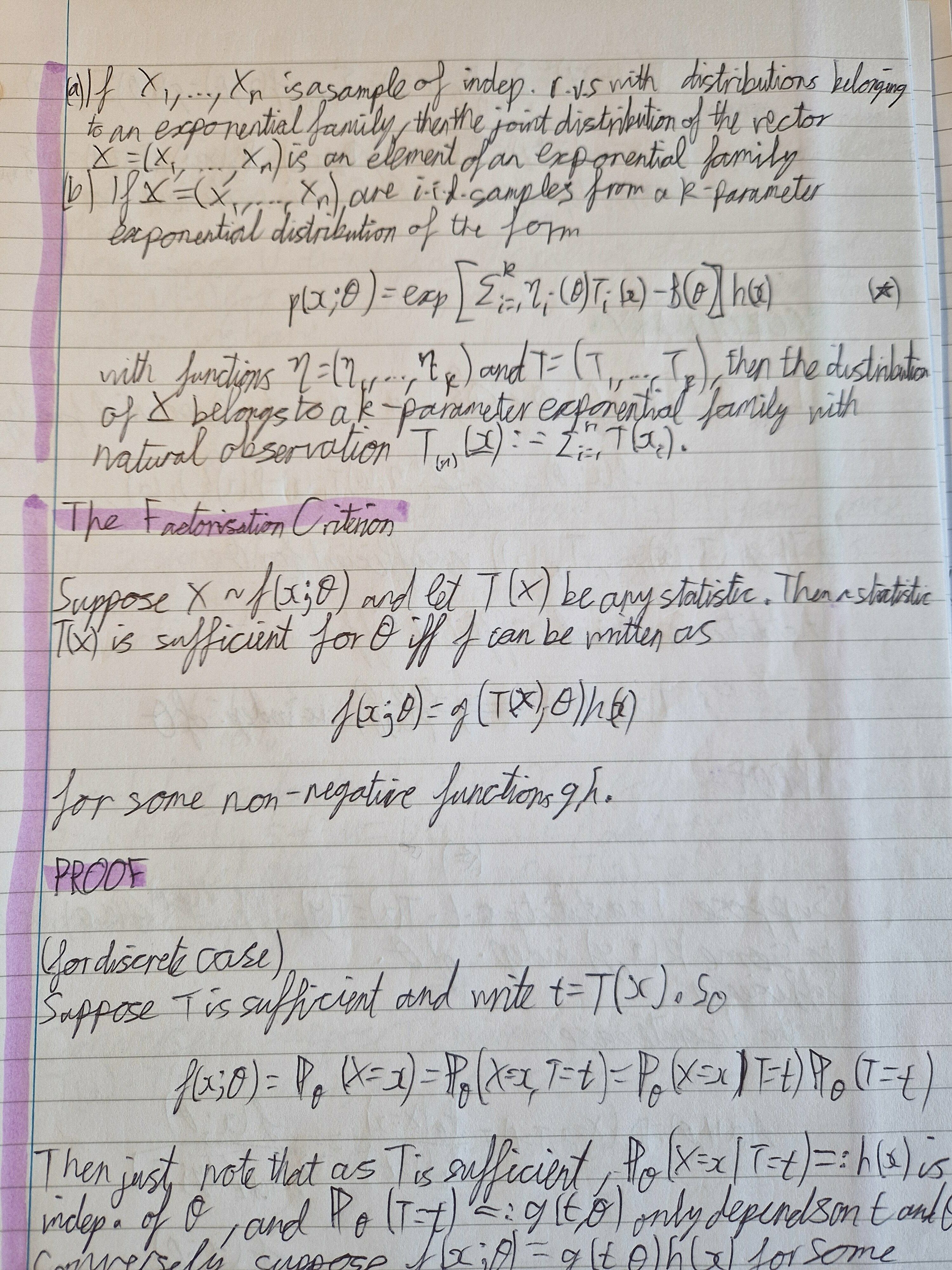
- 1Suppose X~f(x;θ) and let T(X) be a statistic. State The Factorisation Criterion
- 2State The Invariance Property for MLEs
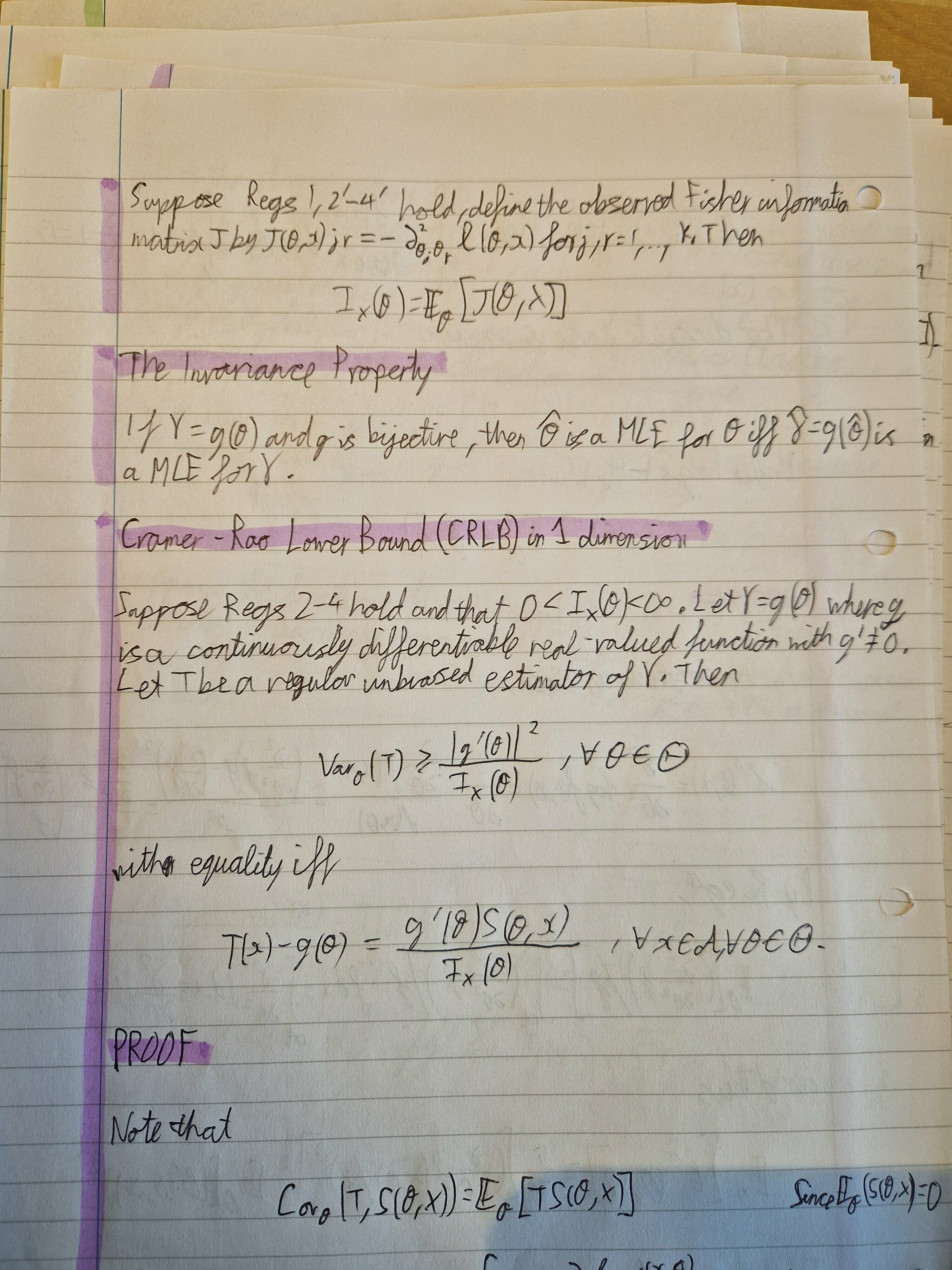
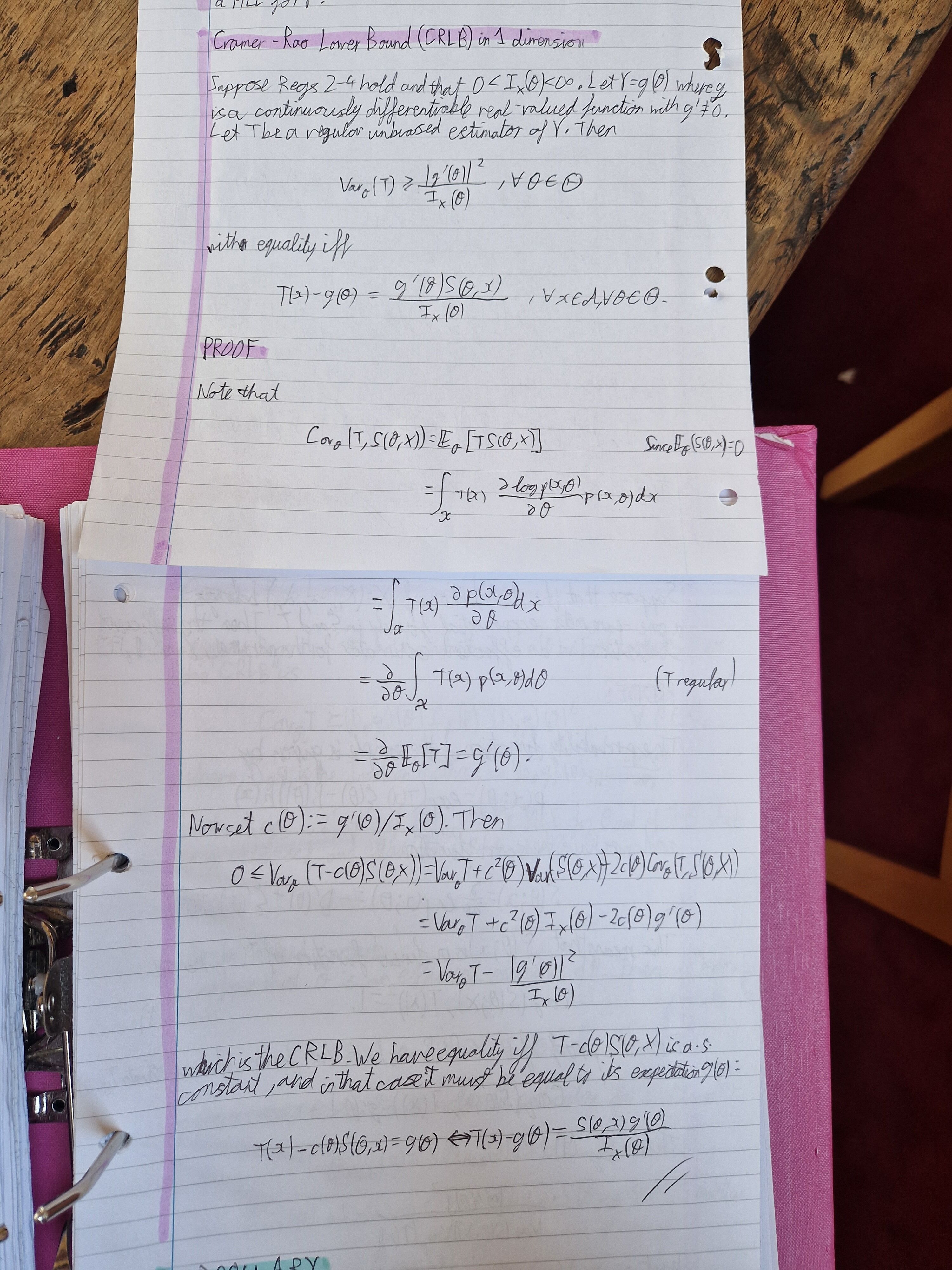
- 3Suppose Regs 2-4 hold and that 0
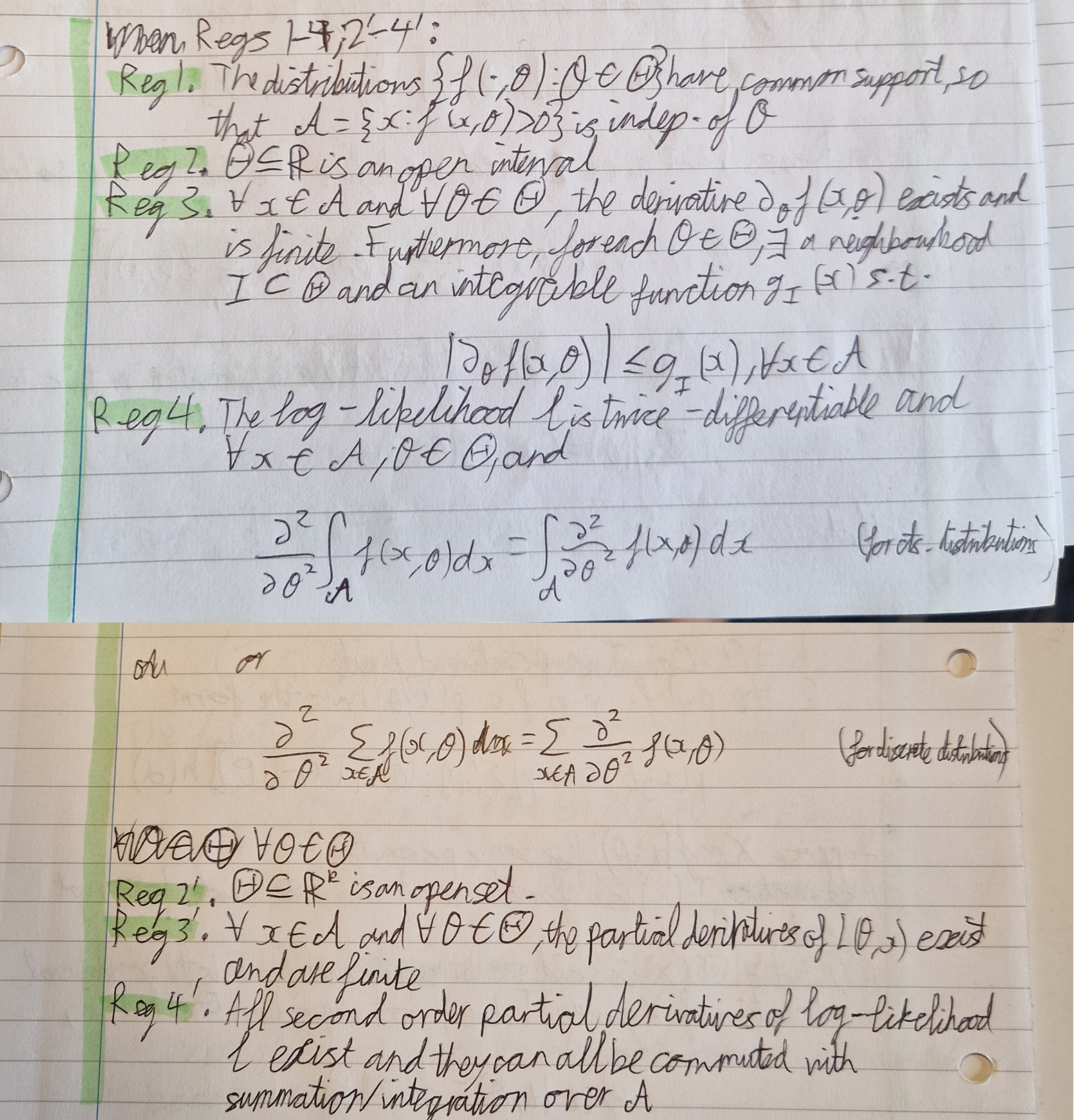
- 4State Regs 1-4,2'-4'
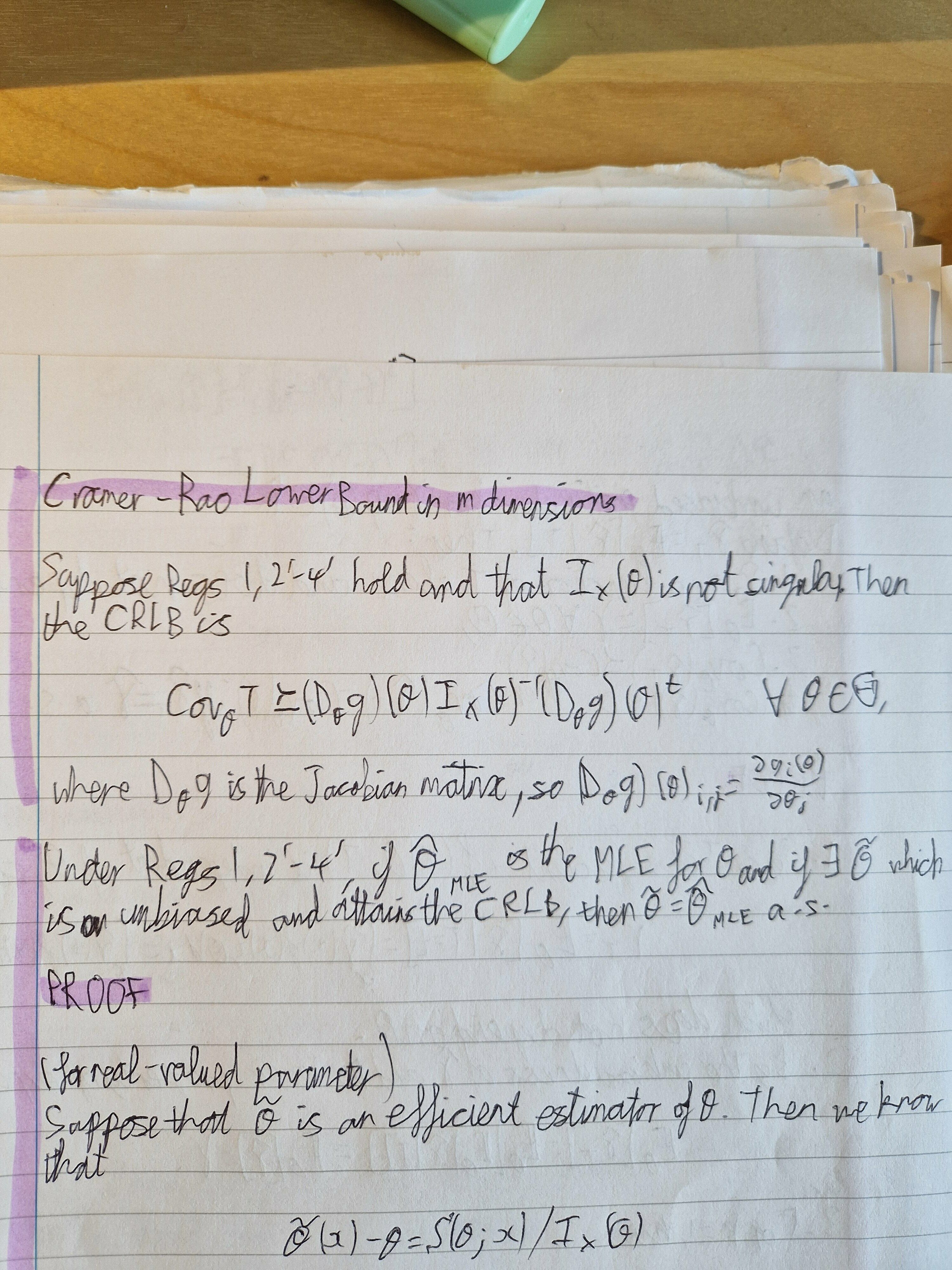
- 5Suppose Regs 1,2'-4' hold and that I_X(θ)is not singular. State the Cramer-Rao lower bound in m dimensions
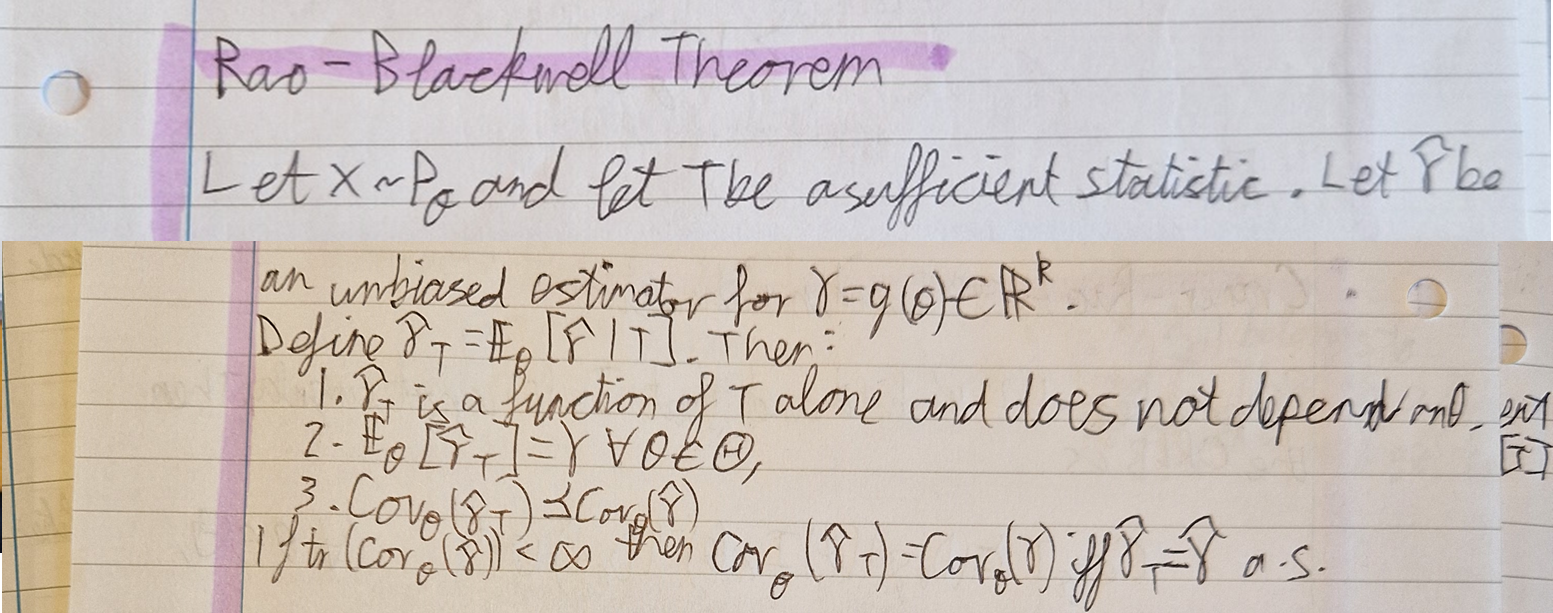
- 6Let X~P_θ and let T be a sufficient statistic. State the Rao-Blackwell Theorem.
- 7State the theorem regarding Completeness for exponential families
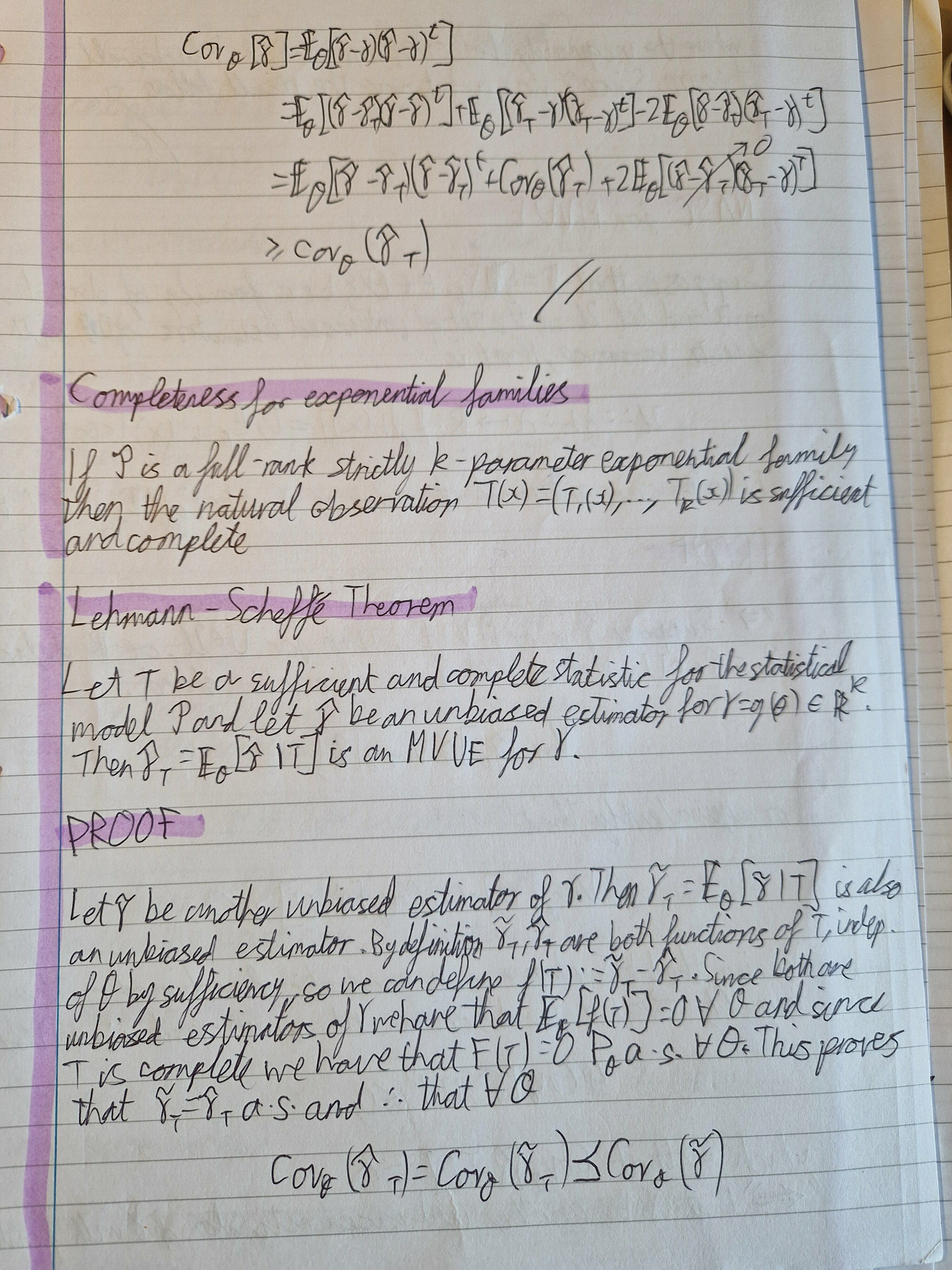
- 8State the Lehmann-Scheffé Theorem
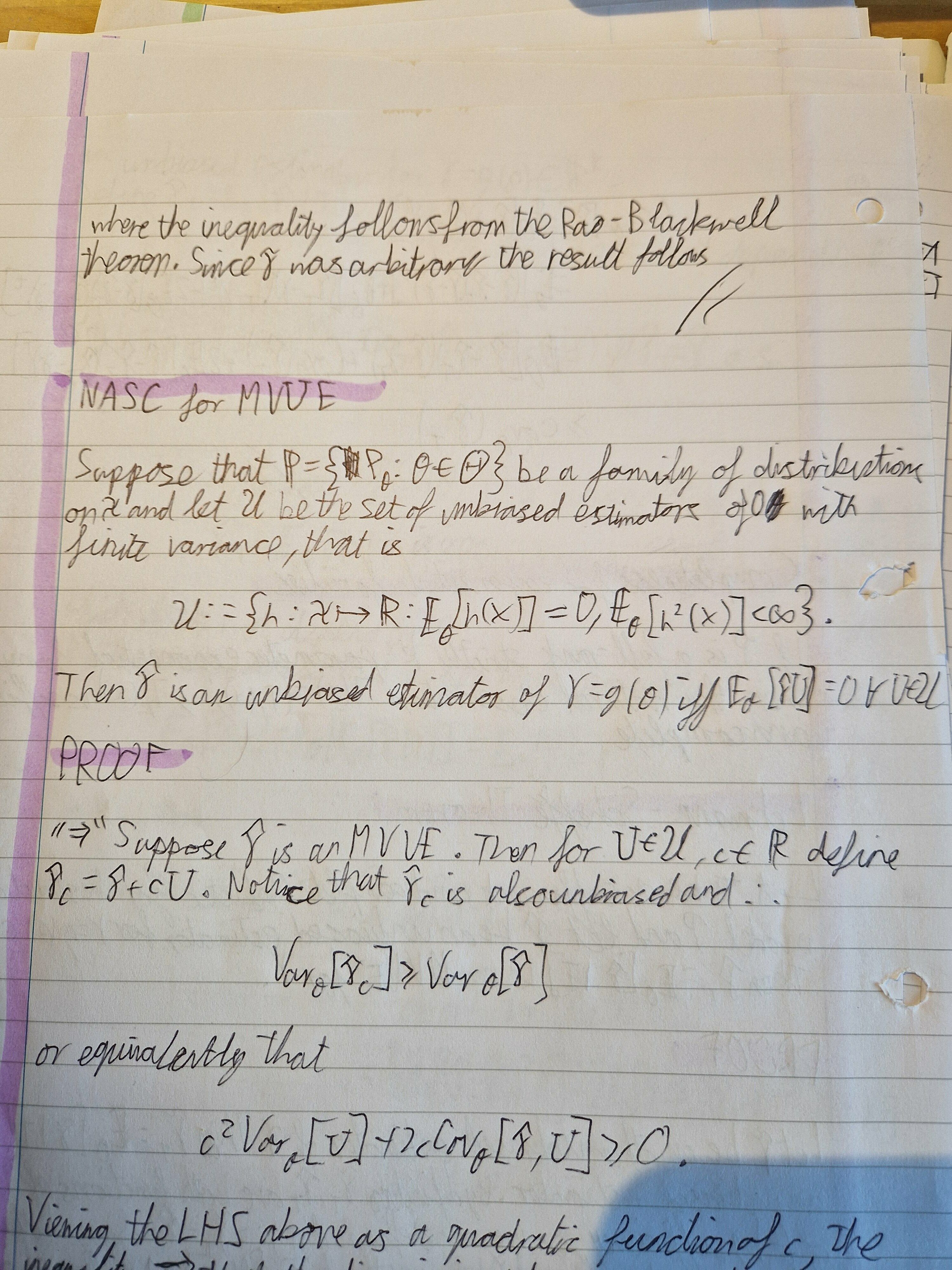
- 9Suppose that ℙ={P_θ:θ∈Θ} is a family of distributions on 𝒳. State the NASC for MVUE Theorem(Should be MVUE)
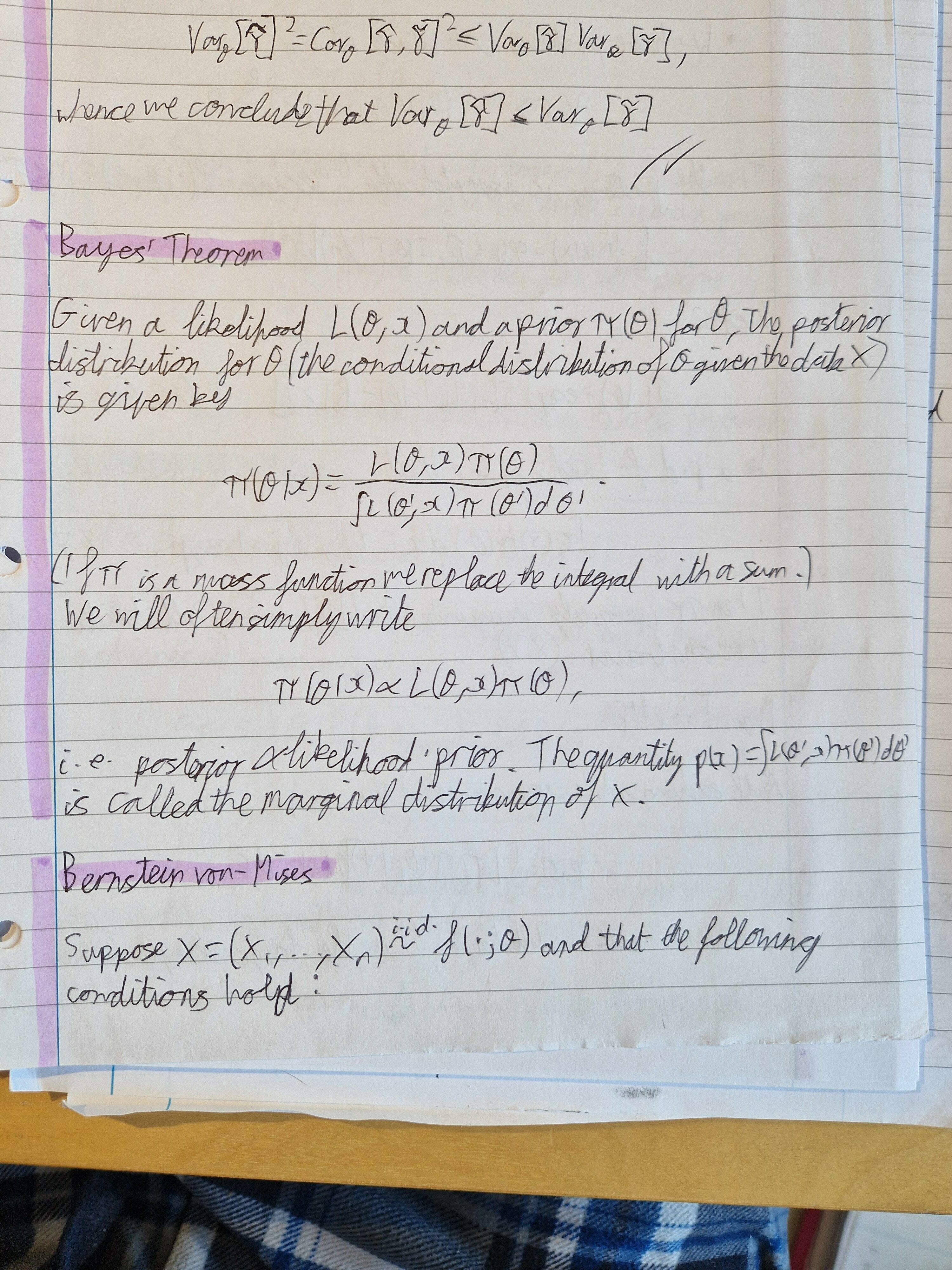
- 10State Bayes' Theorem
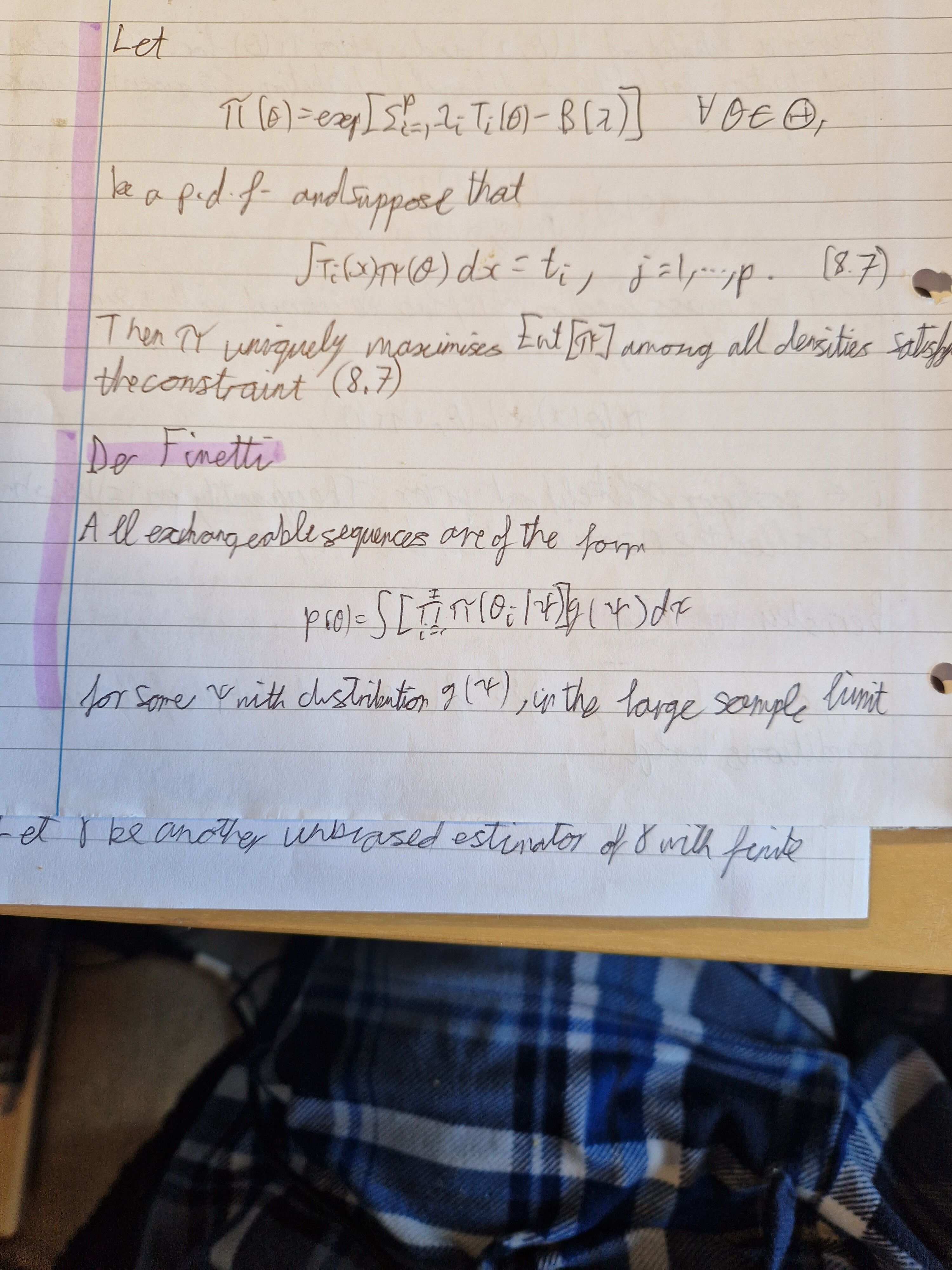
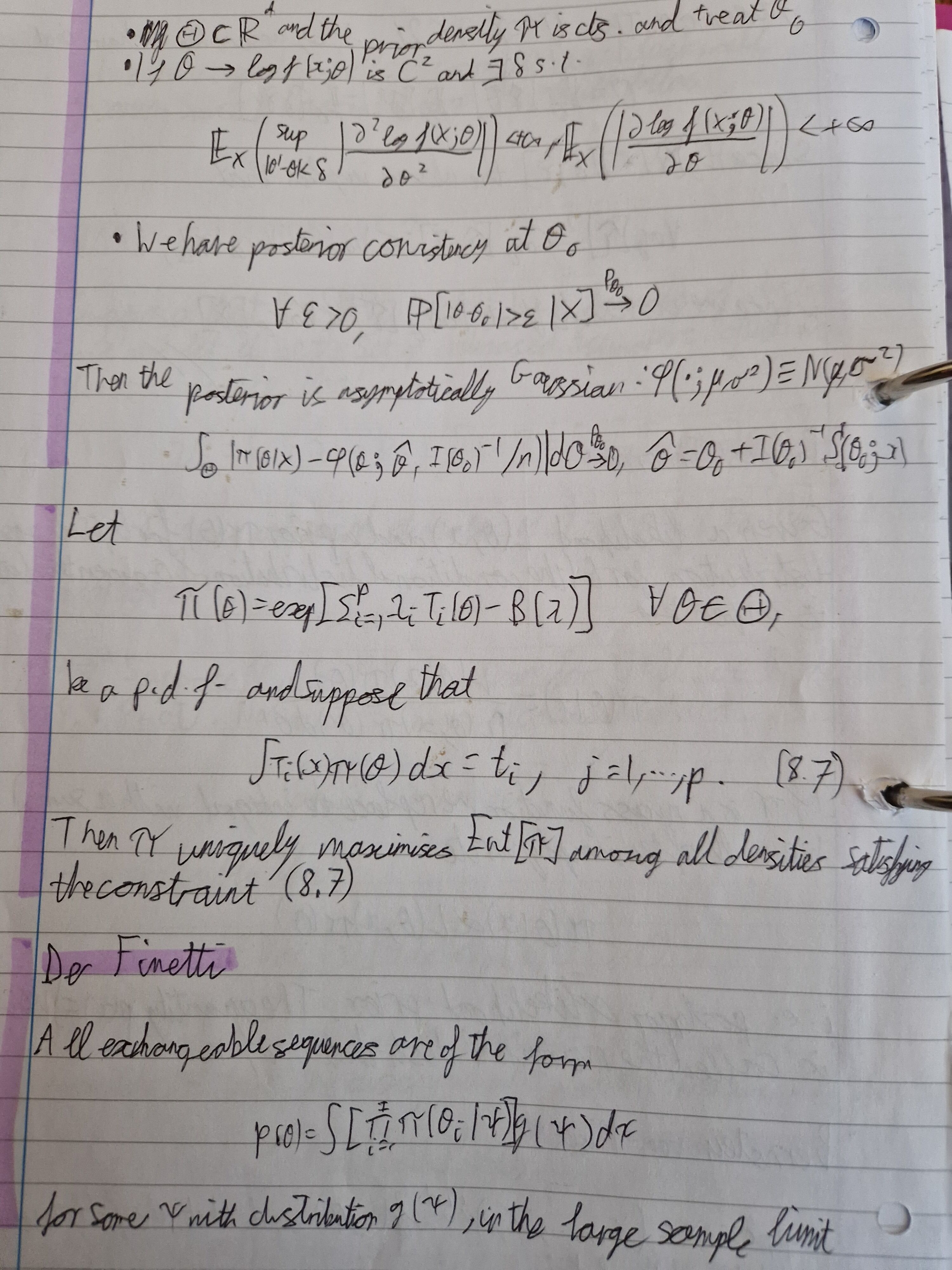
- 11State De Finetti's Theorem
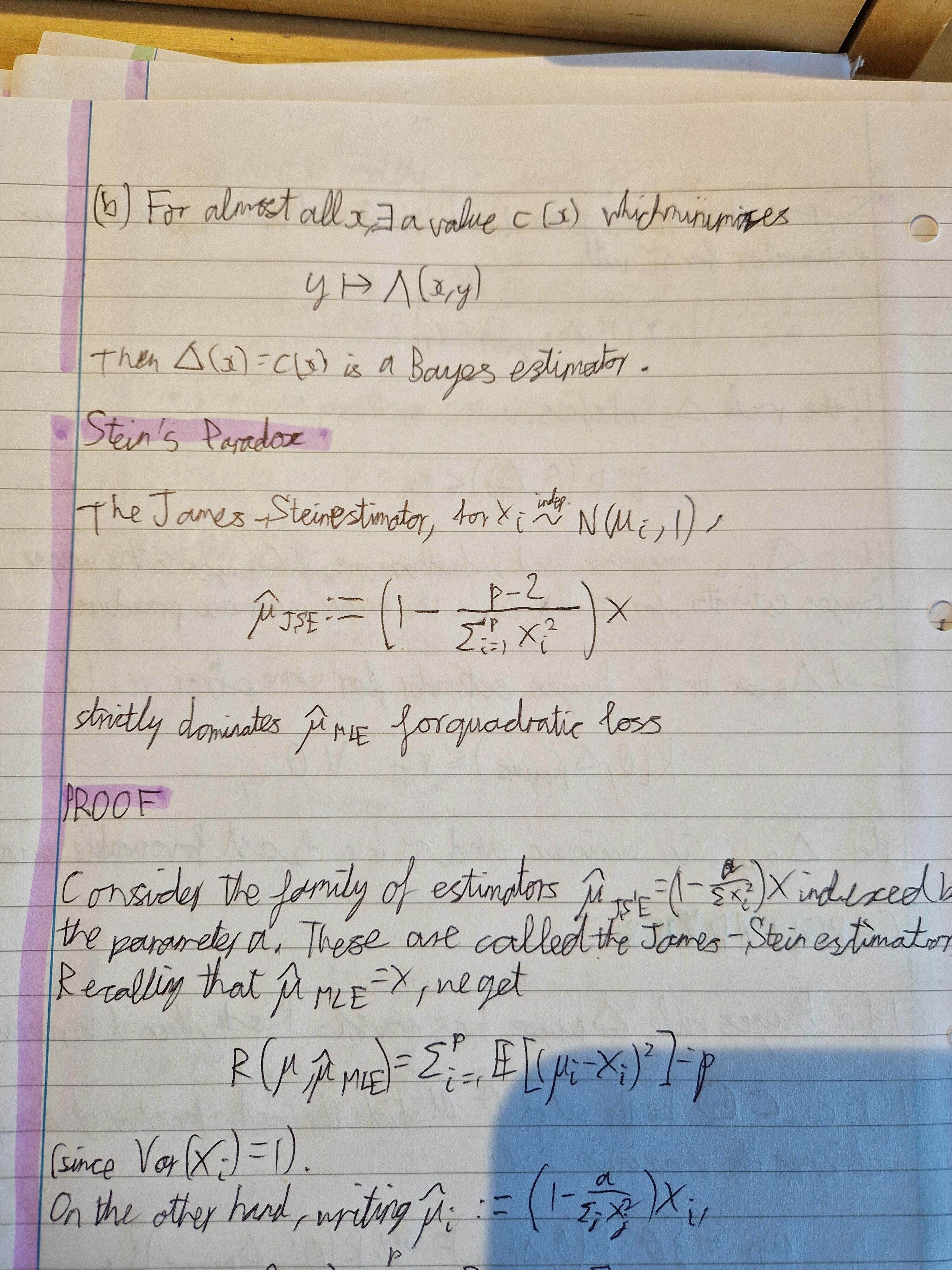
- 12State Stein's Paradox
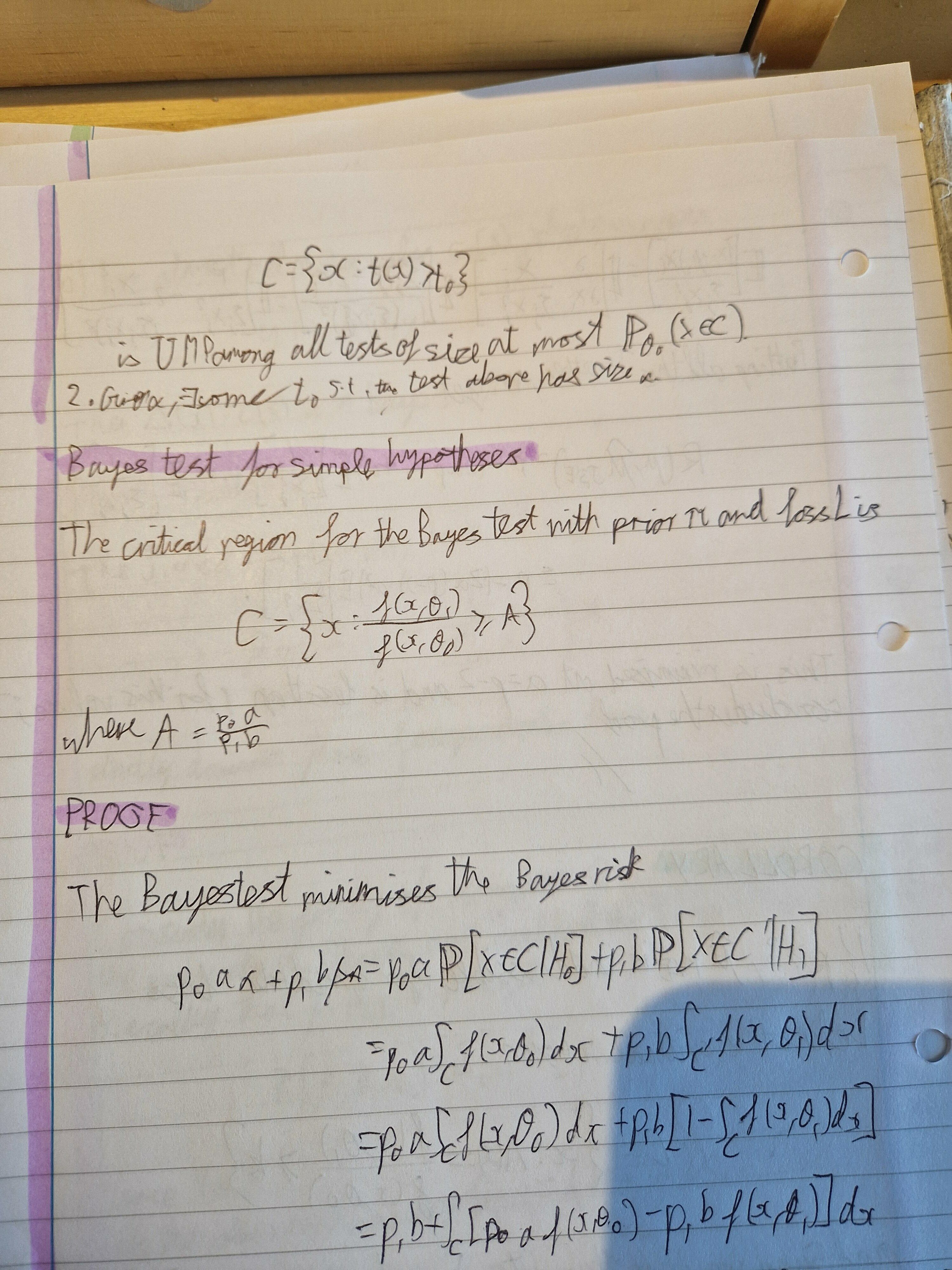
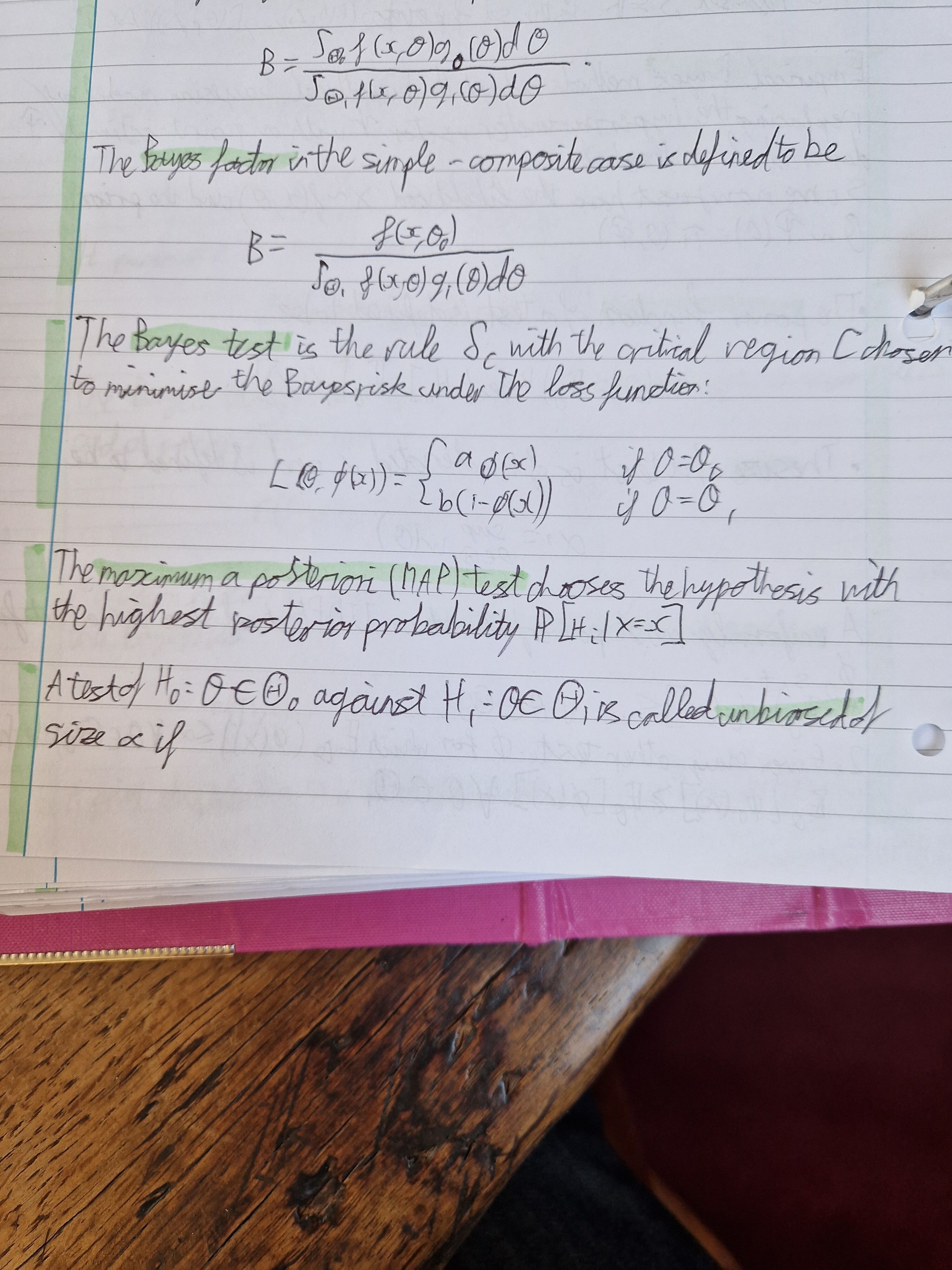
- 13State the Bayes test for simple hypotheses
- 14Suppose X~f(x;θ) for some parameter θ. State what it means for a statistic T(X) to be sufficient for θ
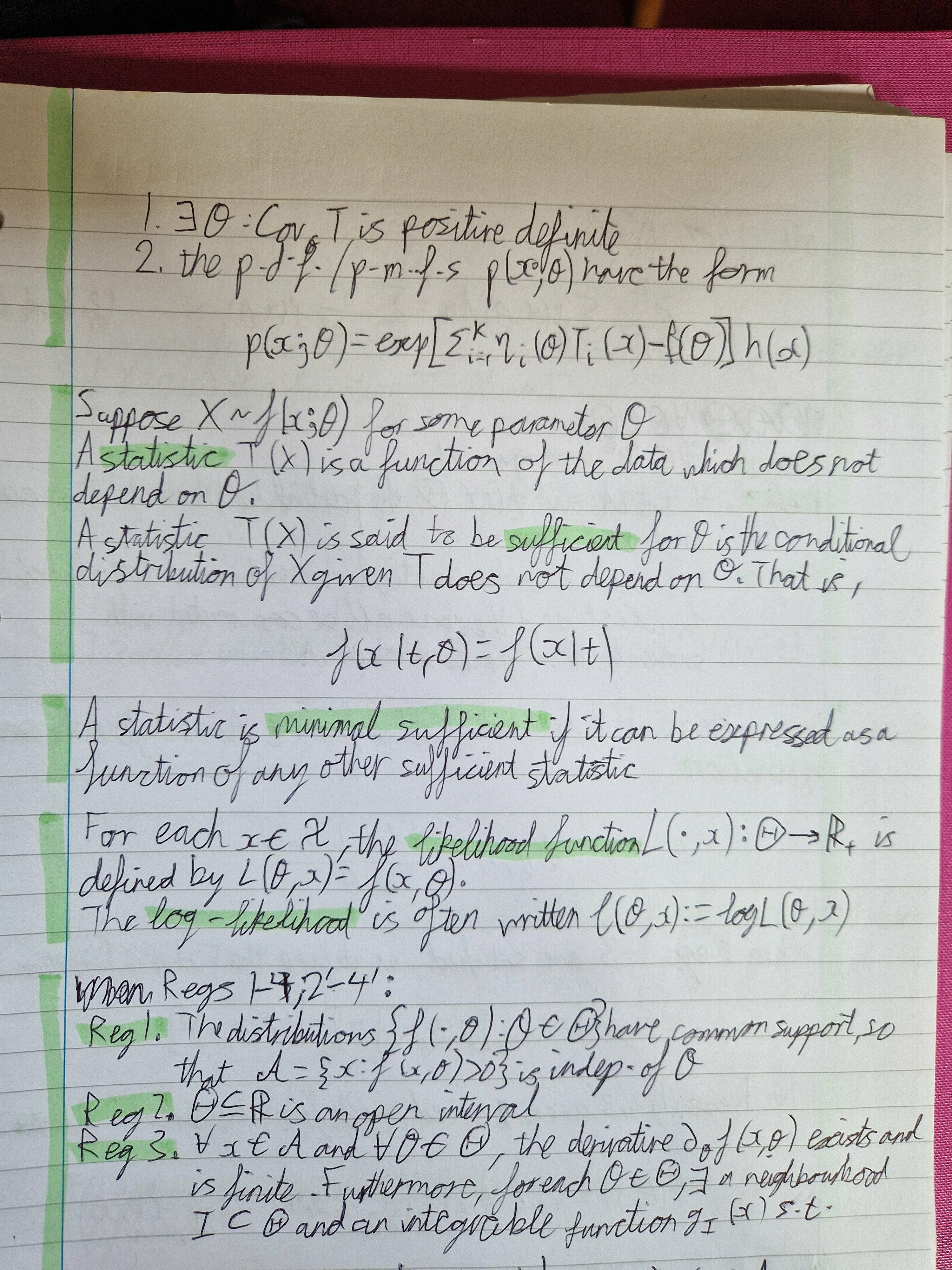
- 15Suppose X~f(x;θ) for some parameter θ and T(x) is a sufficient statistic for θ. State what it means for T to be minimal sufficient
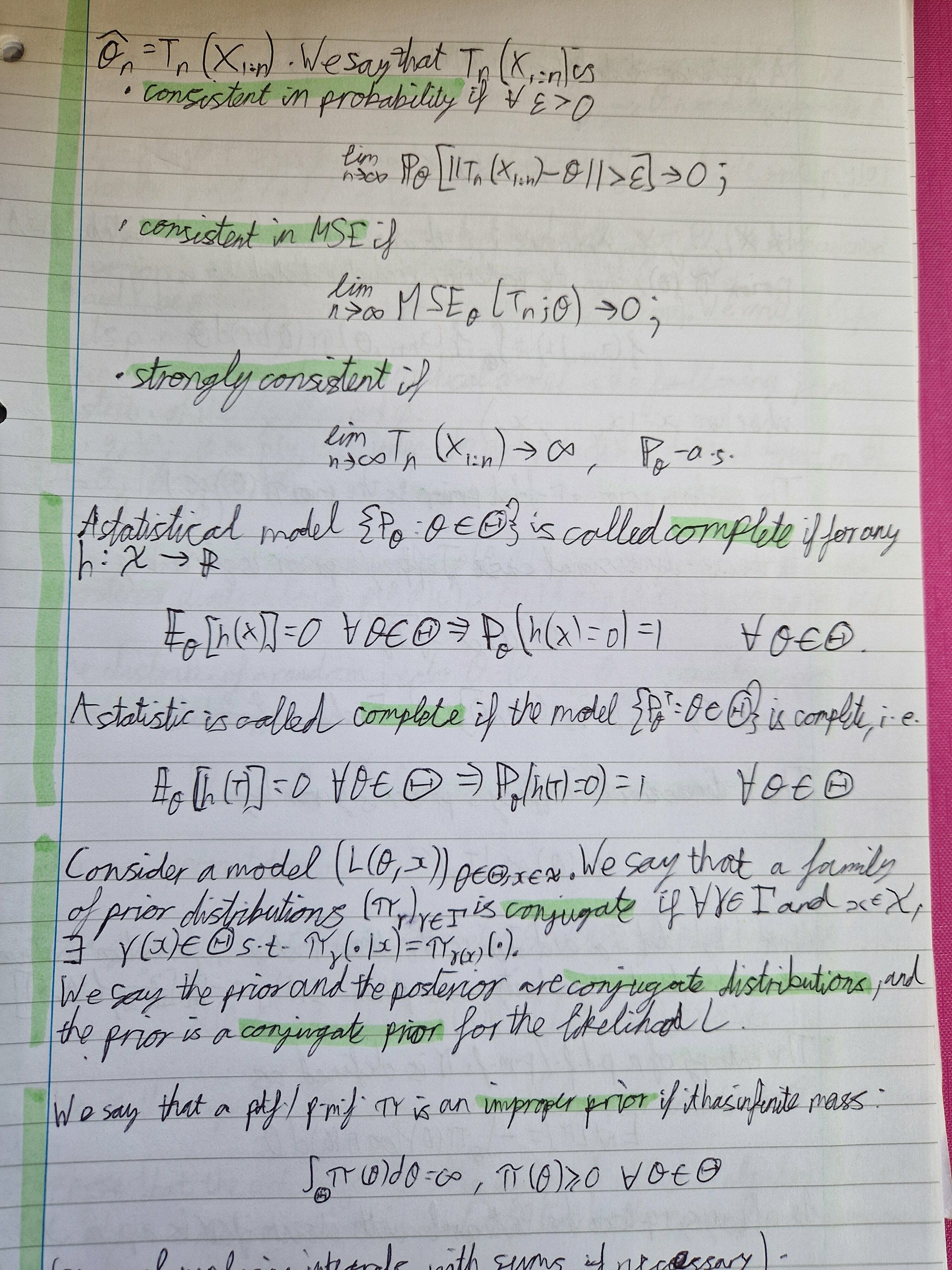
- 16Let {P_θ:θ∈Θ} be a statistical model and T(x) a statistic. Define what it means for {P_θ:θ∈Θ} to be complete and T to be complete
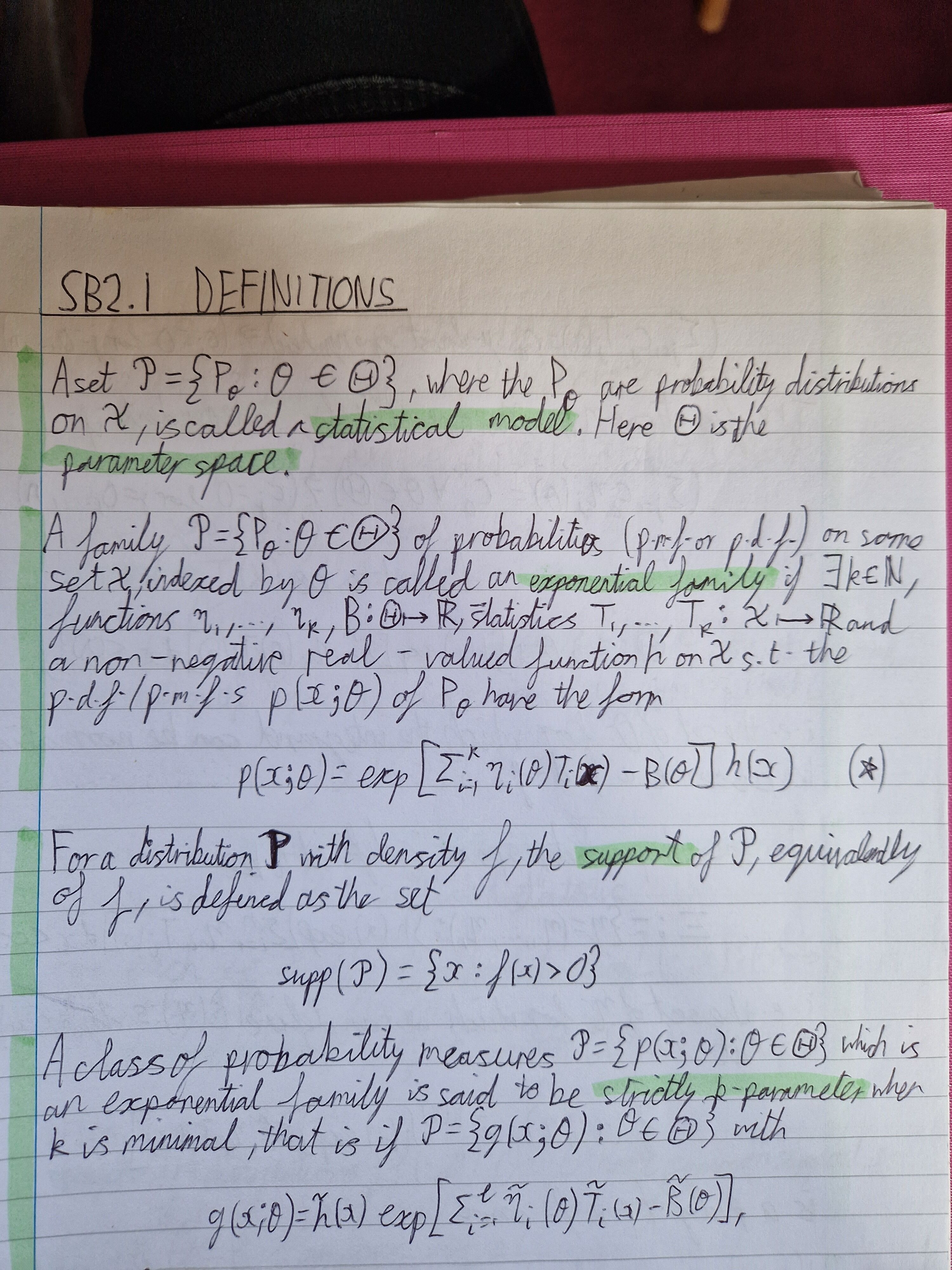
- 17When is a family 𝒫={P_θ:θ∈Θ} of probabilities on some set 𝒳, indexed by θ, called an exponential family
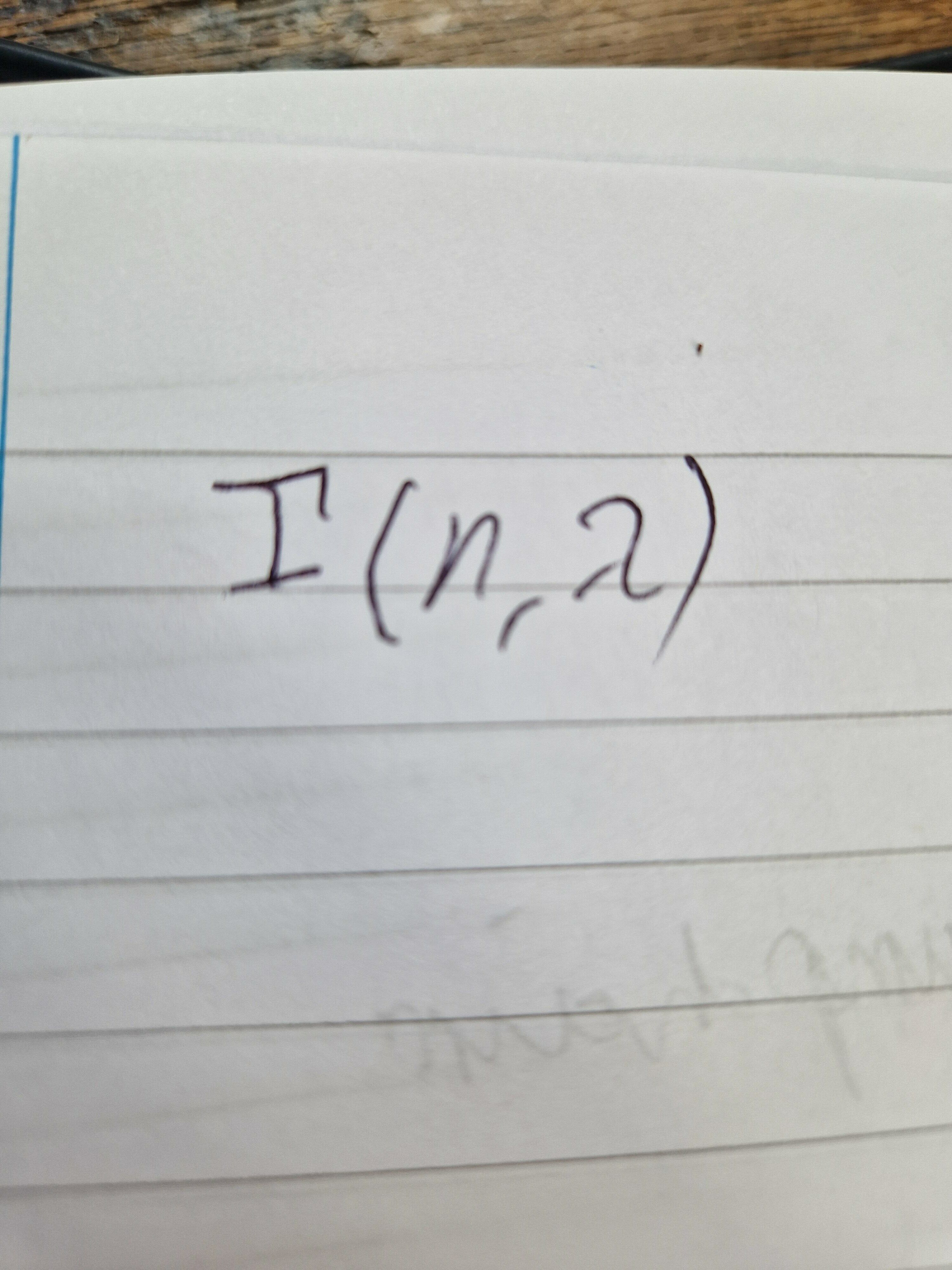
- 18Suppose X_1,X_2,...,X_n are i.i.d. Exp(λ) random variables. State the distribution of Σ_(i=1)^n(X_i)
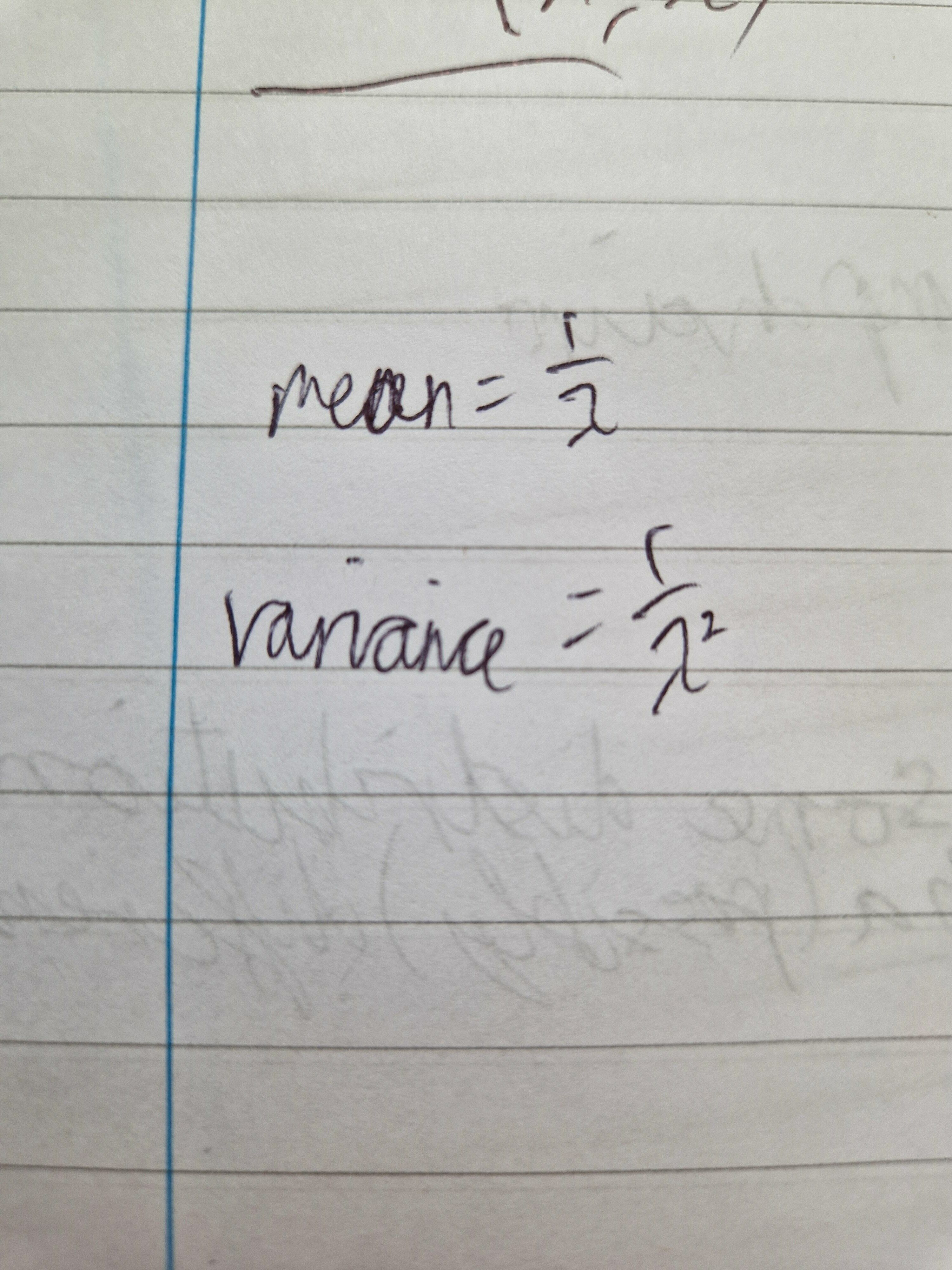
- 19State the mean and variance of an Exp(λ) distribution
- 20When Regs 1-3 are satisfied, define the Fisher information
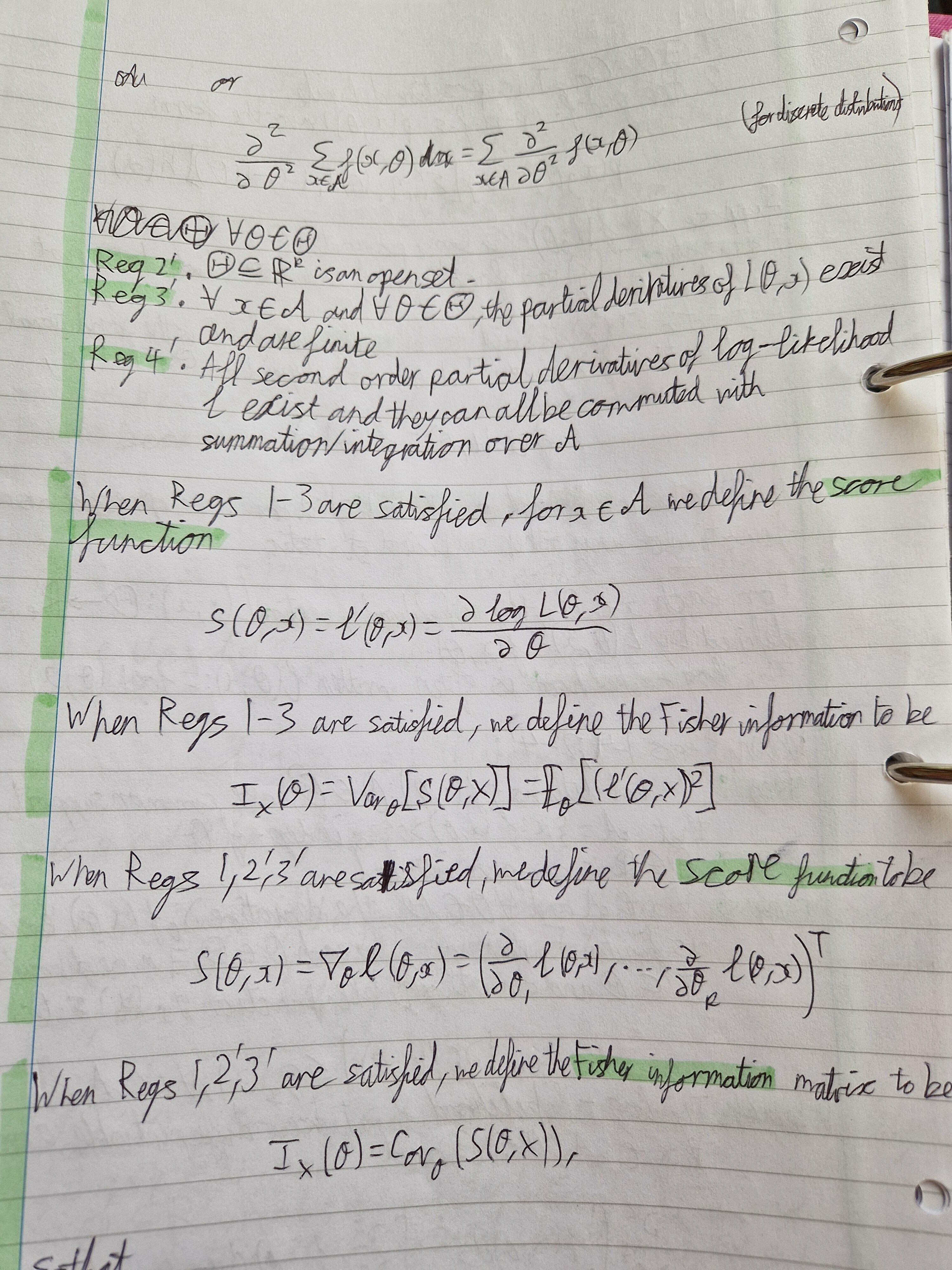
- 21When Regs 1-3 are satisfied, define the score function
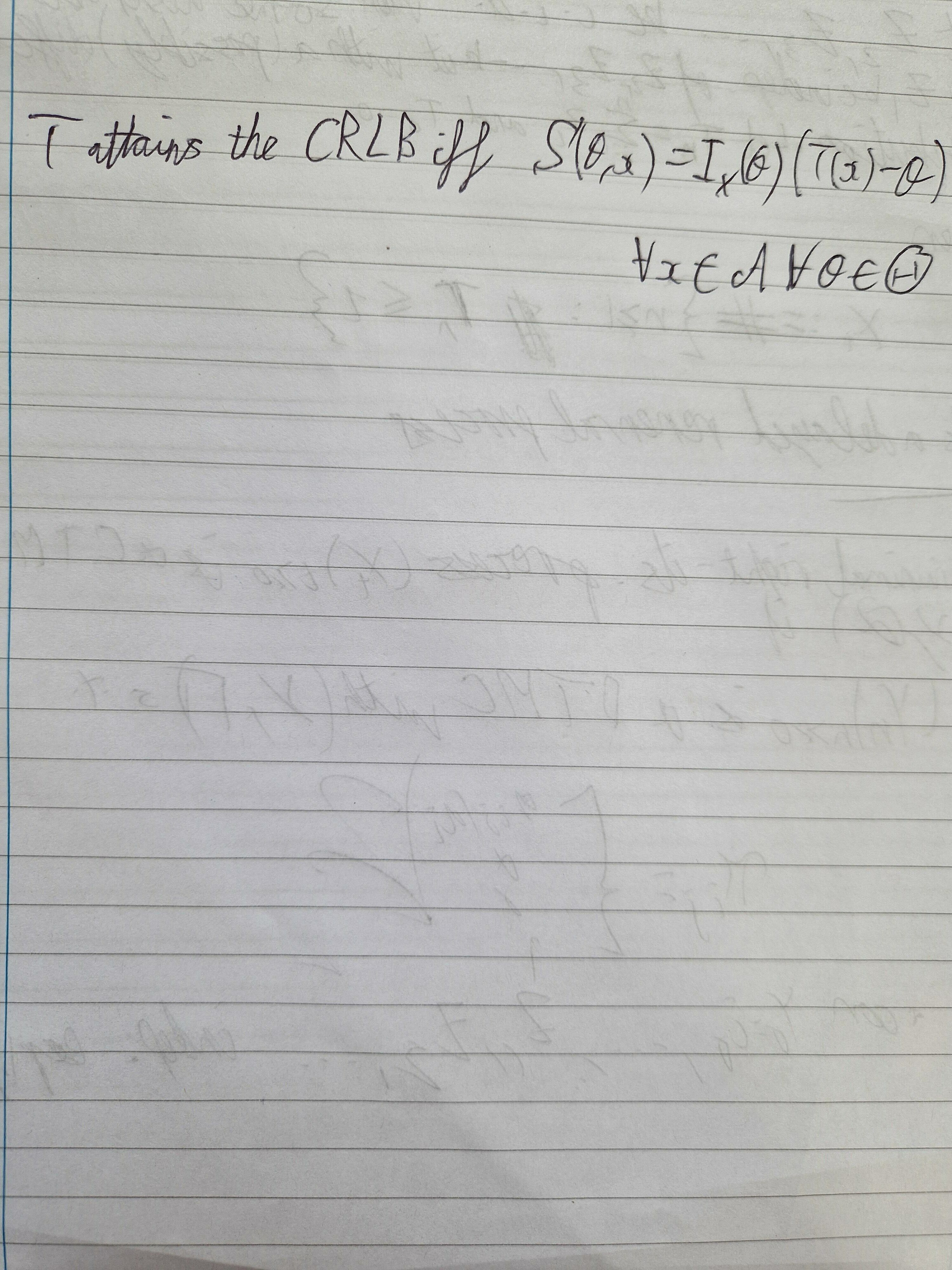
- 22In the case that g(θ)=θ, give an if and only if statement for a statistic T(x) attaining the Cramer-Rao Lower Bound relating to the score function and Fisher information
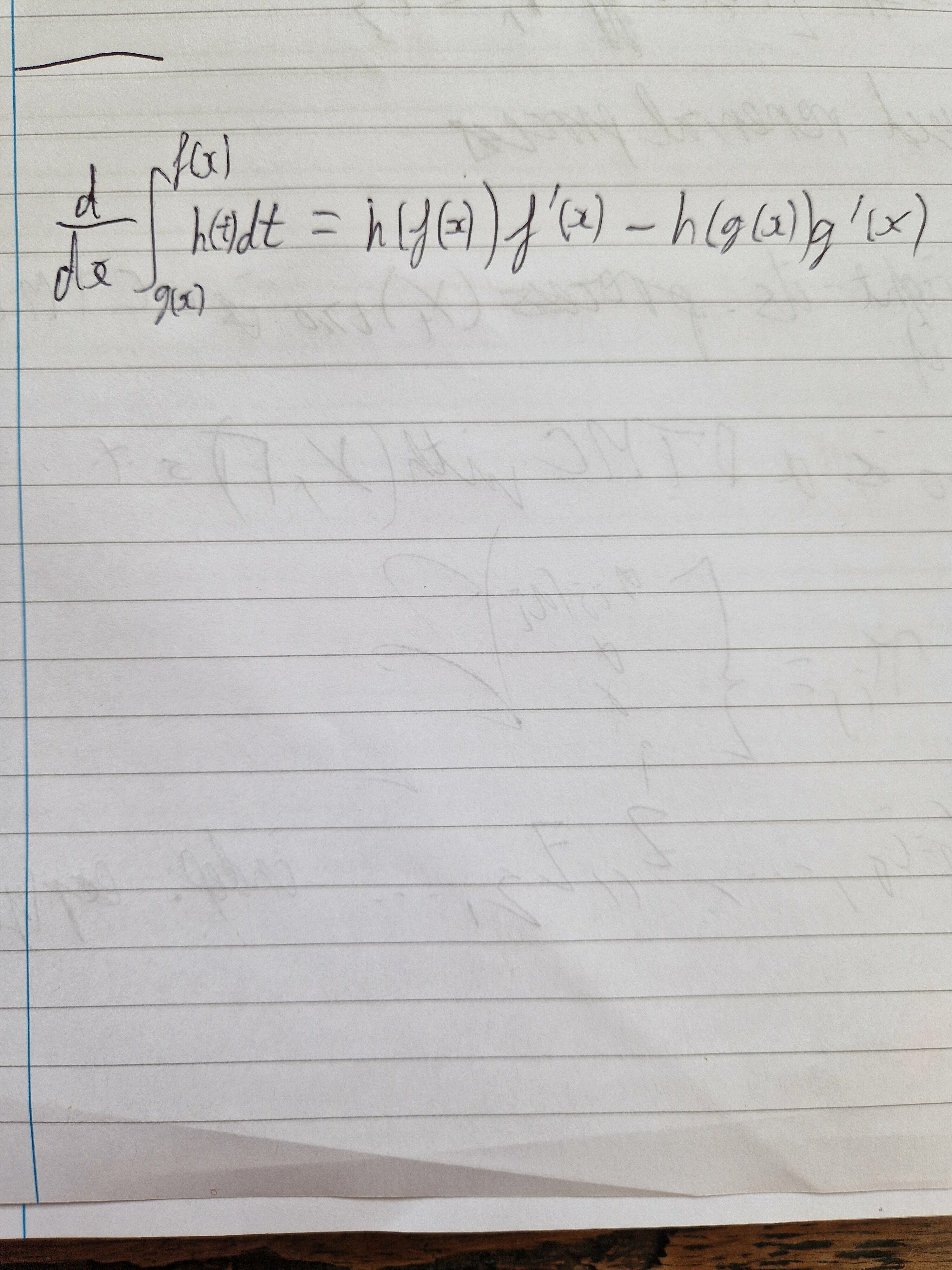
- 23State the derivative w.r.t. x of the integral of a function h(t) w.r.t. t between two functions g(x) and f(x)
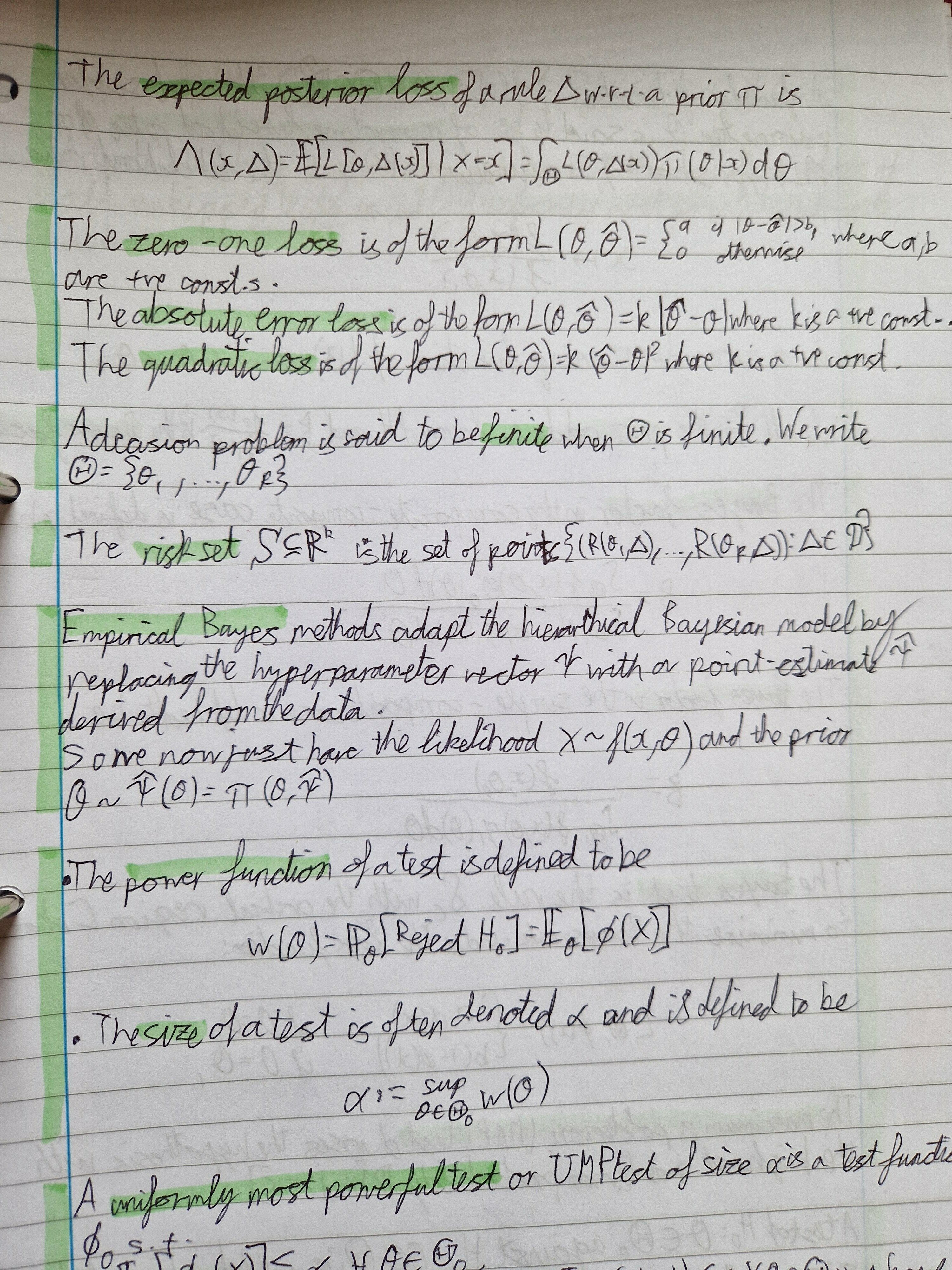
- 24For a given rule Δ∈𝒟 and a parameter θ∈Θ, define the (frequentist) risk
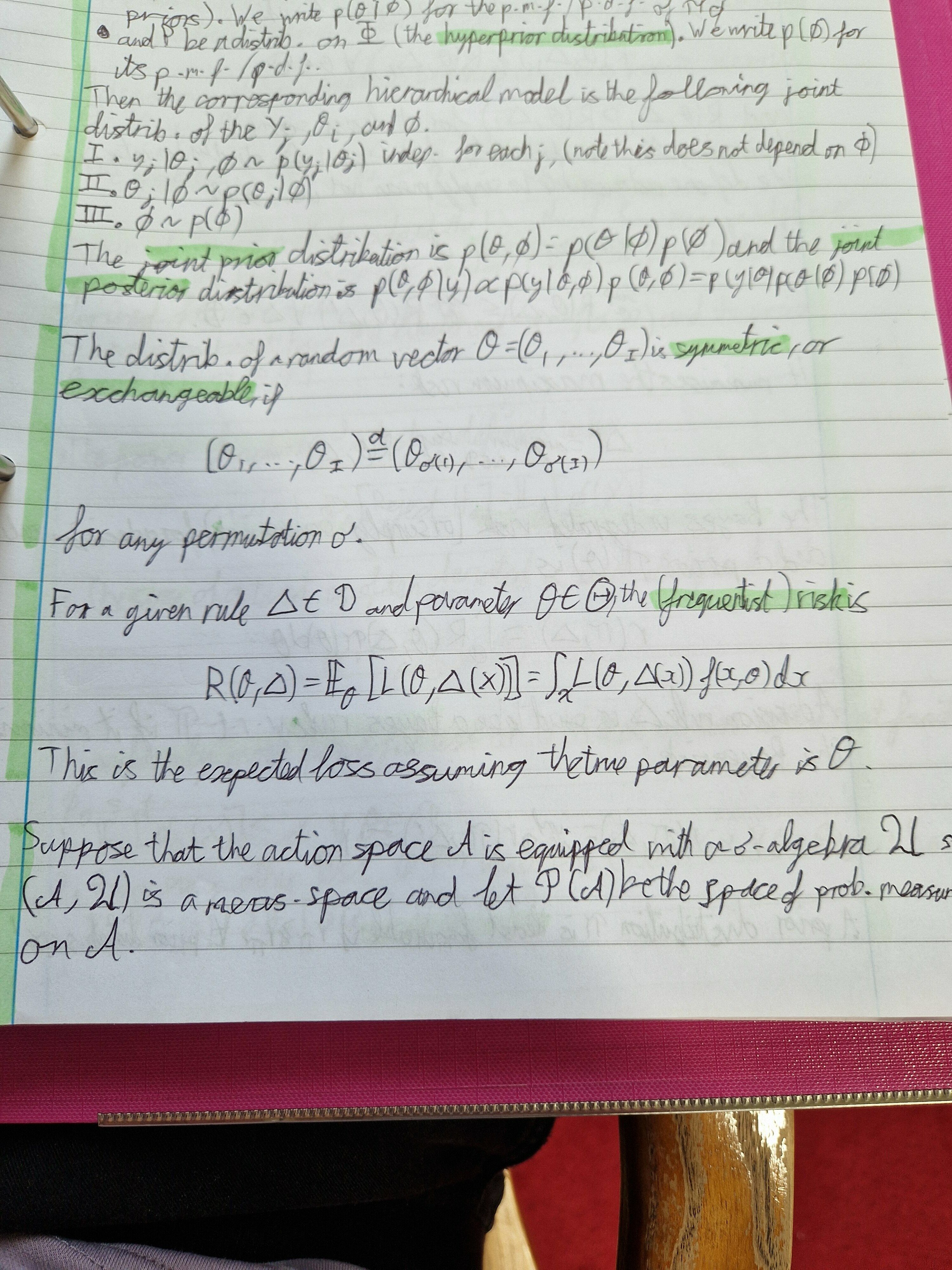
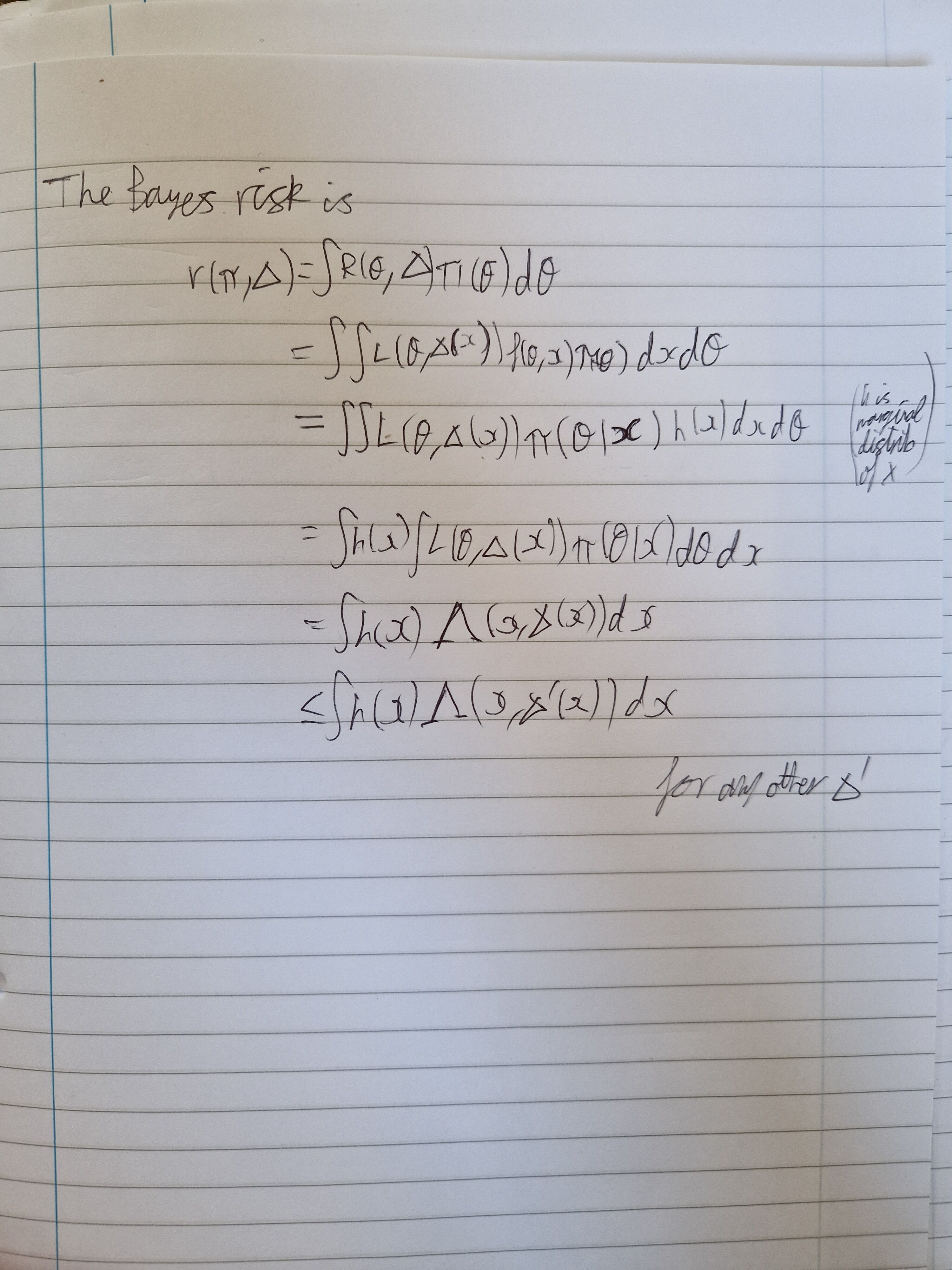
- 25Define the Bayes (integrated) risk for a decision rule Δ and a prior π(θ)
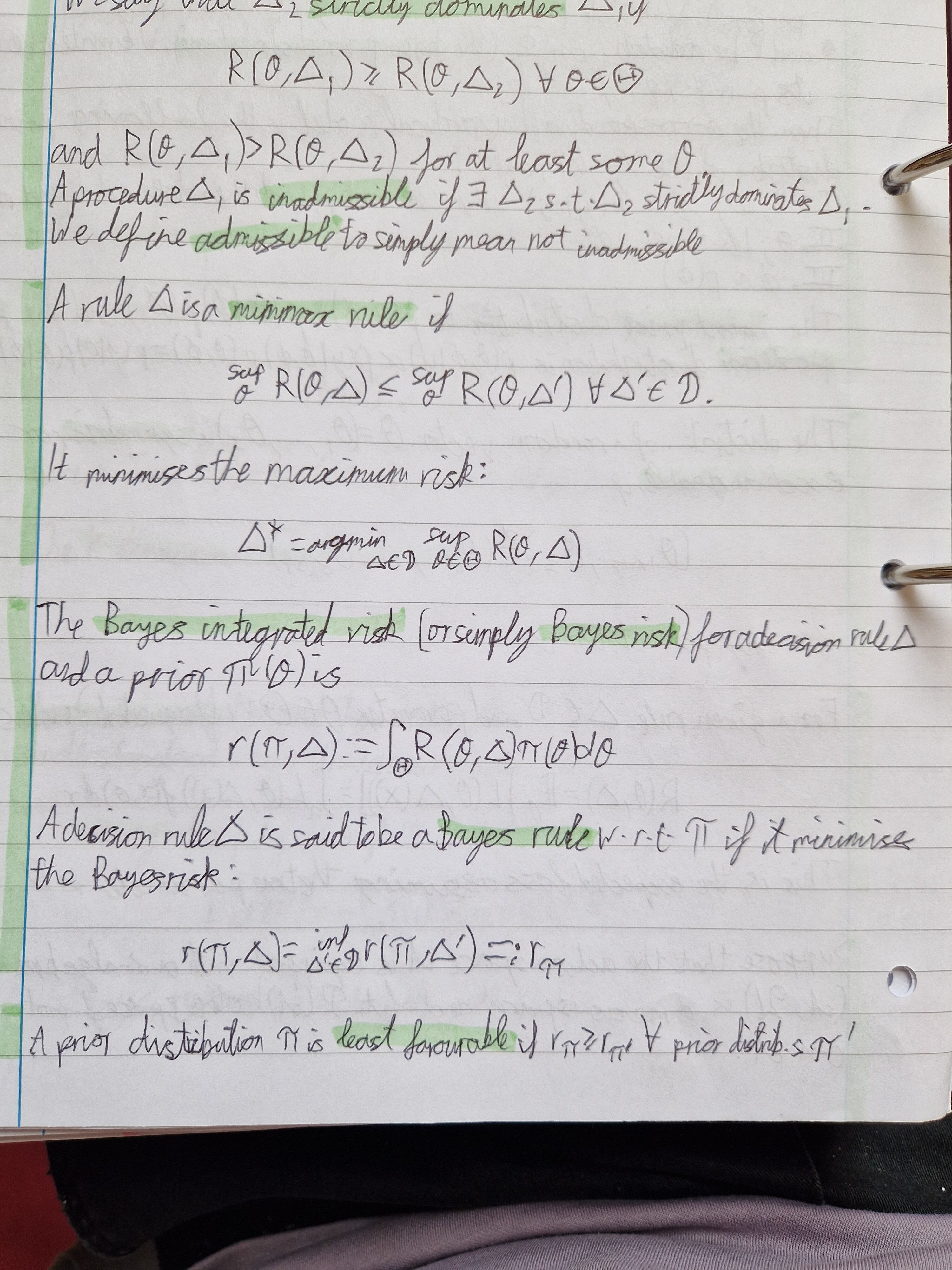
- 26Define what it means for a decision rule Δ to be a Bayes rule w.r.t. a prior π(θ)
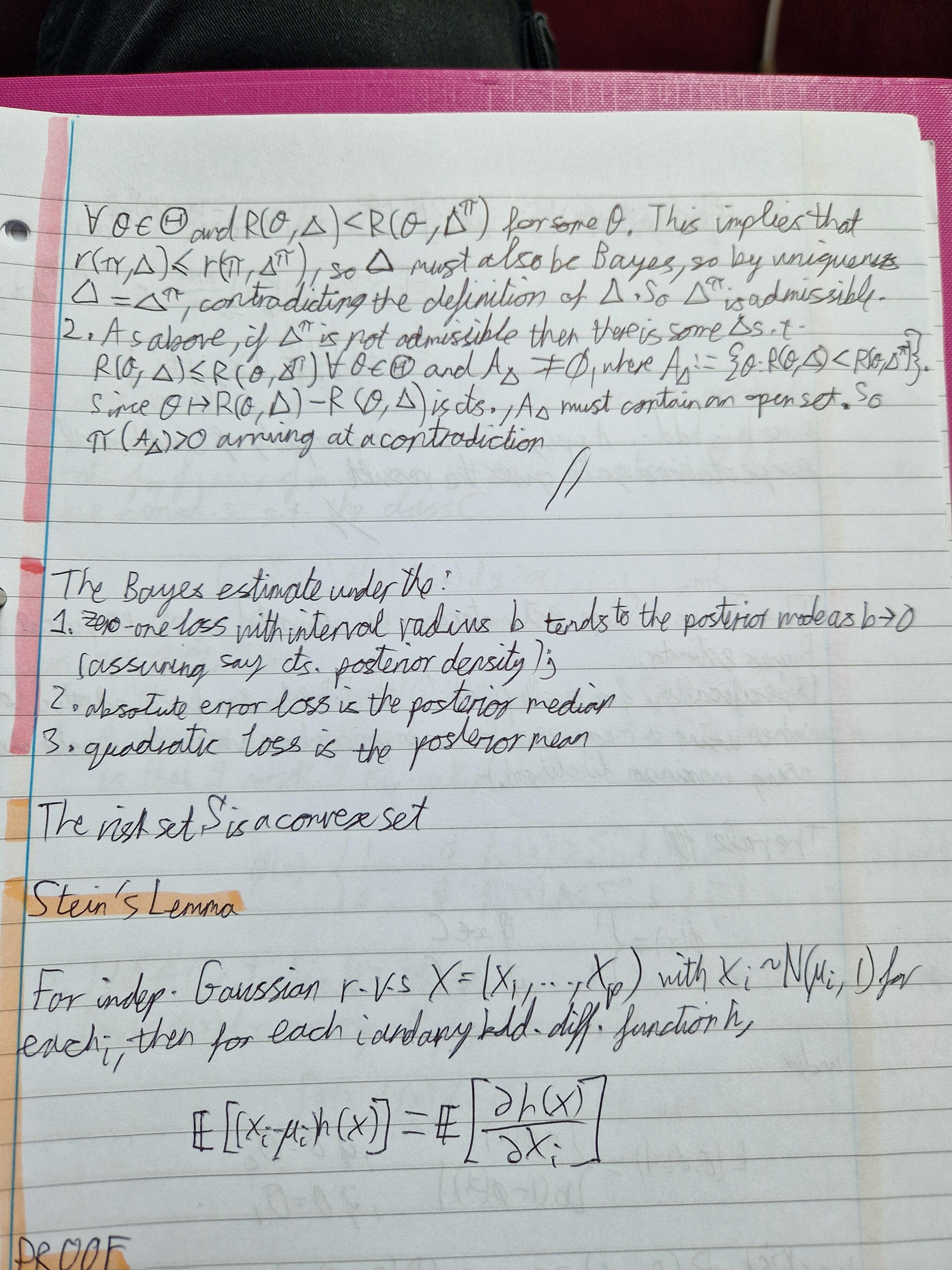
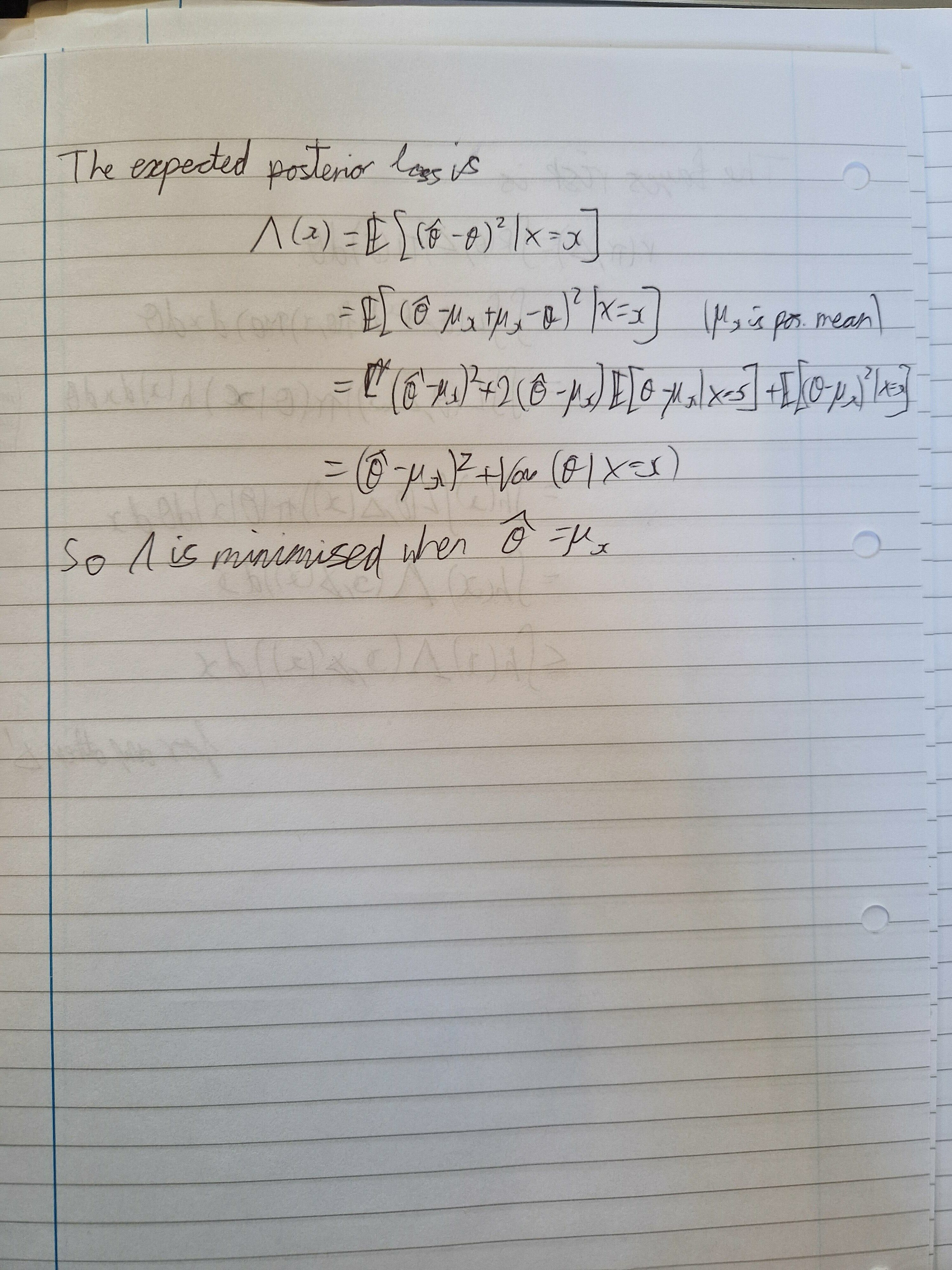
- 27State the Bayes rule under the zero-one loss with interval radius b ->0, under the absolute loss, and under the quadratic loss
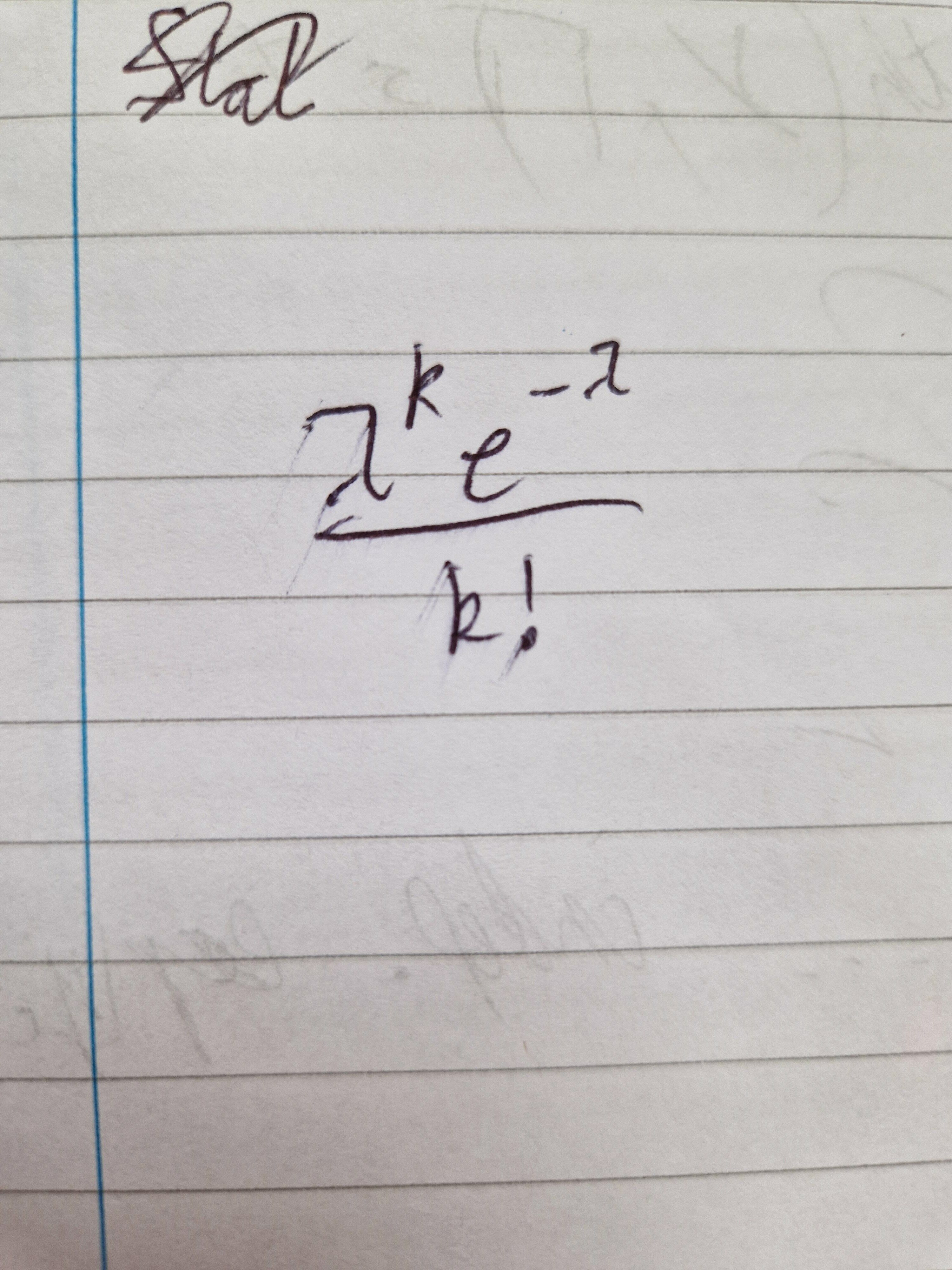
- 28State the p.m.f. of a Poisson(λ) distribution
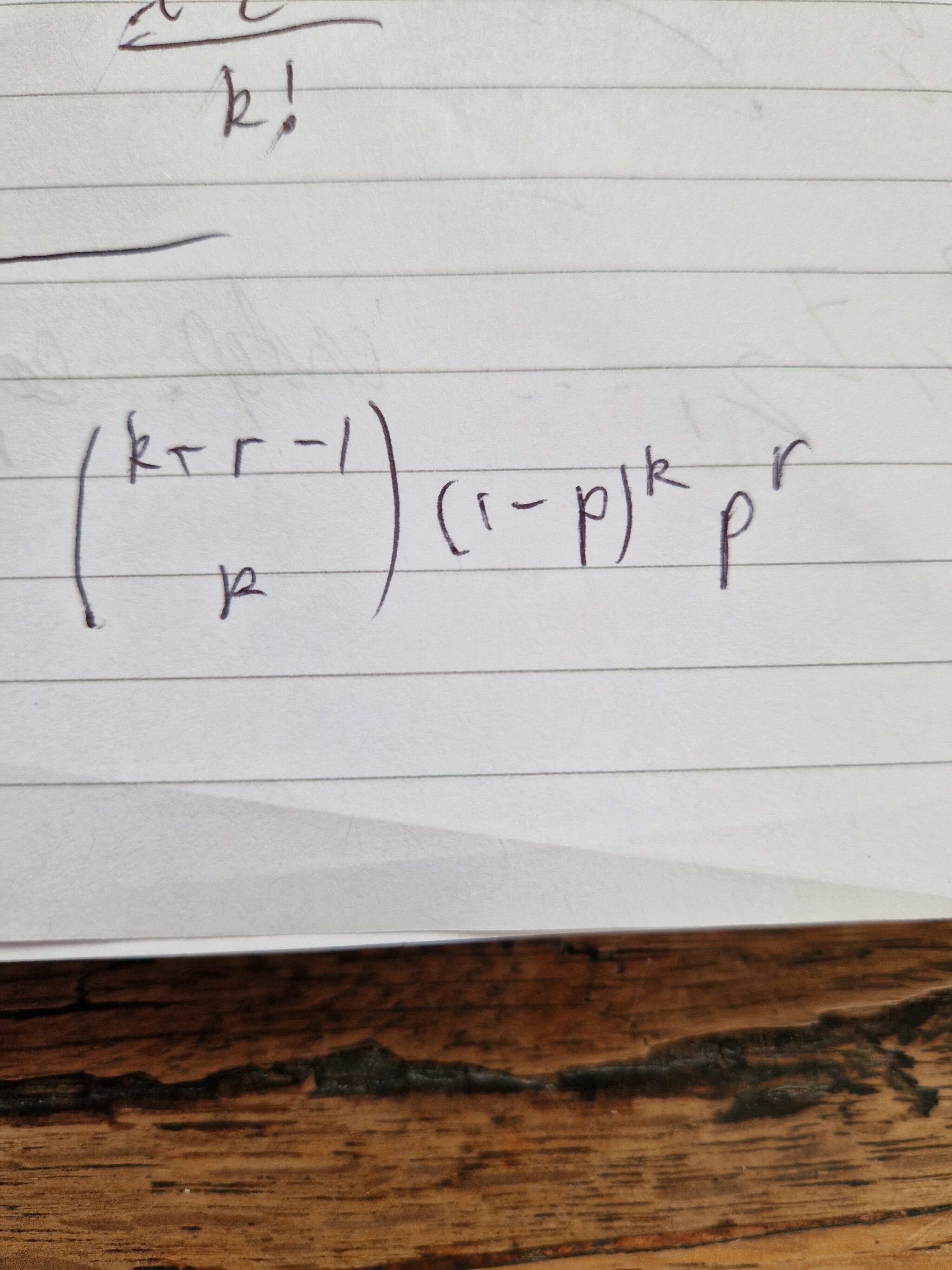
- 29State the p.m.f. of an NB(r,p) distribution
- 30Describe what is meant by empirical Bayes methods
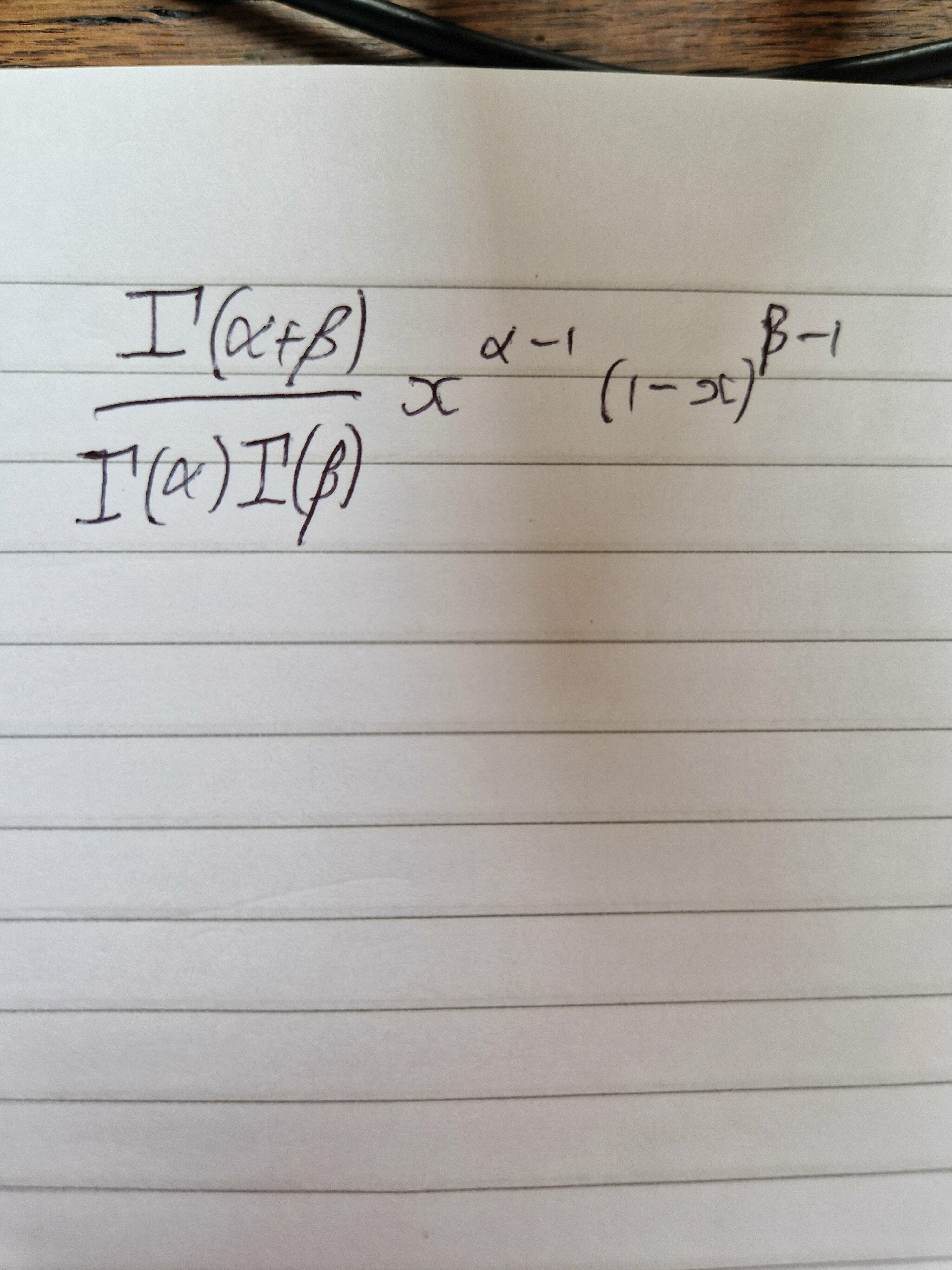
- 31State the p.d.f. of a Beta(α,β) distribution
- 32Suppose τ_1<<τ_2. State the Kullback-Leibler divergence KL(τ_1∥τ_2)
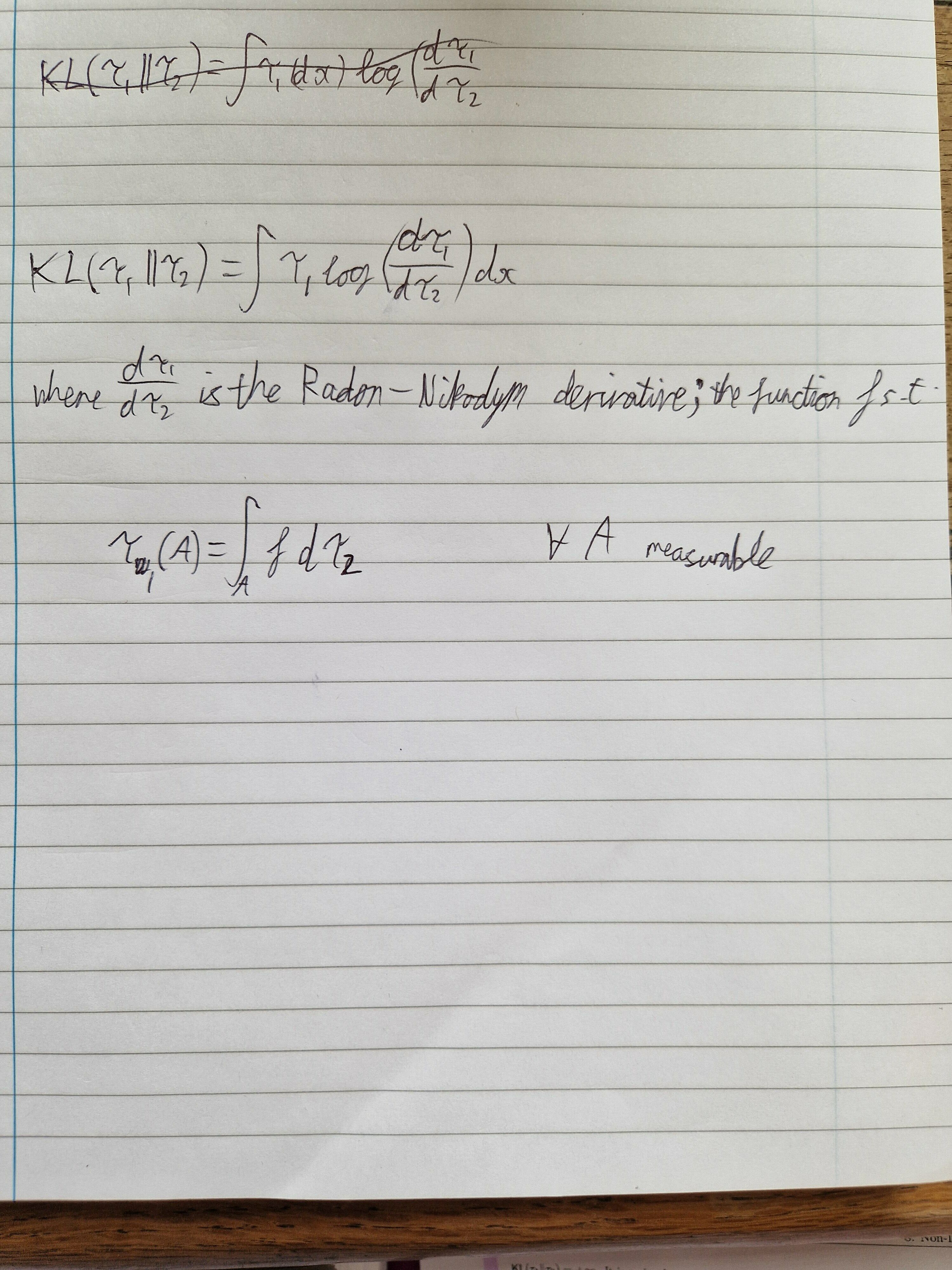
- 33Suppose τ_1<<τ_2. Define the Radon-Nikodym derivative
- 34Consider a model (L(θ,x))_(θ∈Θ,x∈𝒳). Define what it means for a family of prior distributions (π_γ)_(γ∈Γ) to be conjugate
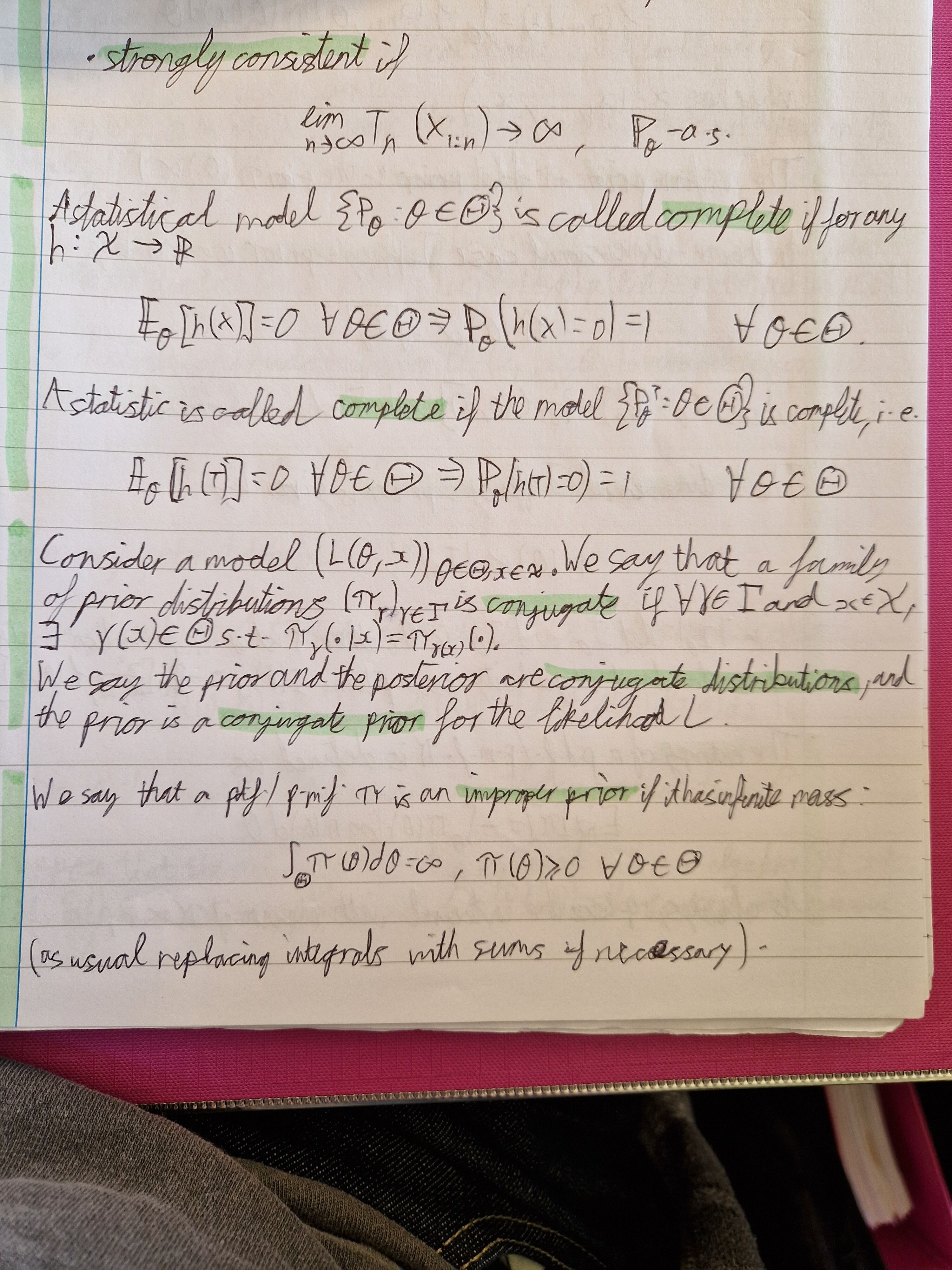
- 35Suppose that X|θ~P_θ and that θ~π. State hypothesis under which we can find a Bayes estimator
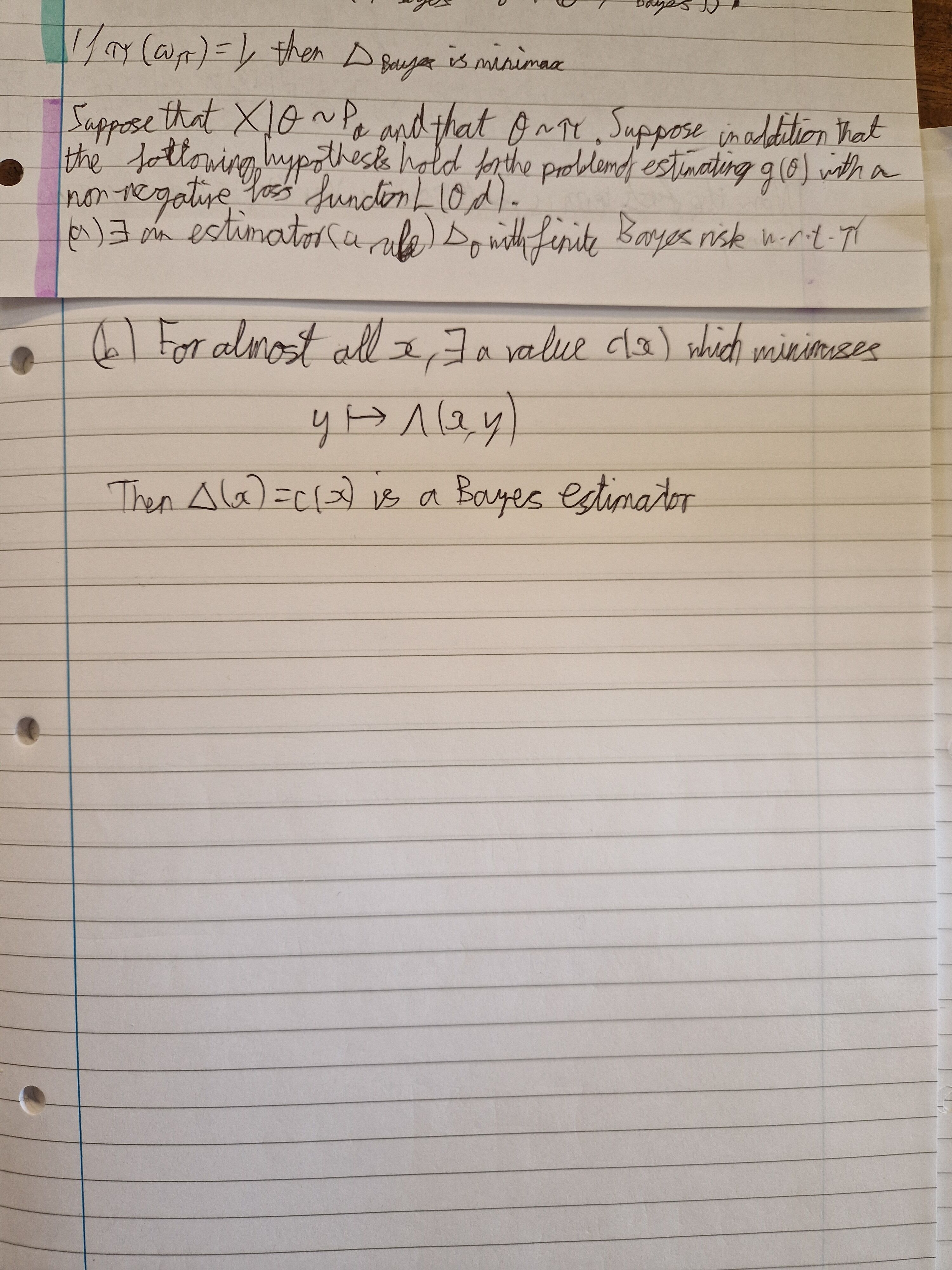
- 36Let Δ^π be a Bayes rule w.r.t. π with finite Bayes risk. Prove that if Δ^π is unique then it is admissible

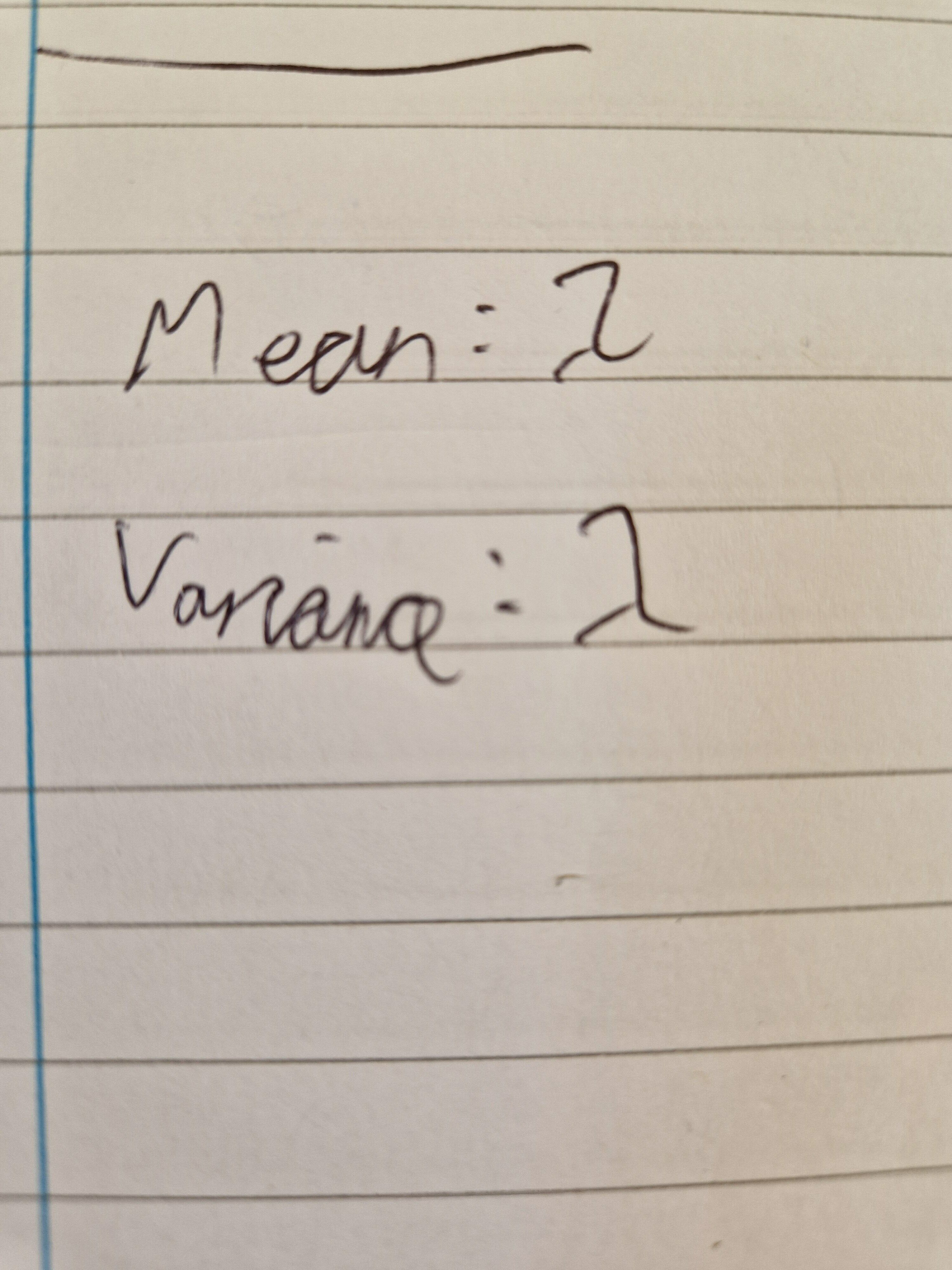
- 37State the mean and variance of a Poisson(λ) distribution
- 38State the variance of a random variable X in terms of it's moments

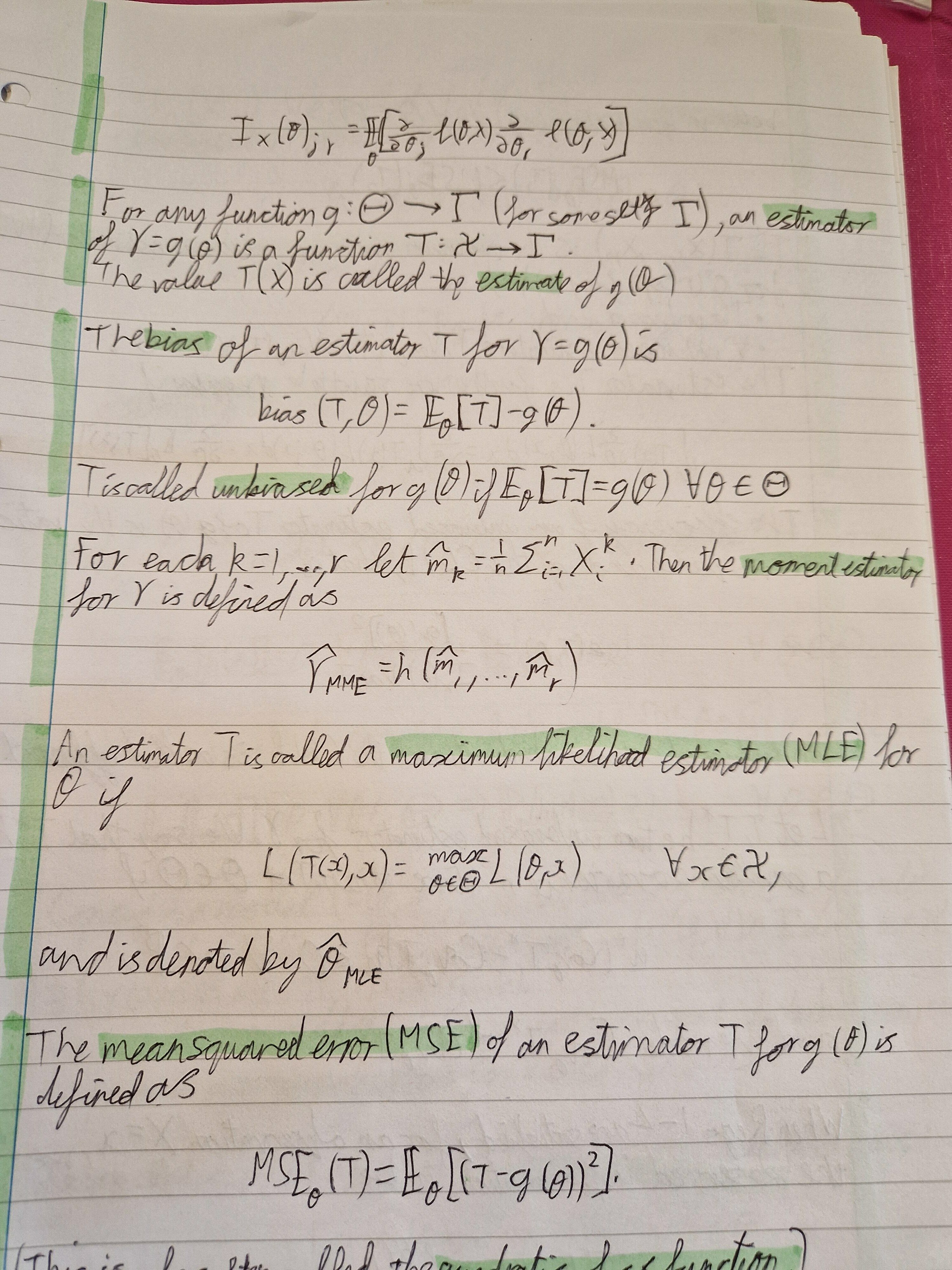
- 39Suppose (X_1,...,X_n) is a sample of i.i.d. P_θ distributed random variables, where θ∈Θ is the parameter. Let m_r be the r^th moment of X and assume there exists a function h s.t γ=h(m_1,...,m_r). Define the moment estimator for γ
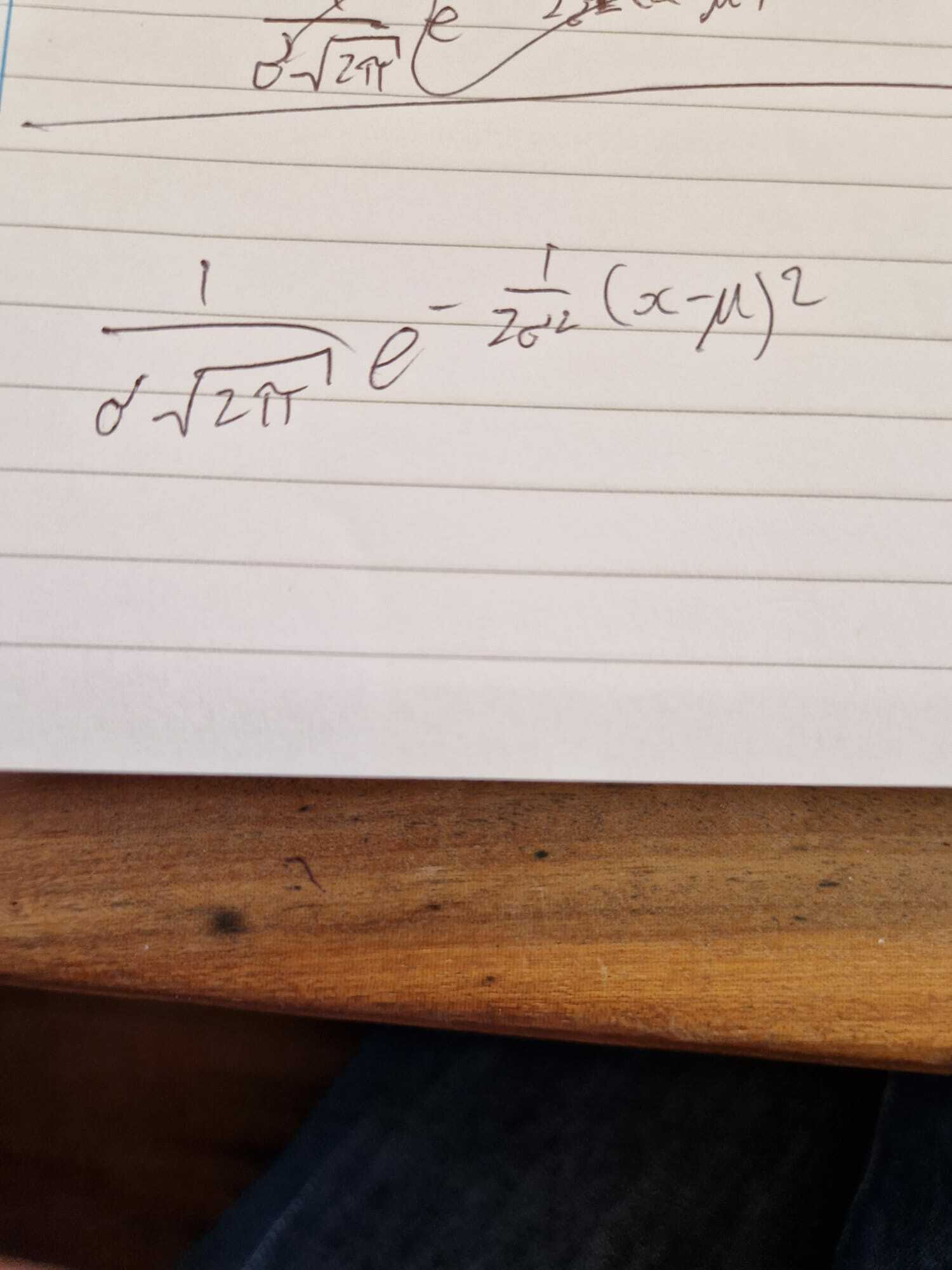
- 40State the p.d.f. of a N(μ,σ^2) distribution
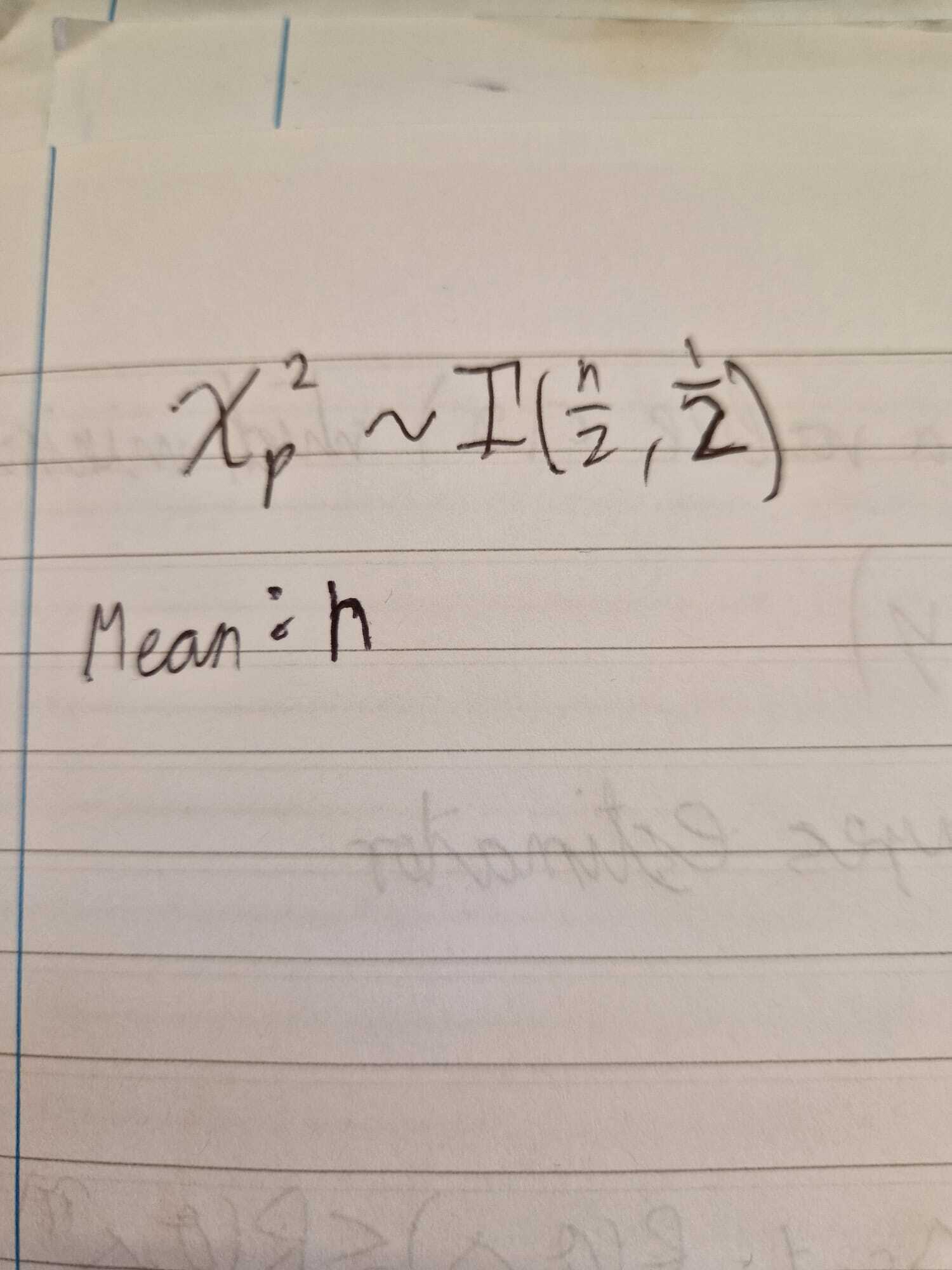
- 41Give another term to describe an exponential family as regular, and define it
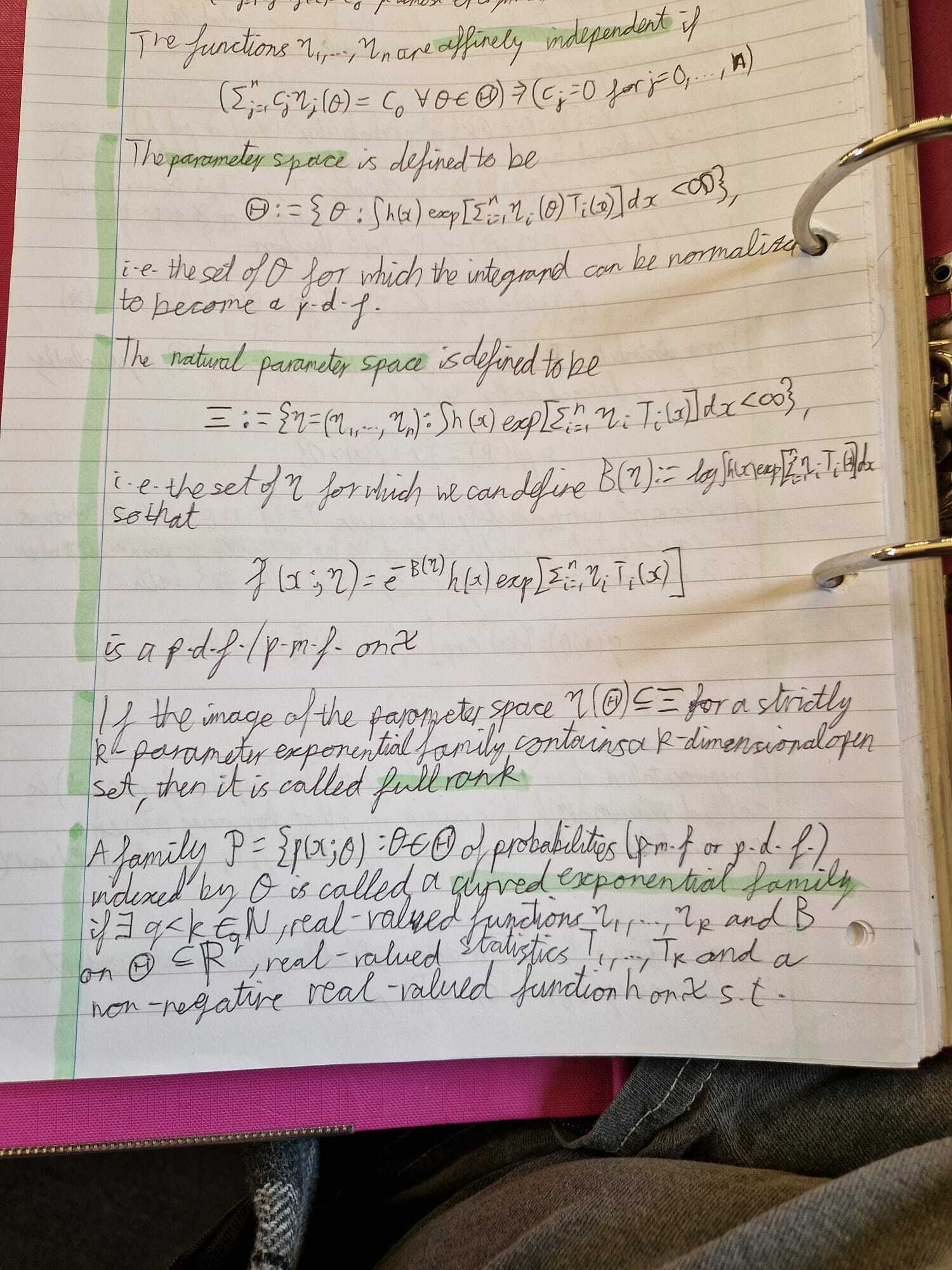
- 42State which Gamma distribution a χ^2_p is and give its mean
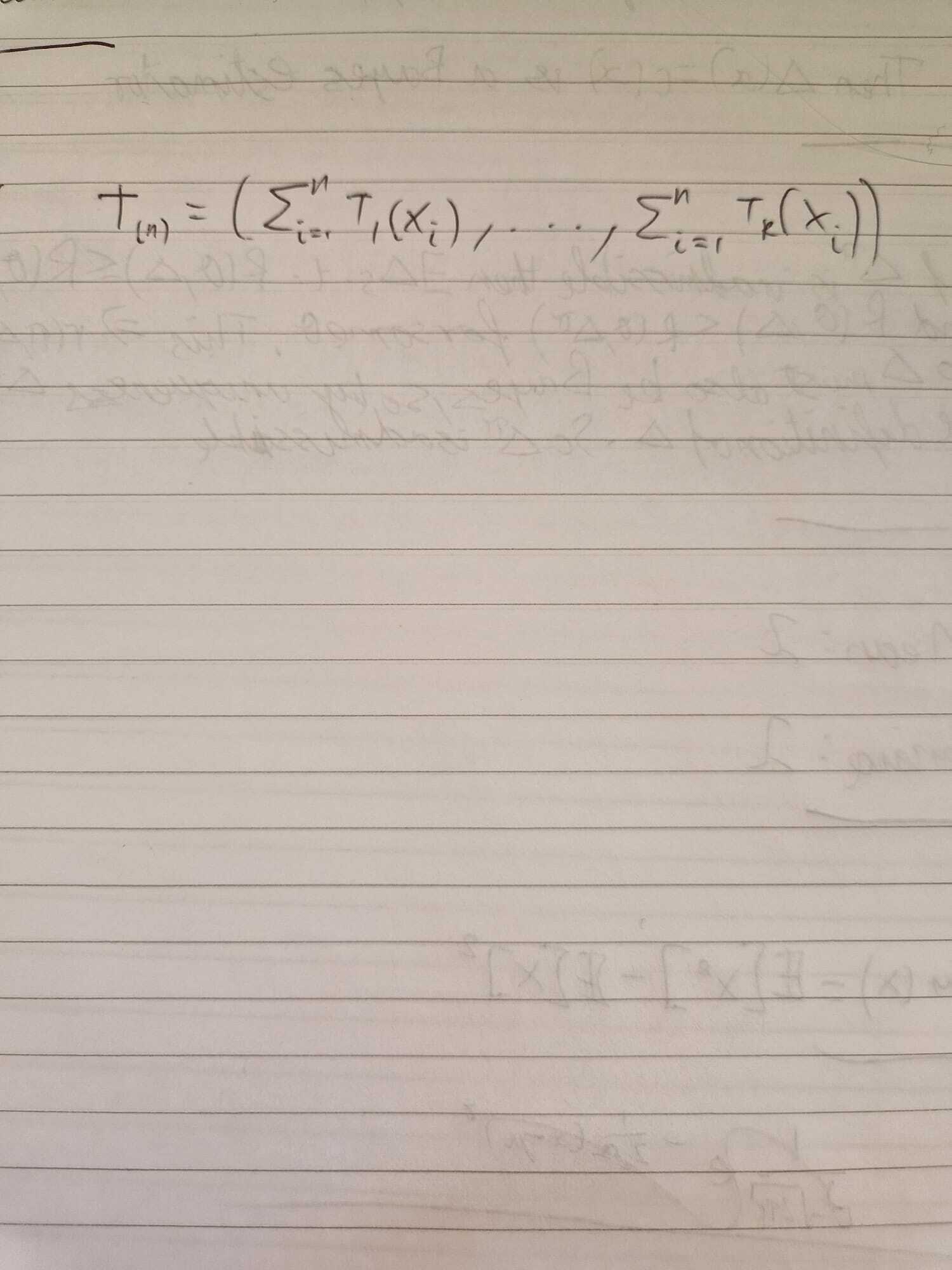
- 43Suppose the functions f(x;θ)=exp[Σ_(j=1)^(k)η_j(θ)T_j(x)-B(θ)]h(x) form a strictly k-parameter exponential family. Let X=(X_1,...,X_n), where X1,...,X_n~f(x;θ) are i.i.d. State a minimal sufficient estimator for θ
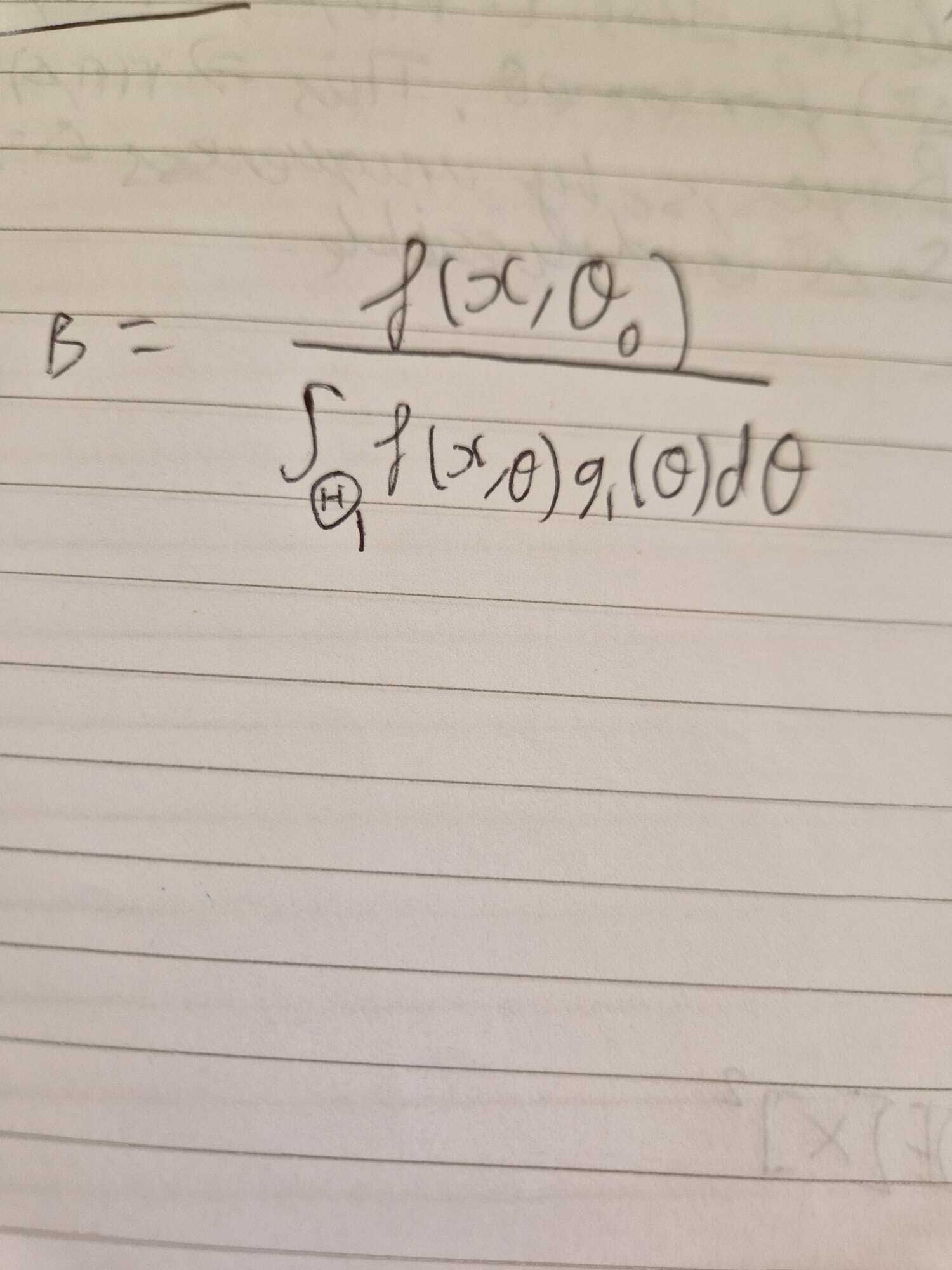
- 44Let f(x,θ) be the density of X assuming θ=θ. State the Bayes factor for the simple hypothesis H_0:θ=θ_0 against the composite hypothesis H_1:θ~g_1(θ), θ∈Θ
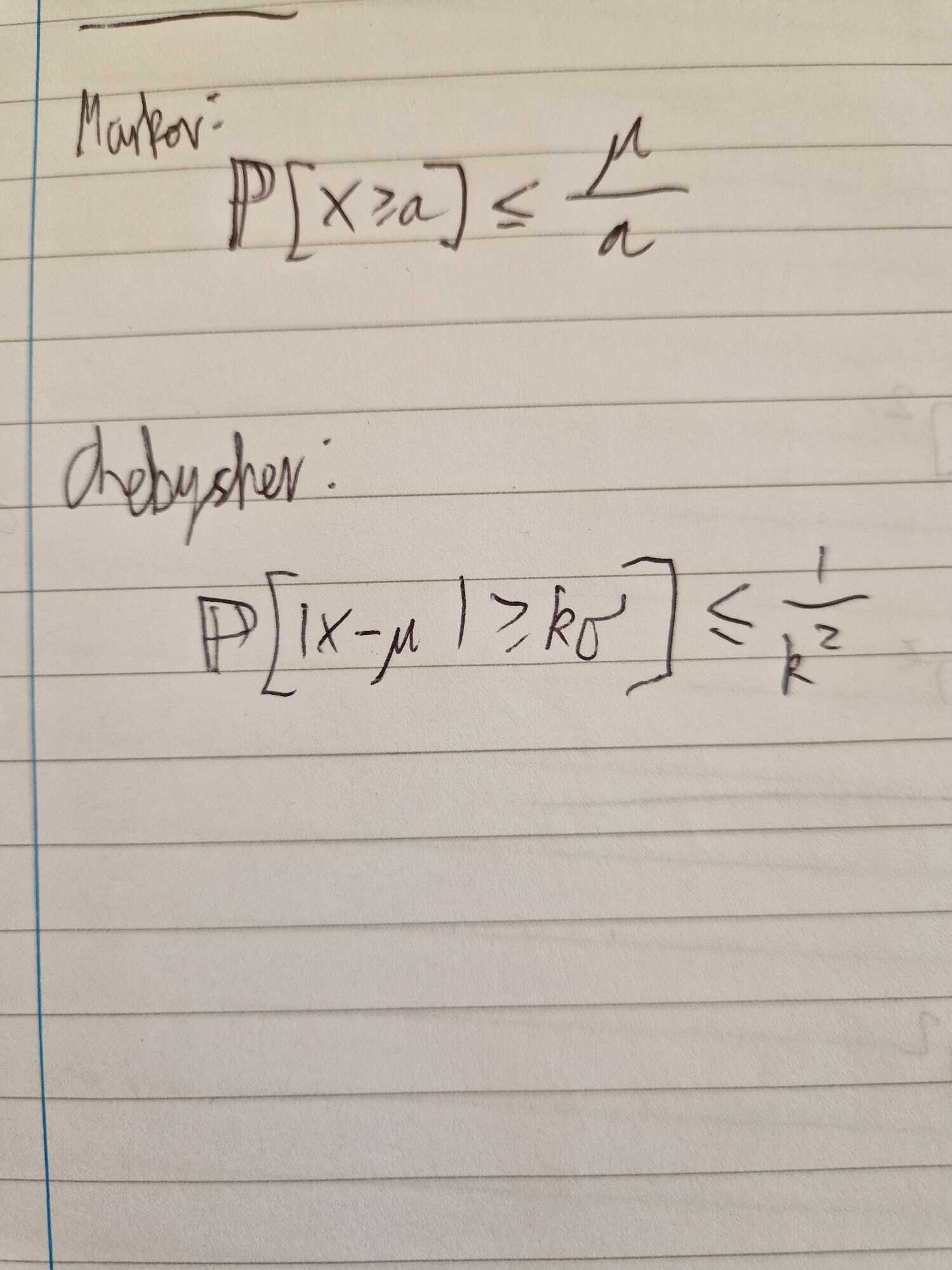
- 45Let X be a non-negative random variable with finite mean μ and finite variance σ^2. State Markov's inequality and Chebyshev's inequality
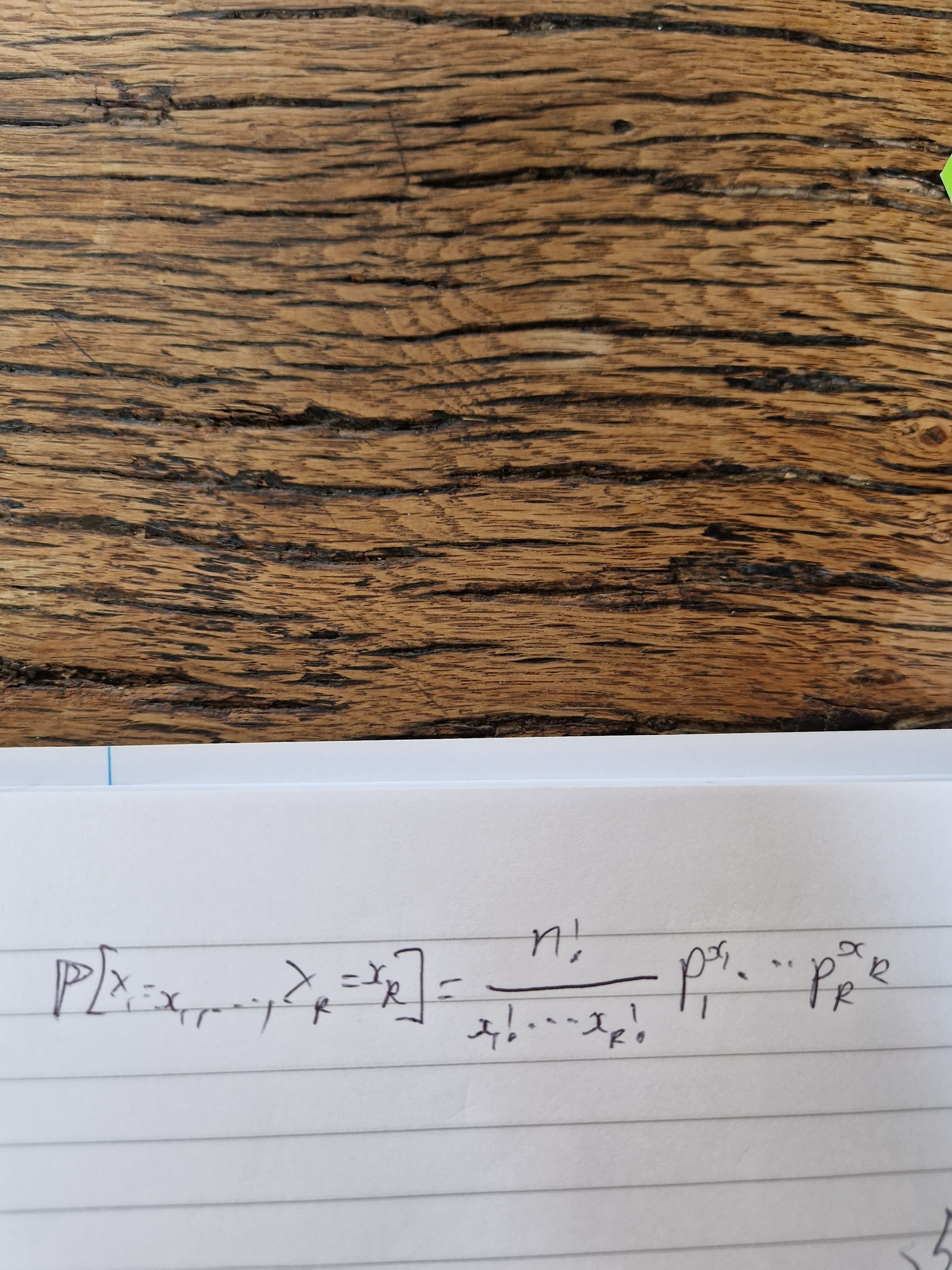
- 46State the p.m.f. of a multinomial distribution with n trials and event probabilities p_1,...,p_k
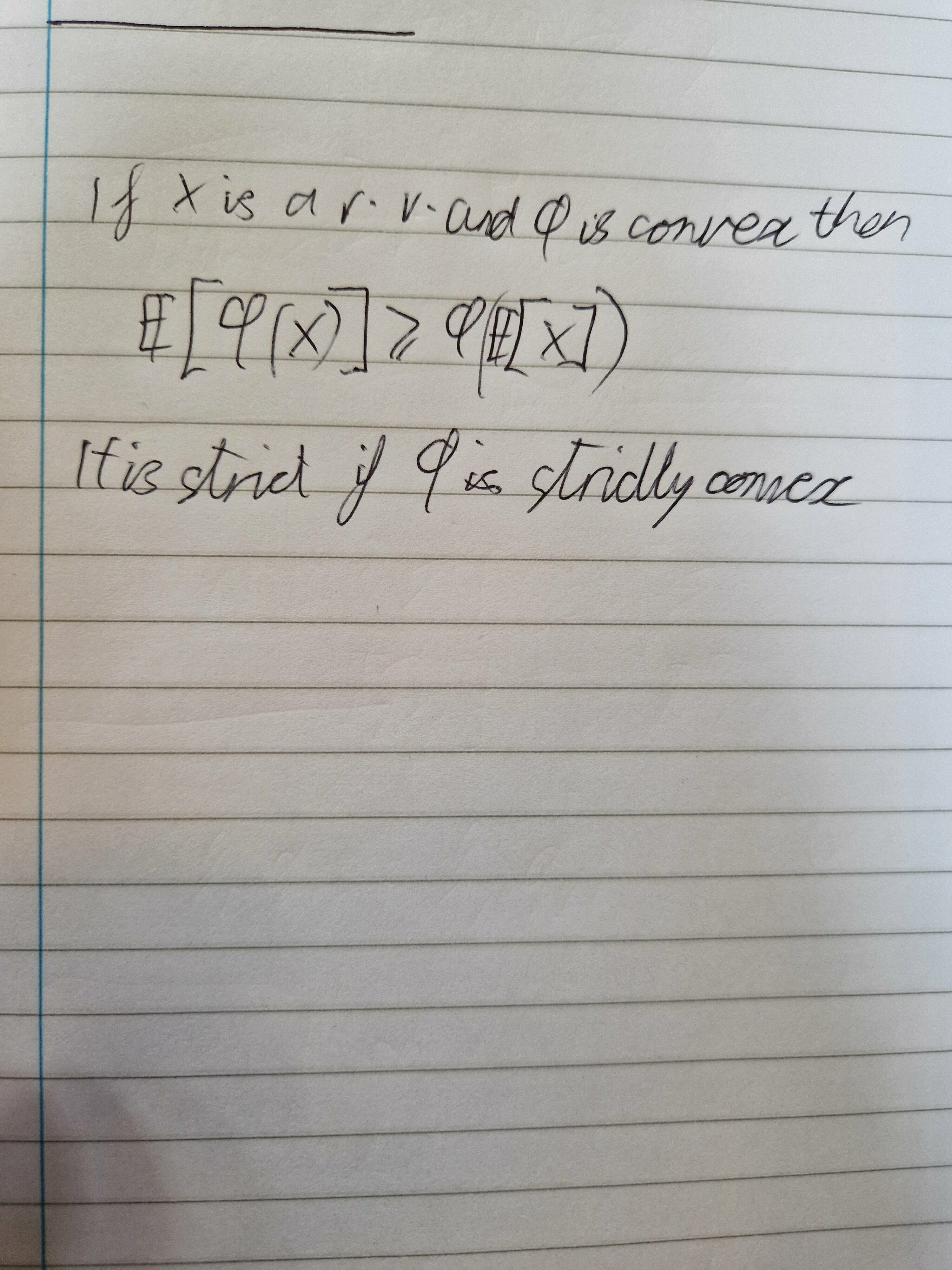
- 47Let X be a random variable. State Jensen's inequality and state when it is strict
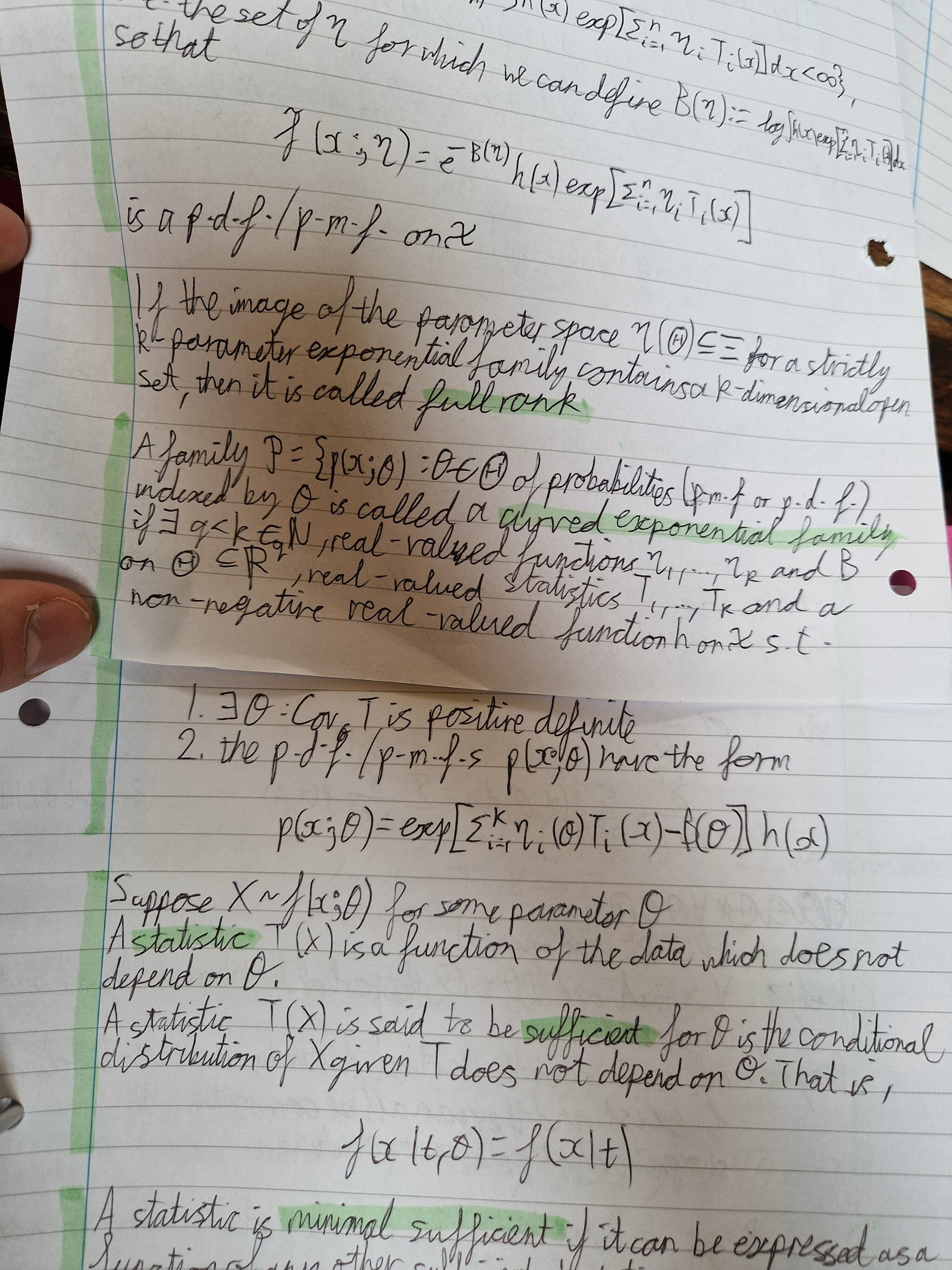
- 48Define a curved exponential family
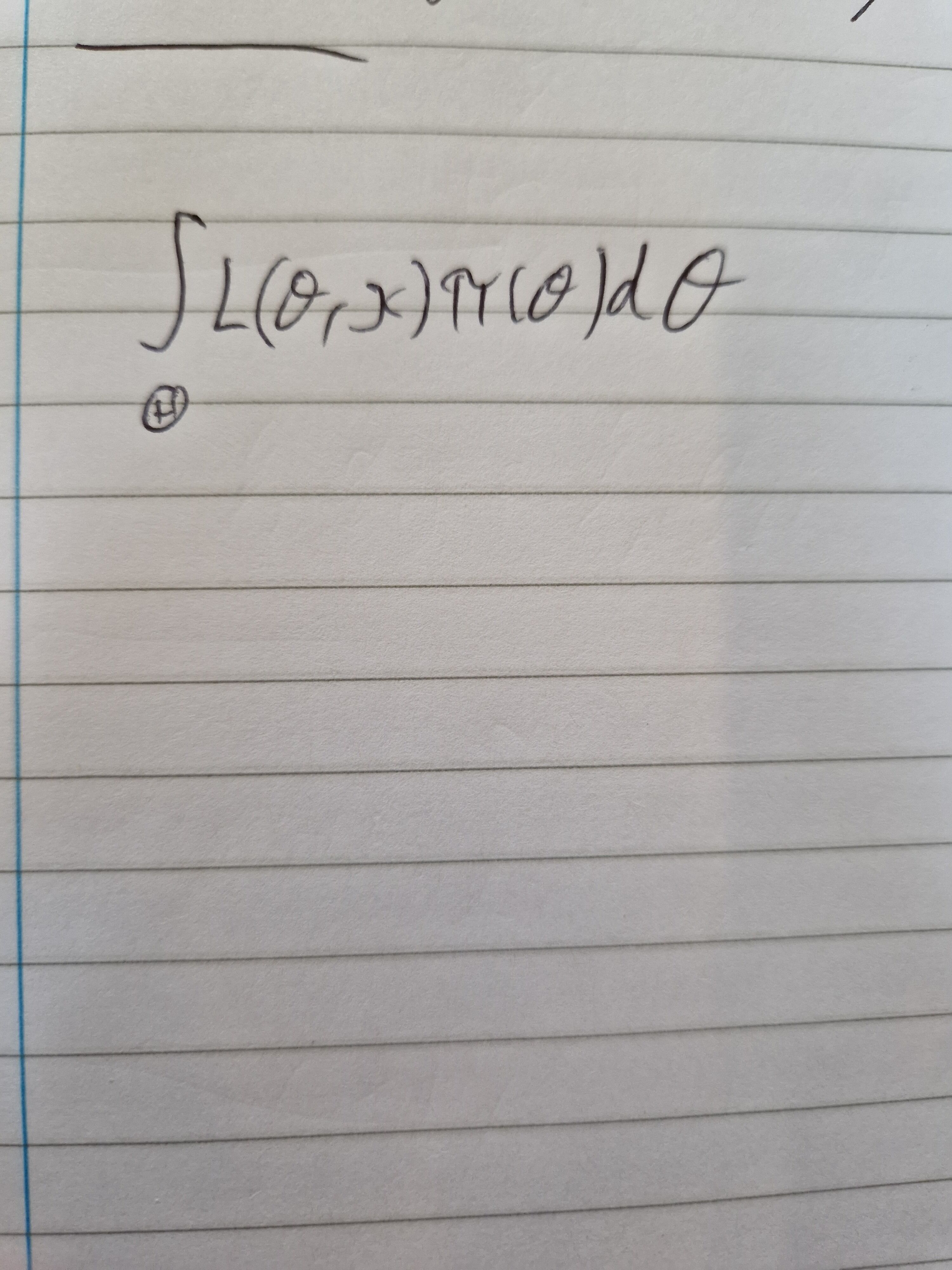
- 49State the marginal likelihood of a random variable X given its likelihood L(θ,x) and a prior π(θ)
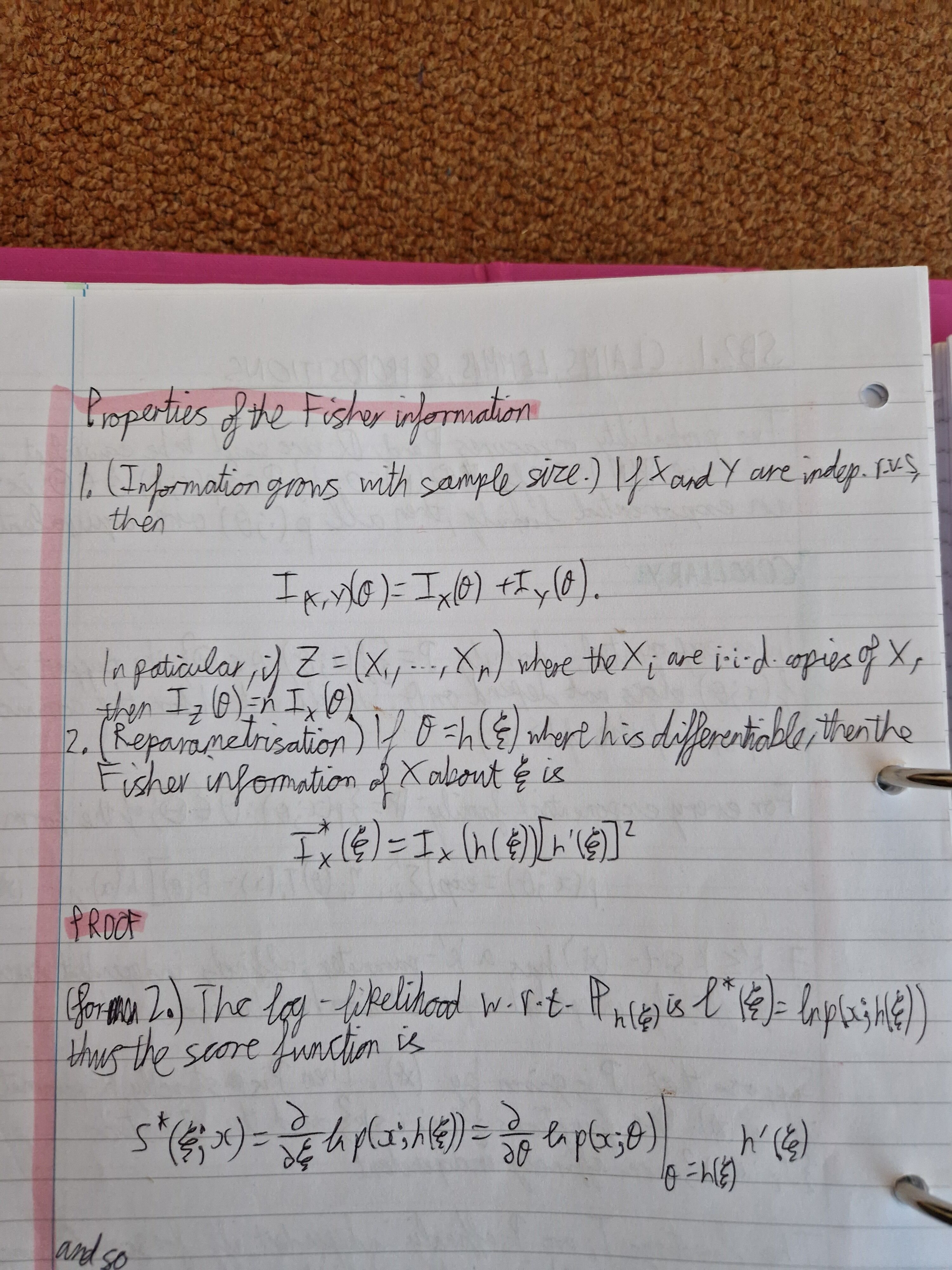
- 50State the result regarding reparameterization of Fisher information
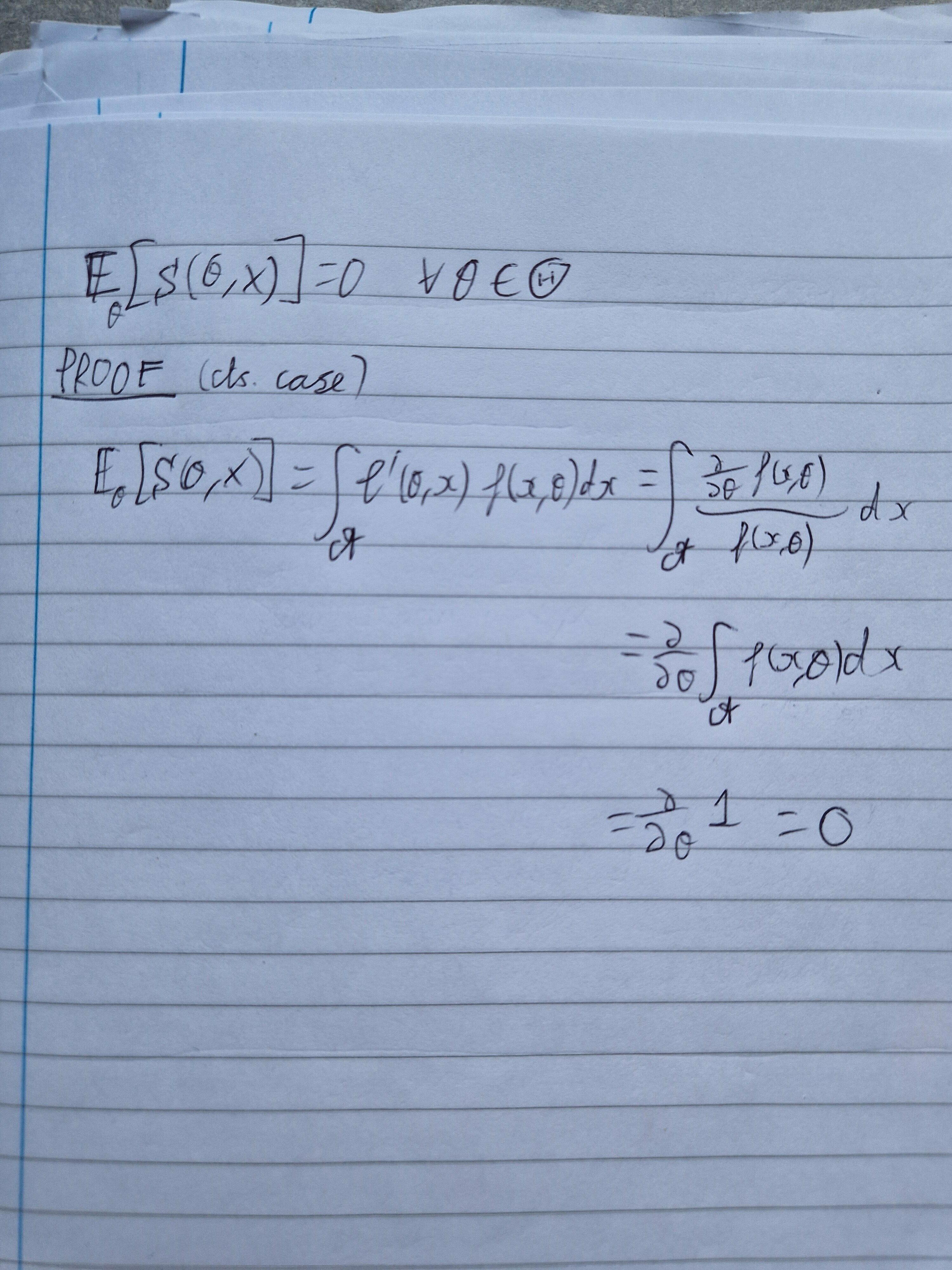
- 51Assuming regs 1-3, state and prove the expectation of the score function
- 52Define the entropy of a distribution π
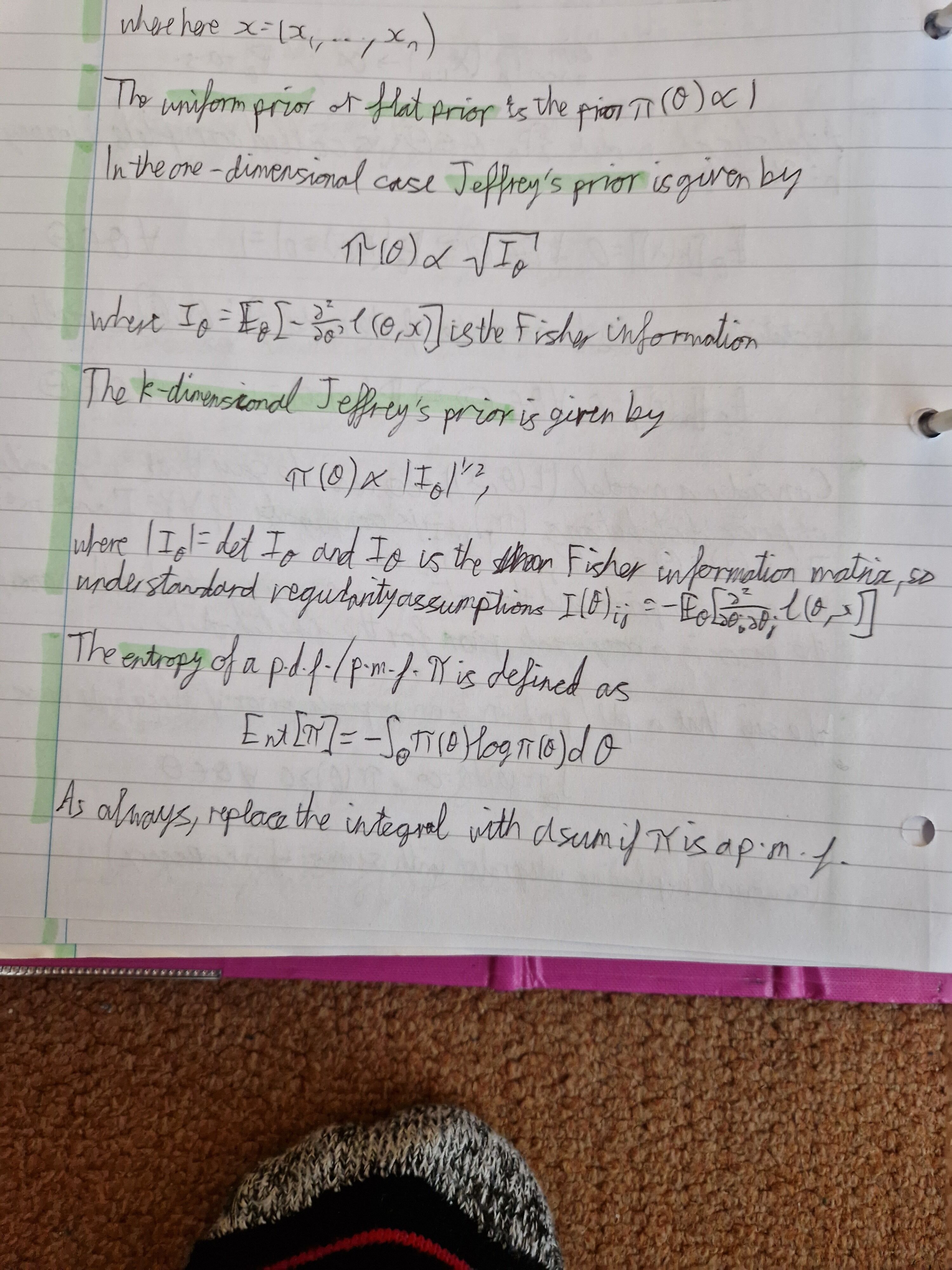
- 53State a theorem regarding the maximum entropy prior
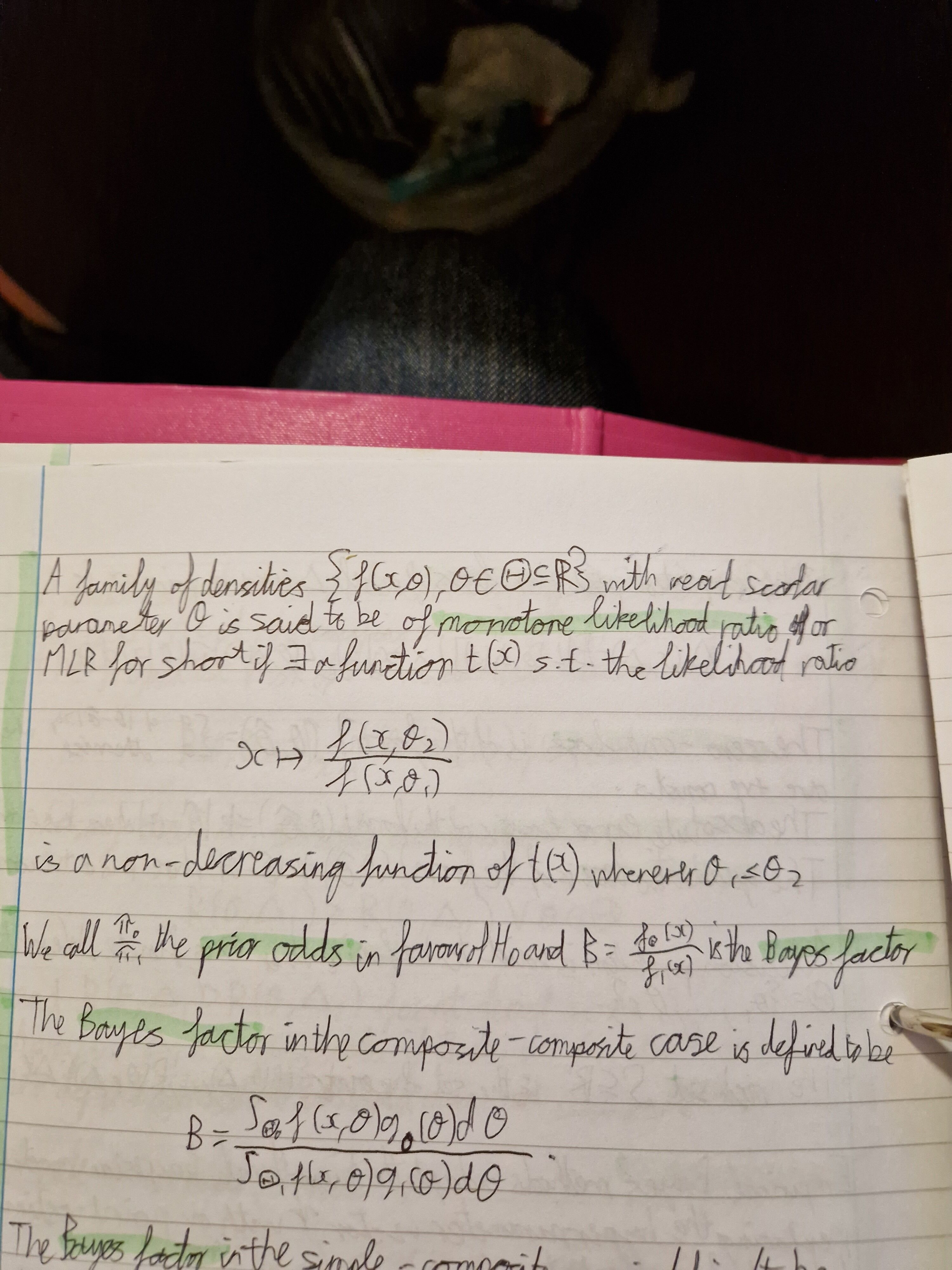
- 54Define what it means for a family of distributions to be of monotone likelihood ratio
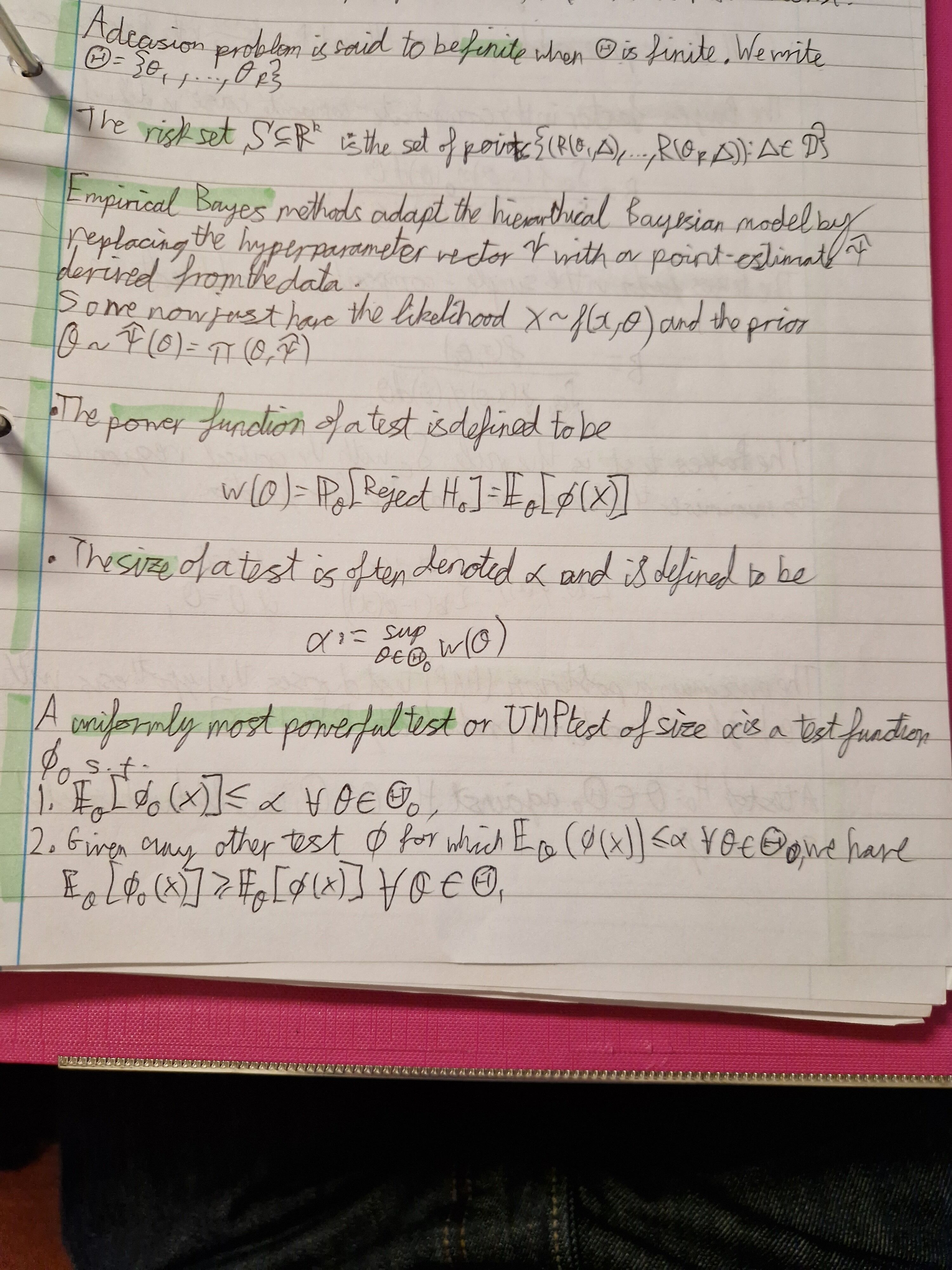
- 55Define a uniformly most powerful test
- 56State the three most common loss functions
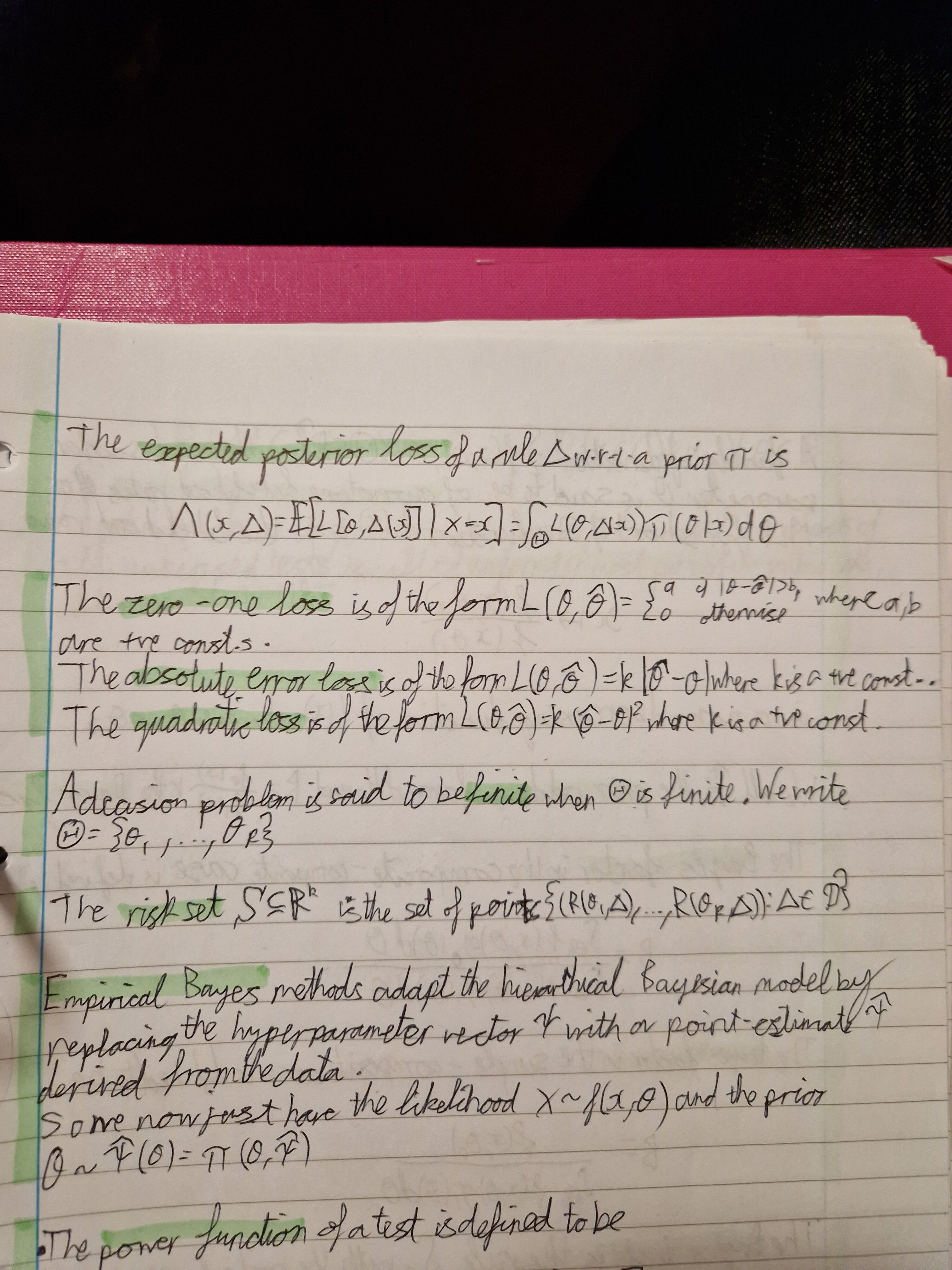
- 57Show that the Bayes rule minimises the expected posterior loss
- 58Define the maximum a posteriori (MAP) test
- 59Show that the Bayes estimator under the quadratic loss is the posterior mean
Informationen
- Beschreibung
- uni Part B Karteikarten am SB2.1, erstellt von Ben Tidswell am 07/04/2023.
- Erstellt von
- Ben Tidswell
- Aufrufe
- 1
- Bewertung