
Karteikarten
Ohne Titel
Karten in diesem Stapel (83)
- 1Which of the following is used for a vital sign assessment during a physical examination? a) Age b) Mucous membranes c) Body condition d) ResponsivenessMucous Membranes
- 2Which of the following behavioural conditions have been shown to be linked to stress in cats? a) Vigilance b) Grooming c) Aggression d) All of the aboveD
- 3Define behaviour. a) It is how the physiological state of an animal changes in response to its environment b) It is the activity of an animal in response to its environment c) It is the observation and detailed description of behaviour with an objective of understanding why the do it d) It is how an animal copes within its environmentA
- 4Which of these does not signify a sign of tension in a dog? a) Looking away b) Yawning c) Ears back d) Lip curlingD
- 5Define anthrozoology. a) It is the observation and detailed description of behaviour with an objective of understanding why the do it b) It is how an animal copes within its environment c) It is the study of human – animal interaction d) It is the use of human characteristics to describe an animals behaviourC
- 6Which of the following is not an external influence on behaviour? a) Experience b) Inter-species interaction c) Environment d) Intra-species interactionA
- 7Which of the following is not an ethical perspective? a) Utilitarianism b) Integrity c) Contractarian d) Animal rightsB
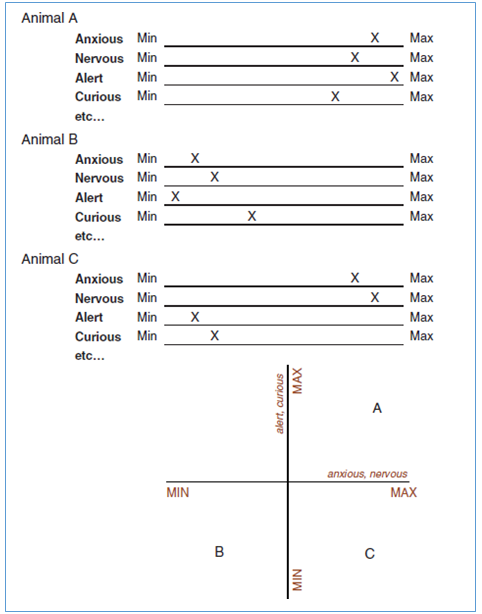
- 8What is this image an example of? a) Ethogram b) Bar chart c) Qualitative behaviour assessment d) HistogramC
- 9Which of the following is a zoonotic disease? a) Campylobacter b) Listeria c) Ringworm d) All of the aboveD
- 10Question 10 At what age does the sensitive period for socialisation in the kitten occur? a) 2 - 7 weeks b) 4 – 16 weeks c) 8 – 10 weeks d) 12 – 18 weeksA
- 11What is the major immediate influence on animal behaviour?Environment
- 12What is the difference between behaviour and welfare? How do they relate to each other?Behavior is the activity of the animal in response to its environment
- 13Identify the 4 key internal influences on behaviour.1. Physiology
2. Genetics
3. Motivation
4. Experience - 14Describe how to take a capillary refill time.Lift up the lip, place ball of thumb on the gum and press till it blanches, remove and count the time it takes for the original colour to return.
- 15Define operant conditioning in horse training.Where the horse makes an association between a behaviour and a negative or positive response. For example, release of a pressure with reward the behaviour that a horse exhibits
- 16What does Workplace Health & Safety entailWorkplace Health and safety is the management and reduction of risks to the health and safety of all personnel in the workplace
- 17Who is responsible for Workplace Health & Safety in the veterinary industry?Everyone
- 18What 4 components constitute the Workplace Health & Safety framework1. Act
2. Regulations
3. Codes of practice
4. Regulating agency - 19What is an ethogram?The record of animals behaviour in response to its environment, it records what behaviours are common and abnormal to better understand the animal.
- 20Define what a stereotypic behaviour is.Stereotypic behaviour is behaviour that is considered normal for that certain animal, and it can also indicate what the animal may do in response to stress or a change in environment
- 21Describe the five welfare domains1. Nutrition – access to food and water, variation of diet and frequency of feeding can all dramatically affect the animals health.
2. Environment – bedding, size of habitat, temperature, access to sunlight and availability of fresh air
3. Health – physical and mental health, can also include fitness level
4. Behaviour – social interactions between other animals such as playtime, mating and exploring
5. Mental state – are the conditions the animal is in affecting its mental health, is it in a constant state of fear and distress - 224 steps of the Physical examination process1) Signalment / History
2) General appearance / Initial observations
3) Vital Signs
4) Physical Exam (Systems Approach or Head to Toe) - 23Examples of Signalment/ History in Physical examinationSpecies, breed, age, sex, neutered status
- 24Examples of general appearance/ Initial Observations in Physical examinationa. Body condition
b. Mentation
c. Posture and gait - 25Examples of Vital Signs in Physical Examinationa. Weight
b. TPR, CRT and MM - 26Body Scoring on a Dog (out of 9)1-3: Too thin
3-5: Ideal
6-9: obese - 27Signs of Tension in a Dog (8)• Yawning
• Panting
• Lip licking
• Fixed gaze
• Looking at you or away
• Ears down, back
• Stiff forelimb stance
• Mild piloerection - 28Signs of tension in a cat- Dilated eyes
- Ears turned back and furrowed brow
- Staring/ Focused at an object
- Hiding/ Looking half asleep
- Laying on side/ tail flicking
- Hair raised
- Walking low to ground, tail and head low
- Excessive grooming - 29Signs of tension in a horse• Vocalisation
• Rearing/kicking/bucking
• Shaking or trembling
• Sweating
• Spooking/bolting
• Pacing and fence walking
• Weaving or stall walking
• Pawing
• Yawning
• Teething grinding
• Rolling eyes - 30Normal temp for Dogs, Cats and HorsesCats and Dogs: 37.5-38.5
Horses: 37.2-38.5 - 31Normal RR for Dogs, Cats and HorsesDog: 18-24
Cat: 10-20
Horse: 8-16 - 32Normal HR for Dogs, Cats and HorsesDog: 60-140
Cat: 120-160
Horse: 20-40 - 33Stress/anxiety can result in alterations• Behavioural change
• Elevated heart rate
• Elevated respiratory rate
• Sympathetic overdrive – pupillary dilation - 34How to take HRWhere do you listen to it?
– Measured on the left hand side
– Maximal sound is behind the elbow
– **some species variation**
How do you measure heart rate?
– One heart beat is the lub dub
– **In horses, you can hear up to 4 heart sounds
– You count over 15 seconds and multiple by 4 - 35How to Take RRBest to do when animal is calm (In cage or sleeping)
• 1 breath = in and out
• Count for 15 seconds (x 4)
– Watch the chest
– Feel the chest
– Listen to the chest - 36Mucous Membranes of Cattle, Sheep, Goats, Pigs, Horses, Cats and DogsCattle, Sheep, Goats, Cats: Pale pink
Pigs: reddish
Horses, Dogs: Pale roseate - 37CRTMeasured by applying gentle digital
pressure to the mucous
membranes
• Release pressure
• Counting the time for the capillary
blanching to disappear
• Textbooks state <2s BUT should
be almost instantaneous - 38Anthrozoology- Study of human-animal interaction
• Human-animal interaction begins at the very early stages of human society - 39DomesticationA process in which humans deliberately and with forethought assume control over the domesticate's movement, feeding, protection, distribution, and, above all, its breeding—directed at achieving specific clearly identified goals
- 40Why are some animals domesticated and others not?1. Flexible dietary requirements
2. Reasonable growth rate
3. Fitness in captivity
4. Temperament and social system that adapts to captive environment - 41Anthropomorphisma mutually beneficial and dynamic relationship between people and animals that is influenced by behaviours that are
essential to the health and well-being of both - 42EthologyThe observation and detailed description of behaviour with the objective of finding out how biological mechanisms function
- 43BehaviourThe activity of an animal in response to its environment
– Increased or decreased
– Individual versus group response
– Influenced by internal and external factors (discussed
later on) - 44Welfare– How an animal COPES within its environment
– Behaviour can be used as a way to assess welfare - 45Influences on behaviourInternal- genetics, physiology, motivation, experience
External – environment, intraspecific, interspecific
ENVIRONMENT is major immediate influence on behaviour - 46Internal influences on behaviour 2- PhysiologyAge
– may be age specific or influenced by age
• Health / Disease
• Reproductive stage
• Homeostasis (hunger, thirst, stress) - 47Internal influences on behaviour 3- Motivation• Factors that contribute to the expression of behaviour
• Biological drivers
• Psychological drivers - may include consideration of
likely consequences
• Can also be external motivators - 48Internal influences on behaviour 4- Experience• Brain development allows experience to shape
behaviour - 49External influences on behaviour 5 Environment• Environment can be stressful for an animal if it is
• Highly variable (no predictability)
• Highly predictable (no stimulus) - 50External influences on behaviour 6 Intraspecific interactions• Animals are not independent of their companions!
• Group living or group housed
• Positive interactions (play, grooming, social support)
• Negative interactions (competition for resources) - 51External influences on behaviour 7 Interspecific interactions• Interaction between that species and another species
– Humans
– Other species
– Children/unfamiliar animals or presentations - 52Sensory perception (prey species) Visual• Large Field of vision
• Constant monitoring and assessing of
– novel object
– sudden movement
• Read cues on animals size and
behaviour to determine if threat - 53Sensory perception (prey species) Chemical• Detect the presence of predators through both
general and species-specific chemical signals
– Air, water or on the ground
• Chemical cues can come from
– a recently killed animal
– urine or skin fats left behind - 54Sensory perception (prey species) Auditory• provide reliable, direct information about
– A predator's presence
– Identity
– Proximity
– Direction of travel
• Especially helpful for nocturnal prey - 55Sensory perception (prey species) Tactile• Vibrational cues cannot be concealed by a predator
- 56Measurement of behaviour1. Frequency of activity
2. Prolonged periods of activity
3. Time of day of activity
4. Presence of other animals/stimuli
5. Preference/motivation testing
6. Facial expression
7. Qualitative behavioural assessment - 57Behaviour can be shown in• Histogram
• Ethogram
• Range tracking (e.g. cats)
• Qualitative behavioural assessment
–welfare indicator
–suggestive of emotional state - 58How do genetics affects behaviourGenes influence the social behavior of an individual through their effects on brain development and physiology.
- 59Stress in owned cats (at home)1. Environmental change
2. Barren environment
3. Poor human-cat relationship
4. Inter-cat conflict
5. Lack of control/predictability (environment) - 60Stress-associated Behavioural Changes for Cats• Vocalisation
• Vigilance
• Hiding
• Urine spraying/marking
• Aggressive behaviours
• Grooming/Stereotypies - 61Common behavioural issues in cats• Spraying
• Indoor soiling / intermittent litter
tray usage
• Aggression
• Inappropriate hunting
• Destructive scratching
• Periodic absence and insecurity
• Intraspecific (cat-cat) aggression - 62Signs of tension in a horse• Sweating, shaking or trembling
• Weaving or stall walking
• Pawing
• Yawning
• Teething grinding
• Rolling eyes
• Vocalisation
• Pacing and fence walking
• Rearing/kicking/bucking
• Spooking/bolting - 63Modern horse training techniques• Classical conditioning – linking a natural stimulus and a response
• Operant Conditioning – repeated exposure to strengthen a response
• Negative reinforcement – removing a stimulus to offer a reward. - 64Habituation in horsesRepeated exposure. Start at low levels of
exposure and build up - 65Counterconditioning in horsesAdverse stimulus is predictor of reward
- 66StressWhen an animal must make abnormal or
extreme adjustments in its physiology or behaviour in
order to cope within its environment or
management - 67Stereotypic BehavioursRepetitive behaviours induced by
frustration, repeated attempts to cope and/or CNS dysfunction - 68Enrichmentto improve, or make something more substantial, meaningful or rewarding
- 69ProfessionalHas specific education and skills
• Exercises these in the interest of others
• Is bound by a regulatory code and high
ethical standards - 70State a professional regulation for Vet Techs– Veterinary Nurses Council of Australia (VNCA)
– Australian Veterinary Nurse and Technician (AVNAT) (voluntary) - 71Utilitarianism (5 perspectives)– Outcomes focused
– Aim: Maximise the positive outcomes of an action while maximising the benefit to the maximum number of people/animals
– Increase positive contribution to human and nonhuman beings - 72Deontology/ Animal rights (5 perspectives)– Rules, consistently applied (deontology)
– An animal has it’s own agency; it is not the property of humans…
– Often confused with animal welfare; this view opposes animal ownership, production, or use of animals in any way for human benefit, including for vaccine research - 73Virtue ethics (5 perspectives)– Character-based approach
– Practising behaviour in an honest, brave, generous and just way will result in a person developing those characteristics - 74Name the 4 WHS Framework1. Act
2. Regulations
3. Codes of practice
4. Regulating agency (regulator) - 75EMPLOYER has a Duty of care to– Provide a safe work environment
– Implementation of safe practices/policies
– Installation of safe equipment
– Appropriate training, instruction and supervision
– Monitoring and maintenance to ensure safe facilities - 76Duty of careMoral and legal obligation of an individual to ensure that their actions do not harm others
- 77Managing WHS risks1. Identify hazards
2. Assess risks
3. Control Risks
4. Review control measures - 78Hazarda source or a situation with the potential for harm in terms of human injury or ill-health, damage to property, damage to the
environment, or a combination of these - 79Hazard Classification (out of 5)1. Biological hazards
2. Chemical
3. Physical
4. Ergonomic
5. Psychosocial - 80Hazard MitigationAny sustained action taken to reduce or
eliminate the long-term risk to life and property from hazard events. It is an on-going process that occurs before, during, and after disasters and serves to break the cycle of damage and repair in hazardous areas - 81Zoonosesdisease transmissible
between animal(s) and human. - 82Spread of zoonotic disease1. Direct contact
2. Indirect contact
3. Vector- born
4. Foodborne
5. Waterborne - 83Notifiable disease– Must be reported to agricultural authorities
– Diseases listed as a major threat to Australian livestock industries and/or export market
Informationen
- Beschreibung
- Exam Vet tech Karteikarten am Ohne Titel, erstellt von Talia Criss am 07/08/2023.
- Erstellt von
- Talia Criss
- Aufrufe
- 1
- Bewertung