
Animal Behaviour
98 resources created by 54 users
This Animal Behaviour page on GoConqr gathers community-made flashcards, mind maps, quizzes, slide sets and notes, from canine communication and fear to dairy cow management and horse behaviour. It's built for university students and professional candidates, plus teachers after ready-made material. There are over 90 resources here, including more than 20 mind maps and 50 flashcards, made by over 50 contributors. Try a quiz to find your gaps, then explore the decks at your own pace.
Select topic
- Biological Influences on Behaviour5
- Animal Learning and Cognition6
- Social Behaviour and Communication6
- Dog and Cat Behaviour12
- Farm Animal Behaviour6
- Horse Behaviour7
- Behaviour and Animal Welfare5
- Clinical Behaviour Assessment14
- Pet Behaviour Problems8
- Fear, Anxiety and Aggression in Pets8
- Behaviour Modification and Training7
Top Animal Behaviour resources
-
236 cardsANS 104 Midterm 2 What are the 3 types of parental behavior?
-
37 cardsDog Behavior What are the 3 communication patterns a dogs uses?
-
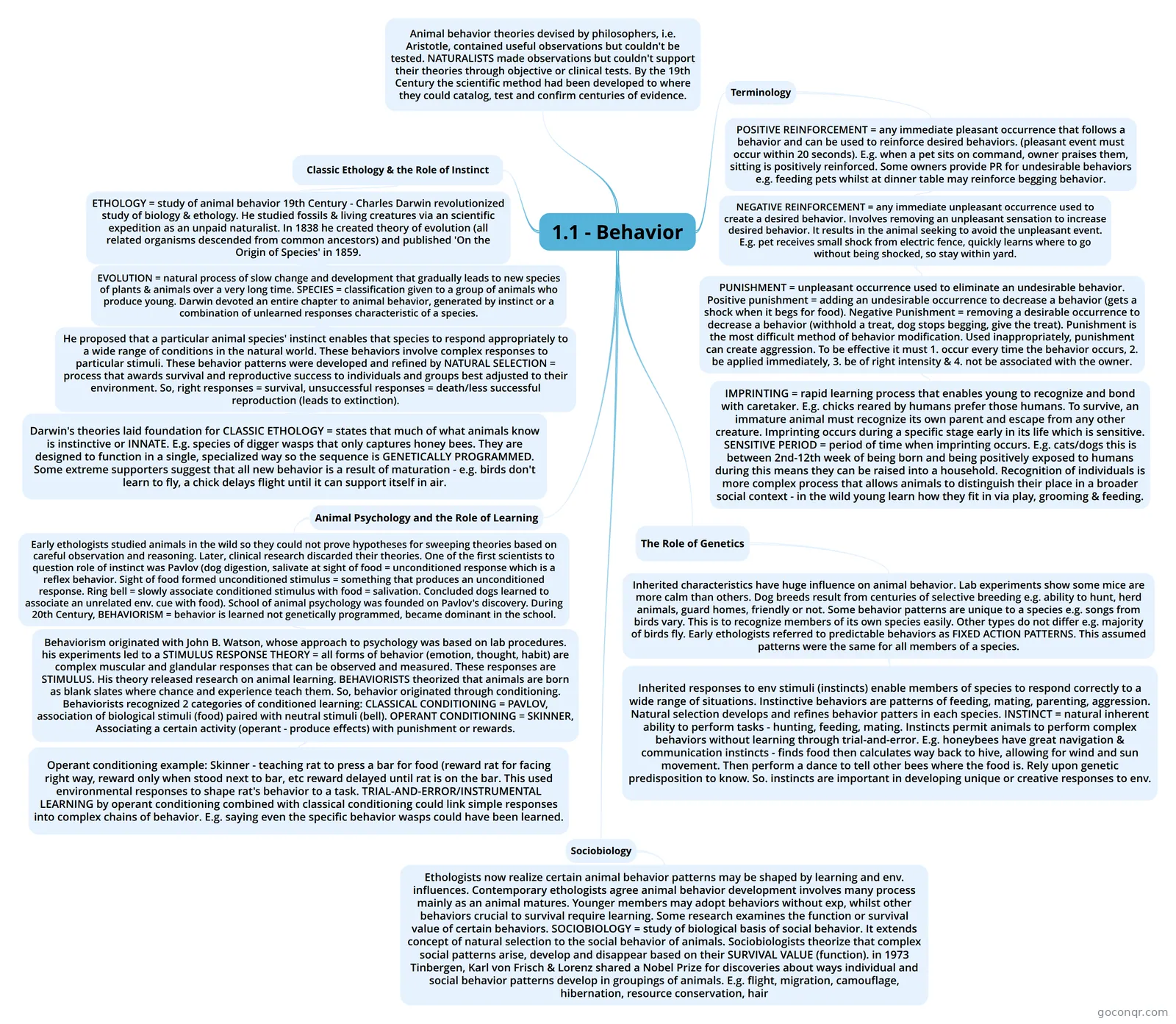 Mind map 1.1 - Behavior intro to vet technology
-
52 cardsSpecies Focus: Dogs and Cats What are the 3 genetic factors that affect behaviour?
-
58 cardsDog behaviour
-
59 questionsBehaviour Quiz "Health" can be seen as 3 equally important components: physical, cognitive and emotional. This is often ca...
-
83 cardsUntitled Which of the following is used for a vital sign assessment during a physical examination? a) Age b) Mucous ...
-
56 cardsPhysiological and Pathological factors in Behaviour Changes How does Disease affect Behaviour?
Quizzes
See all 10 quizzes-
59 questionsBehaviour Quiz "Health" can be seen as 3 equally important components: physical, cognitive and emotional. This is often ca...
-
25 questionsPenn Foster VET 102 Lesson 1.1
-
17 questionsBehaviour in companion and domestic animals which of the following are indications for clinical causes of behavioural changes?
-
21 questionsCompanion Animal Behaviour.
-
13 questionsBehaviour of Neutering
-
7 questionsSocial Structure of Equids
-
5 questionsSocial Learning
-
9 questionslearning, motivation, choices and preferences
Mind maps
See all 26 mind maps-
1.1 - Behavior intro to vet technology
-
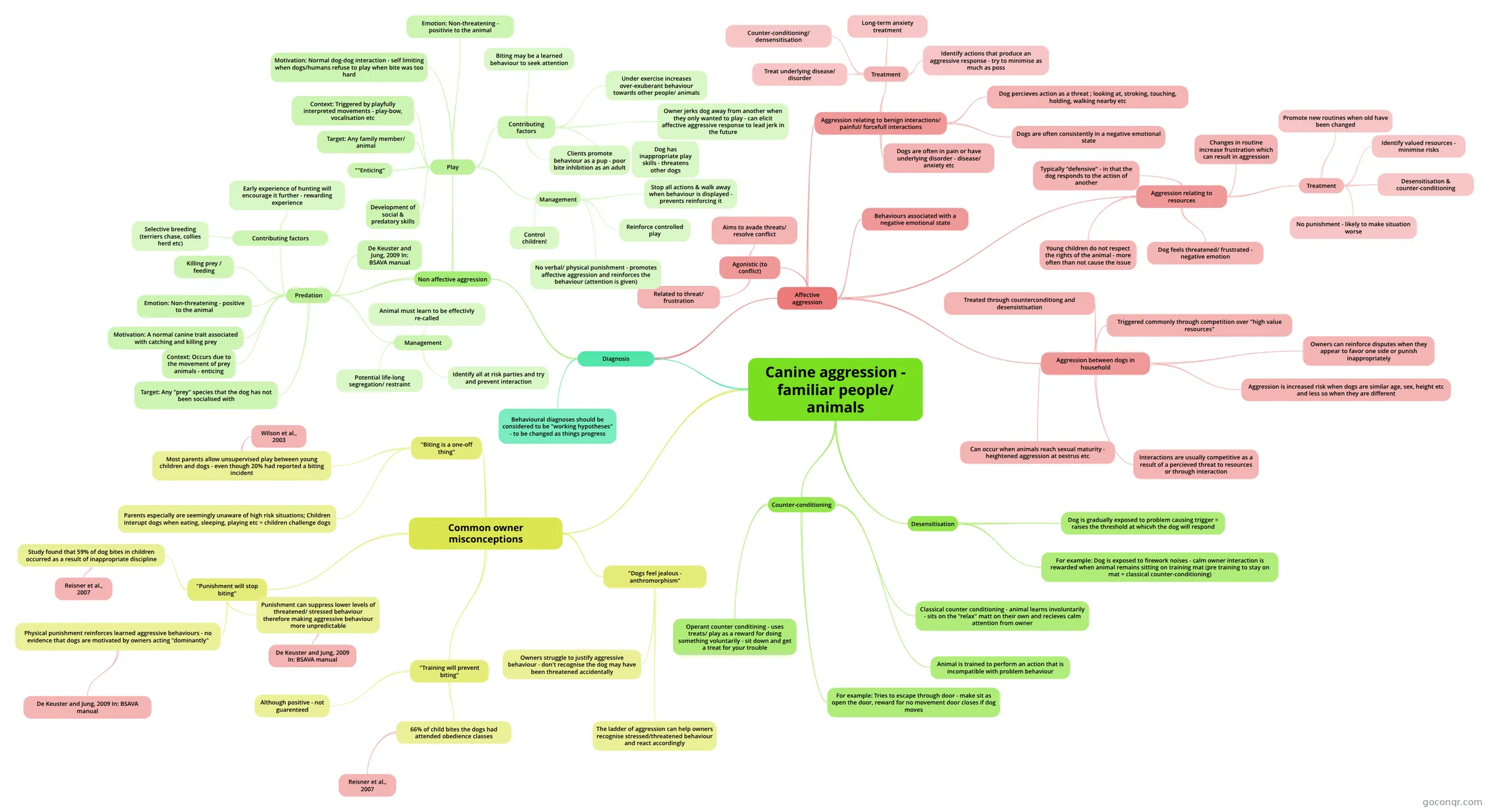 Canine aggression - familiar people/ animals
-
Separation anxiety
-
Canine fear & phobia
-
Aggression
-
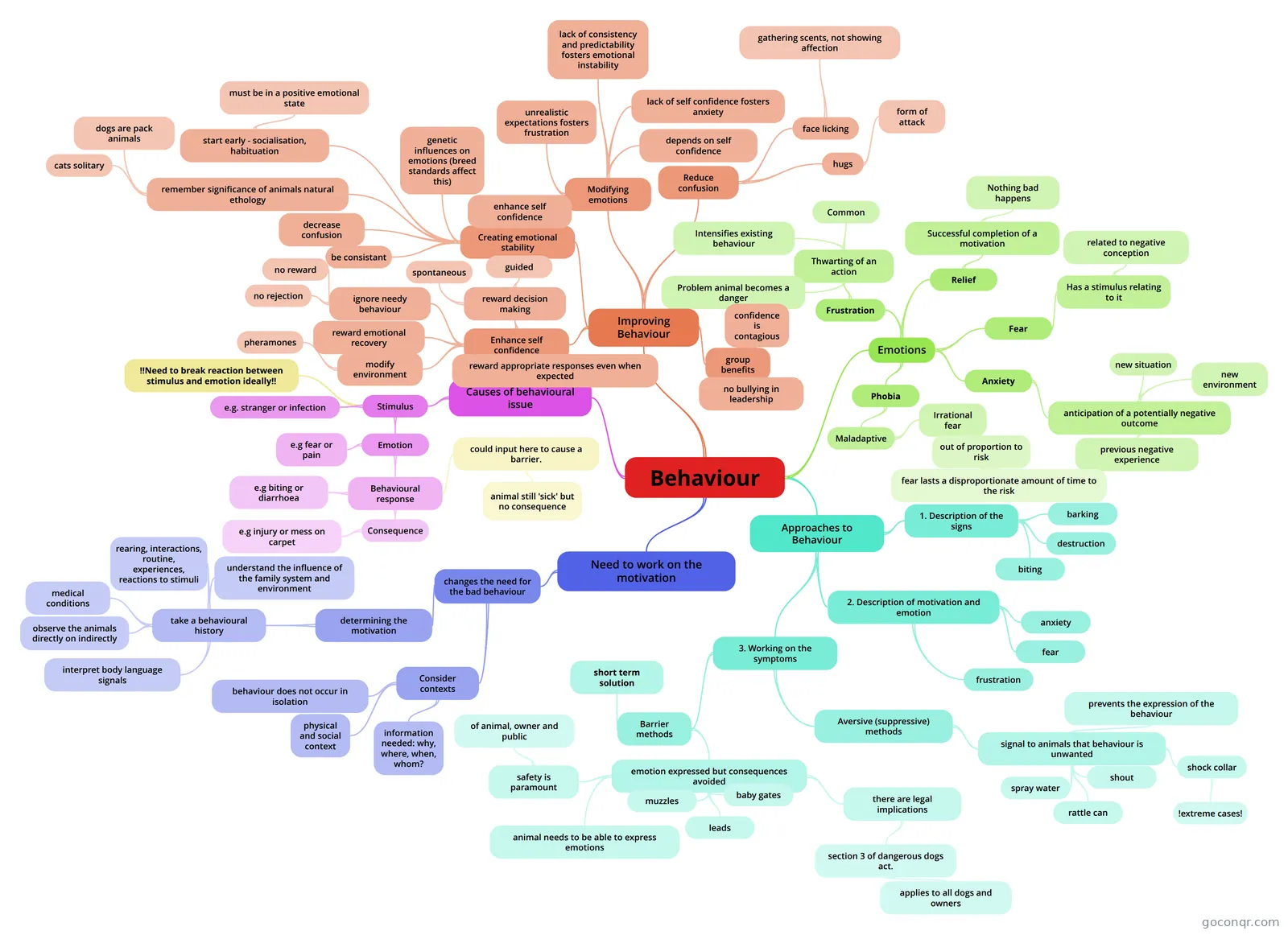 Behaviour
-
Behavior Counseling and Therapy 1.4 Introduction to Vet Technology Behavior Counseling and Therapy 1.4
-
Behavior Problems 1.3 1.3 Behavior Problems Introduction to Vet Technology
Flashcards
See all 51 flashcards-
236 cardsANS 104 Midterm 2 What are the 3 types of parental behavior?
-
37 cardsDog Behavior What are the 3 communication patterns a dogs uses?
-
52 cardsSpecies Focus: Dogs and Cats What are the 3 genetic factors that affect behaviour?
-
58 cardsDog behaviour
-
83 cardsUntitled Which of the following is used for a vital sign assessment during a physical examination? a) Age b) Mucous ...
-
56 cardsPhysiological and Pathological factors in Behaviour Changes How does Disease affect Behaviour?
-
49 cardsBehavior Study Questions What is Ethology?
-
44 cardsPrinciples of Behaviour Modification What is the issue with many behaviours that owners find an issue?
Flowcharts
Notes
-
Canine and Feline Senses and Communication Introduction Senses include visual, olfactory, auditory and tactile. Humans primary sense is vision. Dogs primary sense is olfactory and auditory. Cats primary sense is all of them. Visual Visual capability is not com...
-
AS: body language of the canine while we naturally speak to dogs through the energy we project, we can also comprehend how they are feeling through their body language. now, lets take a look at the study of canine body language and the different mea...
-
key points - common behavior problems 1.3 Key Points for common behavior issues Proper socialization during the sensitive period is the key to successful relationships between pets and their owners. Dogs are highly social and develop strong, close bonds with ...
-
Horse Behavior - created from Mind Map Agnostic: fighting, flight, and other reactions associated with conflict Reactive: classification of activities used by an animal to keep in harmony with its environment Ingestive: eating, drinking, food preference, a...
Slides
Topics in Animal Behaviour
More Veterinary medicine topics
About Animal Behaviour
GoConqr OriginalWhat this unit covers
The page leans towards dogs and cats, but it reaches further. The flashcard deck Dog Behavior opens with the communication patterns dogs use, including scent and vision. Species Focus: Dogs and Cats asks about the genetic, learning and physiological factors that shape behaviour. Other decks look at pigs, dairy, beef and sheep, and horses, so you can compare species.
Where to start
Begin with the basics. The mind map 1.1 - Behavior sets out how early philosophers and naturalists approached the subject. The deck Introduction to ethology and the slide sets on understanding normal behaviour follow naturally. Once you know what normal looks like, the problem-behaviour material makes more sense.
- Read the basics: ethology, genetics and development of behaviour.
- Move to normal behaviour, body language and communication.
- Study problem behaviour and how it is treated.
Problem behaviour and therapy
Several mind maps cover clinical topics. Canine fear & phobia separates temperamental, developmental and learned fear. Separation anxiety covers destruction, elimination and vocalisation, with medical, environmental and behavioural management. There is also a map on canine aggression towards familiar people and animals. The deck Principles of Behaviour Modification and the slide set on behaviour counselling and therapy take you from diagnosis to treatment.
Using quizzes and maps together
Read a mind map first, then test yourself. Quizzes such as Social Learning, Behaviour of Neutering and Behaviour, welfare and ethics show what has stuck. Return to the map for any branch you missed, then run the matching flashcards.
Where it sits
This unit belongs to the strand Animal Care, Welfare and the Profession in Veterinary medicine. That fits its focus on welfare indicators, stereotypic behaviours and the owner's influence on problem behaviour. Most of the material suits university-level study and professional preparation, and teachers can pick items to share.
Choose one topic, take a quiz, and then make a map or deck of your own.
Frequently asked questions
Where should I start with Animal Behaviour?
Start with the mind map 1.1 - Behavior and the Introduction to ethology deck. They set out what behaviour is and how it is studied. After that, move on to the slide sets on normal behaviour, then to the problem-behaviour maps.
What do the mind maps cover?
There are over 20 mind maps. They cover canine fear and phobia, separation anxiety, aggression, stereotypic behaviours, foraging and social behaviour. Others look at cognitive dysfunction, the development of behaviour, and horse behaviour, including how to read what a horse feels.
Which animals are included?
Dogs and cats get the most attention, with decks on anxiety, aggression and communication. You will also find pigs, dairy cows, beef cattle and sheep, and horses. A deck on human and animal interactions touches on reptiles, birds, primates, big cats and elephants.
Are the resources free, and who made them?
Yes. Every resource on this page is free to open, study and take, with no account needed. They were made by GoConqr users, not by GoConqr. A free account also saves your quiz scores and lets you create your own quizzes, maps, flashcards and notes.
What level are these resources?
Most are aimed at university students, with a good share suited to professional candidates. Teachers can use them as ready-made material. No specific exams are named in the listed resources, so use them to build understanding rather than to match a set syllabus.
What if I can't find a topic I need?
Browse the related decks and maps first, since topics often appear inside broader resources, such as the clinical behaviour decks. If something is still missing, you can make your own flashcards, mind map or notes on it.