
Karteikarten
Lecture 4: DNA structure and replication
Karten in diesem Stapel (16)
- 1name two types of nucliec acidsDNA and RNA
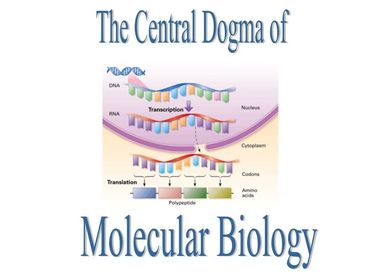
- 2the central dogma
- 3base-pairing proportionsA=T, C=G
50% purine and 50% pyrimidine bases - 4Meselson-Stahl experimentIf DNA could be labelled so that newly synthesised DNA could be differentiated from DNA present at the start of the experiment, it would be possible to identfiy the mechanism of DNA replication base on the distribution of the label in the DNA
-used bacterium, centrifuge - 5which isotope was chosen for the experiment?nitrogen because it is very incoporated into DNA
- 6Meselson-Stahl experiment steps1. bacterium were gorn on N(15) containing medium
2. they were then transferred to N(14) medium and samples were taken at start and after cell replications
3. cells were lysed and seperated by centrifuge - 7On what gradient were the cells separated during centrifuge and why?cesium chloride gradient because heavier molecules more more quickly towards the bottom
- 8Meselson-Stahl experiment
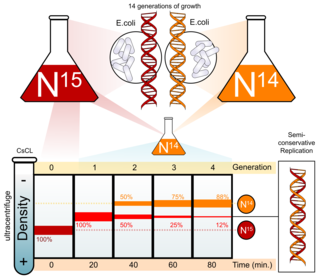
- 9the results concluded that DNA was replication by which mechanism?self-conservative model
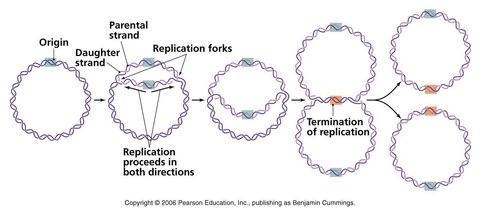
- 10Where does DNA replication start in Bacteria? Does it matter where?at the origin of replication
where it then proceeds in both directions until entire chromosome has been copied - 11bacteria DNA replication
- 12how can the template strands be unwound without creating superknots?Helicase untwists the DNA helix to give single stranded DNA, but increase coiling ahead of the DNA fork
* Topoisomerase fixes the increase coiling in the DNA template
*single-strand binding protein stabilizes the single stranded template - 13How is new DNA synthesised?- Uses nucleotide building blocks
-proceed ALWAYS in 5' to 3' direction
-DNA polymerase catalyze DNA synthesis - 14What happens if the wrong nucleotide gets inserted?enables proof-reading by exonuclease
- they correct mismatched bases
-nucleotide excision repair - 15what happens if repairs aren't made?DNA sequence is altered leading to mutations-the basis of many disorders
- 16how are the ends of a chromosome not lost during replciationthe last part of a linear DNA strand cannot be synthesised during this. the RNA primer at the end of the chromosomes cannot be replaced by DNA polymerase 1
- the ends of chromosomes are called Telomeres and they usually don't contain any coding regions, these are important in aging
Informationen
- Beschreibung
- Learning objectives: 1. to understand DNA structure 2. to be abe to explain the role of DNA as genetic material and the chemical properties of DNA 3 to explain how cells copy/replicate DNA with particular reference to: -replication - the mechanism used t copy DNA - the proteins involved in DNA replication - the structure of the replication fork
- Erstellt von
- Estelle Grundy
- Aufrufe
- 8
- Bewertung