
Karteikarten
Battery tech
Karten in diesem Stapel (51)
- 1Batteries are AC or DC?DC
- 2C rate of a 25Ah battery discharged at 50A2C
- 3C rate definitonDischarged at xC rate will take 1/x hours to discharge
- 4Energy equationE = (int) I x V.dt
- 5trapezoidal integrationa(int)b f(x).dx = (b-a)x(f(a) + f(b))/2
- 6ElectrolyticElectrical energy to chemical energy (battery charging)
- 7GalvanicChemical energy to electrical energy (battery discharging)
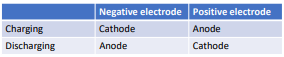
- 8In a galvanic cell, is the positive electrode the anode or cathode?Cathode
- 9Oxidationloss of electrons at the anode
- 10reductiongain of electrons at the cathode
- 11Gibbs free energyGibbs free energy is total energy required to create a system and make room for it, minus the energy provided by the environment
- 12Gibbs free energy equation∆𝑮 = ∆𝒈𝒑𝒓𝒐𝒅𝒖𝒄𝒕𝒔 - ∆𝒈𝒓𝒆𝒂𝒄𝒕𝒂𝒏𝒕
- 13degrees to kelvin273.15
- 14∆𝑮 unitsJ/mol
- 15Electrochemical device performance with temperature increasePerformance Increase:
The kinetic advantages and improved mass transport at higher temperatures can lead to better performance, especially in terms of reaction rates and reducing some overpotentials.
Performance Decrease:
Increased ohmic losses and the accelerated degradation processes can reduce performance and the longevity of the device. - 16what is i in the tafel equationcurrent density (A/cm^2)
- 17mass flowMQ = (M x I)/F =(Molar mass x Current)/F
- 18grams of lithium transferredmass flow(g/s) x hour(h) x 3600(s/h) = g of li
- 19Where is the lithium at 100% charge-ve electrode
- 20Where is the lithium at 0% charge+ve electrode
- 21What is porosityFraction of void volume
- 22Current (A)Rate of reaction
- 23Capacity (Ah)Stored charge
- 24Power (W)Rate of energy transfer
- 25Energy (Wh)Stored energy
- 26C-rateRate of reaction relative to capacity
- 27SoCRemaining capacity
- 28Activation lossesThe energy required to overcome the barrier to reaction and ‘drive’ it in one direction. Defined as a voltage using the Tafel equation
- 29Electrode vs. Electrolyte resistance?Ionic/Electrolyte resistance is MUCH greater than electronic resistance
- 30How can we use theory to improve design?Thinner electrolytes
• Reduced ionic resistance
• Higher concentration gradient
• Higher limiting current
More diffusive electrolytes
• Reduced transport losses
• Higher limiting current
Higher surface area electrodes • Reduced electronic resistance
• Better reaction kinetics
Highly porous separators
• Improved diffusivity - 31Anode and Cathode during charging and discharging
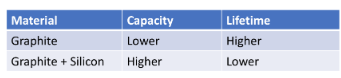
- 32Most common negative electrode materialCarbon, in the form of graphite layers
- 33SEI layerMust be formed on negative electrode for protection
- 34Graphite vs Graphite + Silicon
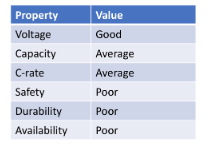
- 35Lithium Cobalt oxide (LCO)
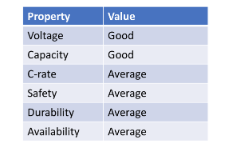
- 36Lithium Nickel Manganese Cobalt Oxide (NMC)
- 37Lithium Nickel Cobalt Aluminum Oxide (NCA)
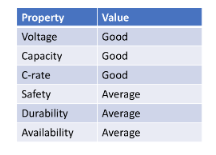
- 38Lithium Iron Phosphate (LFP)
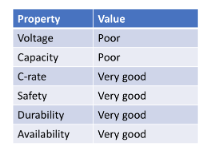
- 39Electrode additivesCarbon binder is added for electrical conductivity and adhesion
- 40How does the electrolyte workLithium ions do not travel by themself
The lithium salt in the electrolyte solvent separates charges and creates solvation shells.
Positive lithium ions combine with solvation shells and are carried across the electrolyte - 41Pouch cell positives and negatives
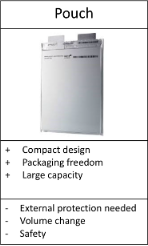
- 42Prismatic positives and negatives
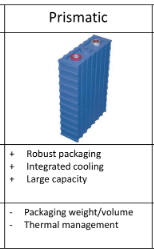
- 43Cylindrical positives and negativesBuilt in safety features also
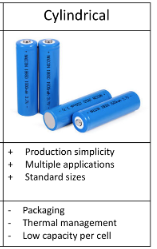
- 44Manufacturing process

- 45Manufacturing temperaturesdown to -70 degrees for electrolyte adding, so no water
- 46energy cells vs power cells
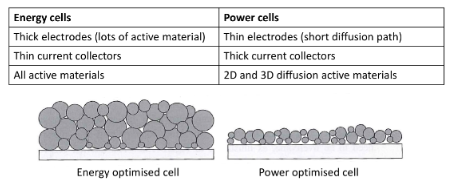
- 47N/P ratioRatio of negative to positive electrode material
- 48N/P ratio values1.1 to 1.4, 1.4 will last longer but not preform as good
- 49Battery voltage limits

- 50N/P ratio greater than 1 means?Positive electrode lithiation limited
- 51—
Informationen
- Beschreibung
- Karteikarten am Battery tech, erstellt von William Somerville am 17/05/2024.
- Erstellt von
- William Somerville
- Aufrufe
- 0
- Bewertung