
Karteikarten
Thermal Physics - flashcards
Karten in diesem Stapel (17)
- 1Experiment that demonstrates Brownian Motion and evidence for movement of moleculesA smoke cell with air has a small amount of smoke let into it and is lit from the side. A microscope us used to view the smoke grains. The smoke grains move fast and randomly because of collisions with the air molecules.
This provides evidence that the air molecules must be moving and have haphazard motion. - 2Kinetic model assumptionsMatter is made up of tiny particles
Particles are always moving - 3Describe solids, liquids and gases in terms of spacing, ordering and motion of atoms/moleculesSolid: small spacing, well ordered lattice, no motion except lattice vibration
Liquid: small spacing with some gaps, less well ordered, motion fairly slow
Gas: large spacing, no order, fast and random - 4Explain in terms of the behaviour of molecules, how a gas exerts a pressure on the walls of its container (3 marks)Many molecules collide with the walls of the container.
Force is rate of change of momentum.
So molecules exert a force of F= -2mv/Δt according to Newton's second law.
Pressure = total force/area of wall - 5Define Internal energyThe sum of the random distribution of kinetic and potential energies associated with the molecules of a system
- 6Convert temperature on Celsius scale to KelvinT (K) = θ (°C) + 273
- 7Absolute zeroFor any matter at absolute zero, you can't remove any more energy from it. Absolute zero is the temperature at which all substances have minimum internal energy (the KE and electrical potential energy of the particles is minimum).
- 8Define Specific heat capacity of a substance.Energy required to raise the temperature of a unit mass of a substance by 1K.
or
specific heat capacity = Energy supplied/mass x temperature change - 9Explain thermal energyThermal energy is transferred from a region of higher temperature to a region of lower temperature.
(Think of thermometer in hot water example) - 10Explain what thermal equilibrium isWhen two objects are in contact and are at the same temperature (and there is no transfer of thermal energy between them).
- 11Describe how there is an absolute temperature scale (Kelvin)...An absolute scale of
temperature that does not depend on the property of any particular substance.
extra - (absolute zero - 0K
triple point - temperature at which water, ice and water vapour can coexist at 273K) - 12Experiment to determine the specific heat capacity of a solid and liquid (method):Heat the substance with an electric heater to get a certain temperature rise.
With an ammeter and voltmeter connected to the heater, calculate the energy supplied using E=IVΔt
(energy =currentxvoltage=time remember P=IV)
Plug your data into E=mcΔθ to calculate c - 13Set up of earlier experiment for solid and liquidFor solid, a metal cylinder of mass 1kg heated by an electrical heater, wrapped in insulator and with a digital thermometer to record temperature change.
For liquid, liquid of known mass with insulating lid, and heating coil, and the liquid is also wrapped in an insulator and has a digital thermometer to record temperature change. - 14Define latent heat of fusion and latent heat of vaporisationLatent heat of fusion is the energy which must be supplied to cause a substance to melt at constant temperature.
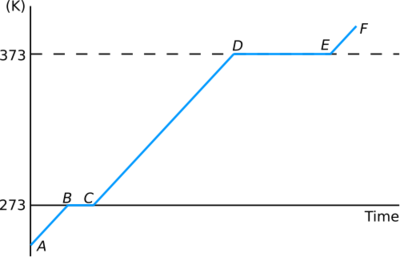
Latent heat of vaporisation is the energy which must be supplied to cause a substance to boil at constant temperature. - 15—Section AB - temperature rises. The molecules vibrate more. Their kinetic energy is increasing, but there is little change in the molecules avg separation so there is little change in their electrical potential energy.
Section BC - The ice melts at 0°C. The molecules become more disordered, separation of the molecules increases so their electrical potential energy increases.
Section CD - The ice has become water. Its temperature rises toward 100°C. The molecules move more sotheir KE increases. There is little change in the mean separation of the molecules so there is little change in their electrical potential energy.
Section DE - The water is boiling, the molecules are becoming completely separate from their neighbours. There is a large increase the the separation of the molecules so their electrical potential energy has increase greatly.
Section EF - The steam is being heated above 100°C. The molecules move even faster, their KE is increasing. The molecules have max electrical potential energy of zero - 16From this analysis...From this analysis, you can see that when water is heated it involves the following (when its flat BC and DE):
there must be an input of energy
the temperature doesn't change
the molecules are breaking free from their neighbours
their potential energy is increasing
In between the changes of state (when its increasing):
the input of energy raises the temperature of the substance
the molecules move faster (so their KE increases) - 17TemperatureA measure of the kinetic energy of particles in a system.
Informationen
- Beschreibung
- Flashcards for definitions, explanations and experiments
- Erstellt von
- Shpat Agushi
- Aufrufe
- 10
- Bewertung