
Temperature and Thermal Physics
128 resources created by 108 users
This Temperature and Thermal Physics page on GoConqr gathers community-made quizzes, mind maps, flashcards, notes and slides, from heat transfer and specific heat capacity to ideal gases and latent heat. It's built for school students revising a topic and teachers after ready-made material. There are over 900 resources here, including more than 50 quizzes, over 500 mind maps and over 200 flashcards, made by more than 800 contributors and mostly pitched at secondary level. Pick a subtopic, try a quiz to find your gaps, then explore the rest.
Top Temperature and Thermal Physics resources
-
Mind map Chapter 14- Thermal physics
-
25 questions0654 P3 Thermal Physics Quiz A liquid is heated in a beaker The density of the liquid changes as its temperature increases.This causes e...
-
25 questions0654 Matter, Thermal Properties & Transfer of Thermal Energy A circular metal disc is heated. Which quantity decreases?
-
22 cardsJan. 19 2022 Science Assessment What have we learned about cup systems?
-
16 questionsTopic 3 Thermal Physics: Quiz 2 Modelling a Gas The graph shows the distribution of speeds for the molecules of a gas at a particular temperature. Which st...
-
11 questionsTopic 3 Thermal Physics: Quiz 1 Thermal Concepts Why is there a constriction in a clinical thermometer?
-
11 questionsHEAT The length of the mercury column in a non-calibrated mercury thermometer is 2cm when its bulb is immerse in...
-
Mind map Thermal Physics Summary of A2 Thermal Physics
Quizzes
See all 12 quizzes-
25 questions0654 P3 Thermal Physics Quiz A liquid is heated in a beaker The density of the liquid changes as its temperature increases.This causes e...
-
25 questions0654 Matter, Thermal Properties & Transfer of Thermal Energy A circular metal disc is heated. Which quantity decreases?
-
16 questionsTopic 3 Thermal Physics: Quiz 2 Modelling a Gas The graph shows the distribution of speeds for the molecules of a gas at a particular temperature. Which st...
-
11 questionsTopic 3 Thermal Physics: Quiz 1 Thermal Concepts Why is there a constriction in a clinical thermometer?
-
11 questionsHEAT The length of the mercury column in a non-calibrated mercury thermometer is 2cm when its bulb is immerse in...
-
15 questionsMCAT Physics: Thermodynamics Thermodynamics is the study of the flow and transformation of energy in the universe.
-
10 questionsHeat Transfer Only hot objects emit Infrared Radiation
-
10 questionsTemperature & Heat: Quiz Temperature is defined as energy due to the movement of molecules within a body.
Mind maps
See all 48 mind maps-
Chapter 14- Thermal physics
-
Thermal Physics Summary of A2 Thermal Physics
-
Chapter 15- Ideal gases
-
Heat Transfer and Sankey Diagrams A summary of methods of heat transfer and how to use Sankey diagrams.
-
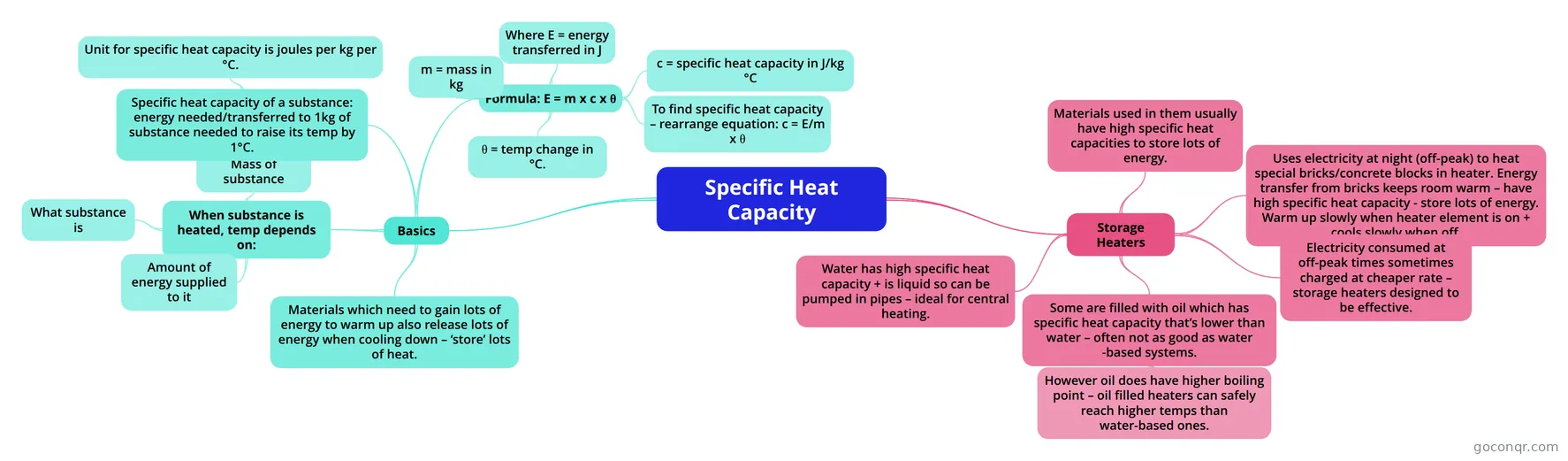 Specific Heat Capacity
-
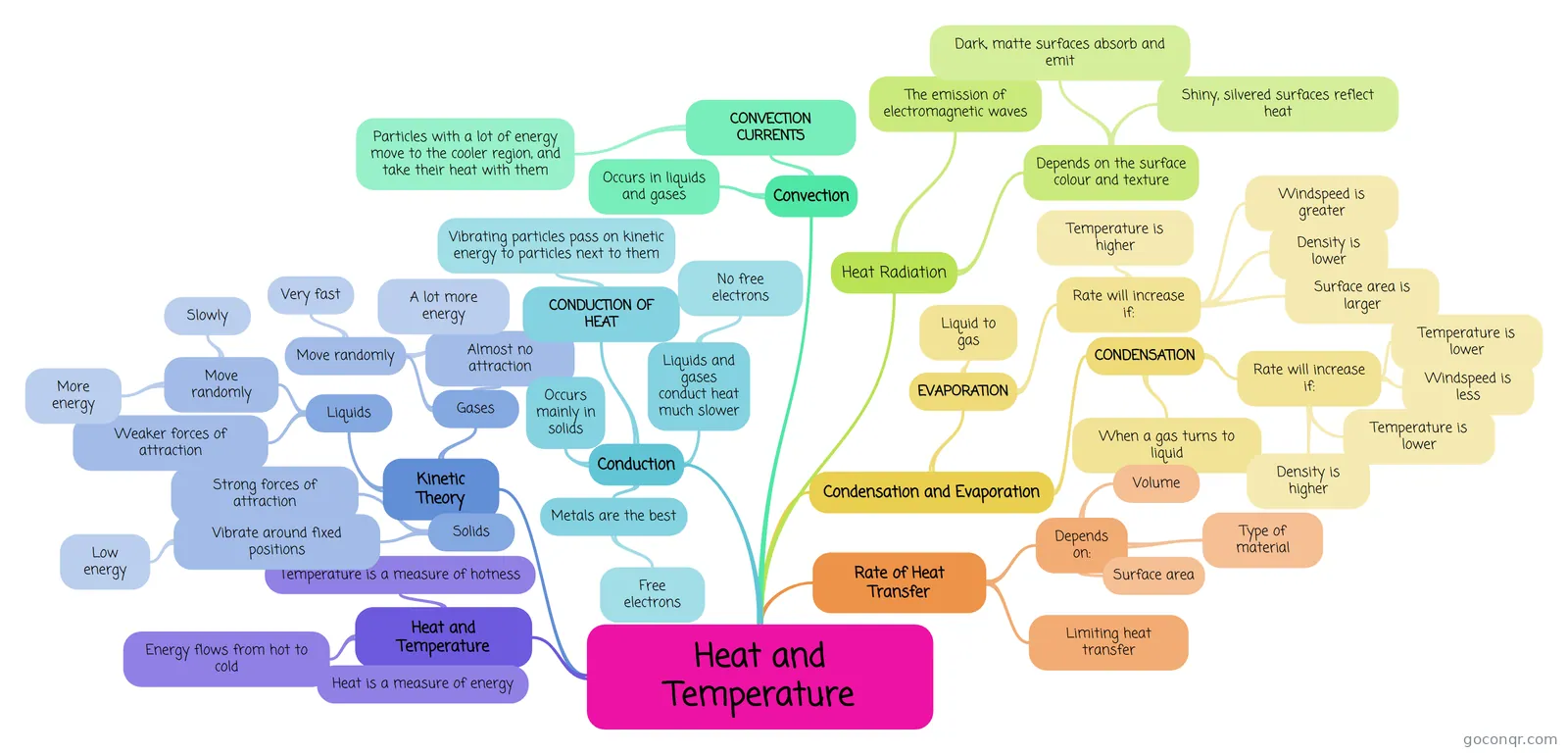 Heat and Temperature
-
Thermal Radiation
-
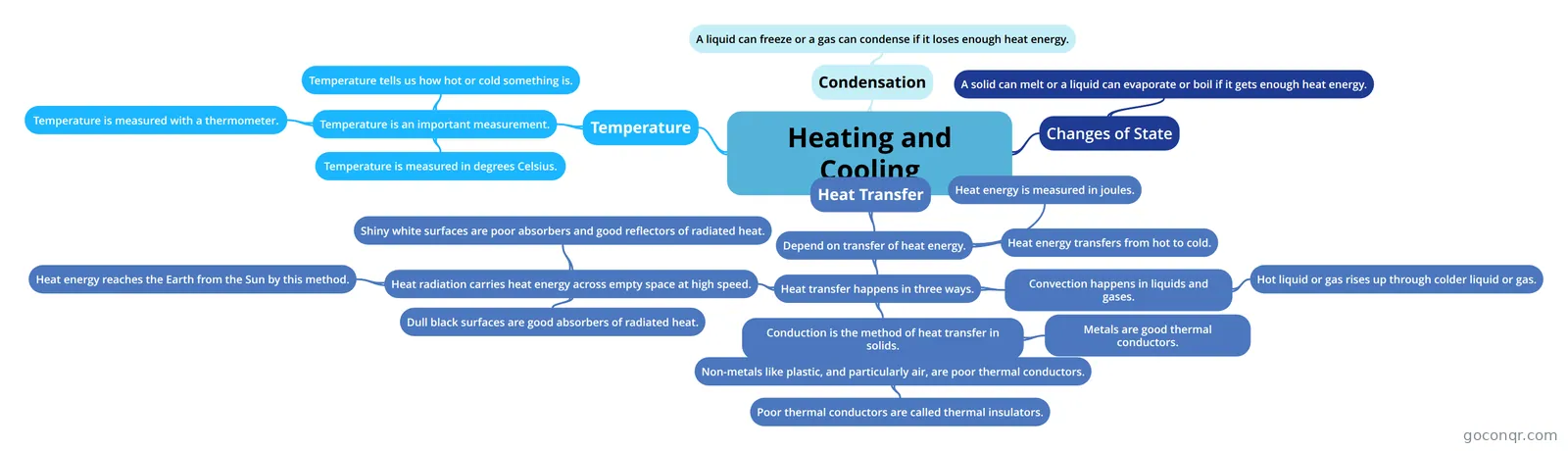 Heating and Cooling This is a year 9 physics topic summary mind map on: Heating and Cooling.
Flashcards
See all 47 flashcards-
22 cardsJan. 19 2022 Science Assessment What have we learned about cup systems?
-
14 cardschanges of state + latent heat • 6.3: changes of state • 6.5: specific latent heat
-
4 cardsHeat Transfer: Conduction, Convection and Radiation Types of Heat Transfer
-
17 cardsThermodynamics Flash Cards A set of flash cards for topic 9.1 thermodynamics including keywords and equations
-
28 cardsPhysics Chapter 6 :p How to convert from Celsius to Kelvin, Kelvin to Celsius formula
-
17 cardsThermal Physics - flashcards Experiment that demonstrates Brownian Motion and evidence for movement of molecules
-
33 cardsDefinitions Thermal physics
-
35 cardsheat and temperature unit test examples of thermal energy for heating and cooking
Notes
See all 16 notes-
Physics p6 - Transfer of thermal energy
-
P6: Transfers of Thermal Energy One experiment: Prepare a few rods made from different materials Use wax to attack small pins to their ends Afterwards heat the end of the rods Thermal energy will be transferred by conduction from one end...
-
THERMODYNAMICS Thermal energy/heat: The non-mechanical transfer of energy between a system and its surroundings due to a difference in temperature. (It is a process! Hence no such thing as “thermal energy in a body” just as there is...
-
Thermal properties of Matter Heat is a form of energy transferred between two(or more) systems or a system and its surroundings by virtue of temperature difference.(definition) Temperature of a substance is a physical quantity which measures the ...
-
Thermal Physics STATES OF MATTERMatter exists in 3 forms.Solid- occupies a fixed volume-has a fixed shape Liquid-occupies a fixed volume-takes the shape of the container.Gas-expands to fill its container-takes the shape of the contai...
-
P2 Kinetic Theory more temperature =- more kinetic energy- more speed- more vibration- more separation - more potential energykinetic = movement keep heating a liquid = turns into gas once they escape the other molecules completel...
-
Temperature & Heat: Latent Heat Latent Heat The latent heat of a body is the amount of heat required to change its state without a change in temperature As it is a form of heat energy, it is a scalar quantity and measured in Joules Specific Latent H...
-
Temperature & Heat: Heat Transfer Conduction Transfer of heat within a substance, molecule by molecule Occurs through rapid vibration of atoms and molecules These vibrating molecules interact with neighbouring particles, transferring some of their ene...
Slides
More Physics topics
About Temperature and Thermal Physics
GoConqr OriginalWhat the resources cover
The unit spans the core ideas of heat and temperature. The mind map Specific Heat Capacity explains why materials that need lots of energy to warm up also release lots when cooling. Heating and Cooling covers changes of state, including condensation and freezing. For gases, Chapter 15- Ideal gases is a mind map that lists the assumptions behind the ideal gas model. Another mind map, Chapter 14- Thermal physics, covers the triple point and thermal equilibrium.
Where to start
Begin with the basics, then build up in this order:
- Open Heat and Temperature or Temperature to fix the difference between the two ideas.
- Move to heat transfer with the IGCSE Physics Heat Transfer slides, which set out radiation, conduction and convection.
- Look at energy and materials with Specific heat capacity (required practical), which links the decrease of one energy store to a temperature rise.
- Finish with gases and thermodynamics, using the ideal gas mind maps and Thermodynamics Flash Cards.
Using quizzes and maps together
Read a mind map first, then test yourself. The 0654 P3 Thermal Physics Quiz asks how a heated liquid's density changes and how energy moves through it. MCAT Physics: Thermodynamics asks about the zeroth law and heat flow. Wrong answers show you which map to reopen. Flashcard decks such as Temperature & Heat: Latent Heat then help you lock in the definitions.
Where this unit sits
This unit belongs to the Matter and Thermal Physics strand of Physics. The listed resources mention GCSE Physics, IGCSE Physics, A-level Physics, IB Physics and Leaving Certificate Physics, so you can match them to your own course.
Choose one subtopic today, work through its map and quiz, and see what you still need to revisit.
Frequently asked questions
Which resource should I open first?
Start with the mind maps Heat and Temperature or Temperature if the basics feel shaky. If you already know them, try the Thermal Physics quiz named 0654 P3 Thermal Physics Quiz and let your wrong answers point you to the right topic.
What do the mind maps cover?
They cover specific heat capacity, heating and cooling, heat transfer, thermal radiation, kinetic theory and conduction, and ideal gases. One chapter map explains the triple point and thermal equilibrium, while another lists the assumptions of the ideal gas model.
Are these resources free to use?
Yes. Every resource listed here is free to open, study and take, with no account needed. They were made by GoConqr users, not by GoConqr itself, so styles and depth vary from one resource to the next.
Which exams do the resources suit?
The listed resources mention GCSE Physics, IGCSE Physics, A-level Physics, IB Physics and Leaving Certificate Physics. Most are at secondary level, so they suit school students working towards those courses and teachers looking for ready-made material.
Is there something on the required practical?
Yes. The slides Specific heat capacity (required practical) give the aim: to determine the specific heat capacity of one or more materials. A separate Note on specific heat capacity and several flashcard decks help with the theory behind it.
What if I can't find what I need?
Try a nearby term such as heat, thermal energy or thermodynamics, since resources are titled by their creators. If a gap remains, a free account lets you make your own quizzes, mind maps, flashcards and notes.