
Karteikarten
Chemistry Flashcards
Karten in diesem Stapel (30)
- 1How can we reduce our carbon footprint/ reduce our CO2 emissions?By using public transport,
eating less cows,
not burning fossil fuels,
using alternative sustainable ways of generating electricity,
growing more plants - 2What will happen if the Earth continues to rise in temperature and why?Sea levels start to rise - floods, loss of land (erosion)--> less typical crops grown, famine?
More extreme weather- droughts, rainfall
Humans will die
Some animals will become extinct
Diseases spreading- e.g.. Malaria - 3Is global warming a natural or man made cycle?Natural : Plants and animals emit a lot more CO2 then humans, oceans release CO2 when they heat up, the Earth's temp. has always gone up and down
Man made : As the industrial revolution started, CO2 levels started going up too, as well as temperatures - 4What evidence is there that global warming is taking place?The ice caps are melting;
Changes in weather- becoming more extreme;
Animals becoming extinct;
Sea levels are rising - 5What is global warming?The warming up of the Earth due to greenhouse gasses trapping heat energy.
- 6How is global warming being caused?Burning of fossil fuels- releasing carbon
Deforestation- means no photosynthesis and nothing taking that carbon in
Cows releasing Methane (CH4)
Melting of ancient ice which has warming gasses trapped inside - 7What are the gasses in our atmosphere and what is their use?78% Nitrogen, used by plants to make proteins, otherwise harmless
21% Oxygen, Combustion and respiration
1% Argon, harmless and unreactive
0.04% Carbon Dioxide, photosynthesis, keeps Earth warm
0-5% Water vapour, hydration + water cycle - 8What is the evolution of the Earth's atmosphere?1) Small balls of matter join to make Earth
2) Earth is very hot because of volcanoes releasing warming gasses such as Ammonia (NH3), Methane (CH4), Carbon Dioxide (CO2) and Water Vapour (H2O)
3) Eventually the Earth cooled, condensing the water vapour into oceans and dissolving the CO2 into it
4) Plants evolved in the oceans, with a new process called Photosynthesis which took in C02 and released oxygen (O2)
5) As O2 levels went up and CO2 levels went down, animals evolved and plants started to move out of the water
6) Lightning split apart the ammonia, forming the harmless gasses of Nitrogen and Hydrogen
7) Carbon got trapped into fossil fuels, called Carbon Stores - 9How is CO2 made, how is it dangerous and how can we reduce it?C02 (Carbon Dioxide) is made by burning fossil fuels and through incomplete and complete combustion
It's dangerous because it adds to global warming
We can reduce it by growing more plants, not burning fossil fuels - 10How is CO made, how is it dangerous and how can we reduce it?Carbon Monoxide is made in hot car engines.
It's dangerous because it's, uh, poisonous? Stops red blood cells from carrying oxygen.
We can reduce it through using a catalytic converter (see my 'Reducing Pollutants' mind map for more info) - 11How is NO made, how is it dangerous and how can it be reduced?Made in hot car engines
Dangerous as if it reacts with oxygen it turns into Nitrogen Dioxide, leading to acid rain
Reduced through catalytic converter (see my 'Reducing Pollutants' mind map for more info) - 12How is SO2 made, how is it dangerous and how can it be reduced?Made from burning fossil fuels with sulphur inside, especially coal
Dangerous as leads to acid rain
Reduced through wet scrubbing (see my 'Reducing Pollutants' mind map for more info) - 13How is NO2 made, how is it dangerous and how can we reduce it?Made from Nitrogen Monoxide reacting with oxygen
Dangerous as it leads to acid rain
Reduced through catalytic converter (see my 'Reducing Pollutants' mind map for more info) - 14How is acid rain made, how is it dangerous and how can we reduce it?SO2 + O2 + H20 OR NO2 + O2 + H2O = Acid rain
Dangerous as leads to deforestation, reacts with limestone, kills fish
Reduced through catalytic converter and wet scrubbing (see my 'Reducing Pollutants' mind map for more info) - 15How are particulates made, how are they dangerous and how can we reduce them?Made by burning fossil fuels and incomplete combustion
Dangerous as makes breathing and lung infections worse
Reduced through electrostatic precipitator - 16How can we test for carbon dioxide, oxygen and hydrogen?CO2- Bubble gas through lime water. If it turns cloudy then CO2 is present.
O2- Should relight a glowing splint
H2- Place a lit splint into a container with hydrogen inside. If a squeaky pop is heard then H2 is present. - 17What is the equation for complete combustion? Blue or orange flame?Hydrocarbon + Oxygen --> Carbon Dioxide + Water
CH4 + 2O2 --> CO2 + 2H2O
Blue flame, is hotter and releases most energy - 18What is the equation for incomplete combustion? Blue or orange flame?Hydrocarbon + (Limited) Oxygen --> Carbon Dioxide + Carbon Monoxide + Particulates + Water
CH4 + O2 --> CO2 + CO + C + H2O
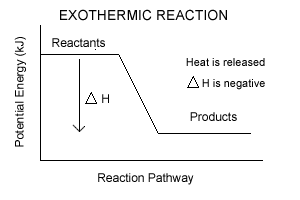
Orange flame, less hot and releases less energy - 19What is the exothermic reaction's profile and characteristics?Hot reaction, less energy taken in, more energy released. Delta H is negative.
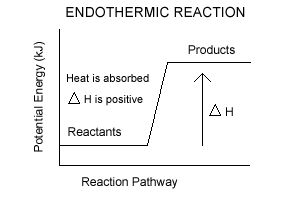
- 20What is the endothermic reaction's profile and characteristics?Cold reaction, more energy taken in, less energy released. Delta H is positive.
- 21What are the energy changes in a chemical reaction?1) Bonds break, energy in (this is called the activation energy)
Intermediates are fully broken bonds
2) New bonds are made, energy out, comes out as heat energy - 22Why do we need potable water? What would happen if our water wasn't safe to drink?We need potable water (drinking water) so we can hydrate.. No hydration = dead you.
If it wasn't safe and we drunk it, we would get so many water borne diseases from microbes and toxic material. Once again, no safe water = dead you. - 23How do we clean up our water?1) Filter the water to get rid of big, solid bits in the water, such as sand
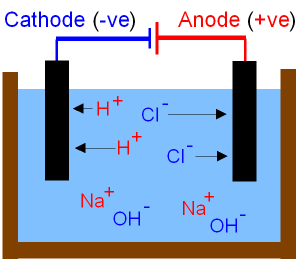
2) Then chlorinate it to get rid of pathogens and microbes carrying diseases - 24What are the products of the electrolysis of brine and what are the uses?Sodium Hydroxide- Bleach, soap, paper, chemical products
Chlorine- Water purification, manufacture hydrochloric acid
Hydrogen- Margarine, potential as a clean fuel, hydrochloric acid - 25What is the electrolysis of brine?The Na+ and OH- join together to make Sodium Hydroxide. Other products include Hydrogen and Chlorine gas.
- 26What are the problems with adding chlorine to water?When chlorine reacts with organic matter it creates THM's which have been linked to cancer.
- 27What are the benefits of adding chlorine to water?Makes water much safer to drink,
Removes unpleasant tastes,
Stays in the pipes to continually clean water,
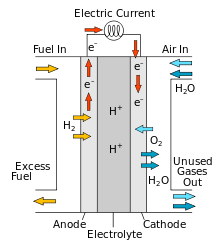
Kills bacteria which would have killed you - 28What is the diagram for the hydrogen fuel cell?
- 29What are the benefits of the hydrogen fuel cell?Three times more energy than petrol;
Can be taken into restricted areas;
Only emits water- not a bad gas;
Only fuel needed is water;
No localised pollutants;
Can be used as a clean fuel;
Sustainable and renewable - 30What are the drawbacks of the hydrogen fuel cell?Requires the burning of fossil fuels for electricity;
H2 is expensive;
The whole infrastructure would need to be refitted;
It is expensive to change every single car;
Flammable
Informationen
- Beschreibung
- Flashcards of everything, from C1.1 to C1.3 and also including potable water :)
- Erstellt von
- Carmen Trinh
- Aufrufe
- 40
- Tags
- Bewertung