
Karteikarten
Science
Karten in diesem Stapel (19)
- 1What are waves? A wave is a disturbance involving the transfer of energy from one place to another.
- 2Explain what causes mechanical waves and the main characteristics of waves. They need a medium to travel.
They transfer energy by the vibration of particles in a medium.
There are three types: longitudinal, surface, and transverse.
Mechanical waves form when a source of energy causes a medium to vibrate. - 3Identify, list and describe the three types of mechanical waves.Longitudinal Waves: are waves that vibrate the medium in the same direction in wich
Transverse Waves: is a wave that vibrates the medium at right angle or perpendicular
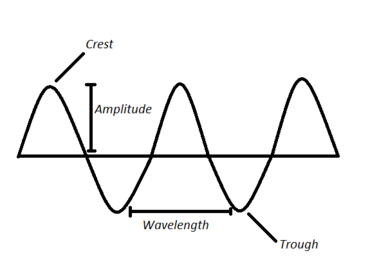
Surface Waves: are a combination of transverse and longitudinal waves. Tralves along - 4Identify the parts of a transverse wave
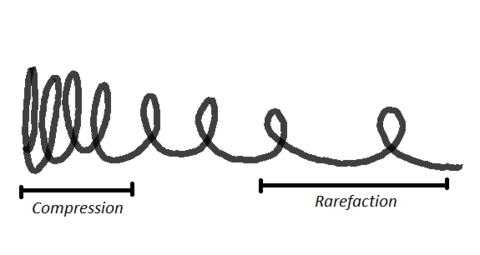
- 5Identify the parts of a longitudinal wave
- 6Describe the basic properties of waves (amplitude, wavelength, frequency, and speed).-Amplitude: is the maximum distance the medium vibrates from the rest position.
-Wavelegth: the distance between two corresponding parts of the wave. From crest to crest or from trough to trough.
-Frequency: the number of waves that pass in a given point in a certain amount of time. It is measured in Hertz (Hz).
-Speed: how far the wave travels in a given amount of time. - 7Explain how a waves speed is related to its wavelength and frequency.-The higher speed the wave has the faster it would pass through a point so the speed can alterait the frequency.
- 8Explain how a waves amplitude is related to its energy.-The bigger its amplitude the bigger its energy.
- 9Determine a waves speed, frequency, and wavelength using a given formula- speed= wavelength x frequency
- Frequncy= speed % wavelength
- wavelength= speed % frequency - 10Describe how relflection, refraction, and deffraction change a waves direction. Provide examples.-Reflection: when a wave hits a surface, any part of the wave that cannot pass through the surface so the wave bounces back. Example: when you look yourself in the mirror.
-Refraction: is the bending of waves due to a change in speed. Example: when you put a straw into a glass of water.
-Diffraction: when a wave moves around barrier or though an opening in a barrier, it bends and spreads out. Example: when there is a big rock in the ocean and the ocean wave surrounds it. - 11State the different types of interference.-Constructive Interference.
-Destructive Interference - 12Understand the Law of Reflection and label the angles and the waves.-The Law of Relfection states that the angle of incidence equals the angle of reflection.

- 13What is an electromagnetic wave?-Is a transverse wave that involves the transfer of electric and magnetic energy.
- 14State what an electromagneticwave consists of. Provide main characteristics.-An electromagnetic wave is made up of vibrating electric and magnetic fields that move through space or some medium at the speed of light.
-The energy that electromagnetic waves tranfer through matter or space is called electromagnetic radiation.
-They do not requirea a medium, so they transfer energy through a vacuum, or empty space. - 15Explain how electromagnetic waves are alike and how they are different.-They travel at the same speed at a vacuum, but they have different frequencies and wavelengths, and different amount of energy.
-All have different uses.
-Only visible light can bee seen.
-All are part of the electromagnetic spectrum. - 16Describe and compare the waves that make up the electromagnetic spectrum. And their uses everyday life.Radio waves
• Electromagnetic Waves with the longest wavelengths have the lowest frequencies are radio waves.
• Are used in broadcasting to carry signals for radio programs.
• There are 2 types: FM and AM
• Have the shortest frequency.
Microwaves
• Has a shorter wavelength than radio waves.
• Has a higher frequency than radio.
• Microwaves cell phones and radar .
• Radar sends a microwave that reflects an object and that measures the distance and speed.
Infrared rays
• Is the invisible heat you feel.
• It has a shorter wavelength than microwaves.
• It has higher frequency than microwaves.
• They are called The Heat.
Visible light
• Are electromagnetic waves that we can see .
• They make a very small part of the electromagnetic spectrum.
• Visible light that appears white is often a mixture of colors.
• It has shorter wavelength and higher frequency than infrared rays.
Ultraviolet rays
• Has a shorter what is blank than visible light.
• Has higher frequency than visible light.
• The energy of this wave tank here living cells.
• It can give cancer.
X-rays
• They have - 17Explain how radio waves are produced and transmit information.-Charged particles vibrating inside a transmition antena produce radio waves
-The transmition antena sends out radio wave in many directions, radio waves carry information from the brodcast station antena to the reciving antena of your radio. - 18Explain how cell phones work.-First: When you place a cell-phone call, the phone sends out microwaves, which are tagged with a number unique to your phone.
-Second: A tower picks up the microwaves and transfers the signal to a hub.
-Third: The hub channels and transmits the signal to a reciver. The reciver may be another tower or hub, depending on the distance between the two phones.
-Forth: The tower or hub transmits the signal to the reciving cell phone.
-Fifth (last): The reciving phone rings when it picks up the signal. - 19Explain how communications satellites work. And why they are important.-Communications satellites work like the recivers and transmitters of a cellular phone system.
-Global Positioning System (GPS): GPS satellites send signals to tell you the exact location and altitude on earth.
-Satellite Phone System: satellite phones use satellites to transmit and recive calls anywhere in the world.
-Television Satellites: television satellites allow networks and cable companies to transmit signal.