
Karteikarten
QUIZ: Identifying regulatory elements in bacterial genomes
Karten in diesem Stapel (37)
- 1What is does the sigma factor do in the 'Transcription cycle in bacteria'?Protein needed for the initiation of RNA synthesis, allows binding between RNA polymerase to gene promoters
- 2What is the consensus sequence?The bases that appear most often in the promoter collection
- 3Where do the sigma factors interact with the DNA?-10 and -35 hexametric elements
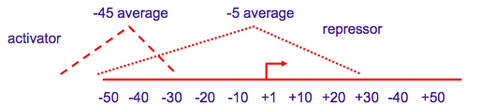
- 4Where do repressors and activators bind? (picture)
- 5Where do repressors and activators bind?Activators bind upstream or partially overlapping region (-35 region)
Repressors usually bind overlapping or downstream from promoter region - 6Where do most searches for regulatory elements focus on?<300bp upstream of translation start
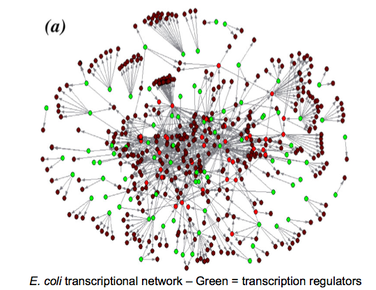
- 7How is transcription initiation controlled?each regulator controls a regulon e.g. Lac I controls lac operon (one or two other genes)
- 8What does the E.coli transcriptional network look like?
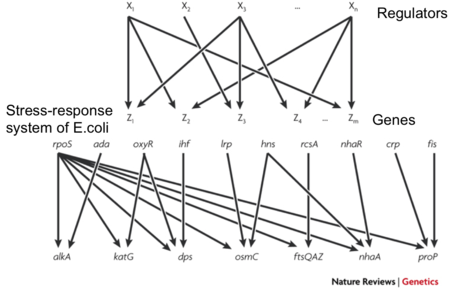
- 9What is a DOR?Dense Overlapping Regulons
A set of regulators control a group of target genes, where each gene is controlled by two or more of the regulators - 10What is a DOR (picture)?
- 11Why are most DNA binding sites bipartite?So can bind to more parts of the DNA
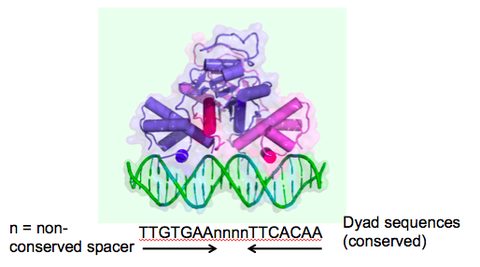
- 12What do the bipartite DNA binding sites recognise?Dyad sequences (highly conserved) that are separated by a non-conserved spacer
- 13What does the interaction between a DNA binding complex and a dyad sequence look like?
- 14Do most sites match the consensus sequence?NO - most regulators bind to a range of sites and have a range of affinities
- 15How do you represent DNA motifs?Visually - WebLOGO
Sequence Patterns
Position Specific Weighted Matrices (PSWM) - 16How do 'sequence patterns' work?String of sequence using four nucleotides
Variation captured using IUPAC codes - 17What is a disadvantage of sequence patterns?Does not capture quantitative information on a particular position
- 18How do you conduct a PSWM?Capture frequency of nucleotides at each position
- 19What is the IUPAC?Code for representing degenerate nucleotide sequence patterns
- 20What is a DNA sequence motif?Short reoccurring patterns in DNA
- 21How do you conduct a PSSM?Start with data used to create consensus
Related sites discovered using a search engine
Align sequences then score each position
Introduce pseudo counts
Introduce background frequency - 22What do 'pseudocounts and background frequency of particular nucleotide in genome' solve?Product of score for each does not equal 0
Score does not account for background GC content of genome - 23What is the formula used to work out PSSM?Score (position, nucleotide) = (q+p) / (N + B)
q=observed counts for nucleotide
p=weighted pseudocounts=B*(overall frequency of nucleotide)
B = total number of allocated pseudocounts
N = total number of sequences (max number of observed counts)
TOTAL SCORE = PRODUCT OF SCORE AT EACH POSITION - 24How do we identify regulatory motifs?1) Intra-genome searches for conserved motifs - DYADS
2) Inter-genome alignments of orthologues - 25What do the approaches for 'identifying regulatory motifs' rely on?most DNA binding proteins bind to related sequences - SPECIFICALLY
- 26When conducting an intra-genome search for dyads, what do we search for?W1 NX W2
W1 = 3-5 nt sequence
NX = spacer with any nucleotide of X nt length
W2 = 3-5 nt sequence - 27What are "intra-genome searches for dyads" limited to ?<300bp from translation start point
- 28For "Intra-genome searches for dyads" what does statistical significance depend on?Length and GC content of Dyad
Context of search e.g. length and GC content of upstream regions - 29What happens following identification of groups of significant dyads?cluster into subgroups based on conservation in surrounding nucleotides
- 30What can a PSSM be used for within Intra-genome searches for dyads ?Search for additional targets
- 31What is an "Inter-genome comparison of - orthologues"?Genome sequences of groups of related but distinct (e.g. Genus level) make this very powerful method
- 32What is the best approach to identify regulator motifs?genome-wide ChIP analysis
- 33What happens if "genome-wide ChIP analysis" is not available?1) Known consensus sequence / PSSM generated using a limited data set
2) Microarray data indicating co-expressed genes (transcriptome analysis) - 34What are the benefits of a string search?Can include mismatches and IUPAC symbols
Can quickly identify close matches
NOT good for degenerate motifs - 35What is a 'string search'?Query is a string of nucleotides derived from consensus e.g. GTGnnnnCAC
- 36PSSM-based searchQuery is a matrix-based pattern
Weighted nature increases sensitivity
Can identify degenerate motifs
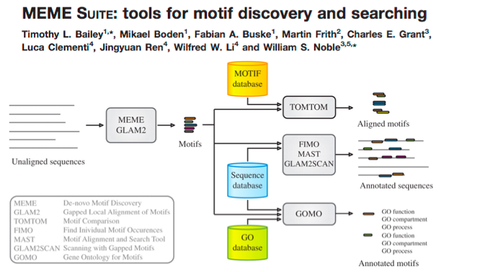
Trade-off between sensitivity and specificity - 37What web based tools can be used for motif discovery and searching?
Informationen
- Beschreibung
- Undergraduate Bioinformatics (Bacterial Genomics - Mark Paget) Karteikarten am QUIZ: Identifying regulatory elements in bacterial genomes, erstellt von Thomas Welford am 12/03/2014.
- Erstellt von
- Thomas Welford
- Aufrufe
- 93
- Tags
- Bewertung