
Karteikarten
Population Change
Karten in diesem Stapel (50)
- 1Zero Growtha population in balance. Birth rate is equal to death rate, so there is no growth or decrease.
- 2Natural Decrease (ND)the death rate is greater than the birth rate.
- 3Exponential growtha pattern where the growth rate constantly increases – often shown as a J-curve graph.
- 4Birth rate (BR)the number of babies born per 1,000 people per year.
- 5Death rate (DR)the number of deaths per 1,000 people per year.
- 6Natural changethe difference between birth rate and death rate, given as a percentage
- 7Natural increase (NI):the birth rate is greater than the death rate.
- 8Life expectancythe number of years a person is expected to live, usually taken from birth.
- 9Newly industrialising countries (NICs)these include the
Asian ‘tigers’ as well as other emerging industrial nations such as Malaysia, the Philippines and China. - 10Asian ‘tiger’one of the four east Asian countries of Hong Kong, South Korea, Singapore and Taiwan, where manufacturing industry grew rapidly from the 1960s to the 1990s.
- 11—High fluctuating
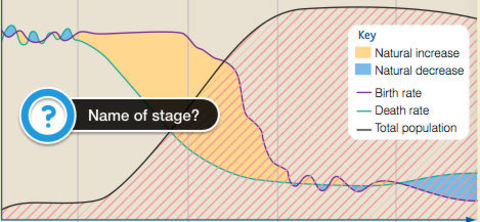
- 12Demographic transition model (DTM)a theoretical model that shows changes in population information (birth and death rates and population growth) over a period of time.
- 13DTM Stage 1 – High fluctuatingThe birth rate is high and fluctuating, the death rate is also high and fluctuating, the total population is stable and there is no natural changes in the population. Only examples of this are tribes
- 14DTM Stage 2 – Early ExpandingThe birth rate is still high and fluctuating, the death rate falls rapidly, the total population rises rapidly and there is a natural rapid increase. Only example of this is Afganistan
- 15DTM Stage 3 – Late ExpandingThe birth rate falls rapidly, the death rate is low and fluctuating, the total population is still increasing and the natural increase is decreasing. Examples of this are found in most places around the world
- 16DTM Stage 4 – Low FluctuatingThe birth rate is low and fluctuating, the death rate is also low and fluctuating, the total population is high and stable and there is no natural increase or decrease. Examples of this are the UK
- 17DTM Stage 5 – Natural DecreaseThe birth rate falls below the death rate, the death rate stays low and fluctuating, the total population falls slightly and there is a natural decrease. Examples of this is Germany
- 18AMEWThese are the four reasoning's for the change in population, between stage 2 and stage 3
- 19Agricultural changeFarmers can now use machines so do not need as many children as they are now no use on the farm
- 20Urbanisationthe growth in the proportion of people living in towns and cities
- 21Rural-to-urban migrationMoving from a rural area to settle in a town or city
- 22Push factorSomething that makes people want to leave an area
- 23Pull factorSomething that attracts people to an area
- 24Educational ChangeThe law states that every child must be schooled and so become less of an asset and therefore people do not want as many kids
- 25Women’s status change (emancipation)Women are treated equally and taught more so there are more women working and not staying home and looking after children so there are less children being born
- 26Population PyramidsThese show three important things, the death rate of a population, the birth rate of a population and the size of a population
- 27Wide baseHigh birth rate
- 28Narrowing baseFalling birth rate
- 29Narrow baseLow birth rate
- 30Convex (bulge)Baby boom within that generation
- 31Steep sides with a narrow topHigh death rate
- 32Wide topLow death rate
- 33High apex (tall)High life expectancy
- 34Short pyramidLow life expectancy
- 35Sudden narrowing around age 5High infant mortality
- 36Age structure:the proportions of each age group in a population. This links closely to the stage a country has reached in the demographic transition model.
- 37Gender structurethe balance between males and females in a population. Small differences can tell us a great deal about a country or city.
- 38Infant mortalitythe number of babies that die under a year of age, per 1,000 live births
- 39Child mortalitythe number of children that die under five years of age, per 1,000 live births.
- 40Transmigrationa population policy that aims to move people from densely populated areas to sparsely populated areas and provide them with opportunities to improve the quality of their lives.
- 41Transmigrationa population policy that aims to move people from densely populated areas to sparsely populated areas and provide them with opportunities to improve the quality of their lives.
- 42Industrialisationa process, usually associated with the development of an economy, where an increasing proportion of people work in industry.
- 43European Union (EU)a group of countries across Europe that work towards a single market, i.e. they trade as if they were one country, without any trade barriers.
- 44Dependency ratiothe balance between people who are independent (work and pay tax) and those who depend on them. Ideally, the fewer dependents for each independent person, the better off economically a country is.
- 45Migrationthe movement of people from one permanent home to another, with the intention of staying at least a year. This move may be within a country (national migration) or between countries (international migration).
- 46Host countrythe country where a migrant settles.
- 47Country of originthe country from which a migration starts.
- 48Immigrant:someone entering a new country with the intention of living there.
- 49Emigrantsomeone leaving their country of residence to move to another country.
- 50Asylum seekerspeople who believe that their lives are at risk if they remain in their home country and who seek to settle in another (safe) country.
Informationen
- Beschreibung
- AQA A GCSE
- Erstellt von
- John Ditchburn · Mär 2014
- Aktualisiert
- 18 Nov 2016
- Aufrufe
- 271
- Tags
- Bewertung