
Karteikarten
5.) Suprasegmental Phonology
Karten in diesem Stapel (23)
- 1What is suprasegmental phonology?• The combination of segments into larger units, such as syllables
/lɪŋˈgwɪstɪks/
• Phonological properties of longer stretches of speech (intonation, stress, rhythm, tone...) - 2What are Syllables?• A phonological unit above the phoneme
• One could say: the smallest rhythmic unit of speech
Not very specific...
• Very difficult to define what a syllable actually is, even though pretty much all speakers of a language will have a feeling for it - 3Monosyllabicone syllable
->I, of, bee, lend, great, stream, crunched - 4Polysyllabicmore than one syllable
-> yellow, computer, America, revolutionary - 5The structure of a syllable
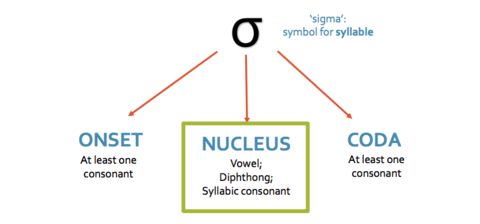
- 6Onset..?At least one consonant
-can remain empty - 7NucleusVowel; Diphthong; Syllabic consonant
must be filled - 8CodaAt least one consonant
-can remain empty - 9Examples• Onset + Nucleus + Coda: bed, get, mop
• Onset + Nucleus: bee, go, my
• Nucleus + Coda: on, up, out
• Nucleus: I, a, oh - 10The coda -> filled vs. empty• If the coda is ‘filled’ (i.e. there is a consonant sound at the end of
the syllable), this is called a closed syllable man, pot, heat, in, rain, ...
If the coda is ‘empty’ (i.e. there is nothing after the nucleus), this is called an open syllable
to, low, how, through, star (RP only!), ... - 11Syllable structures in other languages• Different languages have different rules concerning syllable structure
• Example: Japanese
• Codas far less common in Japanese, open syllables are typical:
• Textte.ki.su.to
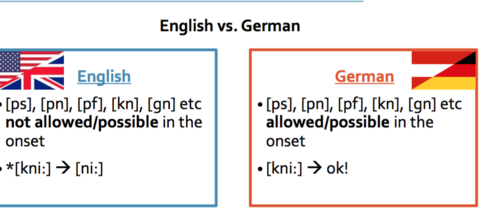
• Vowel insertion to avoid ‘impossible’ clusters - 12PhonotacticsSet of constraints regarding possible or impossible consonant clusters in either onset or coda
i.e. which consonants are ‘allowed’ to go next to each other (different for different languages) - 13English vs. German
- 14Syllabification How do we decide how to split a word into syllables?• Maximal onset principle
• Sonority sequencing principle - 15Maximal onset principle• If you have to choose between filling the onset or the coda, choose the onset
• If there’s no other choice, then fill the coda
banana bə . nɑ: . nə - 16Sonority sequencing principle• Sounds in the onset must rise in sonority
• Sounds in the coda must fall in sonority
• The nucleus is the most sonorous part of a syllable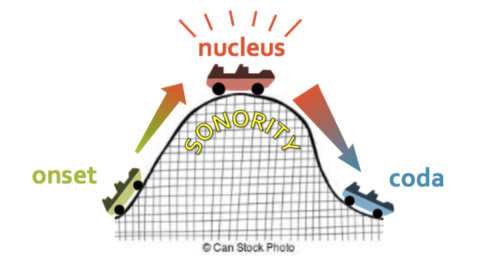
- 17Sonority• ‘a measure of the output of periodic acoustic energy associated with the production of a particular segment, and hence its intrinsic loudness’
->how loud a sound is
• This is a relative characteristic
• Try producing the following sounds: [p] – [g] – [z] – [ɹ] – [ɑ:] - 18The position of /l/ in a syllable• If /l/ is in the onset of a syllable, it is realized as a clear [l] • If /l/ is in the coda of a syllable, it is realized as a dark [ɫ]
- 19What /l/ is produced here? Almost[ˈɔːɫ.məʊst]
dark - 20Follow[ˈfɒ.ləʊ]
clear - 21Telling[ˈte.lɪŋ]
clear - 22Levelling[ˈle.və.lɪŋ]
clear - 23Guilty[ˈgɪɫ.ti]
dark
Informationen
- Beschreibung
- Linguistics (Phonology) Karteikarten am 5.) Suprasegmental Phonology, erstellt von Lisza Neumeier am 29/10/2016.
- Erstellt von
- Lisza Neumeier
- Aufrufe
- 228
- Bewertung