
Karteikarten
generating electricity
Karten in diesem Stapel (19)
- 1what are genoratorsGenerators are the devices that transfer kinetic energy into electrical energy
- 2what can genorators be turned directly byGenerators can be turned directly, for example, by:
wind turbines
hydroelectric turbines
wave and tidal turbines - 3When electricity is generated using wave, wind, tidal or hydroelectric power (HEP) there are two steps, what are theyWhen electricity is generated using wave, wind, tidal or hydroelectric power (HEP) there are two steps:
The turbine turns a generator.
Electricity is produced. - 4what can generators be turned byGenerators can be turned indirectly using fossil or nuclear fuels. The heat from the fuel boils water to make steam, which expands and pushes against the blades of a turbine. The spinning turbine then turns the generator.
- 5nam the steps where energy is generated from fossil fuelsThese are the steps by which electricity is generated from fossil fuels:
Heat is released from fuel and boils the water to make steam.
The steam turns the turbine.
The turbine turns a generator and electricity is produced.
The electricity goes to the transformers to produce the correct voltage. - 6what happens to the energy transferred when burning fuelsThe energy produced by burning fuel is transferred as heat and stored in water as steam.
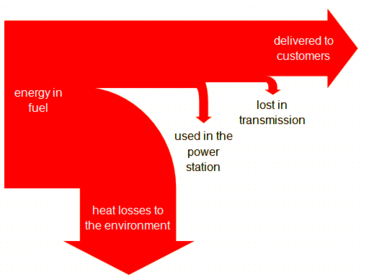
- 7how is the energy in steam transferred-sankey diagramThe energy in steam is transferred to movement in a turbine, then to electrical energy in the turbine. Energy is lost to the environment at each stage. Here is a Sankey diagram to show these losses
- 8what are renuable energy sourcesOur renewable energy resources will never run out. Their supply is not limited. There are no fuel costs either. And they typically generate far less pollution than fossil fuels.
- 9give some examples of renewable energy sourcesRenewable energy resources include:
wind energy
water energy, such as wave machines, tidal barrages and hydroelectric power
geothermal energy
solar energy
biomass energy, for example energy released from wood - 10what are the disadvantages of wind farmsWind farms are noisy and may spoil the view of people who live near them. The amount of electricity generated depends on the strength of the wind. If there is no wind, there is no electricity.
- 11what are non renewable energy sourcesNon-renewable energy sources
There is a limited supply of non-renewable energy resources, which will eventually run out. They include:
fossil fuels, such as coal, oil and natural gas
nuclear fuels, such as uranium - 12what happens to fossil fuels when they burnFossil fuels release carbon dioxide when they burn, which adds to the greenhouse effect and increases global warming. Of the three fossil fuels, coal produces the most carbon dioxide, for a given amount of energy released, while natural gas generates the least.
- 13give a pro and con for nuclear power stationsThe fuel for nuclear power stations is relatively cheap. But the power stations themselves are expensive to build. It is also very expensive to dismantle old nuclear power stations or store radioactive waste, which is a dangerous health hazard.
- 14what are the main nuclear fuelsThe main nuclear fuels are uranium and plutonium, both of which are radioactive metals. Nuclear fuels are not burned to release energy. Instead, heat is released from changes in the nucleus.
- 15give an advantage and a disadvantage of nuclear power stationsUnlike fossil fuels, nuclear fuels do not produce carbon dioxide.
Disadvantages
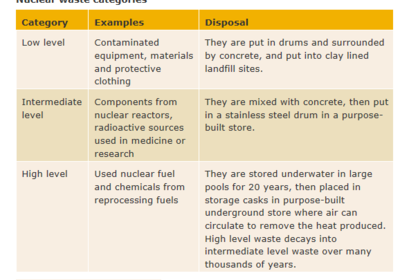
Like fossil fuels, nuclear fuels are non-renewable energy resources. And if there is an accident, large amounts of radioactive material could be released into the environment. In addition, nuclear waste remains radioactive and is hazardous to health for thousands of years. It must be stored safely - 16list the nuclear waste categories
- 17what is nuclear fission and what happens in itNuclear power stations use the heat released by nuclear reactions to boil water to make steam
The type of nuclear reaction used is called nuclear fission. In nuclear fission:
A neutron collides with a uranium nucleus. A uranium nucleus is large and unstable.
The uranium nucleus splits into two similar-sized smaller nuclei.
More neutrons are released.
These neutrons can then collide with more uranium nuclei. - 18what is the rate of the energy released in nuclear fissionIn a nuclear reactor, the reaction is controlled so that energy is released at a steady rate.
The energy released in nuclear fission is far greater than the energy released in a chemical reaction, such as burning fuel. This means that the power output of a nuclear power station is large. The lifetime of a nuclear power station is about 20 - 19—
Informationen
- Beschreibung
- physics Karteikarten am generating electricity , erstellt von ella stokes am 25/02/2017.
- Erstellt von
- ella stokes
- Aufrufe
- 1
- Bewertung