
Karteikarten
Topic 1 flashcards
Karten in diesem Stapel (38)
- 1Between-group designsSubjects are randomly assigned to treatments
- 2With-in subjects designmeasured on more than one occasion
- 3"Treatment factor" is a generic term for...Independent variable
- 4When carrying out some form of data analysis, what is our aim?To generate a confident statistical inference about the existence, direction or magnitude of a treatment effect
- 5What is a "confident inference"?It is an inference from a procedure that produces a specified "error rate" (ER)
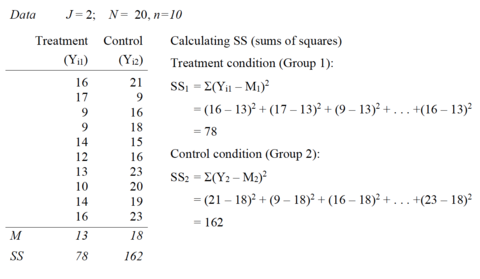
- 6What do "sums of squares" (SS) tell us?Sampling variability, or "a mathematical approach to determining the dispersion of data points"
- 7How do you calculate SS?
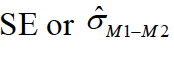
- 8What are the two abbreviations for standard error?
- 9What is the equation for calculating SE?
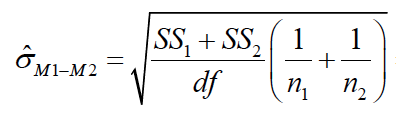
- 10What does SE quantify?It quantifies how variable sample means would be if we replicated our experiment many times
- 11What are the two approaches to making an inference regarding u1 - u2?1) Null hypothesis significance test (NHST)
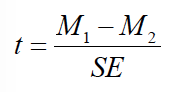
2) Internval estimate of Treatment Effect - 12How do you calculate t?
- 13What is the "decision rule" with hypothesis testing?

- 14What is "t critical"?

- 15The "type 1 error rate" is also known as...?a -alpha
- 16What does a = 0.05 ensure?That the probability of falsely rejecting Ho does not exceed 0.05, another way of saying is that a is the probability of rejecting Ho is Ho is true
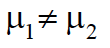
- 17In hypothesis testing, a "confident inequality inference" is:where treatment participants show difference average compared to control participants
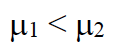
- 18In hypothesis testing, "confident direction inference" is what?where treatment participants show lower average compared to control participants
- 19If u1 = u2 and your a is 0.05, what would you expect?To reject Ho about 5 times out of 100 replications and each 'significant' outcome would be a Type 1 error
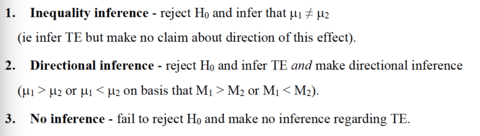
- 20What are the 3 possible outcomes that hypothesis testing allows for?
- 21What is a failure to reject the null hypothesis NOT?It is not evidence that there is no treatment effect, it is just a failure to provide EVIDENCE for a treatment effect
- 22What is type 1 error?The incorrect rejection of a true null hypothesis (a "false positive")
- 23What is type 2 error?Incorrectly retaining a false null hypothesis (a "false negative")
- 24What is type 3 error?"correctly rejecting the null hypothesis for the wrong reason", or where a directional inference is made in the wrong direction (very uncommon)
- 25What happens if there is not adequate type 1 error rate control?A test procedure will generate spurious 'significant' outcome which will render research and study findings meaningless
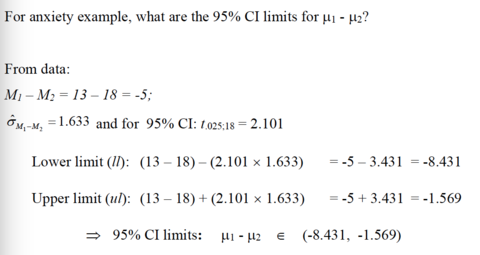
- 26What is the equation for confidence interval (CI) ?

- 27—The weird E symbol here means "contained within"
- 28Regarding CI, what is a "generic CI inference"?u1 is less than u2 by at least ... points, but no more than ... points (OR u2 is greater than u1 by at least ... points, but no more than ... points)
- 29Regarding CI, what is a "substantive CI inference"?Treatment reduces ... by at least ... points, but by no more than ... points, on ... scale
- 30You can round off numbers in which type of inference for CI testing ?It is appropriate to round limits for "substantive inferences"
- 31Regarding CI, When the inference is correct, what can we say?That the CI covers (includes) the parameter
- 32Regarding CI, when the inference is erroneous, what can we say and what is this called?We can say the the CI does not cover the parameter, this inferential error is called noncoverage error
- 33A non-coverage error rate of 0.05 is commensurate with a confidence level of ...100(1-a) = 100(1-0.05) = 95%
- 34In a nonycoverage error rate of 0.05 what percentage will cover the parameter and what percentage will not cover the parameter?95% of the CI will cover the parameter
5% of the CI will not cover the parameter - 35List the 3 inferences about treatment effect from 1 (most useful) to 3 (least useful)

- 36What are the... things that a CI provides that a hypothesis test doesn't?1. Info about effect size: estimate of TE, directional inference of TE and inequality inference
2. Info about precision of estimation: the narrower the CI the more precise the estimation of the TE
3. The possibility of practical equivalence inference - 37What is "practical equivalence" inference?It is an inference that the absolute magnitude of the parameter |u1-u2|, is trivially small (close to zero, not theoretically or clinically significant)
- 38—
Informationen
- Beschreibung
- PSYC3001 - Research Methods 3 Karteikarten am Topic 1 flashcards, erstellt von Rosie Johnson am 02/03/2017.
- Erstellt von
- Rosie Johnson
- Aufrufe
- 0
- Bewertung