
Karteikarten
OCR GCSE Gateway Physics (Higher) - P1 Revision Cards
Karten in diesem Stapel (134)
- 1What type of heat transfer occurs in solids?Conduction
- 2What type of heat transfer occurs in fluids (liquids and gases)?Convection
- 3What is Infra-Red Radiation?Electromagnetic waves carrying heat energy.
- 4What is conduction?Heated particles gain kinetic energy, bump into each other and pass on kinetic energy.
- 5What is convection?Fluids expand, become warm and less dense, so rise above its colder denser surroundings. Cooler fluids take its place.
This makes a circulation of fluids, convection currents. - 6How is conduction stopped?Gases (like air) - as particles are further apart.
- 7How is convection stopped?Solids - as no solid can flow
- 8How is infra-red radiation stopped?Shiny surfaces usually, but sometimes thick solids or liquids.
- 9What does infra-red radiation happen in?Mainly gases and vacuums. Dark, matte colours are best emitters and absorbers of IR.
- 10Which surfaces best emit radiation?Black, rough surfaces.
- 11Which surfaces best reflect radiation?Shiny, smooth surfaces.
- 12Is air a good, or poor conductor?Air is a poor conductor - it stops conduction as particles are far apart.
- 13How does double glazing stop conduction?Traps a layer of air in between two layers of glass, the air making the particles further apart.
- 14How does cavity wall insulation stop conduction and convection?It has foam between two walls. The foam bubbles stop convection and the air pockets in the foam reduce conduction.
- 15What does a vacuum do in terms of heat transfer?Stops both conduction and convection as there are no particles at all in a vacuum.
- 16What is Specific Heat Capacity (SHC)?The energy needed to heat 1kg of a material by 1°C.
- 17What does a low specific heat capacity mean for a material?- It heats up quickly
-It cools down quickly
-It stores less energy - 18What is Specific Latent Heat?The energy that 1kg of material needs to change state.
- 19What unit is heat measured in?Joules (J)
- 20What is heat?Heat is a measure of energy on an absolute scale (J).
- 21How is temperature measured?°C, °F or K
- 22What is temperature?A measure of hotness on a chosen scale.
- 23On heating graphs, what do flat areas of constant temperature show?-A change of state
-Bonds between molecules are breaking - 24Describe heat flow.Heat energy flows from a high temperature to a low temperature.
- 25Describe what happens in ovens.-Heat travels to food by convection and infra-red radiation
-Surface particles on food vibrate
-Vibration heats up solid food by conduction (or food liquid by convection) - 26Describe what happens in microwave ovens.-Heat travels to food by microwaves which can penetrate about 1cm under the surface.
-Upper layer water molecules absorb microwaves and vibrate.
-Vibration heats up rest of solid food by conduction (or liquid by convection). - 27What are thermograms?Images where different colours represent different temperatures:
-White = hot
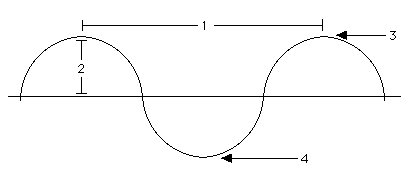
-Purple/Blue = Cold - 28Name the parts of a transverse wave:1 - Wavelength
2 - Amplitude
3 - Crest/Peak
4 - Trough - 29What does frequency mean?The number of waves in 1 second.
- 30What is the electromagnetic spectrum going from: High frequency/low wavelength TO Low frequency/high wavelenthGamma
X-rays
Ultraviolet
Visible
Infra-red
Microwaves
Radio - 31What are the uses of Gamma waves?Killing bacteria and treating cancer.
- 32What are the uses of X-rays?Seeing bones.
- 33What are the uses of Ultraviolet?Sun-beds and fluorescent lights.
- 34What are the uses of visible waves?Optical fibers and light bulbs.
- 35What are the uses of infra-red?Cooking, TV remotes and optical fibers.
- 36What are the uses of microwaves?Cooking, satellites and mobile phones.
- 37What are the uses of radio waves?Radios and TV signals.
- 38What is total internal reflection (TIR)?Where light is completely reflected back from a boundary between two materials - because the incident angle is greater than the critical angle.
- 39How do optical fibers use TIR?Thin rods of high-quality glass transmit signals using visible light or infra-red waves. They 'bounce' along the rod by TIR.
- 40What is the connection between frequency and energy in waves?A high frequency wave is a high energy wave - they are usually more dangerous to the human body.
- 41What is the connection between darker skin and UV rays?Darker skins absorb more UV, stopping it reaching the lower layers of tissue and doing damage.
- 42Is a higher or lower factor sun cream better for protection against UV rays?A higher factor is better?
- 43What does the factor on sun cream mean?It tells you how much time longer than normal you can spend in the sun, e.g. factor 10 gives you 10x as long in the sun as usual.
- 44What is the connection between UV rays and the Ozone Layer?The Ozone layer protects the earth from dangerous UV, but CFCs are depleting the layer.
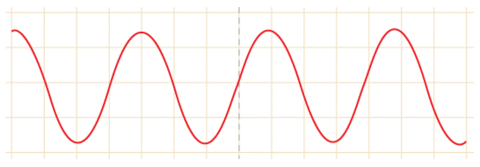
- 45What is an analogue signal? Describe its shape.A continuously variable signal.
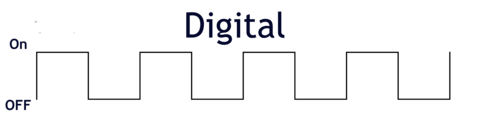
- 46What is a digital signal? Describe its shape.A signal with only two states: 'on' (1) or 'off' (0).
- 47What are the advantages of digital signals?-Interference has less effect on the received signal.
-The signal is less susceptible to interference
-Multiplexing - several signals can be sent at once. - 48What is Morse Code?Messages consisting of digital signals of light or sound transmitted using 'dots' (.) and 'dashes' (-).
- 49How do lasers read CDs?They read the digital signals of 'bumps' and 'pits' on the bottom of CDs. A bump reflects more light and counts as '1', so the pit counts as '0'.
- 50How does wireless technology work?It uses electromagnetic waves to transmit signals without wires.
- 51What is the ionosphere?A layer of charged particles in the atmosphere.
- 52What happens in microwave communication?Microwaves travel in straight lines and can go through the ionosphere to communicate with satellites
- 53How do microwaves lose signal strength?They lose signal strength when transmitted as the signal spreads out (diffracts).
- 54In microwave communication, what happens to signals of similar frequencies?They can interfere with each other and cause signal loss.
- 55What happens in Radio Communication?Radio waves can reflect off the ionosphere ad can be made to bend (refract) over the horizon if they reach a different layer of the atmosphere
- 56In radio communication, what happens to signals of similar frequencies?They can interfere with each other and cause signal loss.
- 57What are seismic waves?The waves that earthquakes produce.
- 58How many types of seismic waves are there?2
- 59What are the two types of seismic (shock) waves?P waves and S waves.
- 60Describe P waves.-Faster than S waves
-Longitudinal
-Shake ground up and down
-Travel through solids and liquids (all of Earth's layers) - 61Describe S waves.-Slower than P waves
-Transverse waves
-Shake ground side to side
-Travel only in solids (stopped by Earth's liquid outer core) - 62What happens when a substance is heated?Its particles gain kinetic energy. This energy makes liquid and gas particles move around faster, in a solid, vibrate more rapidly.
This is what causes a change in state. - 63What is an absolute scale?Can't go lower than zero.
- 64Why is energy measured on an absolute scale?There is a limit as to how slow particles can move.
- 65What happens if there is a difference in temperature between two places?Energy will flow between them.
- 66The greater the difference in temperature, what will happen to the rate of cooling?It will get faster. E.g. Coffee cools down quicker in a cold room.
- 67Do materials which need to gain lots of energy to warm release: a) lots of energy b) little energya) Lots of energy is released on cooling, they can 'store' a lot of heat.
- 68What happens in boiling?When particles have enough energy to overcome their attraction to each other, gas bubbles form in the liquid.
- 69What happens in melting?Heat energy makes particles vibrate quickly until the forces between them overcome and the particles start to move around.
- 70What happens in condensing and freezing?Bonds form between particles which releases energy, so the temperature doesn't go down until it has fully condensed or frozen.
- 71What is condensing?Going from a gas to a liquid.
- 72When does convection occur?When the more energetic particles move from the hotter to the cooler region, taking their heat energy with them.
- 73How do immersion heaters work?Through convection currents - hot on top cold water below heater.
- 74Why can't convection happen in solids?The particles can't move - they just vibrate on the spot.
- 75What method of heat transfers do radiators use?Convection:
Warm air rises and displaces cooler air which falls to replace the gap left by rising heated air. - 76How do we get heat from the Sun?Radiation
- 77How is heat radiated?Infrared waves
- 78How is radiation different from conduction and convection?-Doesn't need a medium to travel through
-Can only occur through transparent substances
-The amount emitted depends on surface colour and texture. - 79What is the connection between heat and amount of radiation emitted?The hotter an object gets, the more heat radiation it emits.
- 80Does everything emit and absorb heat radiation?Yes
All objects continually emit and absorb heat radiation. - 81What happens to cooler objects with heat radiation?Cooler objects absorb heat radiation emitted by hotter things, so the temperature increases.
You can feel it - e.g. when indoors and the sun shines through a window. - 82What happens to matt black surfaces with heat radiation?Matt black surfaces are very good emitters and absorbers of radiation.
- 83What happens to light-coloured, smooth and shiny objects with heat radiation?They are poor absorbers and emitters of radiation - they effectively reflect heat radiation.
E.g. Some put foil behind radiators to reflect heat back into the room. - 84Which surfaces are poor emitters and absorbers of radiation?Shiny, light-coloured and smooth objects.
- 85Which surfaces are very good absorbers and emitters of radiation?Matt black surfaces.
- 86How do grills and toasters work?They heat food by infrared (heat) radiation. The heat radiated is absorbed by the surface particles of the food, increasing kinetic energy. The heat energy is then conducted or convected to more central parts.
- 87Why do people line their grill pan with shiny foil?It reflects the heat radiation onto the bottom of the food, so it is cooked more evenly.
It also stops the pan getting dirty. - 88What are microwaves?Electromagnetic waves that have a different wave length to infrared.
- 89Why don't you cover microwave food with foil? What is better?-It reflects the microwaves so that they won't cook
-It can cause dangerous sparks inside
-Glass or plastic is fine as they can pass through - 90What is another term for wasted?Transferred
- 91What are things that emit energy called?Sources
- 92What are things that transfer/waste/lose energy called?Sinks
- 93What does insulation do?Ensures that sinks 'drain' less energy.
- 94How does insulation both cost AND save you money?It cots money to buy and install insulation, or buy more efficient appliances, but it saves you money as your energy bills are lower.
- 95What is payback time?The time it takes for the money you've saved on energy bills to equal the initial cost.
- 96What is loft insulation? What is it's average payback time?Fibreglass 'wool' laid across the loft floor reduces conduction through the ceiling into the roof space.
2 years - 97What does a hot water tank jacket do? What is its average payback time?It reduces conduction.
4 years - 98What is draught-proofing? What is its average payback time?Strips of foam and plastic around doors and windows stop hot air going out - reducing convection.
7 years - 99How do thick curtains save energy? What are their average payback time?Reduce conduction and radiation through the windows?
9 years - 100What is its average payback time for cavity walls & insulation?18 months
- 101What is a cavity wall?The layers of bricks with a gap between the, which reduce conduction as particles have further to go.
- 102What does double glazing stop? What is its average payback time?Conduction
30 years - 103How are thermograms taken?With a thermal imaging camera
- 104How do thermograms work?Objects at different temperatures emit infrared rays of different wavelengths which are displayed as different colours.
- 105Why are machines useful?They convert energy from one form to another. E.g. chemical energy (petrol) is turned into KE in cars.
- 106What happens to energy that is inputted into a machine?Some input energy is always lost or wasted, often as heat.
- 107What is the link between energy wastage and efficiency?The less wastage, the more efficient a device is.
- 108What is the symbol for wavelength?λ
- 109What do Sankey diagrams do?Display how much input energy is being usefully employed, compared to how much is wasted.
- 110What is a similarity between light and heat waves?They are both electromagnetic waves.
- 111What is the amplitude of a wave?The length from the rest position to the crest.
- 112What is the frequency on a wave?The number of complete cycles/oscillations passing a certain point per second.
- 113What is frequency measured in?Hz - 1Hz is one wave per second
- 114What is a wavelength?The length of a full cycle of a wave, from crest to crest.
- 1151kHZ (kilohertz) is equivalent to how many Hz?1000
- 1161MHZ (1 megahertz) is equivalent to how many Hz?1,000,000 Hz
- 117How do waves travel?Always in a straight line.
- 118What happens when waves arrive at an obstacle?Their direction can be changed - This can happen by reflection.
- 119How do we see things?Reflection of light. Light bounces off objects into our eyes.
- 120What is the law of reflection?Angle of INCIDENCE = Angle of REFLECTION
- 121What happens when light reflects off an uneven surface?The light reflects off at different angles.
- 122What happens when light reflects off an even (smooth and shiny) surface?Reflected at the same angle so you get a clear reflection.
- 123What does TIR stand for?Total Internal Reflection
- 124What is TIR dependent on?-The angle of incidence being bigger than the critical angle
-If the ray is traveling through a dense object like glass to a less dense substance like air - 125In reflection... What happens if the angle of incidence is LESS than the critical angle?Most of the light is refracted into the outer layer, but some of it is internally reflected.
- 126In reflection... What happens if the angle of incidence is EQUAL to the critical angle?The ray would go along the surface, with some internal reflection too.
- 127In reflection... What happens if the angle of incidence is GREATER than the critical angle?No light comes out, It is all internally reflected, i.e.W TIR.
- 128When they pass through a gap or pass an object, what do all waves do?They diffract (spread out) at the edges.
- 129What is the amount of diffraction dependent on?The size of gap relative to the wavelength
The narrower the gap, or the longer the wavelength, the more the wave spreads out. - 130In relation to wavelength... How would a narrow gap be described?One the same size as the wavelength, so whether it is narrow or not depends on the wave.
- 131If a gap is much wider than the wavelength, how much diffraction will occur?Little
- 132If a gap is a bit than the wavelength, how much diffraction will occur?Diffraction only at the edges
- 133If a gap is the same size as the wavelength, how much diffraction will occur?Maximum diffraction
- 134Describe the wavelengths of light. Can it be diffracted?Very small (about 0.0005mm)
Yes, but with a very small gap.
Informationen
- Beschreibung
- Revision cards for the whole of OCR Gateway GCSE Physics P1
- Erstellt von
- ella stokes
- Aufrufe
- 187
- Tags
- Verlauf
-
- Erstellt von Ein gelöschter Nutzer · 6 Mai 2015
- Kopiert von ella stokes · 6 Mär 2017
- Bewertung