
Karteikarten
earth and space
Karten in diesem Stapel (68)
- 1what is gravityit is the force that pull objects towards each other
- 2what is massthe measurement of the amount of matter in an object
- 3what is weightan measurement on gravity's affect on an object's mass
- 4name all the planets in order (8)mercury
venus
earth
mars
jupiter
saturn
uranus
neptune - 5what is the difference between a rotation and a revolution and give exampleswhen an object turns around an internal axis (like the earth turns around it's axis) it is a rotation and when an object turns around an external axis (like the earth circles the sun) it is a revolution
- 6what are terrestrial (inner) planetsthey are smaller, closer to the sun and have rocky surfaces
- 7name the terrestrial planetsmercury venus earth mars
- 8what are gas (outer) planetsthat are large, further form the sun and do not have solid surfaces
- 9name the gas giant planetsjupiter saturn uranus neptune
- 10what is an asteroidsmall airless rocky worlds that are too small to be considered planets
- 11where can the most asteroids be foundin the asteroid belt in between the orbits of mars and jupiter
- 12what is a natural satellite and give an examplea celestial body that orbits around a lager celestial body for example the moon is a natural satellite for the earth
- 13put the planets in order of largest to smallestjupiter
uranus
saturn
neptune
earth
venus
mars
mercury - 14what is opaquelight us either reflected or absorbed
- 15what are translucent objectslight is scattered and transmitted some
- 16what are transparent objectslight transmitted because of no scattering
color transmitted incolore you see all other colours are absorbed - 17what does absorption of heat meanwhen a light wave is absorbed by an object it is converted to heat energy
- 18what does relection of light meanreflexion is when light bounces of an object (ex: glass or water)
- 19what is part of the visible spectrumthe light we can see (ROYGBIV)
- 20what does ROYGBIV stand forRed-biggest wavelength
Orange
Yellow
Green
Blue
Indigo
Violet-smallest wavelength - 21what is part of the invisible spectrumradio waves, ultraviolet Rays, X rays, gamma rays
- 22what is the crest of a wavelengththe highest point of a wavelength
- 23what is the trough of a wavelengththe lowest point of a wavelength
- 24what is white lightwhen white light passes through the prism and breaks into the colours of ROYGBIV which is the visible spectrum which is part of the electromagnetic spectrum
- 25what are the seven types of EM waves in order1. radio
2. microwave
3. infrared
4. visible light
5. ultra violet
6. X-rays
7. Gamma rays - 26what are radio waves used for and what are theythey have the longest wavelength and lowest frequency for radio and TV broadcasting
- 27what is an infrared rays and what are they used forlight rays with longer wavelengths than red lights used for cooking, medicine, TV remotes
- 28what are ultraviolet waveselectromagnetic waves with frequencies slightly higher then visible light used for food processing and to kill germs
- 29what are X-rays and what are they used forEM rays that are shorter that UV rays they are used for medicine
- 30what are gamma rays and what are they used forhighest frequency EM waves and shortest wavelength used for cancer treatment
- 31what is daythe time between sunrise and sunset
- 32what is nightthe period of darkness between sunset and sunrise
- 33what causes night and dayday and night are caused by the rotation of our planet on it's axis
- 34how long is a cycle of day and night24 hours
- 35when is it daywhen our location on earth is turned towards the sun
- 36what is nightwhen our location on the earth is faced away from the sun
- 37what is the dark side of the moonthe side that never faces the earth
- 38what is a lunar cyclethe change of appearance of the moon as it makes a full revolution around the earth
- 39name the steps of the lunar cycle in order (8)new moon
waxing crescent
first quarter
waxing gibbous
full moon
waining gibbous
third quarter
waining crescent - 40what is a new moonthe first moon phase
it appears unlit from earth
the moon is between the earth and the sun - 41what is the waxing crescentthe light is on the right and it is new and bright
- 42what is a first quarterthe moon is one quarter f the way through its circle from earth it appears to be half lit on the right
- 43what is a waxing gibbousfrom earth the moon appears to be more than half lit on the right
- 44what is a full moonfrom the earth the moon appears fully lit
the earth is between the sun and the moon - 45what is a waining gibbousfrom the earth the moon appears more than half lit on the left
- 46what is the third or last quarterthe moon is three quarters of the way through it's cycle
it is half lit on the left - 47what is a waining crescentthe lighted part of the moon as seen from earth is decreasing on the left
- 48what are spring tidesa tide just after a full or new moon, where there is the highest difference between high and low water
- 49what are neap tidesa tide just after a first or third quarter, where there is the least difference between high and low water
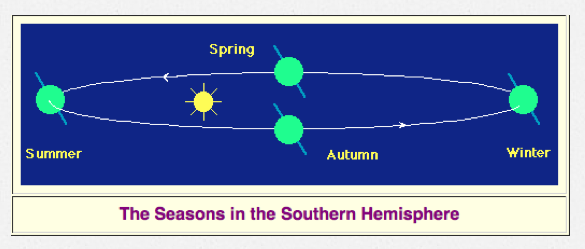
- 50what are seasonsa season is one of the four divisions of the year it is marked by the change in weather and different amounts of daylight
- 51what causes the change of seasonsseason are caused by the sunlight tilt on the earth. the earth rotates around an invisible axis
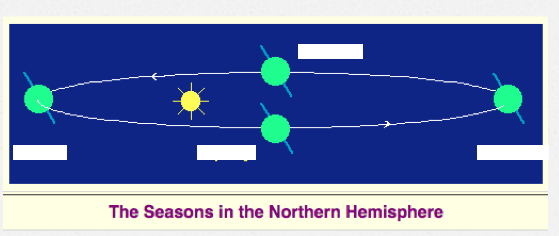
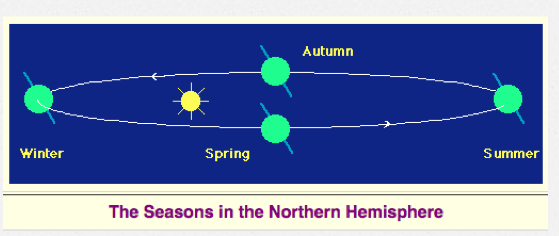
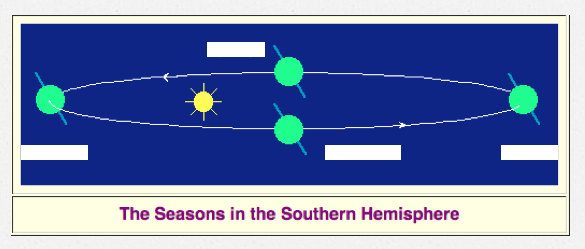
- 52what causes summerwhen a hemisphere is tilted towards the sun it experiences summer
- 53what causes winterwhen a hemisphere is tilted away from the sun it experiences winter
- 54what causes spring and fallwhat the axis is parallel to the sun
- 55label this diagram
- 56label this diagram
- 57what are is an equinoxthe time at which the sun crosses the celestial equator also day and night are equal
- 58what is a solsticewhen the sun reaches it's highest or lowest point in the sky
- 59what is a leap yeara year occurring one every four years that has 366 days instead of 365 days
- 60what is an eclipsean eclipse is when the moon ad the earth align themselves with the sun. this makes people on earth not able t see the sun because the moon blocks it with a perfect straight alignment
- 61what is a solar eclipsea solar eclips occurs when the moon gets between the earth and the sun
- 62what is a lunar eclipsea lunar eclipse occurs when the moon passes directly behind the sun and into it's shadow
- 63what are northern lightsothers lights occur as a result of charged particles in earths magnetic field colliding with earth's atmosphere
- 64what are cometsa comet is an icy body that releases dust and gas
- 65what is an asteroidasteroids are rocky metallic objects tat orbit stars or the sun
- 66what is a meteoroida small body moving is the solar system that become meters when entered into the earth's atmosphere
- 67what are shooting starssmall rapidly moving meteors burning up on entering the earths atmosphere
- 68what are cratersa large bowl -shaped cavity in the ground
Informationen
- Beschreibung
- grade 7 science (Science Exams) Karteikarten am earth and space, erstellt von Ella Ivanovici am 24/05/2017.
- Erstellt von
- Ella Ivanovici
- Aufrufe
- 11
- Bewertung