
Flussdiagramm
Domestic & Static electrisity
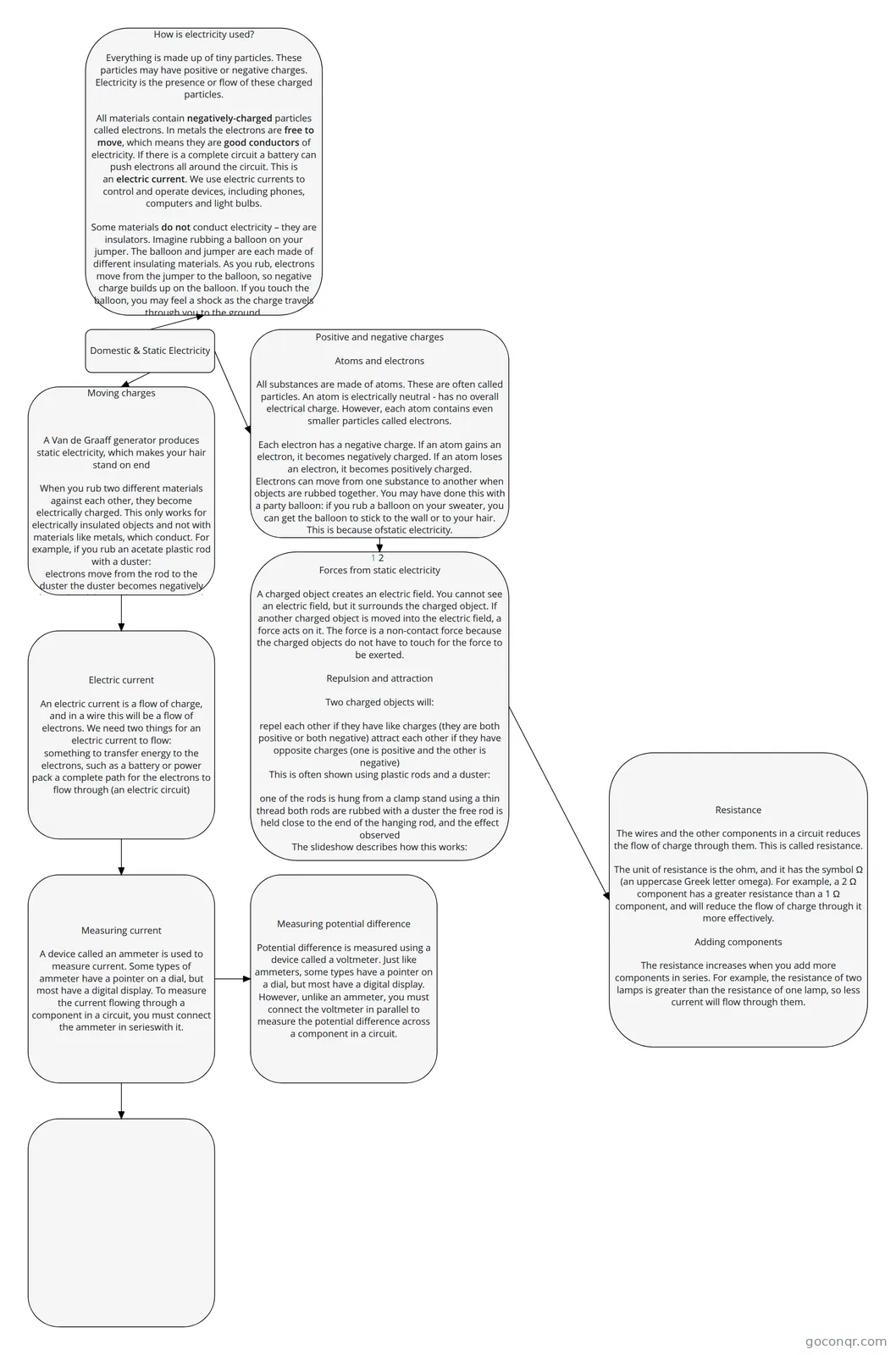
Flowchart: Domestic and static electricity
Inhalt des Flussdiagramms
Domestic & Static Electricity
How is electricity used?
Everything is made up of tiny particles. These particles may have positive or negative charges. Electricity is the presence or flow of these charged particles.
All materials contain negatively-charged particles called electrons. In metals the electrons are free to move, which means they are good conductors of electricity. If there is a complete circuit a battery can push electrons all around the circuit. This is an electric current. We use electric currents to control and operate devices, including phones, computers and light bulbs.
Some materials do not conduct electricity – they are insulators. Imagine rubbing a balloon on your jumper. The balloon and jumper are each made of different insulating materials. As you rub, electrons move from the jumper to the balloon, so negative charge builds up on the balloon. If you touch the balloon, you may feel a shock as the charge travels through you to the ground.
Positive and negative charges
Atoms and electrons
All substances are made of atoms. These are often called particles. An atom is electrically neutral - has no overall electrical charge. However, each atom contains even smaller particles called electrons.
Each electron has a negative charge.
If an atom gains an electron, it becomes negatively charged.
If an atom loses an electron, it becomes positively charged.
Electrons can move from one substance to another when objects are rubbed together. You may have done this with a party balloon: if you rub a balloon on your sweater, you can get the balloon to stick to the wall or to your hair. This is because ofstatic electricity.
Moving charges
A Van de Graaff generator produces static electricity, which makes your hair stand on end
When you rub two different materials against each other, they become electrically charged. This only works for electrically insulated objects and not with materials like metals, which conduct. For example, if you rub an acetate plastic rod with a duster:
electrons move from the rod to the duster
the duster becomes negatively charged and the rod becomes positively charged
1
2
Forces from static electricity
A charged object creates an electric field. You cannot see an electric field, but it surrounds the charged object. If another charged object is moved into the electric field, a force acts on it. The force is a non-contact force because the charged objects do not have to touch for the force to be exerted.
Repulsion and attraction
Two charged objects will:
repel each other if they have like charges (they are both positive or both negative)
attract each other if they have opposite charges (one is positive and the other is negative)
This is often shown using plastic rods and a duster:
one of the rods is hung from a clamp stand using a thin thread
both rods are rubbed with a duster
the free rod is held close to the end of the hanging rod, and the effect observed
The slideshow describes how this works:
Two identical plastic rods have like charges. The hanging rod turns away from the other rod.
Showing that an object is charged
Charged objects will also attract small, uncharged objects. This is why a charged plastic comb or ruler, or a party balloon, can pick up small pieces of paper.
The only way to tell if an object is charged is to see if it repels another charged object.
Electric current
An electric current is a flow of charge, and in a wire this will be a flow of electrons. We need two things for an electric current to flow:
something to transfer energy to the electrons, such as a battery or power pack
a complete path for the electrons to flow through (an electric circuit)
Measuring current
A device called an ammeter is used to measure current. Some types of ammeter have a pointer on a dial, but most have a digital display. To measure the current flowing through a component in a circuit, you must connect the ammeter in serieswith it.
Measuring potential difference
Potential difference is measured using a device called a voltmeter. Just like ammeters, some types have a pointer on a dial, but most have a digital display. However, unlike an ammeter, you must connect the voltmeter in parallel to measure the potential difference across a component in a circuit.
Resistance
The wires and the other components in a circuit reduces the flow of charge through them. This is called resistance.
The unit of resistance is the ohm, and it has the symbol Ω (an uppercase Greek letter omega). For example, a 2 Ω component has a greater resistance than a 1 Ω component, and will reduce the flow of charge through it more effectively.
Adding components
The resistance increases when you add more components in series. For example, the resistance of two lamps is greater than the resistance of one lamp, so less current will flow through them.
Informationen
- Beschreibung
- Flussdiagramm am Domestic & Static electrisity, erstellt von Catherine Pizzey am 25/05/2019.
- Erstellt von
- Catherine Pizzey
- Aufrufe
- 9
- Bewertung