
Flussdiagramm
Cognitivism
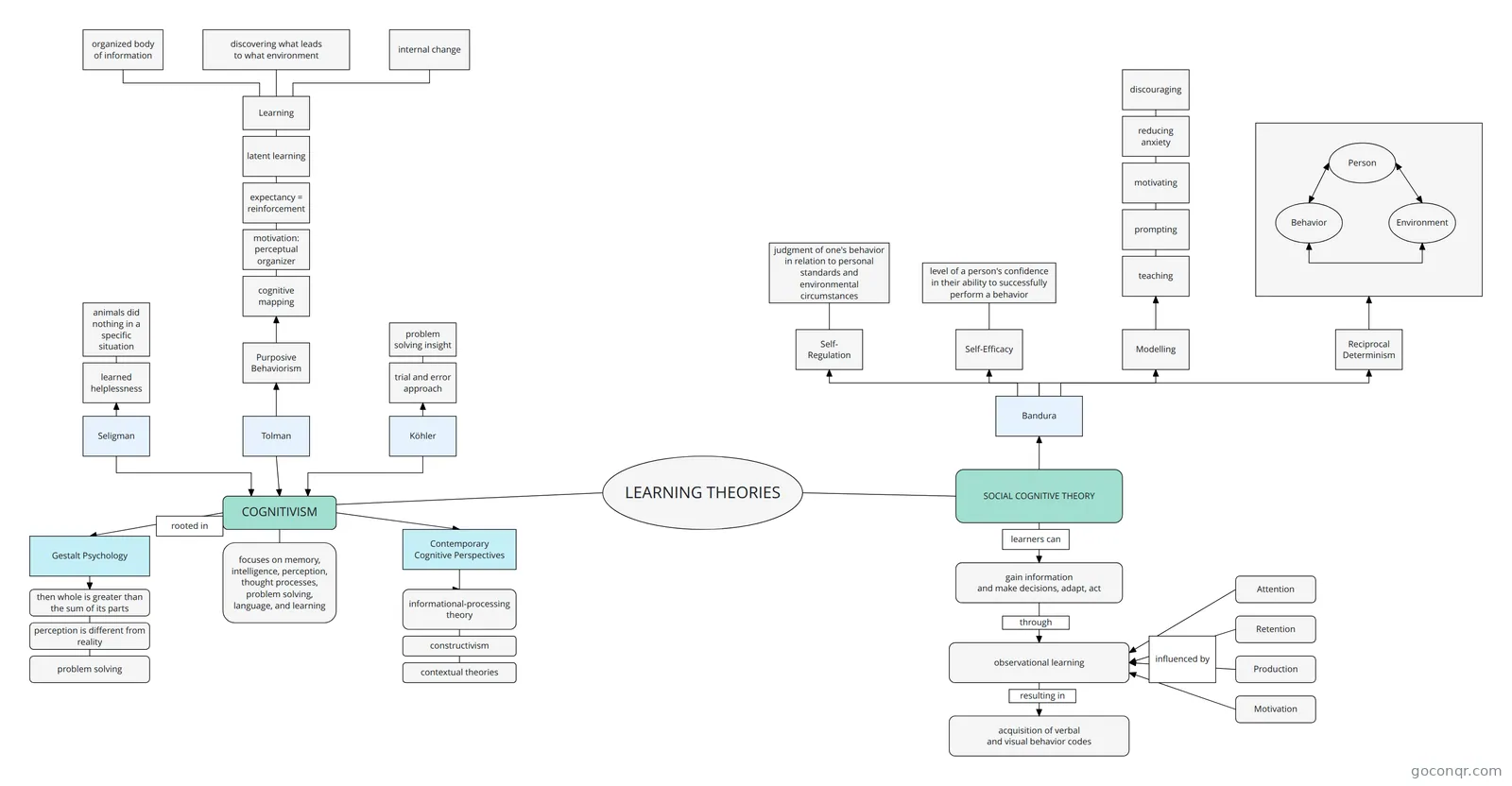
Flowchart: Learning Theories and Cognitive Perspectives
Inhalt des Flussdiagramms
COGNITIVISM
focuses on memory, intelligence, perception, thought processes, problem solving, language, and learning
Seligman
learned helplessness
animals did nothing in a specific situation
Köhler
trial and error approach
problem solving insight
Tolman
Purposive Behaviorism
cognitive mapping
motivation: perceptual organizer
expectancy = reinforcement
latent learning
Learning
discovering what leads
to what environment
internal change
organized body
of information
Gestalt Psychology
then whole is greater than the sum of its parts
perception is different from reality
problem solving
Contemporary
Cognitive Perspectives
informational-processing theory
constructivism
contextual theories
SOCIAL COGNITIVE THEORY
LEARNING THEORIES
gain information
and make decisions, adapt, act
observational learning
acquisition of verbal
and visual behavior codes
Bandura
Modelling
Reciprocal Determinism
Self-Efficacy
Self-Regulation
level of a person's confidence in their ability to successfully perform a behavior
Person
Environment
Behavior
Retention
Attention
Production
Motivation
learners can
through
resulting in
teaching
prompting
motivating
reducing anxiety
discouraging
judgment of one's behavior in relation to personal standards and environmental circumstances
influenced by
rooted in
Informationen
- Beschreibung
- Flussdiagramm am Cognitivism, erstellt von Sandra Malonzo am 10/03/2020.
- Erstellt von
- Sandra Malonzo
- Aufrufe
- 12
- Bewertung