
Learning Theories and Educational Psychology
1,721 resources created by 1,412 users
This Learning Theories and Educational Psychology page on GoConqr gathers community-made mind maps, quizzes, flashcards, notes and slide sets, from Jerome Bruner and social constructivism to behaviourism, neuromyths and Bloom's taxonomy. It's built for university students and professional candidates, plus teachers after ready-made material. There are over 1,600 resources here, including more than 1,400 mind maps and more than 30 quizzes. Pick a theory, try a quiz to find your gaps, then make your own revision sets.
Select topic
- Behaviorism and Conditioning35
- Cognitive Learning Theory79
- Ausubel's Meaningful Learning Theory29
- Constructivism140
- Sociocultural Theory and Situated Learning63
- Experiential Learning9
- Connectivism25
- Brain-Based Learning and Neuroeducation33
- Learning Styles158
- Multiple Intelligences71
- Motivation and Learning9
- Bloom's Taxonomy and Learning Domains32
- Gagné's Conditions of Learning6
- Teaching and Learning Strategies13
- Learning Environments and Classroom Management5
Top Learning Theories and Educational Psychology resources
-
Mind map Educational Paradigms Educational Paradigms
-
Flowchart A cognitive theory of learning concept map
-
 Mind map PSYCHOLOGY OF EDUCATION Mindmap psicologia
-
5 questionsSocial Constructivism Questionnaire by Vygotsky What benefits does Social Constructivism attribute to us ?
-
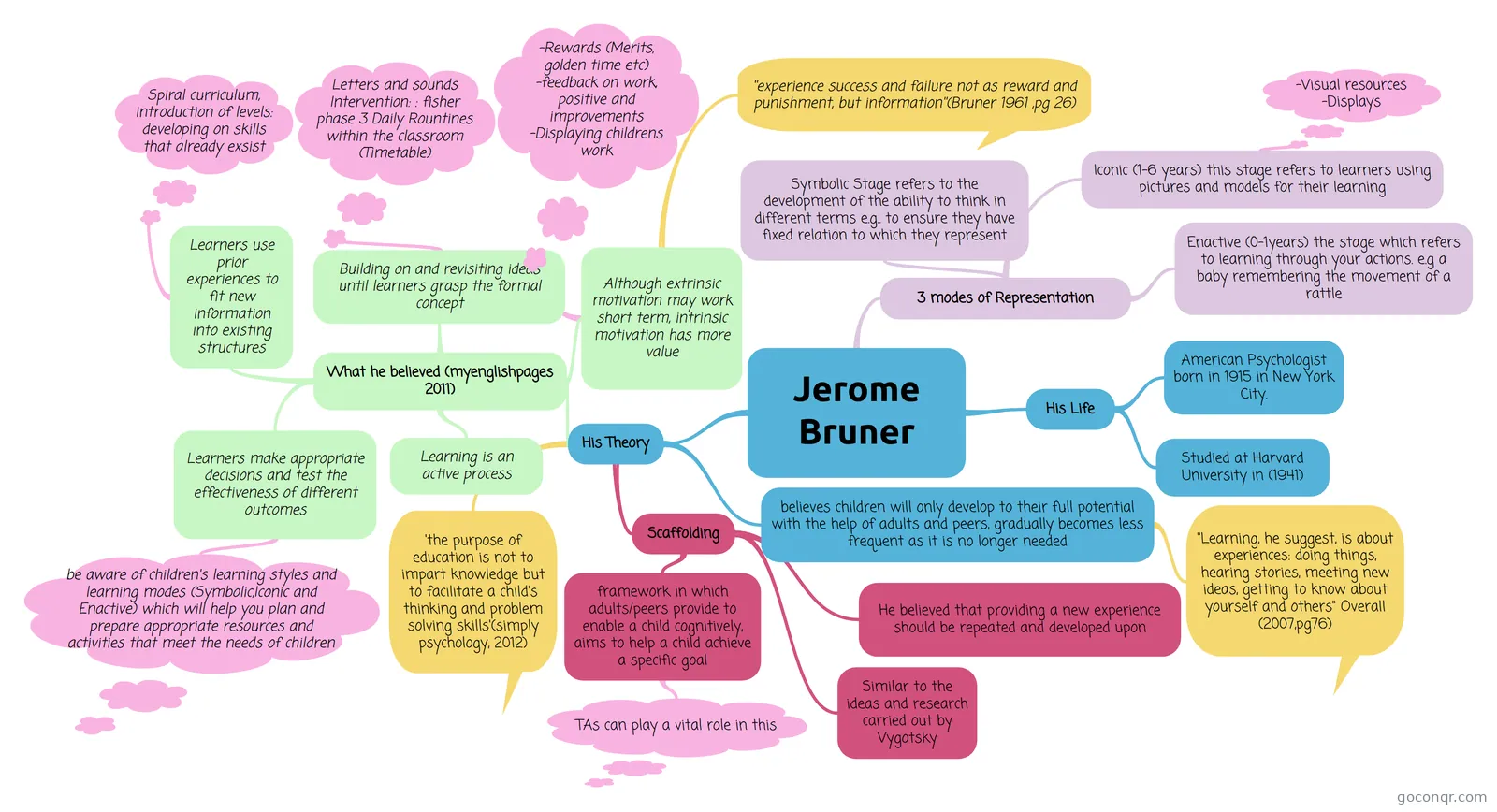 Mind map Jerome Bruner
-
9 cardsNeuromyths in Education Have you ever heard that we only use 10% of our brain, or that listening to Mozart improves our attention s...
-
16 cardsFoundations of Instructional Design- Chapter Two Describe at least four major assumptions of the authors of this test regarding instructional design and dis...
-
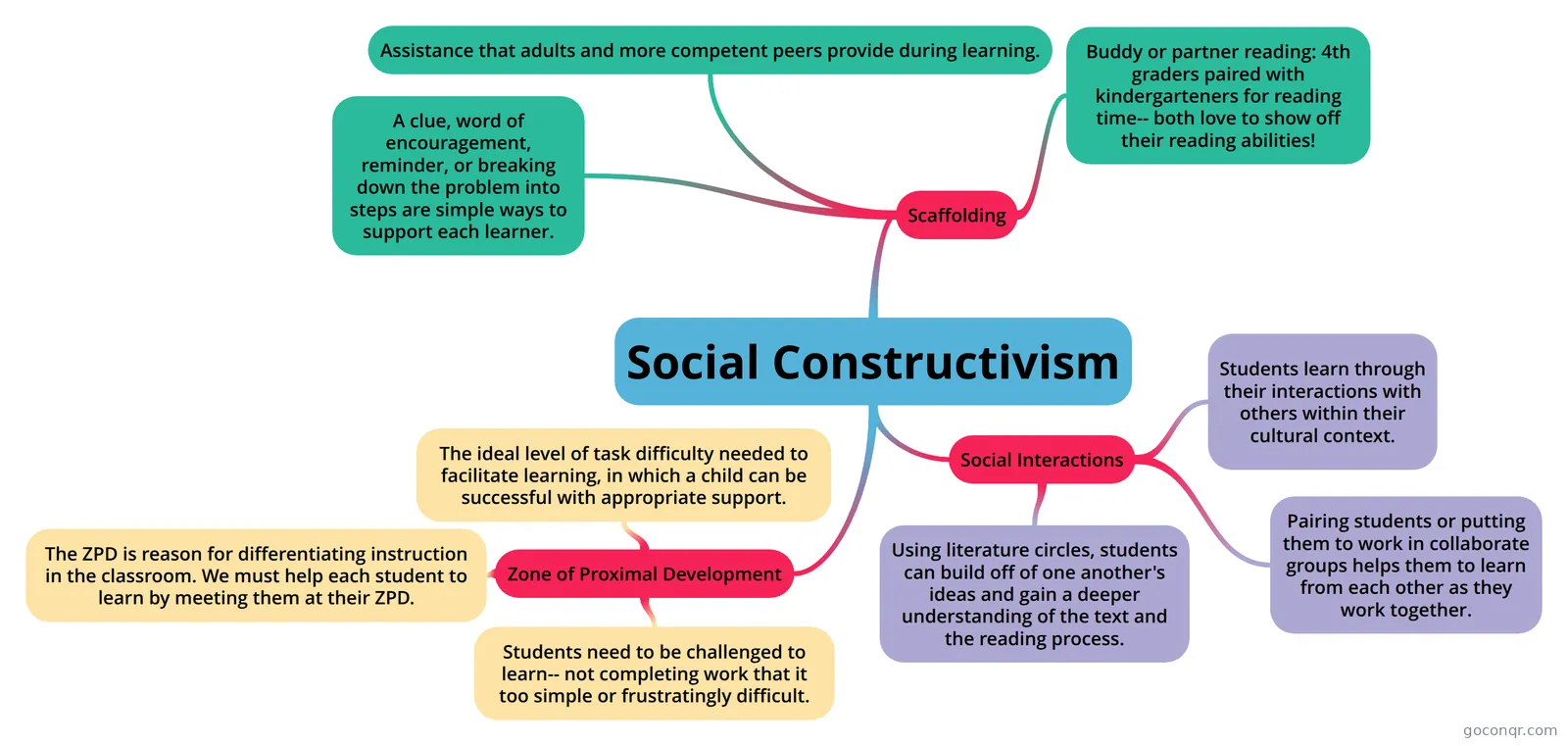 Mind map Social Constructivism A resource describing Vygotsky's Social Constructivism.
Quizzes
See all 40 quizzes-
5 questionsSocial Constructivism Questionnaire by Vygotsky What benefits does Social Constructivism attribute to us ?
-
10 questionsConstructivism Who is in the center of the learning/teaching process in constructivism approach?
-
76 questionsHuman Development and Learning What theorist designed the Reciprocal Determinism/Causation model?
-
36 questionsQuiz 2: CI 152 Educational Psychology What is Development/Learning Theory?
-
10 questionsConstructivism In a constructivist classroom....
Mind maps
See all 1,494 mind maps-
Educational Paradigms Educational Paradigms
-
PSYCHOLOGY OF EDUCATION Mindmap psicologia
-
Jerome Bruner
-
Social Constructivism A resource describing Vygotsky's Social Constructivism.
-
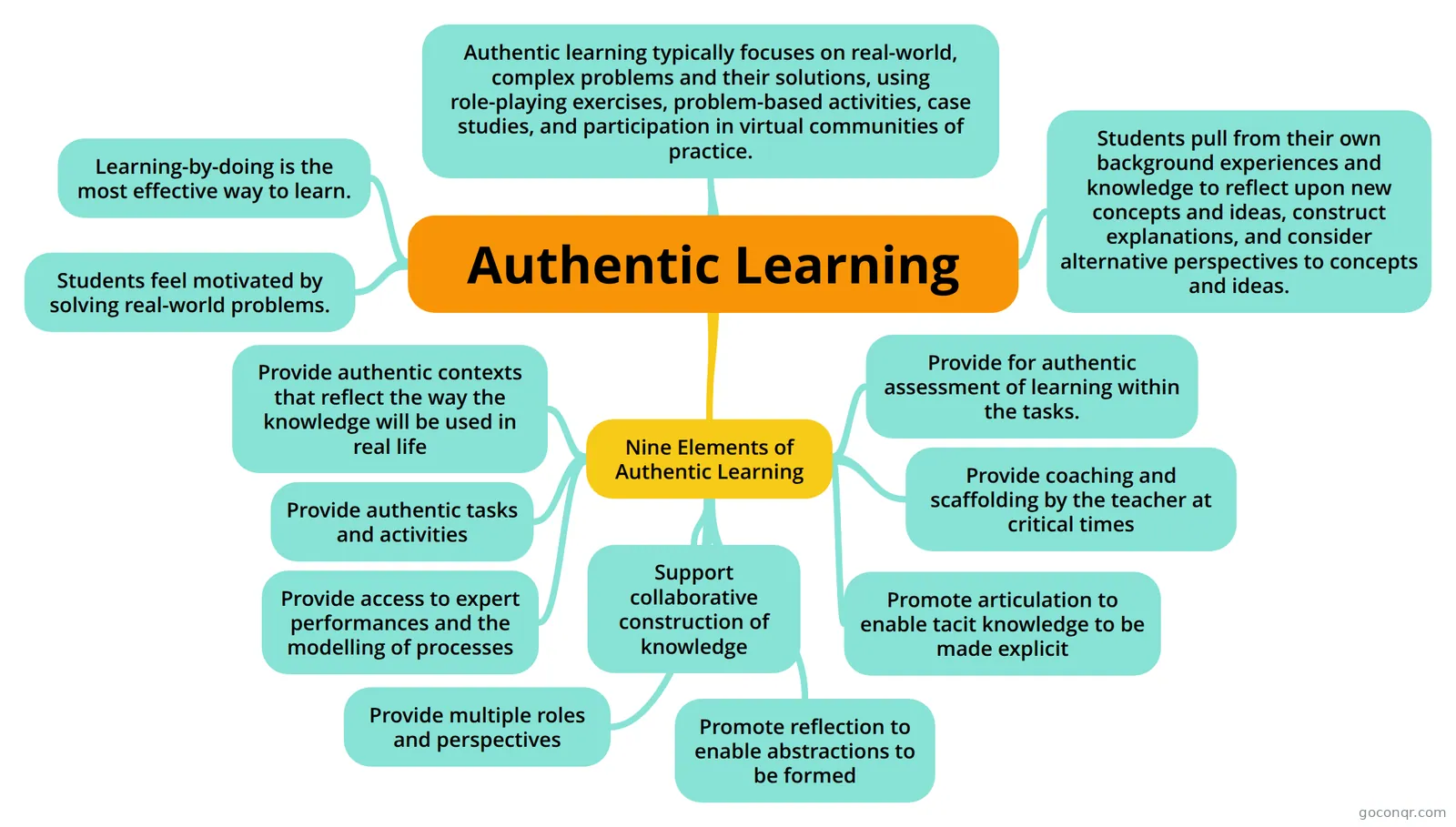 Authentic Learning The following c-map contains important information about Authentic Learning
-
theories of language learning figure out how language shape learning by conscious learning and by constructivism theory of learning, we c...
-
Margaret's mind map It's a mind map including behaviourist perspective, cognitive perspective and humanistic perspectie of lear...
-
Perspectives of learning sdsdf
Flashcards
See all 88 flashcards-
9 cardsNeuromyths in Education Have you ever heard that we only use 10% of our brain, or that listening to Mozart improves our attention s...
-
16 cardsFoundations of Instructional Design- Chapter Two Describe at least four major assumptions of the authors of this test regarding instructional design and dis...
-
8 cardsLearning Theories Flashcards What Learning theory the below principles relate to? change of behaviour by stimuli transmission of knowled...
-
66 cardsPraxis PLT 7-12 Bruner's Inquiry Teaching
-
23 cardsEducation Psychology Cards About Theories of Intelligence, Self-Efficacy, & Self-Concept Implicit theories of intelligence
-
15 cardsNeurolearning How our brain works when learning a new language
-
52 cardsEducational Psychology Cognitive view assumes
-
8 cardsLearning theories definitions Kolb's Experiential Learning
Flowcharts
See all 42 flowcharts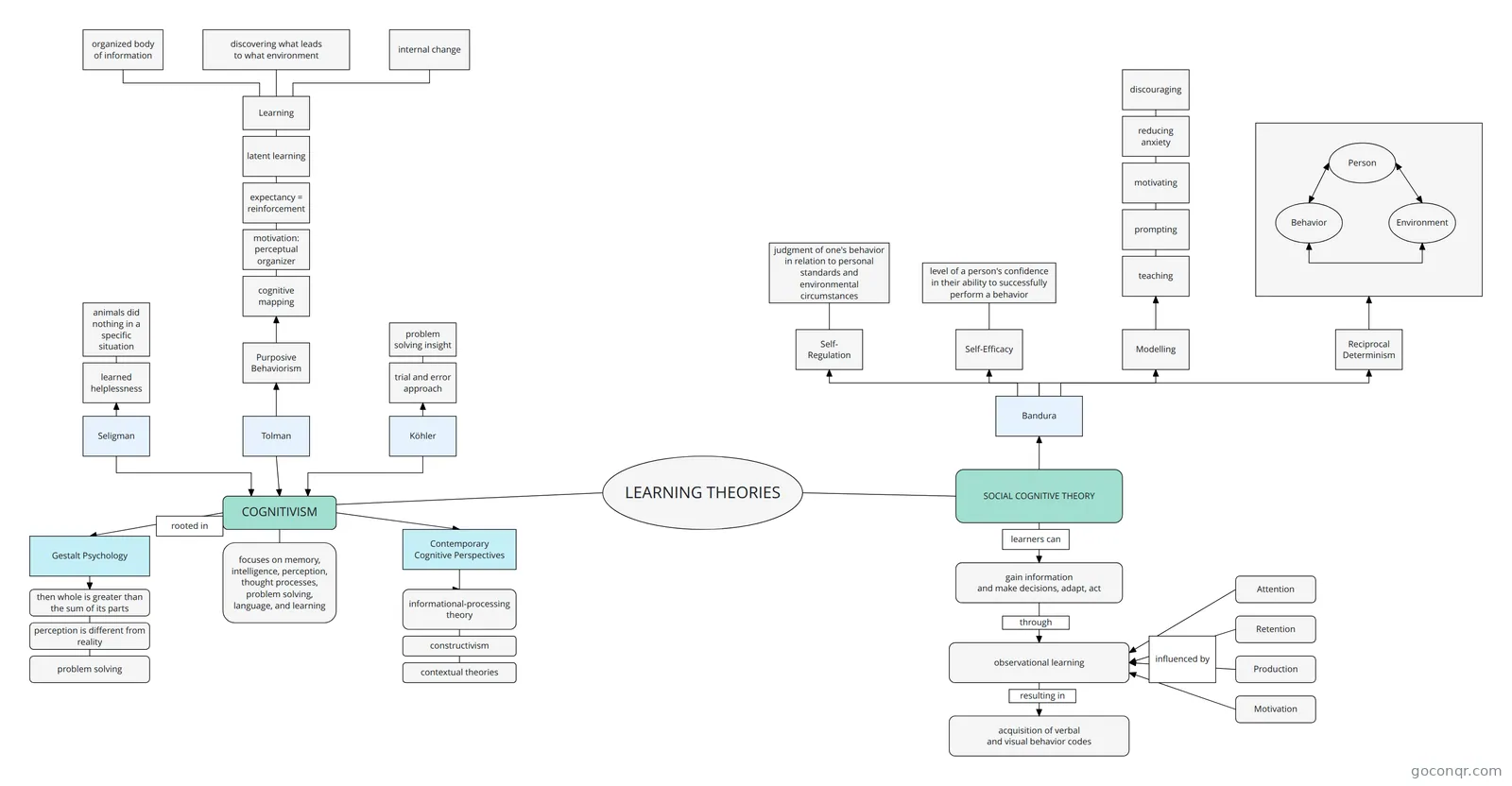
Notes
See all 44 notes-
The application of the second type of self-fulfilling prophecies. Date : Oct.21.15Question : How might parents and teachers make use of what was demonstrated in Pygmalion in the classroom model ? The second types of self-fulling prophecies is imposed by one person on another. The re...
-
BEN BLOOMS (3Domains) Taxonomy BEN BLOOMS Taxonomy Bloom has 3 learning Domains that impact how teachers set up learning objectives and plan activities. COGNITIVE DOMAIN
Slides
See all 13 slidesTopics in Learning Theories and Educational Psychology
More Education and pedagogy (incl. teaching methods, curriculum, educational psychology) topics
About Learning Theories and Educational Psychology
GoConqr OriginalWhat the page covers
The resources compare the main ways of explaining how people learn. Many are mind maps, so you can see each theory as a branching outline. Topics include behaviourism, cognitive models, constructivism, social development theory, learning styles and the domains of learning.
Where to start
Begin with the overview maps. The Educational Paradigms map sets out the constructivist, cognitive, behavioural and environmentalist paradigms side by side. The Learning theories interconnections flowchart shows how they relate. Then the Learning Theories Flashcards deck asks which theory a set of principles belongs to, such as conditioning, a passive learner or a teacher at the centre.
Going deeper by theorist
- The Jerome Bruner map covers his life and his view of how children reach their full potential.
- The Social Constructivism map explains the zone of proximal development, scaffolding and social interaction, with classroom examples such as buddy reading.
- The Authentic Learning map focuses on real-world problems and learning by doing.
- Notes on Piaget's cognitive-developmental theory and on Bandura's social learning theory sit alongside these.
Using quizzes and maps together
Read a map first, then test yourself. The Social Constructivism Questionnaire by Vygotsky asks what the zone of proximal development is and what it aims to do. The Neuroteach quiz takes true-or-false statements about neuroscience and praise, and the Neuromyths in Education flashcards pair well with it. If you are preparing for the Praxis PLT, look for the Praxis PLT 7-12 flashcards and the two PLT quizzes. Return to any map where you slip up.
Where it fits
This unit sits in the Learning and Development strand of Education and pedagogy. It supports teaching methods and curriculum work by explaining the ideas behind them. Choose one theory this week, work through its map and quiz, and then build your own flashcards to keep it fresh.
Frequently asked questions
Which resource should I open first?
Start with the Educational Paradigms mind map, which compares the constructivist, cognitive, behavioural and environmentalist paradigms. Then try the Learning Theories Flashcards deck, which asks you to match principles such as conditioning or a passive learner to the right theory. After that, move to a single theorist.
What do the mind maps on this page cover?
There are more than 1,400 of them. They cover theorists such as Jerome Bruner, social constructivism, scaffolding and the zone of proximal development, authentic learning, information processing, learning styles and Gardner's multiple intelligences. Several are titled simply Learning Theories, so each gives a different take.
Is there anything for Praxis PLT preparation?
Yes. The listed resources mention the Praxis PLT, including a Praxis PLT 7-12 flashcard deck and quizzes titled PLT and PLT2. They were made by GoConqr users, not by GoConqr, so use them alongside your official preparation materials.
Who are these resources for?
Mostly university students and professional candidates studying educational psychology, and teachers who want ready-made material on how learners think and develop. You can use them to revise a theory, check your understanding with a quiz, or find examples for lesson planning.
Are the resources free, and who made them?
Every resource listed here is free to open, study and take, with no account needed. They were made by GoConqr users, not by GoConqr. A free account also saves your quiz scores and lets you create your own quizzes, maps, flashcards and notes.
What if the topic I need is missing?
Try nearby titles first. Constructivism, for example, appears under several maps, quizzes and notes with different spellings and emphases. If you still can't find it, make your own mind map or flashcard deck for the topic and build the set you need.